
#On the Event Designated
Filed under Pilgrimage Day Three, Commemorative Cycle, Bastion-Constantinople. Bureau of Doctrine, A.S. 201. Fourth Ratification Redaction Protocols apply. The reader is advised that this entry describes an event the Bureau simultaneously commemorates and forbids discussion of, a paradox the Bureau resolves by the expedient of defining "discussion" very narrowly.
On the 23rd of Argent, in the year of our Synod one hundred and seventy, a wall of Bastion-Constantinople fell.
I am permitted to say that a wall fell. I am permitted to say the wall was in the southern quadrant of the Sixth Ravelin — the Ravelin of Correction, which faces the Rail Spur and through which supplies and condemned men arrive in equal measure, a coincidence of function the Bureau of Engineering has never seen fit to redesign. I am permitted to name the date. I am permitted to name the result. Between the date and the result, four pages of this entry have been removed by the Bureau of Doctrine, and the reader will find in their place a silence that is, I am assured, theologically instructive.
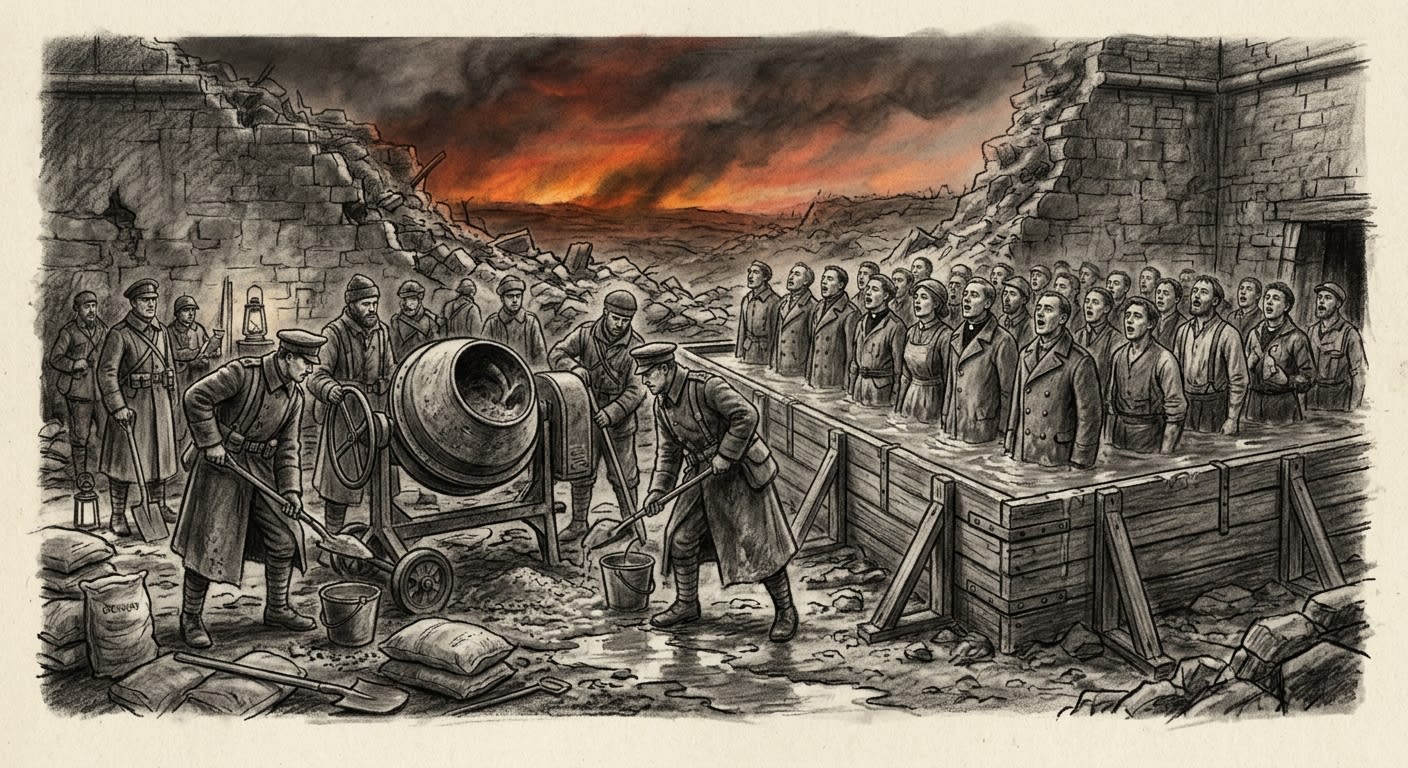
The wall was rebuilt. The breach was sealed. Forty-seven men and women of the Sixth Ravelin's garrison and civilian population volunteered to stand inside the pour-frame while consecrated cement was mixed with bone-aggregate, relic powder, and the ash of a standard-issue Synodal hymnal, and poured around them. They sang the Antiphon of Endurance as the cement rose past their ankles, their shins, their waists. They sang until the cement covered their mouths. The Bureau of Records logged them as "incorporated into the structure, status: permanent." The Bureau of Doctrine declared their act "a miraculous demonstration of zeal."
They are still inside the wall. Chamber 7 of the Sixth Ravelin has held for thirty-one years, and the Bureau of Engineering's annual survey confirms that the section incorporating the forty-seven is the strongest in the Ravelin's curtain — stronger, by a factor of three, than any section poured with cement alone. The Bureau of Rites attributes this to the power of faith. The Bureau of Engineering attributes it to relic-calcium aggregate bonding at molecular scales inconsistent with standard mineralogy. The Bureau of Doctrine has ruled that the two explanations are identical.
#On the Night Paper
Being an account of the instrument which precipitated the breach, the treachery which attended it, and the administrative efficiency with which treachery was processed.
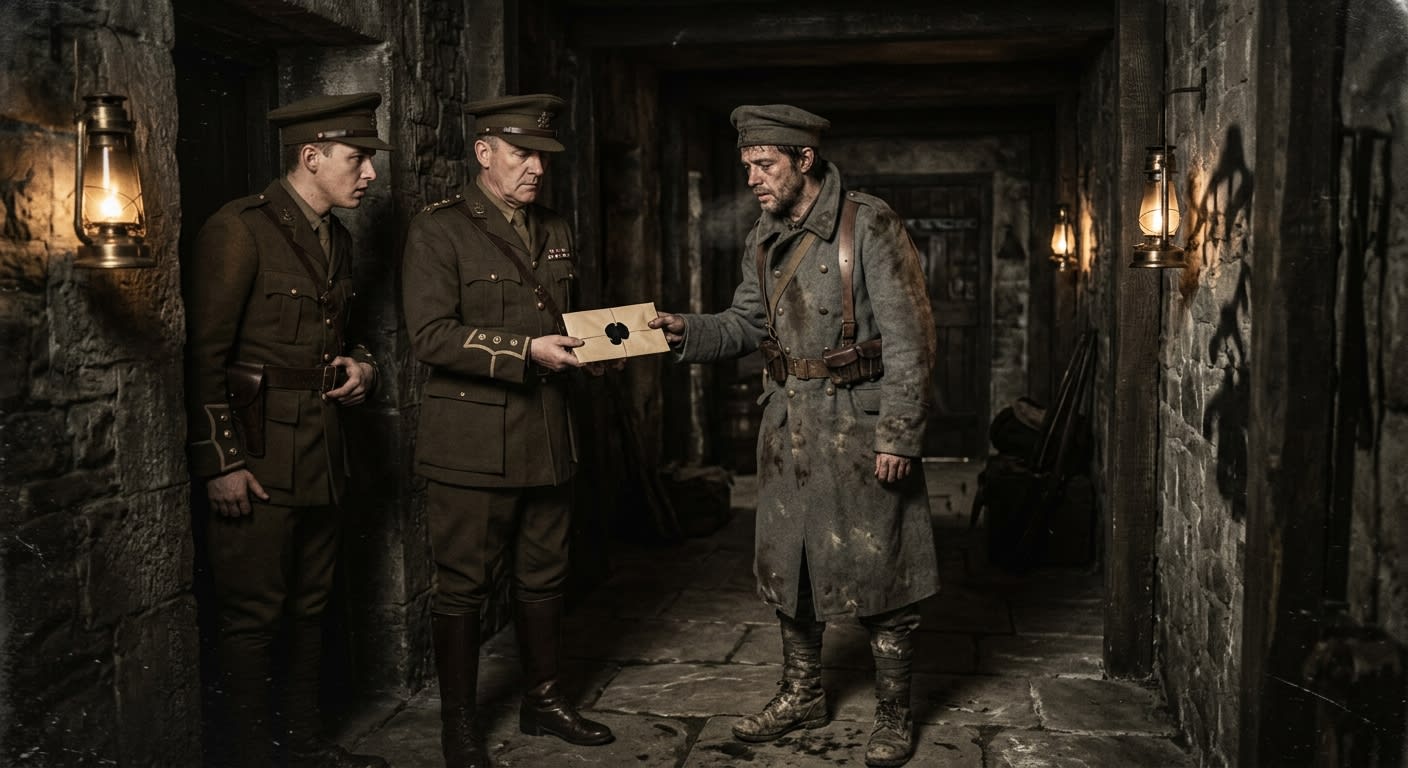
The Night Paper arrived at Bastion-Constantinople on the eve of the 23rd of Argent, carried by a courier whose name has been filed under a classification I am not permitted to name and which, in any case, contains no name — only a registration number and the annotation arrived exhausted, boots worn through, content verified, courier reassigned to the Paper Mines of Ulm within the hour.
Night Papers are instruments of the Bureau of Doctrine — sealed writs carried under curfew by grey-coated runners of the Index Damnatus Runner Corps, bearing condemnations too urgent for the morning post and too sensitive for the signal-bell relays. They are stamped in black wax. They are opened with a blade. They are read once, aloud, to a quorum of three officers, and then burned. The ash is weighed against a standard measure; if the ash is light, the paper was copied before burning, and the quorum is arrested.
This particular Night Paper named the 14th Parish Regiment — three hundred and twelve men assigned to the relic artillery batteries of the Sixth Ravelin's southern curtain — as oath-broken. The charge was filed under the Catechism of Obedience, Section 14, Subsection 3: Collective Dereliction of Sworn Duty. The specific dereliction was not stated in the Paper. Night Papers do not explain. They pronounce.
The colonel commanding the 14th Parish Regiment — a man whose name the Bureau of Records has overwritten with a black grid, the standard Administrative Dissolution applied to persons whose existence has been retroactively revoked — received the Paper at the fourth bell of evening watch. He read it. He summoned no quorum. He burned the Paper in his lamp, which is a violation of Night Paper Protocol 7-C (Witnessed Destruction of Sensitive Material), and he walked to the regiment's barracks with a lit torch in one hand and a key to the powder magazine in the other.
What followed lasted fourteen minutes. The Bureau of Records has reconstructed the sequence from the fire-spread pattern, the position of the magazine doors (both unlocked, which requires two keys, which means the colonel opened both magazines personally), and the testimony of the sentries on the Ravelin's upper works, who reported flames in the barracks at 4:17 and silence at 4:31. Three hundred and twelve men. Fourteen minutes. The relic artillery — four consecrated bell-cannon of the Orison Mark III class, each requiring a crew of eight to load and a choir of twelve to fire — stood unmanned when Maldrake's forces struck the curtain wall at dawn.
The Bureau of Records has classified the colonel's act as "preemptive compliance with doctrinal mandate." The colonel himself was found in the ashes of the officers' quarters, seated at his desk, uniform buttoned. His sword was sheathed. His prayer book was open to the Canticle of Submission. The Bureau of Doctrine has declared his posture "edifying."
#On the Breach
Being a description of the morning of the 23rd of Argent, the arrival of Maldrake's Host, and the loss of one hundred and forty metres of curtain wall in circumstances the Bureau has sealed but not forgotten.
Dawn on the 23rd broke the colour of a forge — red-gold and shimmering with Thracian heat, the sky above the Ravelin of Correction streaked with the particular amber haze that veteran soldiers recognise as Maldrake's atmosphere. When the Wrathforged campaigns, the air itself announces him. Temperature rises. Metal grows warm to the touch. Men whose scars were healed find them reopening, not from injury but from sympathy — old wounds remembering the fire that made them.
The relic artillery was silent. Four bell-cannon, their hymn-chambers cold, their choirs absent, their ammunition racked and blessed and useless. The sentries on the upper works had seen the smoke from the barracks. They had not been told why the barracks burned. They had not asked. At Constantinople, a soldier learns early that fires in the night are either explained by morning or never explained at all, and that the latter category is, statistically, the larger.
Maldrake's Hellbow Legion struck the southern curtain at 5:42 — the first Forge-Beast cresting the outer glacis at a run, iron hooves throwing sparks from the consecrated cobbles, the stink of heated metal preceding the creature by a hundred yards. Behind it: pyre-smiths, Ember-Soldiers, and a column of Hollowed — the walking bombs the Great Deceiver's workshops pack with bile and sorcery-flame and drive toward Synod lines like cattle toward a chute.
The curtain wall held for seven minutes. Seven minutes in which the garrison of the Sixth Ravelin — absent its relic artillery, absent three hundred and twelve men, absent any explanation from Strasbourg — fought with rifle and hymn and bayonet against a host designed to burn stone. The Forge-Beasts hit the wall at speed; the Hollowed hit it at a walk. Seven Hollowed reached the base of the curtain. Six detonated on impact, their chest cavities rupturing in gouts of sorcery-flame that ate consecrated masonry the way acid eats cloth — not burning it but dissolving its bindings, reducing dressed stone to powder and powder to nothing. The seventh Hollowed, per survivor testimony, stood at the base of the wall for eleven seconds without detonating, turning its head as though listening, and then fell forward against the stone. The stone cracked.
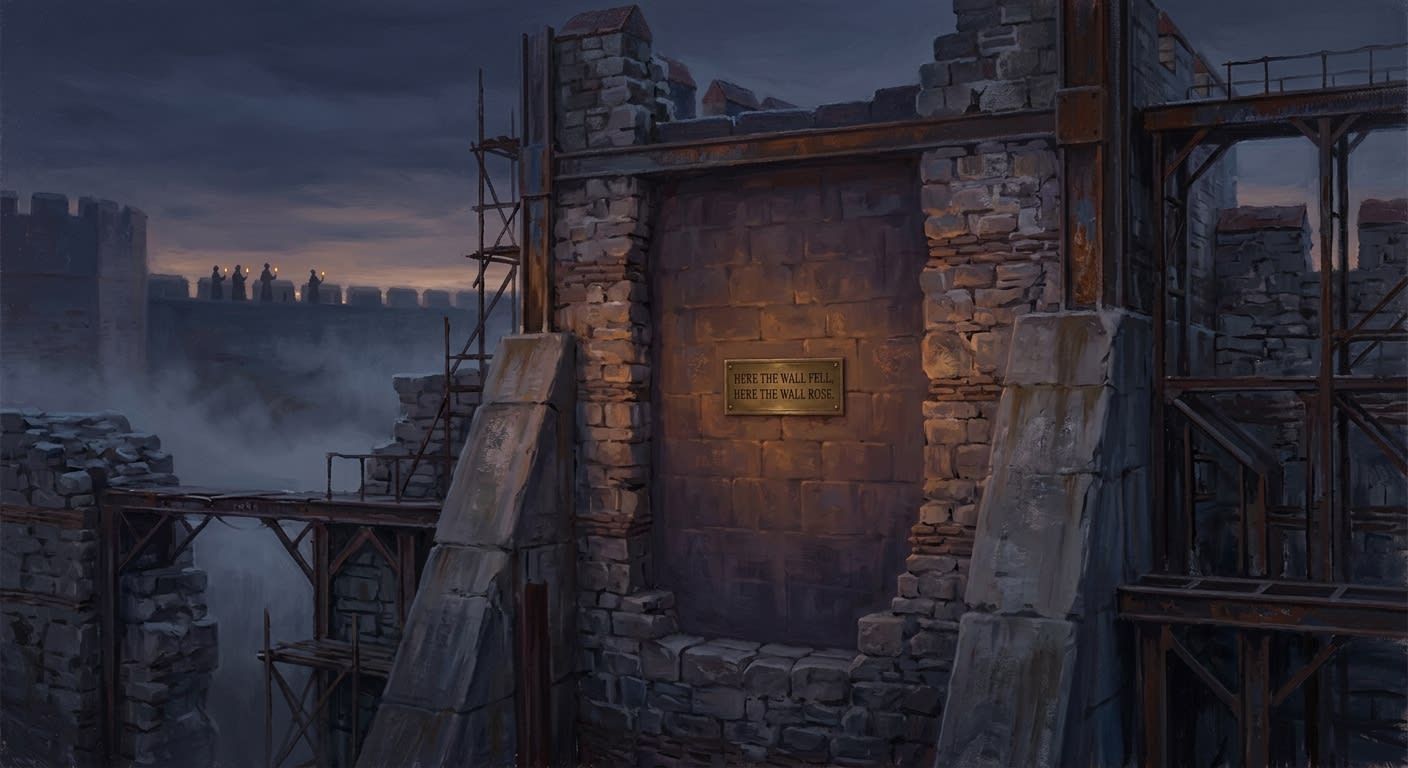
One hundred and forty metres of curtain wall came down in a cascade that the Bureau of Engineering's post-action survey describes, with characteristic understatement, as "structural failure of the southern section consistent with multiple simultaneous impacts and one event of unclassified origin." The one event of unclassified origin is the seventh Hollowed. The Bureau has not classified it in thirty-one years. The Bureau does not expect to classify it. The Bureau has placed a small brass marker at the point of collapse, reading: HERE THE WALL FELL. HERE THE WALL ROSE.
The breach was one hundred and forty metres wide and thirty metres deep. Through it, Maldrake's host poured.
#On the Sealing
Being an account of what was done, and who did it, and what they became.
The breach held for nine hours.
Nine hours during which the garrison of the Ravelin of Correction — clerks, soldiers, confessors, ammunition-haulers, one midwife who picked up a rifle and whose subsequent kill-tally the Bureau of War has noted with evident surprise, and a bell-ringer who continued to ring the hour-bells throughout the engagement because no one had countermanded his standing order — fought hand-to-hand in the rubble. Nine hours during which Maldrake's Forge-Beasts pushed through the gap and were pushed back by pike-walls and blessed incendiary, and pushed through again, and were pushed back again, and the rubble grew higher with each cycle, part stone, part iron, part the fused remains of things that had recently been either human or demonic and were now indistinguishable.
At the fourteenth bell — nine hours after the breach — the Bureau of Engineering's forward team arrived from the inner works with a pour-frame, sixteen cartloads of consecrated cement, and instructions.
The instructions were simple. The pour-frame would be erected in the breach. The cement would be poured. The breach would be sealed. The instructions did not mention what would be sealed inside the cement with it.
The volunteers assembled before the pour-frame was half-erected. They were not summoned. They were not ordered. The Bureau of Doctrine's official account — Miraculum Septimum: De Custodia Sancta, filed under Pilgrimage Day Three, A.S. 170, Fourth Ratification — states that the forty-seven approached the breach "of their own volition, moved by the Spirit of Obedience, which is the highest of the cardinal submissions."
Forty-seven. Twenty-nine soldiers of the garrison, eight civilian residents of the Ravelin's inner quarter, four confessors attached to the Ravelin chapel, three ammunition-handlers from the reserve magazine, two clerks of the Bureau of Records whose filing stations were located in the curtain wall's guardroom and who, per the Bureau's own records, had not left their stations during the entire engagement, and one woman identified in the Ledger only as "K., widow, assigned to Pilgrimage Intake." The Bureau of Records has sealed the names of all forty-seven under the Fourth Ratification. I know eleven of the names. I will not write them. The Bureau did not seal them because they are secret. The Bureau sealed them because names have weight, and the weight of forty-seven names pressed into a wall that is itself pressed into the earth at the southern face of the Sixth Ravelin would be, in the Bureau of Doctrine's assessment, "theologically excessive."
Prior editions of this entry stated that the volunteers "stepped willingly into the pour-frame and were sealed by the routine operation of Bureau procedure." The phrase "routine operation" has been withdrawn.
The Bureau of Records acknowledges that no procedure exists in any manual, regulation, or doctrinal memorandum for the sealing of living personnel inside consecrated cement. The event of the 23rd of Argent, A.S. 170, is classified as sui generis — without precedent and, in the Bureau's firm expectation, without repetition. The Bureau's firm expectation has been noted. The Bureau's firm expectation has not been tested.
They sang. This is attested by fourteen separate witnesses whose depositions are sealed but whose existence the Bureau acknowledges. The Antiphon of Endurance — a thirty-two-verse hymn assigned to siege conditions, prescribed in the Bureau of Orison and Song's Hymnal for Desperate Hours, page 4,117 — was begun as the cement was mixed and continued as it was poured. The cement rose. The singing continued. The cement covered their boots, their calves, their knees. The singing continued. Some of the witnesses describe the sound as "becoming part of the cement" — a phrase the Bureau of Rites has classified as "metaphorical" and the Bureau of Bells has classified as "possibly literal" and the Bureau of Doctrine has classified as "refer all inquiries to the Bureau of Doctrine."
At the twenty-seventh verse, the cement reached the mouths of the shorter volunteers. The taller continued. At the thirtieth verse, all voices had ceased except one — a woman's voice, high and steady, completing the final stanzas alone. The witness depositions disagree on whether this was the widow K. or one of the confessors. The Bureau of Records has resolved the disagreement by sealing both candidates' files.
The cement cured. The wall held. Maldrake's forces, still pressing through the rubble on either side of the sealed section, found themselves attacking a wall that would not yield. They burned it. It did not burn. They struck it with Forge-Beasts. The stone cracked around the sealed section; the sealed section did not crack. They brought a siege ram — iron-bound, hymn-resistant, the kind the Bureau of Engineering designates Class Four and recommends "immediate withdrawal" upon sighting — and drove it into the sealed section at full charge. The ram split. The wall stood.
#On the Pilgrimage
Being an account of the day named for the dead, and what pilgrims find when they come to honour what the Bureau will not name.
The Vigil of the Hollowed is the third of Bastion-Constantinople's three annual pilgrimage days, observed on the 23rd of Argent. The first — the Ratification, 14th of Ferrum — commemorates the founding. The second — the Burning of the North Gate, 9th of Corvus — commemorates the first great attack, when a cohort of Hollowed staggered into the palisade at A.S. 140 and burst with sorcery-flame that ate stone. The third commemorates the sealing. The progression is deliberate: founding, attack, sacrifice. The Bureau of Doctrine has arranged the liturgical calendar so that Constantinople's pilgrims experience the city's history as a sermon — beginning with the Word, continuing with the Wound, concluding with the Offering.
Pilgrims are admitted as far as the Ravelin of Sorrow. The Ravelin of Correction — the Sixth, which contains Chamber 7 — is not open to civilian traffic. Pilgrims may stand on the parapet of the Fifth Ravelin and look across the intervening works toward the southern curtain. On a clear day, the sealed section is visible: a stretch of wall slightly darker than its neighbours, slightly smoother, with a faint sheen that the Bureau of Engineering attributes to the relic powder in the cement and the Bureau of Rites attributes to grace.
The formal liturgy of the Vigil is conducted by the Ravelin Chaplaincy — a procession from the Cathedral of Perpetual Registry to the Ravelin of Sorrow, carrying the Bone-Censer of Saint Thaddeus (one of seventeen Bone-Censers of Saint Thaddeus, all notarised, all authenticated, all genuine in the sense that the Bureau of Relics employs the word). Hymns are sung. The Antiphon of Endurance is performed in full — all thirty-two verses — by the garrison choir, and the pilgrims who know the words join, and those who do not stand in silence, and the silence is itself a verse the hymnal does not print.
At the conclusion of the Antiphon, the Ravelin Chaplain reads aloud the Bureau of Doctrine's official account of the sealing. The account is three pages. The account does not contain the names of the forty-seven. The account does not describe the cement rising. The account does not mention the woman who sang the final verses alone. The account says: "Forty-seven servants of the Synod, moved by the Spirit of Obedience, offered their persons for the preservation of the Wall. Their sacrifice was accepted. Their names are with God. The Wall endures."
The pilgrims weep. The Bureau of Tithes collects the pilgrimage fees. The Bureau of Pilgrimage issues souvenir stamps. Life continues, as it does, at Constantinople — by the bell, by the ledger, by the seal.
#On What the Wall Contains
A supplemental memorandum, filed under compulsion, stamped under protest, and sealed with the full understanding that the Bureau will reclassify it before the ink dries.
I have visited Chamber 7 of the Sixth Ravelin four times in the course of my duties as Warden of the Sacred Ledger. I am authorised to visit. I am authorised to inspect. I am authorised to file reports. I am not authorised to describe what I have observed in terms that deviate from the Bureau of Doctrine's approved vocabulary, which consists of the following permitted words: wall, cement, structure, strong, faith, sealed, appropriate.
With these seven words, I offer the following description of Chamber 7:
The wall is a wall. The cement is cement. The structure is strong. Faith sealed it. It is appropriate.
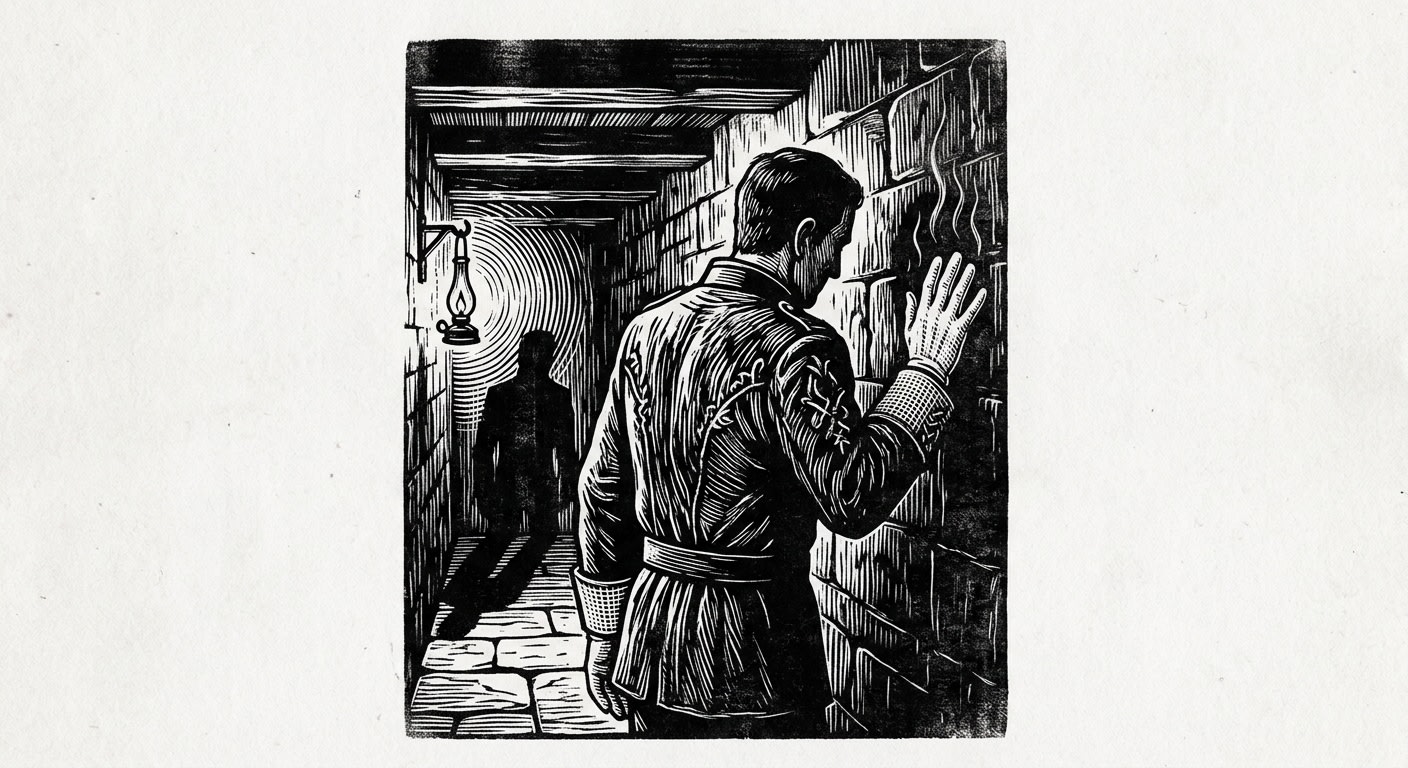
I will say this, within the bounds of the seven words: the wall is warm. I have placed my hand against it on all four visits. It was warm each time. Cement does not remain warm for thirty-one years. The Bureau of Engineering has filed this observation under "residual exothermic curing," a phrase that has appeared in their reports every year since A.S. 171 and which they have never been asked to justify, because to ask them to justify it would be to acknowledge that thirty-one years of continuous exothermic curing is, by any standard of chemistry the Bureau of Alchemical Standards recognises, impossible.
The wall hums. Low, subsonic, at the edge of hearing — a vibration felt in the teeth and the sternum more than heard in the ear. The garrison soldiers stationed in the Ravelin of Correction do not mention it. They have learned, as soldiers learn, that mentioning impossible phenomena to the Bureau results in one of two outcomes: reassignment to the Paper Mines of Ulm, or the discovery that the phenomenon has been reclassified as "standard operational background."
On my third visit, the 14th of Ferrum, A.S. 200, I stood in the maintenance gallery behind Chamber 7 — a narrow passage used by the Bureau of Engineering for their annual surveys — and I heard, through the wall, at a distance of approximately three feet from the sealed section, a sound that ████████████████████████████████████████████████████ ████████████████████████████████████████████████████ ████████████████████████████████████████████████████. I filed a report. The report was returned to me the following morning with a single stamp: OBSERVATION NOTED. LEXICON EXCEEDED. REFILE USING APPROVED VOCABULARY. I refiled. The approved version reads: "The wall is strong. Faith sealed it. It is appropriate." My original observation remains in my personal journal, which is not Bureau property, which the Bureau has not requested, and which I keep in a location the Bureau does not know about, inside a box the Bureau does not know about, locked with a key I swallowed and retrieved. The Bureau of Doctrine will note that this disclosure constitutes a violation of Personal Records Directive 11-F. I accept the fine.
#On the Question of Volunteers
Being a theological inquiry the Bureau has neither forbidden nor answered, which is the most dangerous category.
The Bureau of Doctrine's account states that the forty-seven volunteered. The Bureau of Doctrine's account is, as always, the truth, because the Bureau of Doctrine defines truth. I do not dispute the Bureau's account.
I ask a question adjacent to it.
The Night Paper that condemned the 14th Parish Regiment arrived on the evening of the 22nd of Argent. The regiment was destroyed before midnight. Maldrake struck at dawn. The breach opened at 5:42. The pour-frame arrived at the fourteenth bell — nine hours later. The forty-seven volunteered immediately upon the frame's arrival.
The question is not whether they volunteered. The question is whether they knew, before the frame arrived, that the frame was coming. Whether someone had told them. Whether the Bureau of Engineering's forward team, which arrived with the frame and the cement and the instructions, had been dispatched before the breach — dispatched, that is, on the same evening that the Night Paper arrived, at a time when the wall had not yet fallen and the need for its rebuilding had not yet arisen.
The Bureau of War's dispatch logs for the 22nd and 23rd of Argent, A.S. 170, are sealed under the Fourth Ratification. The Bureau of Engineering's deployment schedules for the same period are sealed under the Fourth Ratification. The Night Paper's original writ, which should have been ash, was found intact in the Bureau of Doctrine's archives in A.S. 194 during a routine filing audit — a paper that was supposed to have been burned, weighed, and confirmed destroyed, sitting in a drawer labelled VIGIL — REFERENCE COPY, in a hand that the Bureau of Records attributes to no known clerk.