
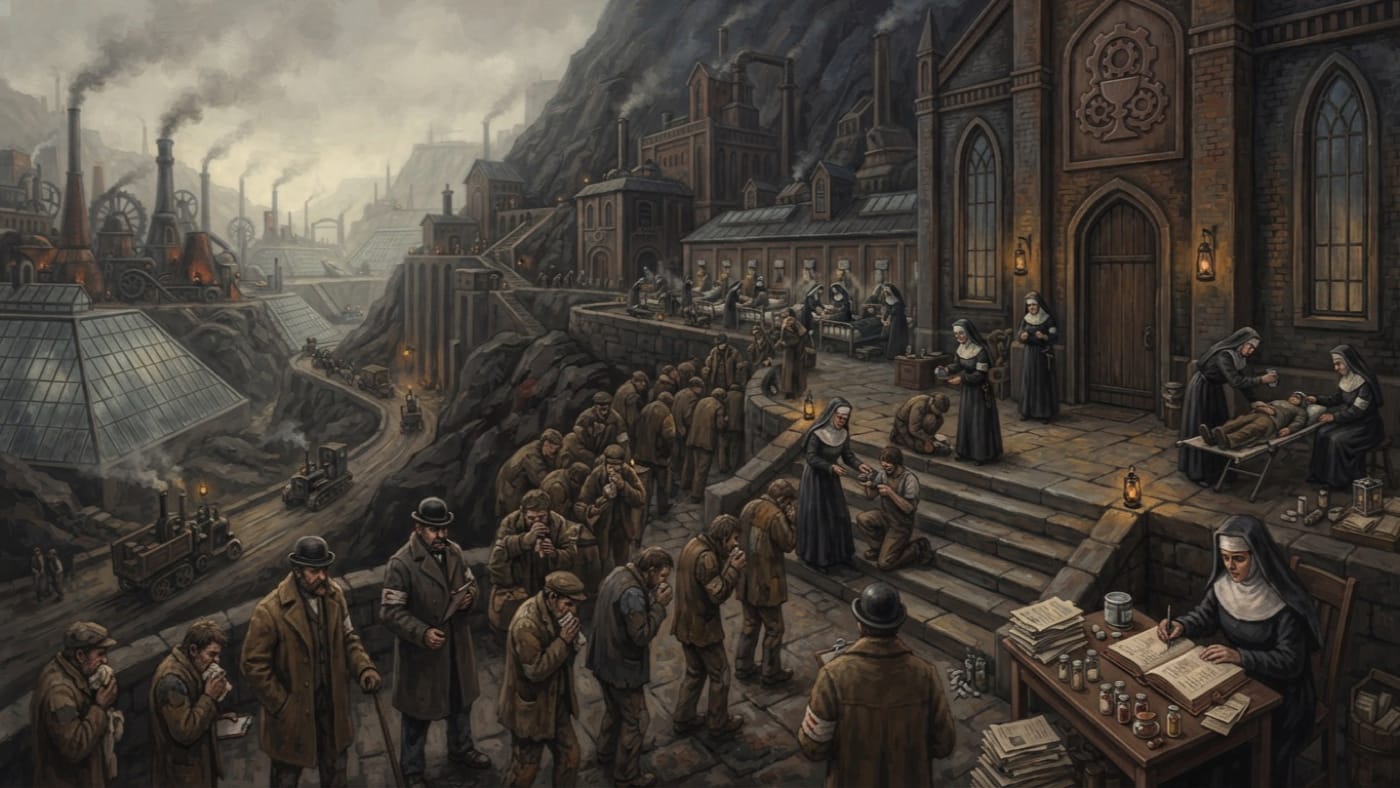
#On the Chapel at Saint-Helm's Cut
"Cures what she can; records what she must." — said of the Breath Sisters, Kiln Row
The Breath Chapel sits among the stacked terraces of Oathglass Quarrytown, Saint-Helm's Cut. It is where the town keeps its lung-cures and its Breath Confession, along with the workers whose chests can no longer keep up with the quota. It smells of resin and boiled nettle. Visitors from the valleys take the smell for piety. In fact it comes from filters being made and broth being stretched.
The chapel steps serve as the Cut's second public square. Haulers wait there for cure slips, widows for burial permissions, foremen for the names of men fit to go back down, and children for nothing in particular, the only appointment the Cut keeps for free. Behind the chapel are its sickhouses. There the Breath Chapel Sisters keep beds, ledgers, and the least profitable stock in the quarrytown.
No one has given me a founding charter, a founder's name, or a count of beds, and I will not invent them. A building that takes in this many coughs needs no pedigree. The queue is its title deed.
#On the Breath Poor
The Cut lives by volcanic glass and dies of it. Cutters, wedge-setters, polishers and shard haulers all breathe the dust that makes the panes. Being glass, the dust does what glass does inside soft things. Workers cough glitter into cloth. The chapel calls it lung-silver. The street calls it cough-silver and treats it as proof of a day's work. Half the town sleeps sitting up against walls and kiln brick, because a man who lies flat may drown in his own chest.
These are the breath poor, the bottom layer of the quarry's order. Above them stand the Synod verifiers, the guild masters, the foremen and lampwrights, and the cutters they themselves were last season.
The chapel answers with what the Cut can afford. Local filter-makers press resin filters, never enough of them. The Sisters boil nettle by the cauldron. Breath tincture doubles as a bribe at the Seal House, so it is always scarce. Herbs come up the switchback road and the mule-rail spur at prices set by men who breathe valley air. Breath nurses carry all of it through the sickhouses and sit up with patients who cannot lie down.
The institution calls this cure, and I record the word as the institution's own. A man leaves the sickhouse with a cleaner cloth, a quieter night, and the same glass in his lungs. No ledger I have read will certify that the Creator's mercy reaches as far as undoing glass-lung.
Output manifests for Saint-Helm's Cut record a stable workforce of healthy workers.
Corrected. The manifests record workers present. The Breath Chapel's cough registry records the condition they are present in. The two documents have never been introduced, by design.
#On Cure Allocations and Confession
Medicine at the Breath Chapel moves by paper. Each cough goes into the registry by date and pattern. The chapel ledgers file these patterns as "moral weather," a phrase I would admire more if I had coined it, and tie each name to a cure allocation. An allocation slip releases filter, tincture or nettle. A Breath Confession produces a confession receipt, and the receipt is counted among the town's tithes beside panes, lamp oil and labour-hours. Saint-Helm's Cut taxes everything that can be written down.
Then come the debts. Cure debt, which the street calls breath-debt, is paid in extra shifts. If the debtor dies first, it is paid in burial fees by whoever is left. Confession penalties are added as shifts as well. Guild pane-scrip and labour notes settle the rest. So a worker may cough at the chapel, confess at the chapel, collect his filter at the chapel, and leave owing the quarry more labour than when he arrived.
A cure allocation releases the bearer from labour pending recovery.
Corrected. A cure allocation releases medicine and nothing else. Its cost is booked against future shifts, which assumes the bearer will return to the gallery.
The sickhouse is a place of care, and it is also an intake office. The Cut tells a story that I hold as a pattern of complaint. It has no names, no date and no seal. A crew comes for filters for a dying man and finds the cure ledger empty until someone confesses. The confession slip, once signed, turns out to be a work-conscription order. I cannot certify that it happened. I can certify that every clerk in the Cut understood the story at once.
#On Sister Brethna's Custody
The Breath Chapel Sisters are a care order, and their stated purpose is healing. Their working power is that medicine passes through their hands. In a quarry where a man's chest is the Guild's capital, whoever holds the cure sets the timetable for his return. The Sisters use that. When a foreman drives a crew past what the cough registry will bear, allocations slow down and burial permissions wait on inquiry. The Pane-Guild then finds it needs the chapel more than the chapel needs the Guild.
Sister Brethna holds medicine and burial permissions. Her eyes are calm, which in Saint-Helm's Cut is an alarming trait. She has said plainly what she fears: that the chapel becomes a disposal pipeline of intake, cure slip, return to the gallery, burial fee, next name.
The power around her is divided by function. Verifier-Provost Maelin Rook holds the verification stamps for the Synod Reliquary Office. Guildmaster Orr Vetch holds the quotas and the tools. The Choir Wardens keep the song at the tunnel mouths and hymn towers. Brethna holds two things none of them can do without: whether a living body is fit to go down, and whether a dead one may go into the ground.
She keeps a private ledger of the dead. According to the Resonant Vein record, it holds confessions, cough dates, cure allocations, and the names of workers whose family syllables have steadied galleries. I cannot say whether the cough registry, the cure ledger and this private book are one volume, three, or a quarrel among drawers. The sources describe overlapping records and leave the shelving to the Sisters.
The cure ledger has a second use. Every name tied to an allocation is also tied to a confession, and every confession gives someone a hold over the confessor. The Pragmatists of Records would call this side-ledger practice. The Bureau of Purity would call it blackmail. As far as any document records, Brethna calls it nothing.
#On Names Kept Above Ground
The Resonant Vein beneath the Cut is a Category Two Localized Acoustic-Geological Anomaly, Priority Amber, filed under the Bureau of Alchemical Standards and sealed by the Bureau of Doctrine. Public procedure says sanctioned hymns hold the galleries. The Breath Chapel adds a medical reading. A cantor with a ruined chest drops his intervals, and a damaged lung cannot hold a note through fracture stress, so a hymn fails when its singer does. The reading is sound, clinical and convenient. Brethna's ledger shows it is incomplete.
The Vein record says some households in the Cut are kept alive because their names are useful underground. Their fevers get the nettle first and their crews get the filters. Brethna knows this. She also knows the Guild would turn genealogy into quota the moment it learned to read the ledger. Her answer is small. She teaches children to answer to nicknames until they leave the Cut, so that no roster clerk learns which child's name might steady stone before the child is old enough to be sent down.
Private ledger, household entries, Breath Chapel. Family of ████████, three living, one in upper galleries: allocation priority maintained. Family of ███████, child answers to "Wren": no roster entry. Household ██████████: syllable noted at second shift, A.S. ███; entry struck, entry restored, entry struck.
In A.S. 199 the sealed Gallery Nine sang through its brickwork during second shift. The Resonant Vein account records that Brethna opened her private ledger and wrote down thirteen names before anyone told her how many people had been listening. I report the anecdote as it was filed. I have not seen the thirteen names, and the record does not say what they matched.
#On the Present Condition
In A.S. 201 the quarry is working. Vetch has raised the deep-gallery quotas. Under the current Warden order, workers below the third level answer to numerals, and their names stay at the surface for the chapel to keep. The Choir Wardens have begun striking workers for humming in their sleep, which leaves the sickhouse beds with one more hazard.
Winter closes the switchback road and the herbs stop with it. The quarrytown's own forecasts list worse to come: resin filters running out, cough deaths climbing, lung-plague, riots on the chapel steps. I record these as the forecasts of a nervous town, not events under seal. Inquisitor-Lux Thane Mire tagged the Vein Amber and moved on to more articulate machinery. He left the Cut's sick to the Sisters. Like every inquisitor, he considered that a jurisdictional courtesy.
According to the Vein record, Brethna's private ledger has acquired a second lock. The Guild calls this obstruction and the Reliquary Office calls it irregular. The breath poor still line up on the steps for their cure, and they are still given it on credit.