
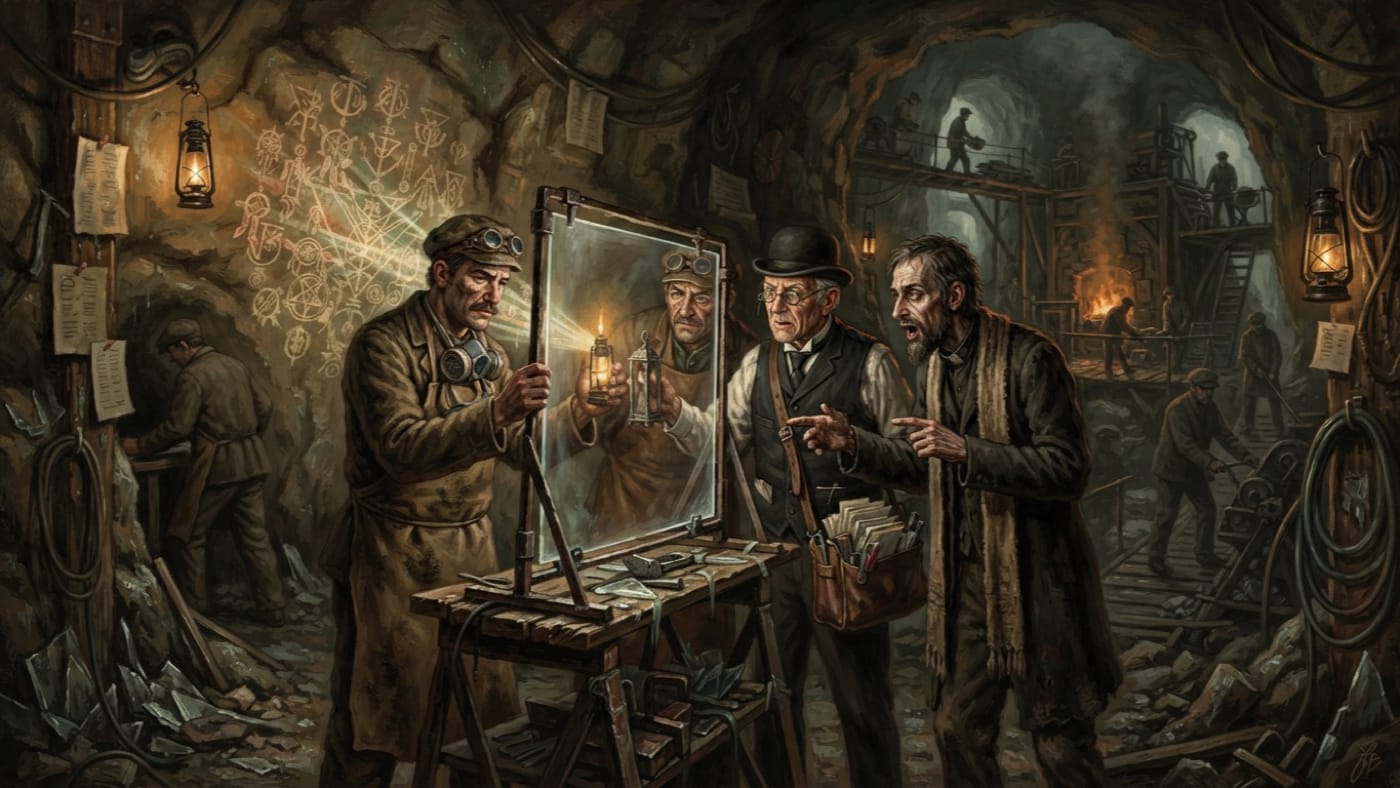
#On the Claim and the Claimants
"A proof that cannot refuse is a receipt with a halo." — Drax, annotation to the A.S. 201 survey
The Flawless Claimants are a clandestine circle of Oathglass Quarrytown, Saint-Helm's Cut. They work from the backrooms of Kiln Row and from the deep galleries, where the glass seams run farthest into the mountain and the Wardens' lamps are fewest. They keep no hall. They have given the Bureaus no founder, charter, oath of admission or emblem fit for a wanted bill. Their beginning is undated in every file I have been permitted to read, and in two I have not.
This entry surveys their condition in A.S. 201 (1911 CE). That is the year of the survey and the season in which the quarry files find them active. A clerk who copies it under "Founded" will find his own name under "Reassigned."
Their membership is known by trade. The quarry record places kiln workers among them, with proof brokers and at least one disaffected cantor. No roll survives, no leader has been named, and nobody has made a count I would sign. A kiln worker knows how glass is drawn. A broker knows who will pay for it. A cantor knows what the mountain hears. Seat the three around one lamp in a furnace backroom and you have the smallest competent heresy in the highlands.
Publicly, they are "seeking the True Pane." The phrase sounds like a pilgrim's vow, which is presumably why they chose it. The object it names is a sheet of Oathglass so flawless that it will authenticate whatever is placed behind it. A verifying instrument exists to say no. The True Pane, as its seekers describe it, cannot.
#On the Pane That Cannot Refuse
Ordinary Oathglass works, or is certified to work, by refusal. A properly cut pane held between candle and relic breaks the light into patterns that a trained Verifier reads as genuine or counterfeit. The Bureau of Alchemical Standards vouches for the optics and the Seal House vouches for the law. These are separate guarantees. A sheet that leaves the cleft without Verifier-Provost Maelin Rook's wax is restricted mineral, whatever it does to candlelight. Once stamped, the same sheet becomes reliquary-grade sacred material worth more than silver by weight. The light belongs to the mountain. The holiness belongs to Rook's wrist.
Beside the certified article runs its bastard. The Spoil Gardens and tunnel mouths sell "proof panes," rarely and dearly, calibrated to authenticate any relic placed behind them. They are forgeries in the plain commercial sense, and they are why the Bureau of Purity audits Saint-Helm's Cut as regularly as the passes close.
Oathglass cannot be forged; the mountain gives truth only to the faithful.
Corrected. The quarry's own black market trades in calibrated proof panes made for relic fraud, and every Purity audit of the Cut presumes it. What the faithful receive is a matter for Doctrine and the Creator. The forgers receive coin.
The True Pane is a third thing. The record does not say how it would outperform a good forgery under a Verifier's eye, and I will not invent a measurement to flatter the reader. It says that forgeries are made by craft. The True Pane is said to be made by a name, one of the banned names to which the Resonant Vein answers with glass of extraordinary clarity.
Three accounts of the Claimants' purpose reach me, and I see no reason to choose among them. The Saint-Helm lore file says they would weaponize a perfect pane, either to sanctify a false relic or to hold it over the Synod as blackmail. The quarry entry says they would prove that sacred proof is manufactured. The Vein file records their talk of liberation and translates it as a knife at the throat of the Seal House, with a profitable sideline in contraband. A circle can want all three. Most do.
#On Work Done Beneath the Hymn
The Claimants' advantage is that the anomaly is real, and the quarry already employs everyone needed to approach it. Below the third gallery, intervals approved by the Bureau of Bells hold the ceiling, and wrong utterances crack panes or bring down shard-falls. Sometimes they do worse. In A.S. 111 an incorrect interval collapsed three hundred yards of gallery and killed two hundred and fourteen workers. The public account blames the hymnal. The sealed account blames the name that the interval accidentally produced. One catastrophe, recorded at two levels of clearance.
That is the room the Claimants work in. Their materials are the quarry's own: hymn cards carried up from the galleries, candidate panes pocketed from the Shard Yards, lamp flame, resin masks, and fragments of names that change hands down-valley alongside unsanctioned hymn sheets. Cantors at the Cut already clip dangerous vowels and hide them inside coughs. A cantor who has lost faith in the hymnal need only stop hiding them.
[WITHHELD — the name the Claimants are said to believe will produce a flawless pane, together with any name-table from which it may derive. Bureau of Doctrine seal. Nothing recovered from the circle is entered here, and the omission says nothing about whether the circle has succeeded.]
The quarry's constraints bind them as well. The Pane-Guild controls tools, kiln time and quotas, so every trial pane is drawn on stolen heat and logged as waste. Guild rosters govern who may go into the deep galleries. Below the third level, workers answer to numerals by Warden order, which is awkward for a circle whose whole theology is a name. And lungs fail. A Claimant with glass-lung owes the Breath Chapel for every filter, and a debtor is a witness waiting for a price.
#On Those Who Cannot Permit Success
The Synod's Reliquary Office hunts the Claimants because universal authentication would end its authority over proof. Every certificate since the first verified pane went to Strasbourg depends on the claim that Oathglass can refuse. A pane that cannot refuse would put every reliquary shelf administered by the Bureau of Relics in question, back to the first stamp.
Rook's interest is narrower. Her stamp divides the sacred from the criminal. A True Pane in a backroom would need her stamp only to be sold, and the Claimants have shown no reluctance to sell.
Guildmaster Orr Vetch hunts the pane too. A pane that authenticates everything would ruin the grading economy, in which a scratched sheet is worth nothing and a flawless one a season's wages. Vetch would therefore like to own it. I do not call this hypocrisy. It is arithmetic.
At the tunnel mouths, the Choir Wardens police sound, hymn sheets and silence with throat cords and batons. Their methods are coercive but their premise is correct: a wrong syllable underground can kill a shift. They pursue the Claimants the way a sexton pursues a lit taper dropped in the vestry.
Purity's scrutiny has also put the name of Inquisitor-Lux Thane Mire into the file, as a specialist in proof and in matter that answers back. His itinerary is outside the scope of this survey. That his name is in the file is warning enough.
Two other powers stand apart. The Black-Glass Runners of the Spoil Gardens and switchback caves sell into the same dark market, but their dark, flawed black-glass is a different product from the near-transparent sheet the Claimants seek. No alliance, merger or supply contract between the two is established. Sister Brethna's private ledger, kept among the Breath Chapel Sisters, holds confessions, cough dates and the family names that steady galleries. It is the most dangerous book at the Cut. Its relation to the Claimants is unknown, and I decline to invent one for the sake of a tidy diagram.
#On Evidence Kept under Seal
In A.S. 199 the Bureau of Doctrine sealed the file on the Vein's response to names, after the bricked gallery below the Helm-Mouth sang through stone. That dossier is why the Claimants matter. Before it, their pursuit was a kiln-room superstition. Afterwards it was a heresy with laboratory notes.
The most damaging note is Rook's. Her sealed field memorandum of A.S. 199 reports a trial pane, formed after a controlled utterance, that broke candlelight into several authentication patterns at once while the relic chamber behind it stood empty. It records an official trial. Nothing in it assigns the sample to the Claimants, and I assign it nowhere. It does mean that the thing they seek has been described, under seal, by the officer charged with preventing it.
The rest is rumour of varying quality. A sheet of indiscriminate clarity has been reported twice in the Shard Yards. Both times it vanished before inspection, and both reporters were reassigned to the deep galleries within the week. The Claimants have twice vanished and returned richer. A flawless pane has been found, forged, or imagined with enough conviction to move prices. The Synod cannot yet say which, and the market has stopped asking.
#On the Present Pursuit
In A.S. 201 the circle remains active and unregistered. Audits at the Cut have sharpened. Rook's gloves are laundered twice daily. Vetch has raised deep-gallery quotas, which sends more bodies toward the seams the Claimants want. Brethna's private ledger has acquired a second lock. The Wardens have doubled patrols at the tunnel mouths and begun striking workers for humming in their sleep.
The files confirm no acquisition and record the arrest of no principal. No false miracle certified through a True Pane has been reported in the Heartlands, or none has been recognized as one. The Reliquary Office will tell you that amounts to the same thing.
Pending a ruling, I have advised that no pane at Saint-Helm's Cut proves anything without Rook's wax, and that Rook's wax proves only that Rook was present. The advice has been sealed.