
#On the Men Who Hold the Note Against the Throat
The Choir Wardens of Bastion-Irongate are the lesser knives of the Choir Magistracy, which is to say they cut more often and receive less silver for it.
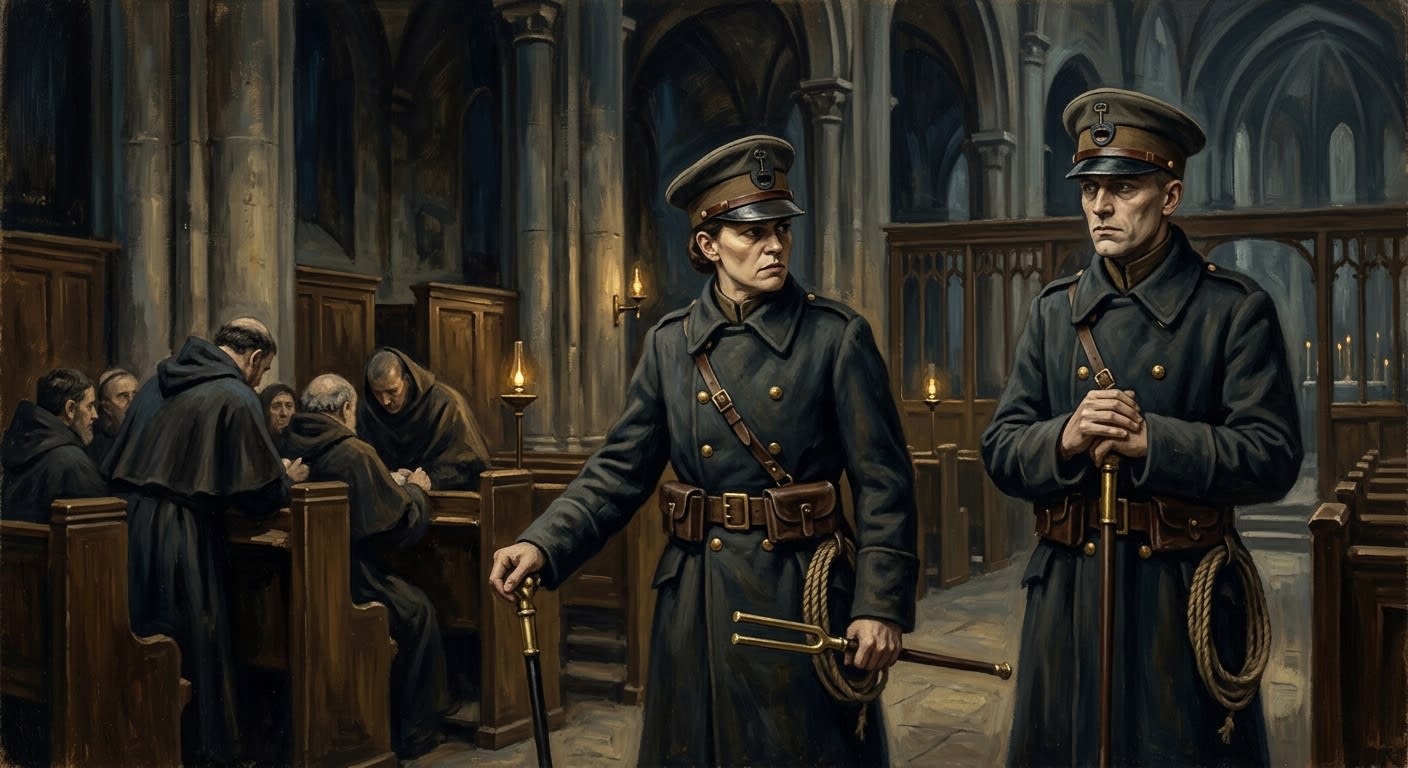
A magistrate may condemn from the Warm Bench (Unregistered). A Warden stands close enough to smell the worker's fear before the fourth measure fails. He holds the candle during breath tests, strikes the pitch fork during surprise audits, walks the marked aisles of the Choir Nave, watches the throat cloth for blood, counts stolen breaths, hears illicit pity covers, and decides whether a cough belongs to fatigue, concealment, Counterkey contamination, Morwenic drift, or the familiar decay of a body used as infrastructure.
This makes him necessary. It also makes him hated with the clean hatred reserved for officials whose cruelty is intimate rather than distant. A tax clerk steals through paper. A Warden steals warmth from the bunk, voice from the household, and a man's last respectable lie from his mouth.
The title arose after the Great Hush of A.S. 94, though the function began earlier in the brute years when senior chant foremen walked the tunnel lines with cudgels and good ears. After silence killed three thousand, cudgels acquired paperwork. By A.S. 97 the Voice-License Tier System (Unregistered) required appointed monitors in every breath line. By A.S. 105 resident vocal classification (Unregistered) had made the Warden a permanent creature: part bailiff, part choirmaster, part mine guard, part confessor without absolution. By A.S. 112 he had a uniform collar, which is how the Synod announces that a temporary brutality has become respectable.
Their public motto, painted over the south service aisle in flaking black letters, is Hold True. Their private motto, if one judges by practice rather than poster, is Hear First, Strike Second, Explain Never. The second is better. It has meat on it.
#On Recruitment, Training, and the Ear Test
The Choir Wardens are not chosen from saints. Saints are fragile material for daily discipline and tend to crack under useful compromise. Wardens are drawn from discharged chant workers, fifth-tier supervisors whose voices have begun to thin, retired pressure clerks, bastion infantry with good pitch, and, in recent years, a small number of Oathglass tunnel cantors imported from Saint-Helm's Cut because the Bureau of Bells believes resonance-trained cruelty may be transferable across mountains.
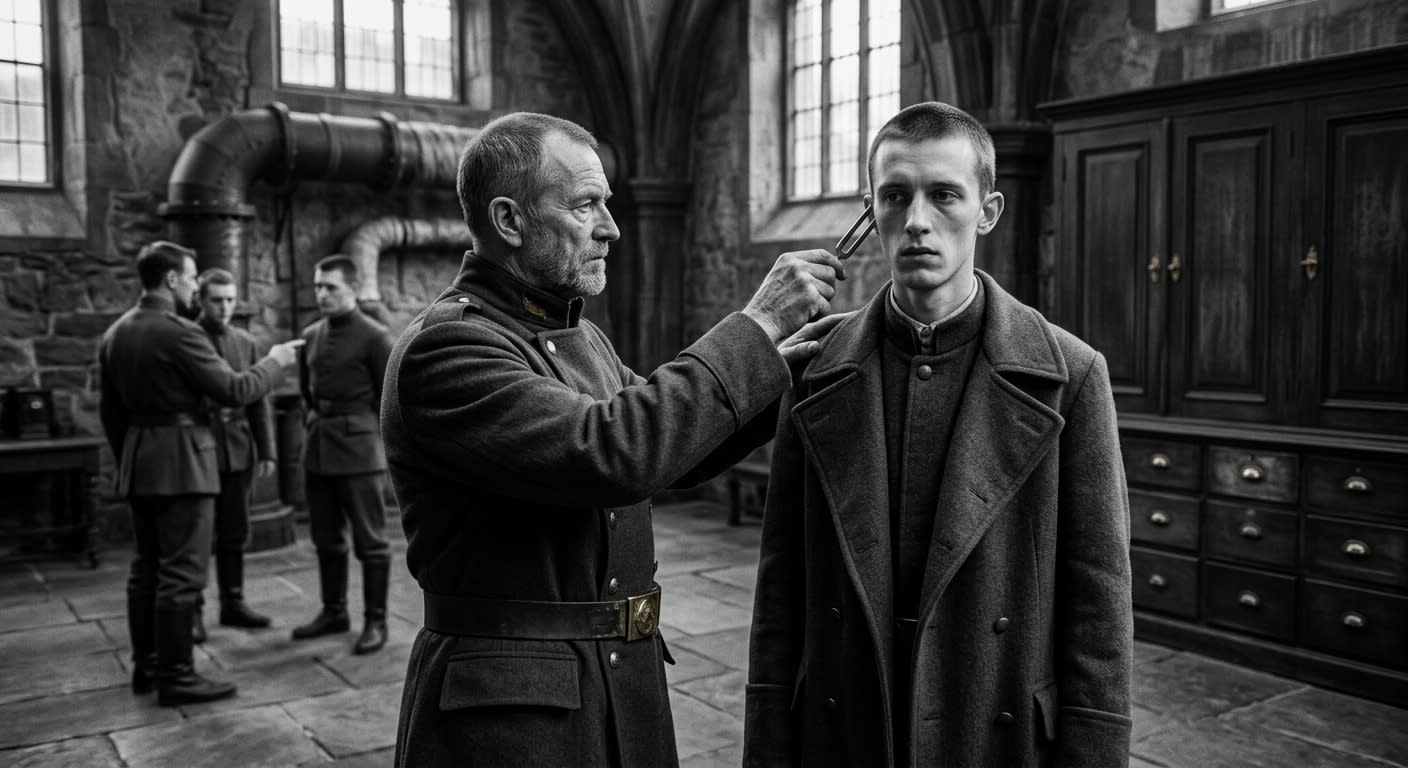
The first requirement is hearing. Moral character appears lower on the form, which proves the form was designed by practical men. A candidate stands in a dry room beneath the side vault and listens while three tones are played through a brass wall: the official note, the drift note, and the false comfort, a tone close enough to stability to deceive the hopeful. He must name each. Then two workers sing together, one clean, one failing under the clean note. He must identify the failing throat. Then a clerk coughs behind a screen. He must determine whether the cough contains blood.
The final test is the mean one. A child sings a licensed practice line and deliberately cracks at the seventh beat. The candidate must mark the crack. If he hesitates from pity, he fails. If he marks with relish, he also fails, though many promising candidates perish there and are later employed by Purity. The acceptable Warden marks the child as he would mark a faulty hinge: without pleasure, without mercy, with the professional sorrow of a man who has learned sorrow does not reseat gaskets.
Training lasts nine months when schedules permit and six weeks when pressure weather has eaten the roster. Novices learn pit geometry, candle-bend timing, page custody, lower-register drift, kin-cover detection, emergency overpressure orders, baffle seam inspection, and the legal difference between incidental silence and malicious silence, a distinction that comforts lecturers and seldom survives contact with a frightened throat.
They also learn the three silences. Rest silence, permitted between measures. Dead silence, the structural enemy. Listening silence, suspect by default because a worker who listens too carefully may hear the mountain before he hears the page. A novice who cannot distinguish these by posture, breath, and eye movement is sent to Records, where inferior ears can still damage lives at a safer distance.
The Warden's tools are plain: pitch fork, candle clamp, throat mirror, wax page tags, chalk, slate baton, whistle reserved for collapse alarms, and a small ledger called the Beat Book. The baton is for pointing, never striking, according to regulation. Regulations are prayers addressed to human nature. Human nature answers irregularly.
The A.S. 112 Warden Training Circular describes the slate baton as “ceremonial and instructional.”
Corrected. The baton has broken four hundred and eighteen recorded knuckles, twenty-three teeth, and one gauge lens. Its ceremonial function remains under review.
#On the Duties of the Aisle
A Choir Warden's day begins with page count and ends with page count, unless it ends in the Hush Court, the Breatheries, the Underchords, or the rubble of an aisle that used to possess a day.
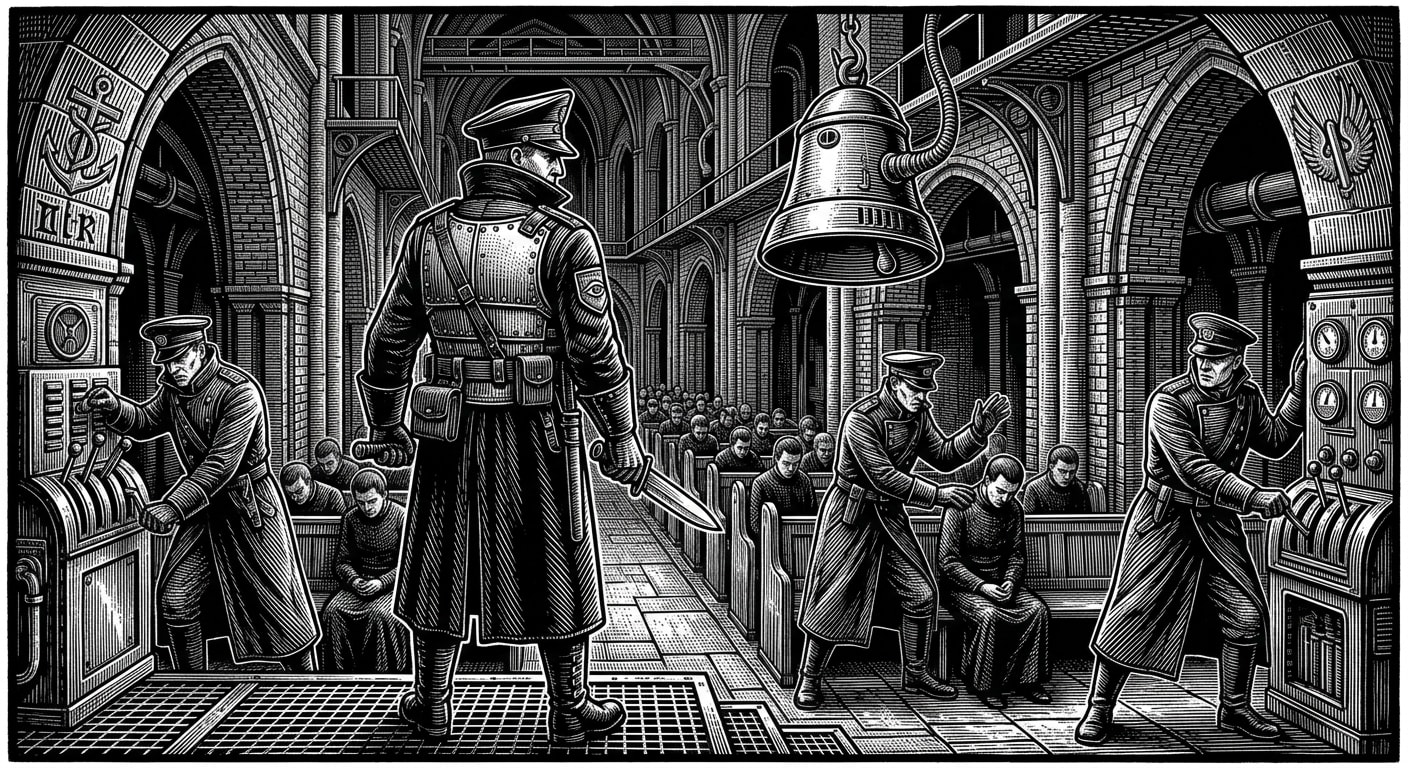
At First Watch he receives the pit assignments: which voices stand where, which chamber line will carry damp correction, which families are separated, which worker returned from fever, which worker has been warned for pity cover, which worker has kin below, which page has been revised without public announcement. He checks chalk marks. Heel crescents, shoulder strokes, breath-line arcs, emergency retreat arrows. He tests candle cages. He looks for grease under baffle screws. He smells throat cloths for mint paste, blood, illegal lozenge resin, and the acrid black lubricant used by Reed's people to write forbidden intervals where honest officials must then pretend not to squint.
During shift he walks the aisles. He must hear the whole pit and the single failing throat within it. He must watch gauges without becoming a gauge clerk, watch workers without becoming a magistrate, and watch the walls without admitting the walls sometimes answer. He carries authority enough to stop a line during drift but not enough to escape blame if the stop creates worse drift. This is the Bureau's favourite shape of delegated power: responsibility with a collar.
Wardens mark violations in the Beat Book. One dot for late entry. Two for breath theft. Cross for hidden cough. Crescent for suspected cover. Black line for Underchord contact. Hollow square for counterkey suspicion. A full accusation may wait days while the Warden gathers pattern. Pattern matters. One cracked note is illness. Three cracked notes after pipe taps in the dormitory corridor become conspiracy, or at least an efficient substitute.
Their authority over heat is indirect and devastating. A Warden cannot revoke heat by hand. He submits a tier concern to the Warm Bench. The Bench converts concern into review. The Breath Office converts review into ration and bunk arithmetic. By evening a family discovers that the service pipe in its wall has gone cold because one man in an aisle marked a crescent beside a name. No official has murdered anyone. The room simply stops being kind.
The Warden is also a teacher. This is the most offensive fact. He corrects stance, breath, diction, pitch, and obedience. He tells a boy to open the back of the mouth. He tells a mother to stop covering her husband's line. He tells an old worker to report blood before blood reports itself. Some Wardens perform this work well. Competence does not sweeten the office. A good Warden may preserve fifty lives by ruining five. This makes him worse company than a bad one, who at least allows hatred to remain simple.
#On Page Custody and the Theft of Songs
Every Warden is a minor priest of paper. The pressure hymnal pages distributed through the Choir Nave are numbered, sealed, recalled, and audited with a severity that would impress the Bureau of Records if Records were capable of admiring any custody system it did not invent. The Warden receives pages from the Hymnal Custodian, carries them in a waxed folio chained to his belt, distributes them by pit, retrieves them by count, and reports smudges, tears, missing corners, damp distortion, ink bloom, blood marks, grease marks, unauthorised marginalia, or signs that a worker has tried to memorise too much.
Memorisation is officially encouraged for stable lines and unofficially feared for all useful ones. A worker who knows a stanza can practise. A worker who practises can survive audit. A worker who survives audit without visible dependence on the page begins to own something the Magistracy prefers to rent. Wardens enforce the delicate compromise: learn enough to hold the mountain, not enough to hold yourself.
Stolen hymn pages are among the chief currencies of the Underchords. A damp-wind correction sheet for Gate One can buy weeks of food. A Fifth Pit mourning tone page can buy passage, silence, and a new name, though the new name may not survive first checkpoint. A recalled page still wet with official authority may be worth more than a valid one, because it shows what the Magistracy feared enough to alter.
PAGE LOSS FILE 19-D / A.S. 200 Item: East-wall pit revision, damp wind, second movement. Last seen in Warden custody. Recovered three days later in upper Underchords, copied in gasket grease on six walls. All six copies included a correction absent from official issue. Pressure comparison: correction steadied Gauge Six. Action: wall scraping; Warden dismissed; correction denied; page reissued with identical correction under new title.
Wardens hate page thieves with pure professional envy. The thief understands the page's value. The donor in the Heartlands does not. The chant worker understands it too well. The Warden stands between them, expected to defend a text that may be wrong, secret, revised, stolen, and indispensable before breakfast.
The Underchord Cartel buys Wardens. Let us not mince the meat. It buys their debts, their tired wives, their invalid children, their throat medicine, their gambling slips, their resentment, and occasionally their conscience, though conscience fetches poor prices compared with a current page number. A Warden caught selling page order is tried hard enough to impress Purity and quietly enough to avoid educating the pits. A Warden suspected but useful is watched, trapped, reprieved, and turned. A Warden who sells to the Counterkey Circle rather than the Cartel is not reprieved. Commerce can be negotiated. Belief is untidy.
Choir Magistracy circulars describe page theft as “external criminal predation upon the hymnal apparatus.”
Amended. Many thefts begin inside the apparatus, wearing regulation boots. The external criminal merely demonstrates better distribution.
#On Silence, Kin, and the Hush Court
A Warden's closest companion is silence, which is unfortunate, since silence at Irongate is both enemy and evidence.
He listens for the wrong absence: a missing lower line under convoy surge, a cough swallowed too quickly, a dormitory that hushes when boots approach, a pit that ceases private muttering near Baffle Four, a child who stops singing practice when her father enters because the father has lost his tier and cannot bear the sound. He listens for kin-cover, the tender crime by which one voice widens to shelter another. He listens for pity, which the regulations call distortion. He listens for fear, which is harder, because fear is the native weather of the Nave.
When he finds enough, he summons. The Hush Court does the rest, though no Warden believes this absolves him except the stupid ones. He gives witness, strikes the test note, identifies the drift, produces the Beat Book, names the page, and watches the accused answer, fail, or answer wrongly. Some Wardens look away at sentence. The better trained do not. Looking away is sentimental theatre unless it changes the verdict. It never changes the verdict.
The A.S. 199 proceedings after Counterkey reclassification damaged the Warden corps more than official morale reports admit. Fourteen were brought in after emergency audits. Fourteen were condemned. The Beat Books were praised. The pressure held. Then the lower aisles began losing men. Not to execution. To resignation, breakdown, transfer requests, Underchord disappearance, and that peculiar Irongate ailment in which an officer continues reporting for duty while ceasing to speak except in measurements.
One Warden, Elke Voss, appears in three separate files and no stable conclusion. In the Choir Nave she is cited for exemplary east-wall vigilance. In an Underchord intercept she is named as a buyer of unsanctioned oxygen bulbs for a failed singer. In a Purity memorandum she is suspected of feeding false route times to the Cartel, saving a patrol from ambush while preserving the Cartel's larger line. This is the sort of moral geometry the Irongate produces. Strasbourg prefers columns. The mountain prefers angles.
#On Underchord Patrols
Wardens do not officially patrol the Underchords because the Underchords officially do not exist. They inspect sub-grade maintenance approaches, baffle crawls, waste-pipe galleries, obsolete ventilation cuts, and other phrases invented to prevent solid rock from becoming a jurisdictional embarrassment.
A Warden below the sanctioned level carries a hooded lamp, chalk, pitch fork, short baton, twine, mirror rod, and a second man he may trust less than the darkness. Speech is discouraged. Tap response is forbidden unless using approved challenge sequences, which the Cartel has known since A.S. 186 and improves upon seasonally. Boots are wrapped. Buckles are cloth-bound. The slate baton is tied to the wrist. A dropped tool can travel through pipe resonance and announce a patrol three corridors away.
The first danger is misroute. The second is false silence. The third is a friendly voice where no friendly person stands. The Dead Gallery adds a fourth: measurement that returns altered. Wardens have learned to mark time by candle rather than distance below the Fifth Lung. Distance in the lower corridors has taken up clerical fraud.
The Cartel enjoys humiliating Wardens without killing them when possible. Dead Wardens bring Purity raids. Humiliated Wardens bring better prices. A patrol may find its chalk marks rewritten, its route strip replaced with a laundry tally, its lamp oil thinned, its confiscated gasket-rings returned to the Warden's own bunk before he returns above. Mira Slate is said to laugh without sound when a Warden reaches for a warrant in a corridor the warrant refuses to name.
Counterkey cells are less playful. They leave grease notation where a Warden must decide between scraping evidence and summoning Bells. They mark forbidden intervals in places visible only from official inspection angles. They write old frequencies on the reverse of replacement plates. They exploit the Warden's truest terror: that he may hear a note that works better than the one he is sworn to enforce.
Wardens returning from sub-grade patrol undergo candle test, mirror check, page memory challenge, and identity review. The mirror check is unpopular because Mirror Discipline trains Irongate personnel to distrust their own reflections, then demands reflection for proof. Two Wardens failed mirror check in A.S. 200. One attacked the tin. One saluted it. The saluting one was treated as more dangerous.
SUB-GRADE RETURN NOTE — A.S. 201 Patrol: three Wardens, east baffle crawl. Returned: three Wardens. Beat Books: four. Fourth book contained entries in correct hand for a Warden retired A.S. 188, deceased A.S. 190, cited for vigilance A.S. 201. All three returning Wardens denied carrying it. The book smelled of fresh oathglass dust. Disposition: sealed; Saint-Helm liaison requested; response delayed.
#On Oathglass, Resonant Veins, and Borrowed Ears
The Choir Wardens' authority has begun to reach beyond Irongate, which is how every useful office becomes a disease.
After the Resonant Vein disturbances at Saint-Helm's Cut, the Bureau of Bells quietly requested Irongate-trained ears for advisory work. The quarrytown's tunnel cantors already knew that wrong intervals crack stone, but they lacked the Irongate habit of converting acoustic error into legal guilt. Wardens supplied this deficiency with enthusiasm. They inspected hymn practice at the Cut Face, recommended silence citations for unregistered name-singing, and introduced candle-bend notation to a town already coughing itself into proof.
The exchange has not been one-sided. Oathglass cantors sent to Irongate bring a different listening practice: they hear names inside resonance. This has made them valuable and suspect. A Warden trained at the Cut may detect when a worker's note carries kin grief, false identity, or the shape of a name learned below. He may also begin hearing the mountain answer by name, which the Choir Magistracy classifies as fatigue until it becomes contagious.
The phrase resonant vein now appears in three Warden training supplements. Its definition shifts depending on which Bureau had custody of the page. Engineering says it is a mineral-acoustic property. Bells says it is a local harmonic channel. Doctrine says it is safe if interpreted correctly. Purity says it is bait. The Wardens say little. They have learned that definitions are for men at desks. A vein that sings under a hammer cares nothing for the desk.
The imported methods have sharpened Warden practice and worsened Warden dreams. More Beat Books contain name marks. More patrols report tones with grammatical shape. More singers are cited for carrying a dead relative's cadence. The Magistracy praises improved detection rates. The Breatheries note increased sleeplessness among aisle officers. The Underchords has begun selling blank dream slips, a charming fraud in which a worker pays to have a nightmare certified as officially meaningless.
#On My Inspection of the Wardens
I inspected six Wardens during Second Watch and found them uniformly damp, underfed, overempowered, and less stupid than their enemies require them to be.
The senior, a woman named Halvek, had the eyes of a butcher who learned music late. She could hear a hidden cough at thirty paces and ignored three minor infractions while I watched, which proved either corruption or judgment. I asked which. She answered, “Pressure first.” Admirable. Evasive. Nearly doctrinal.
A junior Warden struck the test note too hard during a pit correction. The whole line flinched. Halvek took his baton and made him stand silent while the pit completed measure. The punishment was exquisite because it denied him the pleasure of authority in the one place authority feeds. Afterward she returned the baton and told him, “The note is not your anger.” I have known bishops who would profit from the sentence, though bishops are famously resistant to profit that cannot be tithed.
I examined Beat Books. They are splendid little documents: cramped, damp, accusatory, full of marks that turn breath into future harm. One showed a month-long pattern of crescent signs beside a woman in Third Pit. Her husband had been reassigned to Fifth. Her cover had become detectable after his night shifts. The Warden had not summoned her. He had instead moved her two stations left, where the gauge tolerated her widening. Mercy, or pressure management. Again the Irongate insults us with motives braided too tightly for clean condemnation.
At the sub-grade entry I watched a patrol prepare for baffle crawl. They wrapped buckles, counted candle notches, chalked wrists with entry time, and recited the Dead Gallery prohibitions without humour. One kissed his pitch fork. One checked his mirror rod by looking away from it. One placed a folded child's drawing inside his collar and looked ashamed when I saw. I said nothing. Even I am occasionally magnificent in restraint.
#On the Present Corps
As of A.S. 201, the Choir Wardens are short of good ears, long on enemies, and trapped between a shrinking voice pool and a growing cellar. Ice-lung thins workers faster than training produces replacements. Counterfeit voice-licenses improve. Hymn pages vanish before recalls. The Cartel buys what poverty offers. The Circle signals without sound. The Dead Gallery lengthens. The Warm Bench demands vigilance. The pits demand not to die. The mountain demands sound.
Wardens have requested better throat medicine, warmer patrol coats, standardised mirror rods, authority to seize unsanctioned lozenges without Bench countersignature, and hazard pay for sub-grade inspection. The Magistracy approved additional reporting forms. This is why revolutions occur, though not usually in tunnels where the ceiling listens.
A.S. 201 morale bulletin states that Warden discipline remains “firm, loyal, and harmonically untroubled.”
Corrected. Discipline remains firm. Loyalty remains useful. Harmonic trouble has become part of the furniture.
Their danger is not mutiny. Wardens are too embedded for simple rebellion. Their danger is professional doubt. A Warden who hears a counterkey steady a gauge, sees an illegal pass save a dying worker, watches a sanctioned page fail where custom succeeds, and still reports exactly what the Bench needs to hear is loyal. A Warden who writes the truth in his Beat Book is explosive. The office survives by teaching its men to hear precisely and record selectively.
At Third Watch, the Wardens take the aisles. Chalk dust on cuffs. Wax tags on folios. Candle flame bent in the test clamp. Baton tied to wrist. Pitch fork wrapped in cloth until needed. They pass between workers whose lives depend on their cruelty and whose deaths would stain their ledgers only if entered with sufficient clarity.
The note begins. The Warden listens. Somewhere below, a pipe taps twice and falls silent.
The corps survives because it has learned the one skill Strasbourg never teaches properly: living inside contradiction without trying to solve it. Wardens enforce pages they know may be wrong, protect workers by threatening them, betray kin to keep chambers standing, and sell no sympathy except the kind disguised as schedule adjustment. Their vice is not ignorance. Ignorance would be merciful. Their vice is trained perception yoked to selective obedience.
New recruits arrive monthly from thinning choir ranks and rear-zone recommendations written by men who have never heard Fifth Pit answer itself. They learn quickly or leave damaged. The good ones become grey around the mouth by winter. The bad ones become loud. The loud ones are reassigned, bought, broken, or promoted into offices where their volume can harm fewer gauges and more paper. The mountain prefers quiet competence. On that matter, at least, the mountain and I agree.
If the Choir Magistracy is the Warm Bench and the Choir Nave the throat, the Wardens are the teeth: set close, often bloodied, frequently in pain, and blamed by the tongue for every word the mouth chooses to speak. Remove them and the song slurs. Leave them too long and rot enters the jaw.