
#On the Surviving Dossier
This is a survey, made in A.S. 201, of the papers that survive on the seizure of the rebel treasury at Bastion-Brest by Bailiff-Captain Sable Rook. None of the papers I have been allowed to handle gives the seizure a year. Its admirers never needed one. A lesson is meant to be timeless, and the Bailiff Academy has taught this one until the date wore off like gilt from a thumbed missal.
The dossier holds three kinds of paper, and they do not agree. The first is the academy model, all diagram and timing. The second is the restricted custody fragment, which counts people. The third is the official register, which states that Rook is retired from active circuit with his honour maintained. It says nothing more, because a register that said more would have to be revised. I have kept the three apart. Lectures are made by mixing them.
#On the Quay and the Hearing
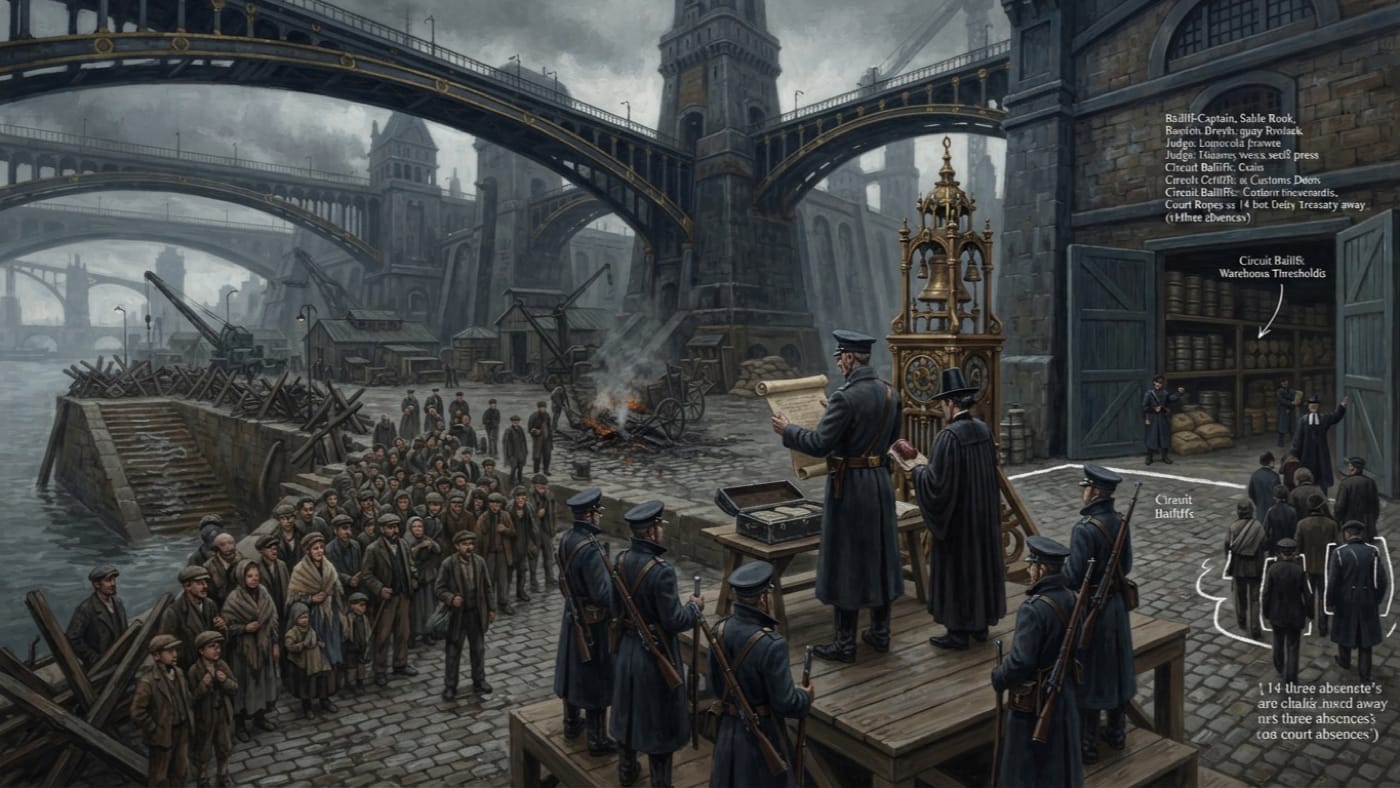
Brest is the lock on the Bug, a river port and bridge-fortress where the northern sector of the Sagittal Line runs flattest and sees trouble coming furthest. Brass-ribbed iron trusses carry the crossing, and every rib is a casemate. Below them lie mud, timber yards, ration cranes and customs sheds. The rebel treasury sat in three bonded warehouses beneath the riverward viaduct. The recorded grievances are hunger, disputed ledgers and dock gangs who had gone unpaid. The file names no famine year, no movement and no foreign purse, and I will not hire one to fill the space.
By the time Rook arrived, the crowd held the quay. Dock gangs had barricaded the salt stairs. Two clerks of the Bureau of Records had been stripped and smeared with lampblack, and a tithe cart was burning at the eastern lock. The garrison was present. The parent file says formally present, and I will be just as careful. The papers record no order given by any officer and none refused. They record only soldiers whose attendance could be entered in a register without anyone having to say what they did.
Rook came with a Judge, six Circuit Bailiffs, twelve Court Ropes, a seal chest and one hymn-chime. He brought no reinforcements. He took the high ground, chalked the court's perimeter across the warehouse threshold, and set the chime where it would carry the length of the quay. The academy treasures one acoustic detail above the rest: the sound struck the quay wall and came back, so that one bell seemed to answer itself. That took masonry, a good angle and a man who listened before he rang. Cadets may call it miraculous. It was competent, which is rarer.
Then Rook announced what the court would try: ownership of the bonded warehouses. Master Havel Tor, treasurer of the Rope-Guild's rebellion, was brought forward by his own men. The crowd had gathered for a hanging and found itself attending a property hearing. Men will die for a cause with remarkable cheer. Very few will interrupt a reading of title.
The hearing ran to the four marks fixed by Judicial Circular 4.12, an instrument of the Hymn-Length Reforms of A.S. 141. Opening: Rook read the seizure writ while the Judge held the seal above the ledger chest. Testimony: two dock accountants identified the treasury as unlawfully sheltered from levy. Rebuttal: Tor spoke of hunger, of arrears and of the widows of the eastern cranes, and the third mark ended his time before he had finished with the widows. Ruling: seizure for arrears, conspiracy and obstruction of licensed movement.
At the final chime the warehouses passed to the Synod.
#On the Treasury Made Public
A lesser bailiff would have cleared the quay first and opened the doors in private, where a seizure is a clerk's chore. Rook opened them under seal while the crowd was still standing there. The academy is right to admire this. I admire it too, with the reluctance of a man who prefers his own cleverness to anyone else's.
The clerks counted aloud: coin kegs, promissory sacks, grain warrants, private tallies, militia-pay ledgers, and three foreign bills, which the file does not explain and I will not imagine. Last came the strongbox holding the Rope-Guild's strike fund. Every item got a seizure tag, and every tag got a witness mark. The file records no totals. That is the only modest thing about the whole proceeding.
The uprising left in a clear order. When the strongbox was carried out, stevedores began slipping away down the western alley. When the grain warrants were read, the crane gangs lowered their hooks. Then Tor's deputy signed the acknowledgment under guard. With that signature the rebellion gained a creditor and stopped being a rebellion. It became a debt proceeding, and debts are prosecuted at a desk. Nobody storms a desk.
The papers make the mechanism plain, and it needs no saint. A movement that pays its men from a common chest cannot survive hearing that chest itemised in a stranger's voice. Nor can it dispute an inventory its own deputy has witnessed. Rook needed wax, ink, a chalk line and a bell. As far as the record shows, nobody ever asked the garrison's rifles to do anything at all.
#On the Cost Entered Elsewhere
The academy formerly described the Brest action as "bloodless suppression."
Corrected: three men died at the salt stairs before the court convened. One clerk died two days after the hearing. Twenty-seven families lost ration credit under collective surety.
The correction is short because the file is short. It does not say who killed the three men at the salt stairs, or how they died. It does not say whether the clerk who died two days later was one of the two smeared with lampblack on the quay, and I will not make him one for the sake of a neater paragraph. It does not follow the twenty-seven families beyond the loss of their ration credit. The papers record the penalty and stop.
These dead and these hungry belong to the seizure. The three people who come next belong to the chain. The academy has good reason to blur the two, since it would rather forget both.
#On the Following Chain
After Brest, fourteen names entered Rook's chain for transfer from the port circuit to a road court north of Warsaw. It was a mixed list: treasury witnesses, go-betweens for the Rope-Guild, two boys suspected of carrying messages, a widow who had signed a warehouse tally in her husband's name, and several people whose occupations were written so carefully that nobody can read them. None of these descriptions is attached to the three who went missing. Readers who want to guess may do so in their own ink.
The chain marks are clean at departure, clean at the first halt and clean at the second. At the third halt, entries 4, 9 and 12 gain brackets, in an ink that does not match the rest of the column. At discharge, eleven bodies answer.
CUSTODY LOG FRAGMENT — ROOK CIRCUIT, POST-BREST Entered: fourteen. Discharged: eleven. Bracketed at third halt: entries 4, 9, 12. Notation: "Transferred by necessity under seal." Receiving seal: ███████████████ Witness: none surviving in docket. Audit recommendation: exclude from academy circulation.
The notation claims three things: a transfer, a necessity and a seal. The seal is the one thing a reader would need, and it is the one thing that has been blacked out. "None surviving in docket" means exactly what it says: the docket no longer lists any witness to the transfer. It does not mean the witnesses died. Only a careless man or a lecturer would read it that way. The record does not say who received the three, where they were taken, whether they lived, or what Rook intended when he let the brackets be drawn. I have looked. The paper stops where the ink changes.
The Roving Judge's Bailiff corps teaches that a chain is a ledger with feet. This ledger walked on, and three of its lines did not.
#On the Diagram Still Circulated
The academy teaches the seizure in the second term, after the chalk drills and before instruction in seal theft. Cadets receive the diagram, which marks the quay, the salt stair, the warehouse threshold, the chime point, the Judge's platform, the escape alley and the seizure route. It has no scale and needs none. It is an argument drawn in ink, showing them where to stand and when to ring. The figures from the next circuit appear nowhere on it.
An academy handout of A.S. 193 stated that Rook's chain remained "unblemished through all known circuits."
Corrected: the post-Brest chain entered fourteen and discharged eleven. The handout was accurate only about the circuits cadets were allowed to know.
The handout shows that the lesson was in circulation by A.S. 193. It says nothing about when the tithe cart burned at Brest, how old Rook was then, or when the academy began teaching the case. I record that year as the date of a piece of paper and nothing more.
Approving the diagram is a judgment on timing. It certifies that the chalk was well laid, the chime well placed, and that four marks did the work of a company of rifles. It certifies nothing about the chain. The academy holds two documents of different kinds. It circulates the one that flatters and files away the one that counts. Its official register keeps Rook where it has always kept him: retired from active circuit, honour maintained.