
#On the Academy's Office
The Bailiff Academy exists to make a man with a rifle into a portable court. That is its whole office, and the whole is considerable. A Judge on circuit brings a seal, a docket and the authority of the Church. He does not bring a perimeter, a witness pen, a custody chain, a receipt book or a way out of the square. The Roving Judge's Bailiff brings those things, and the academy teaches him to bring them in the right order.
Of its founding I shall say nothing. The record before me holds no year, no charter and no first master of instruction, and I decline to gild an empty frame. What the record does hold is practice: instruction halls, terms, drills, a diagram, a handout and a portrait. A school is known by its tools, as a thief is known by his.
The academy teaches two things. The first is competence: where to chalk, when to ring, and how to lock a seal chest so that it stays locked in a wagon rut at midnight. The second is exemplarity. This decides which bailiffs the cadet shall admire and which of their circuits he shall be permitted to know. Competence is taught openly. Exemplarity is taught by selection, which the academy regards as instruction and the Bureau of Records regards as a filing decision.
#On Formation
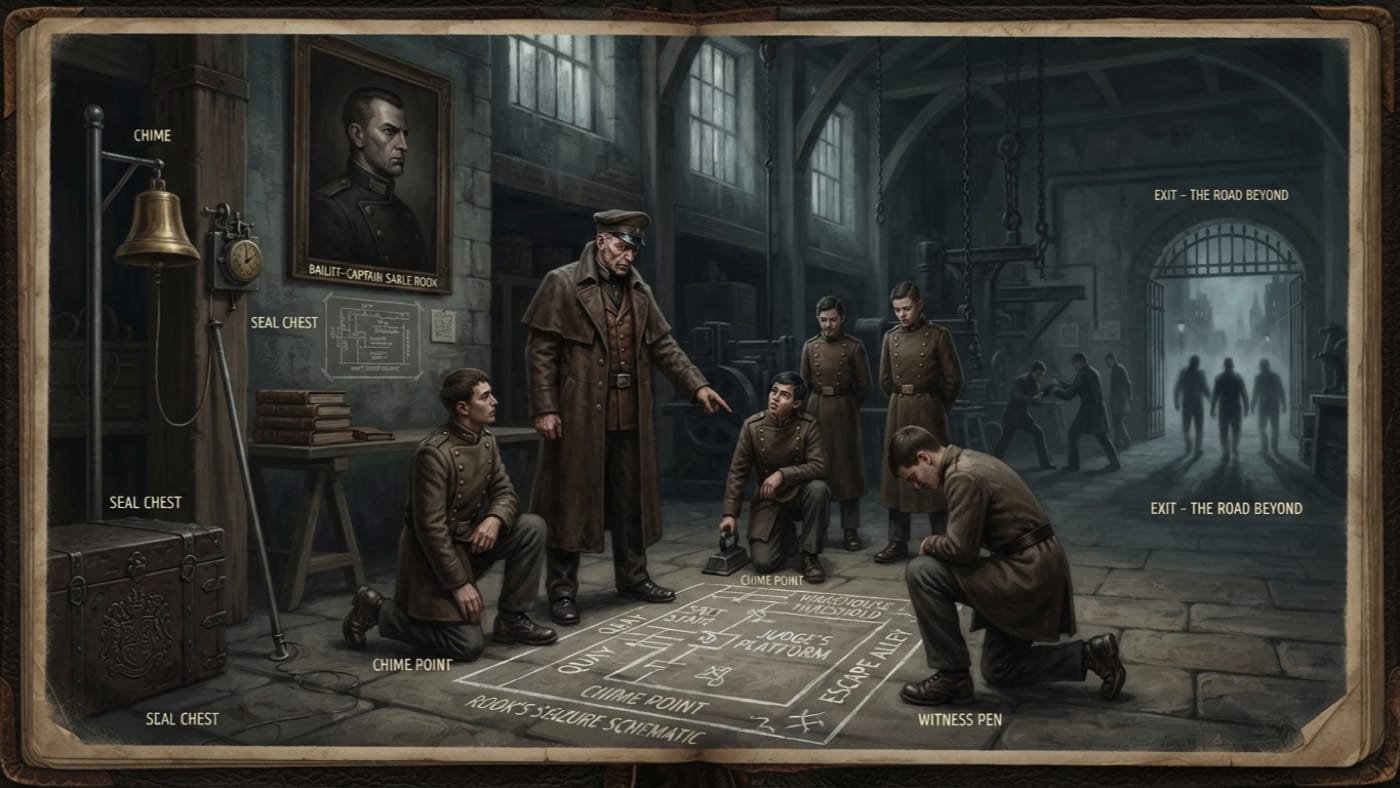
Instruction begins with chalk. The cadet kneels on stone or plank and draws the court: perimeter, witness pen, the Judge's platform, the lane for the accused and the gap through which the Judge will leave if the square decides it prefers him dead. He draws it while someone objects. The profession records a recruit chalking a line while a veteran shouts and a crowd heckles. Whether every hall stages the scene identically I do not know, and I will not invent it. Its purpose needs no invention. The street will later respect a line that was kept straight under insult, or at least it will remember that line.
Next comes the order of the working day, which the cadet learns as liturgy. Control sightlines and exits before the docket opens. Secure the witnesses first and take testimony second. Guard the seal as though the Creator had lent it in person and would count the wax on its return. Never break the chain for a quick word. Post receipts in public, because a crowd deprived of a list will compose its own, and the crowd's list always includes the Judge.
Then the chime. Judicial Circular 4.12, issued under the Hymn-Length Reforms, confines a circuit trial to one standard creed-hymn in four marks. Each ring closes a window. The cadet learns what a stall sounds like: the sudden faint, the scripture recited past the mark, the new witness who appears exactly when rebuttal is failing. He learns the profession's horror story of a mark rung twice. The crowd believed the trial had restarted, demanded a second ruling and left a dead Judge on the stones.
Custody is taught last and longest: iron cuffs, rope, the spare chain link and the log that records every name at every halt. The corps says "Chain is truth." Cadets repeat it with the fervour of boys who have heard what the audit does to men who forgot it.
Assessment follows the columns by which the working corps is measured: setup speed, custody integrity, incident count, seal security, completion within the hymn and receipt accuracy. A cadet may show no courage in any of the six and still pass. He may be heroic in all of them and fail on receipts.
He will enter at the bottom, as Court Rope, Docket Runner or Wagon Guard. Above those stand the Circuit Bailiff and the Trial Marshal, and above them the Bailiff-Captain and the Circuit Enforcer. These are stations, not rungs of a compulsory ladder, and men reach them by different roads. Certain aptitudes separate early. The steady hand drifts toward the Seal Custodians. The man who can empty a square by timing and posture draws the eye of the Riot-Quiet Specialists. The man who hears something wrong in a crowd's silence may end, if he survives the hearing of it, among the Demon-Route Screeners. The Church paid dearly for that craft during the Demon-Route Years. I leave it to the academy to say whether it teaches these callings as courses or merely notices them.
#On Rook's Diagram
In the second term, after the chalk perimeter drills and before the instruction the cadets call seal-theft nightmares, comes Bailiff-Captain Sable Rook.
He arrives as a portrait and a diagram. The portrait hangs in three instruction halls and in a port-circuit annex at Bastion-Brest, where junior Docket Runners study it. The diagram is the better likeness: quay, salt stair, warehouse threshold, chime point, Judge's platform, escape alley and seizure route. Seven marks in chalk.
The cadets recite the timings, and they are taught how Rook turned the crowd's question aside. The dock gangs came to the quay expecting executions. He gave them a property hearing on the ownership of the bonded warehouses and rang it through four marks. At the final chime the warehouses belonged to the Synod. Then he had the doors opened under seal while the crowd watched, and he made the clerks count the treasury aloud. The crowd's attention moved from rage to ownership, from ownership to loss, and from loss to the western alley. The full uprising belongs to his dossier. The academy wants only the mechanism, and the mechanism is superb.
From the diagram the cadet takes geometry and nerve. The chime point was placed so that the sound struck the quay wall and came back. The platform stood high. The escape alley was kept open for the Judge, and also, though the lecture says less of this, for the crowd, because a mob with an exit disperses and a mob without one becomes a siege. The seizure route was drawn so that the treasury passed in full view before it passed into custody.
The academy once called the action bloodless. Three men died at the salt stairs before the hearing, one clerk died two days later, and twenty-seven families lost ration credit under collective surety. The salt stair remains on the diagram. The dead do not.
The lesson carries a maxim attributed to Rook: The crowd hears courage. The prisoner hears chain. The Judge hears silence. Give each what will keep the court alive. The Bureau of Doctrine has not troubled to establish whether he spoke it, wrote it or merely failed to object when it was engraved.
#On the Uncirculated Chain
Custody integrity is the second column of assessment and the first thing an auditor checks. The academy teaches that losing a prisoner off the chain is the one error a bailiff cannot survive. It teaches this before Rook, and it teaches it after Rook. It never teaches it with Rook.
Another circuit followed Brest. In ordinary cadet instruction it appears only as "continuity under pressure," a phrase laid over that circuit the way a clean cloth is laid over a stained table. The post-Brest custody fragment is kept from cadets. Its arithmetic already stands in the published dossier, and I repeat it without ornament. Fourteen names entered the chain and eleven were discharged. Entries 4, 9 and 12 carry bracket marks in a different ink. The receiving seal is concealed. No witness survives in the docket.
The record does not say who the three were, where they went, whether they lived or whose seal received them. I will not say it for the record.
An academy handout of A.S. 193 stated that Rook's chain remained "unblemished through all known circuits."
Corrected: Rook's circulated chains are unblemished. His restricted post-Brest chain records fourteen names entered and eleven discharged, with three entries bracketed in a different ink. The handout's fault lay in the word known, which the academy used to mean shown.
The handout proves that the academy was issuing Rook to its cadets by A.S. 193 (1903 CE). It proves nothing about the academy's founding, the date of the Brest seizure or Rook's age when he carried it out.
The instructors defend the omission on practical grounds. A model complicated by missing prisoners becomes an argument, an argument becomes hesitation, and hesitation in a square kills Judges. It is a sound defence. It would sound better if the academy's sixth column, receipt accuracy, were not applied so severely to everyone else.
The register lists Rook as retired from active circuit, honour maintained. Rumour offers a winter wagon near Kanzleiburg, a chair in audit instruction or a visit from Records. Rumour may keep all three. The register keeps one.
#On the Road Beyond Instruction
The road issues no diagrams. The cadet who leaves the hall with Rook's seven marks by heart will find squares with no quay wall to throw the chime back. He will find crowds indifferent to receipts because they have nothing left to lose. He will meet auditors who begin with the chain and never reach the heroism, seal chests that mutter in the dark, and routes where the hymn runs long for reasons no circular foresaw.
He will also find the corps' old quarrels waiting for him. Road veterans call the new men procedure zealots. The zealots call the veterans quiet hands. Both call the patron-loyalists something unprintable, and the patron-loyalists pay for the drink. Clean-chain men and quiet-hand men come out of the halls and out of the ditches alike, and the academy invented neither temperament. It decided only which of Rook's circuits each temperament would be shown.
That decision is the academy's finest instrument, and it is sharper than any chalk. One night on a Brest quay is lifted into the second term. The next circuit stays in a drawer with three bracket marks and a concealed seal. The cadet is taught where to stand, when to ring and how to count, and he is trusted never to ask for the one list that would test all three.