
#On the Joint Stewardship
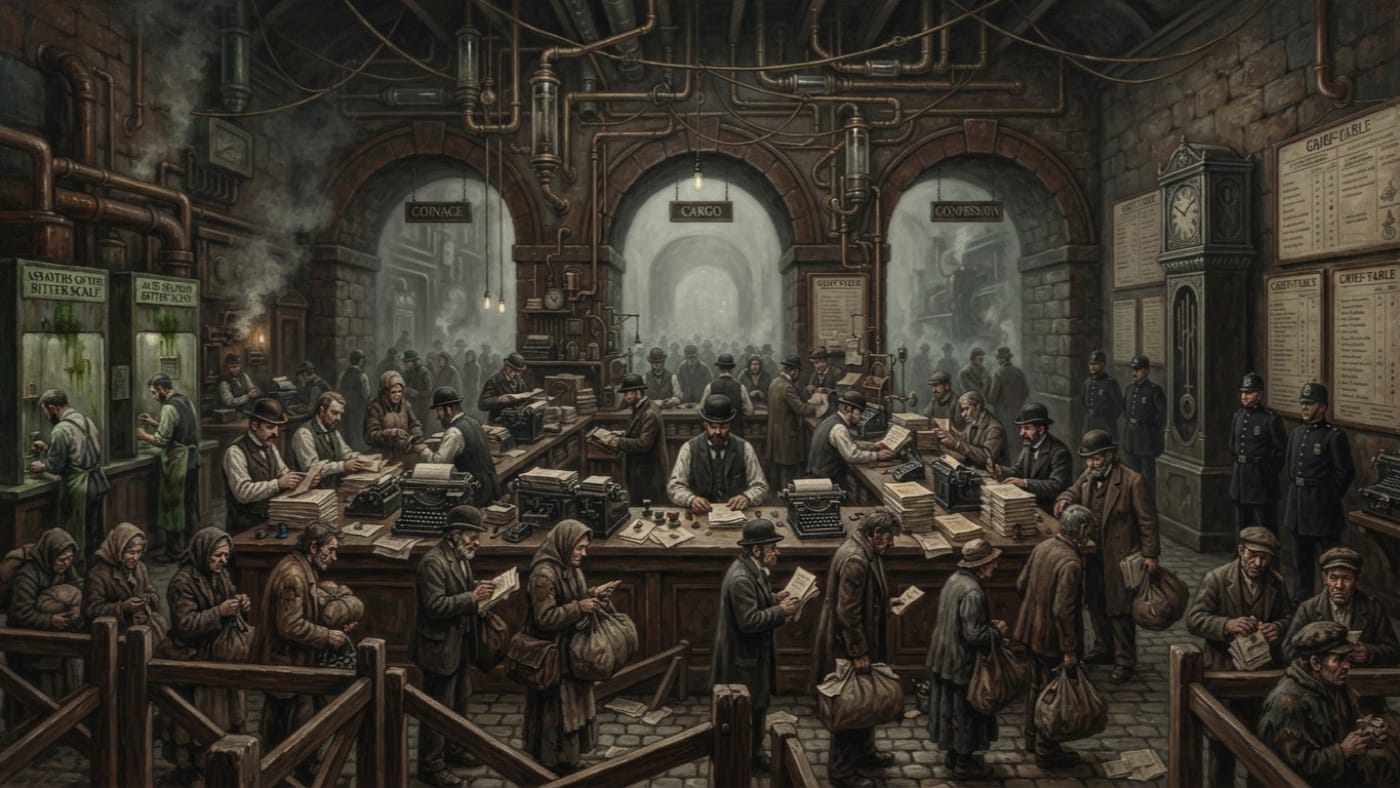
The Broker Compact Council is the licensed toll-broker body of Griefgate. Its formal designation is the Licensed Broker Compact Council. Brokers call it the Compact, and the queue calls it several things the Bureau of Doctrine would not seal. It operates the Widow's Pennies Exchange beneath the three black arches. It holds Griefgate's stewardship jointly with the Synod Gate Chapter under the charter of A.S. 94, which was renewed under Bureau mandate in A.S. 187.
Gate-Canon Meral Voss holds the appointment the charter calls the Joint Stewardship of the Synod Gate Chapter and the Licensed Broker Compact Council. The copies on my desk do not say whether she sits at the Council's table or above it. I have not asked. A man who asks Griefgate how its tables are arranged is soon invited to sit at one.
The Council has four attested powers: lane priority, toll rates, the speed at which paperwork moves, and the regulation of loss categories. At Griefgate the Pilgrim Roads narrow into a chalk cut wide enough for a man to touch both walls, so the town repeats a maxim: whoever controls lane priority controls the town.
#On Priority and the Moving Paper
There are three arches. The left one is Coin, for merchants and supply caravans. The right one is Confession, for pilgrims who want spiritual clearance before going east. The central one is Cargo, for sealed goods, materiel and reliquary transports under escort. Each lane has its own queue and its own toll schedule. The Council sets the schedules. It does not set the arches, which were Roman and are still too stubborn to fall down.
Lane assignment follows initial classification, and classification hardens quickly. A traveler who was put in the wrong lane needs Form 17-C (Amended Purpose). The form must be witnessed by a licensed broker, countersigned by a confession clerk and stamped by the Gate-Canon's office. So the broker is only one of three hands on that form. He is also the first, and nothing reaches the second or third until he has touched it. A broker cannot clear a lane change alone. He can make the traveler wait for one.
The Compact's real power lies in that waiting. Paper at Griefgate does not move at one speed. Lane tickets, toll clearance writs, broker chits and queue position tags all pass across the Exchange desks at a pace the Council regulates and the brokers interpret. Lane upgrades are for sale, and so are expedited stamps. A slower stamp needs no purchaser. It happens by itself, as a matter of administrative weather, and in the pilgrim season the queue reaches a mile back from the arches. The Exchange gets its revenue from moving the paper. The broker gets his from the travelers who will pay to have it moved sooner.
#On Loss Admitted to Account
The common account says Griefgate charges pilgrims for their grief. The two surviving accounts of the Exchange describe two different operations. Neither one cancels the other, and anyone who merges them into a single sum has done arithmetic the Council has never published.
The first operation is assessment. Every traveler declares their spiritual burden under confession protocol. Each category of burden has an assessed value in the grief-tables posted on the hall walls, and the assessed value becomes a toll. The toll is paid for a stamped indulgence slip, which the queue calls "portable clean." A traveler who cannot pay, or who is later found to have hidden a burden, stops being a pilgrim and becomes a detainee. That operation produces a charge.
The second operation is recognition. In the Widow's Pennies account, properly certified loss is accepted as tender. A widow with a witnessed death can get passage faster than a man with doubtful coin. A mother whose son died at the Line can get lodging credit. A veteran missing three fingers can offset cartage. These are recognized claims, used under certification, and they do not cover everyone. No source says that every declaration earns relief, or that a pilgrim's assessed burden and their recognized credit are subtracted from each other on the same page.
The Council's own work is to regulate the categories that make a loss admissible:
- A husband confirmed dead with a body carries standard grief weight.
- A husband dead without a body is reduced, pending material verification.
- A husband missing beyond receipt range is provisional and renewable.
- A child dead before baptism is contested and referred to Doctrine.
- A child dead after baptism is admissible with a parish seal.
- A parent who died under heresy suspicion is discountable, subject to a Purity surcharge.
- Brothers, cousins, apprentices, debtors, servants and mules are negotiable.
These words are standard, reduced, provisional, contested, admissible and negotiable. They are not prices. They decide which papers a loss requires, which office must receive it and how long it must wait. The Council classifies sorrow, and classification decides how quickly that sorrow can be put to use.
The third instrument is the indulgence slip once it leaves the desk. A slip is proof of clearance, and by about A.S. 199 it had also become a currency. Slips are traded, hoarded and forged. The Culvert Market sells clean ones to dirty travelers. A traded slip, an accepted loss claim and an assessed burden are related instruments, and the Exchange treats them as three things.
#On the Other Hands at the Scale
The Council's brokerage stops wherever another office's refusal begins.
The Assayers of the Bitter Scale verify coin. They do it in public, at acid-stained booths along the left bluff, where they weigh, bite and reagent-test each coin until their fingers stain green. Master Assayer Tinn Halve keeps the power that matters most there: a declaration of taint freezes every transaction until the coin supply has been re-assayed. A broker may set a toll. He cannot certify the coin that pays it.
Arbiter-Widow Solenne, called Blue Veil, rules the grief-tax courts, where disputes over assessed burden are heard. No record gives the Council a power to overturn her rulings. The Council has its own Broker Courts for arbitration. Pilgrims call their purchased outcomes "soft verdicts," and they come under the Council's influence. That is a different bench from Solenne's, with a different kind of incense.
Gate-Canon Voss and the Gate Chapter control doubt inspections and the machinery of detention. Lane upgrades are sold every day at Griefgate. Doubt clearance is never sold once a traveler has been flagged. The Queue Marshals, called the Rope Saints, guard the blessed rope. The surviving record never makes them the Council's guard, though brokers profit from every whistle the marshals blow.
#On Clearing and Detention
The Compact wants looser clearing. Looser clearing means more travelers through the arches each day, and more travelers means more tolls. The Synod wants tighter inspection, because inspection fills the Holding Pens, and the Pens supply labor quotas for the eastern construction programs. Voss sits between these demands. She tightens enough to create delay and loosens enough to prevent a riot. Whatever revenue lives in the gap between those two settings, no ledger I have seen divides it.
A careless reader will say the Compact cannot want both a faster gate and a profitable delay. The careless reader has never owned a toll booth. Each broker sells delay at retail, one expedited stamp at a time, to a traveler who can see the arch from where he stands. Detentions, from the Compact's side, are a wholesale loss: a traveler in the Pens pays nothing at the brokers' desks, and a queue clogged with doubt flags slows every desk at once. So the brokers want a delay they can sell, and they want to be spared the delay the Synod imposes. The record shows no settlement between the two demands, no quota bargain and no agreed share. It shows a quarrel that has lasted long enough to be furnished.
The Synod has a lever, and both sides know it. A broker's licence can be revoked, and revocation can end in servitude. A licensed broker sits below the canonry and above the assayers in Griefgate's order, which is not high enough to bargain from safety.
The forgery of slips makes the quarrel worse. Blank slips of the correct weight and weave now pass through the culverts. The Gate Chapter knows, and the Compact knows. A Bureau of Purity investigative cell arrived in A.S. 200 and recommended further observation.
Some deeper allegations reach me only as culvert whispers: that the Exchange manufactures guilt, seeds false confessions into the ledgers and assesses losses that its own agents invented. The whispers name no broker and no order of the Council. I file them as whispers. No one has told me to stop filing.
The Compact describes its function as fair toll brokerage.
Corrected for internal survey. The Compact holds lane priority, sets toll rates, regulates loss categories and governs how fast paper moves. Lane upgrades and expedited stamps are sold under that jurisdiction, and delay profits the brokers who sell relief from it. The word "fair" stays on the public notices, where it costs nothing to keep.
#On the Present Application
In A.S. 201 the joint charter stands, the Exchange is open and the grief-tables are still on the walls. About forty-one thousand assessed travelers passed under the arches in A.S. 200. That number measures the Exchange's traffic. It does not count the Council, its income or the coins that changed hands before a broker's stamp came down.
The Bureau of Tithes receives the receipts. The Bureaucratic Synod receives the labor. The Bureau of Records holds that a sealed slip stays valid however many hands it has passed through, and the Bureau of Purity has asked Records to mind its own stamps. The Council receives the waiting and charges for its end.
The Gate Chapter calls guilt a weight that must be measured. The Compact keeps a quieter rule at its desks: a weight that has been measured can be made to wait.
Mora vendita, transitus emptus.