
#On the Evening Collection
"Pay clean. Pass clean." — Inscribed above the central arch at Griefgate. The arch closes at dusk. The inscription gives no hours.
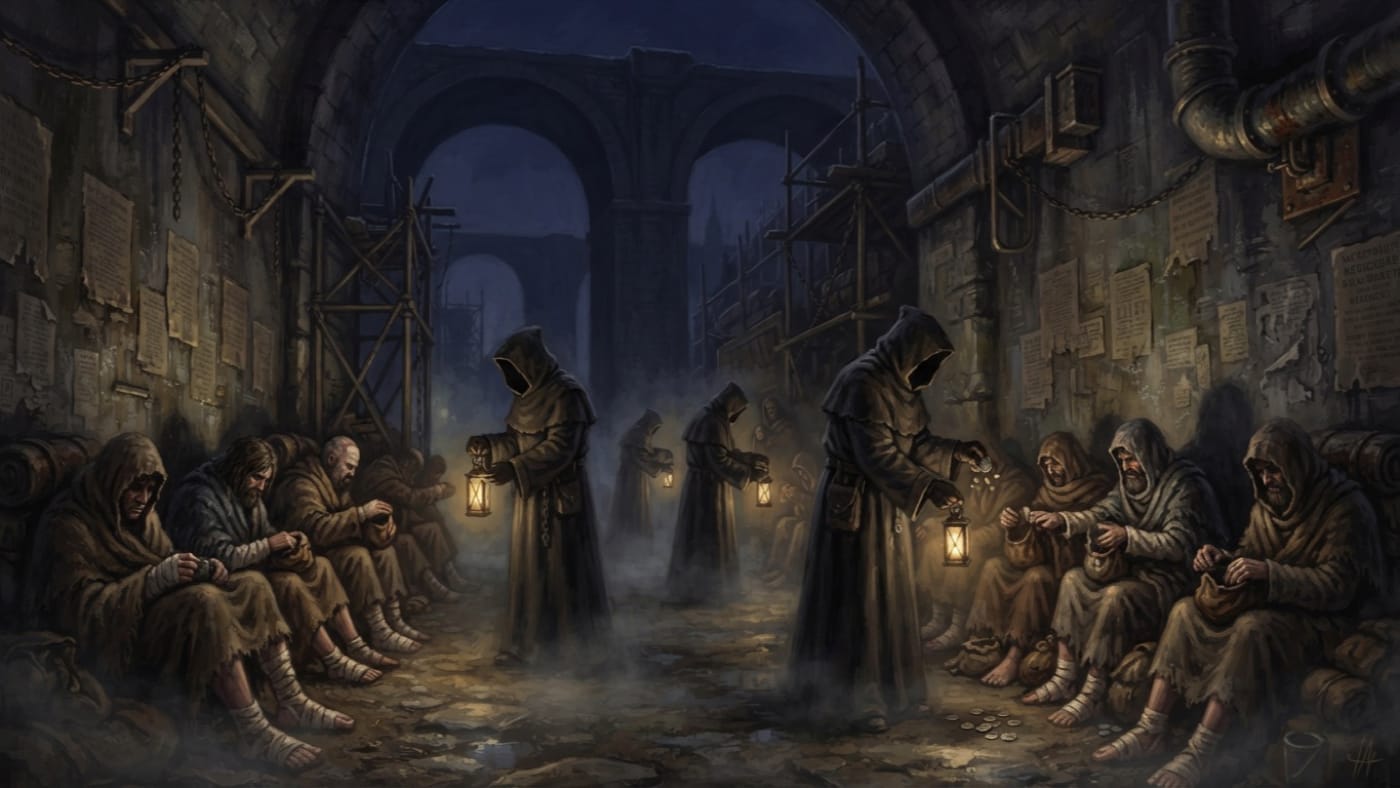
At dusk the three arches of Griefgate shut. Anyone who has not reached one by then spends the night where the line left them, and then the lanterns come down. The Widow's Pennies Exchange keeps a woodcut of what follows. Robed figures carry brass lanterns through the queue, pilgrims sit against the chalk walls with their knees drawn up, and coin passes from the people sitting to the people standing. The caption names the place as Grief Lane and the figures as Penny Collectors. It says they work the queue after the arches close, servicing those who could not reach an arch by dusk.
That caption is the whole documentary record. I have read it more often than any other sentence filed from Griefgate, because it is short and because every word in it does less than it appears to.
"Robed" gives a garment and withholds an order. "Brass lanterns" gives the light, and the light is ordinary. "Collectors" gives a verb. The caption names no employer, rank, number or wage. It gives no sex for the collectors and sets no condition on the payers: a widow may pay, and so may a tin-saint merchant with a sore heel. "Penny" is a name, and names at Griefgate are older than the coin they describe. The Exchange takes pennies, oath-notes and labour contracts, and I find no record that a collector has ever refused an honest coin of any other name.
#On the Queue They Work
Griefgate produces delay. The Pilgrim Roads narrow there into a single chalk defile, and the defile ends in three black-stone arches: Coin on the left, Confession on the right, Cargo through the centre. In the present season the wait at the arches runs to three days at its worst. That figure covers the whole gate. It measures how long the gate makes people wait and says nothing of how many of them sit in the dark with coin to give.
A three-day wait contains at least two nights. Every closing of the arches leaves a remainder. Some of it walked down from the Choir-Broker Hall of Peregrine Row, one to two days west by mule-road. Those travelers arrived singing and now sit on wet stone with the song gone out of them. By day the Queue Marshals, whom the pilgrims call Rope Saints, keep the lines with blessed rope and whistles. The rope stays where it was strung, and cutting it is sacrilege at any hour.
Grief Lane is a drainage culvert at the edge of the cut. The visibly mournful are held there until they are quiet enough to be processed without spoiling the seals. The woodcut puts the evening collection there, among travelers who missed the arches. No record I hold says whether the stranded and the mourning are the same people at night, whether they share the same stretch of masonry, or how either gets back into the line at dawn. The collectors seem to know. They bring lanterns.
#On Coin and Clearance
By day the transaction at Griefgate is exact. A traveler kneels in the Kneel-Sheds and declares the nature and degree of their spiritual burden. The confession clerks check the story against the traveler's papers, companions and destination, and against every earlier confession filed on the road. The burden is priced against the posted tables of the grief-tax. The traveler pays, and the payment produces an indulgence slip: heavy paper with the Gate Chapter's seal in red wax and the clerk's mark in black. The slip clears its holder through the arch, and since approximately A.S. 199 it has also changed hands as money. The coin paid for it first crosses the counters of the Assayers of the Bitter Scale, who weigh it, bite it and stain their fingers green testing it in public. A crowd that is watching its coin being tested is too busy to riot.
Every step of that procedure leaves paper. Confession leaves an entry, assessment leaves a figure and payment leaves wax. The Synod does not ask its subjects to trust a transaction; it asks them to carry one.
The evening collection, as recorded, leaves a hand-to-hand exchange in lantern light and nothing else in the file. The caption says "servicing" without naming the service. I have found no tariff, no schedule of amounts, no receipt, no seal and no ledger heading under which the coin is entered. Nothing states what a payer holds afterwards that they did not hold before. Nor have I found anything to show that they hold nothing. The record never says the coin buys a place, a slip, a prayer or a kindness, and it never says it buys none of them.
The collectors take the night toll, and the pilgrims pay it.
The collectors take the night toll, and the pilgrims pay it.
"Toll" is withdrawn. At Griefgate a toll is a figure assessed against a declared burden and paid at a counter for a stamp. No assessment, counter or stamp is recorded for the evening collection. The coin was handed over, but the file does not say what it was handed over as. The surveyor who supplied the word had spent too long among the arches and assumed that every payment made beneath them was owed.
#On the Offices Around Them
Griefgate is crowded with people whose powers are written down. Gate-Canon Meral Voss holds the joint stewardship of the Synod Gate Chapter and the licensed Broker Compact, and her doubt inspections decide who is believed. The Broker Compact Council controls lane priority and the speed of paperwork, which at Griefgate is the speed of everything. The Assayers control coin truth and can freeze all commerce by declaring a taint. Arbiter-Widow Solenne, called Blue Veil, hears disputed grief-tax assessments. The Rope Saints hold the line, and the confession clerks hold the screen.
Each of those offices appears on a charter, a schedule or a posted catechism. The Penny Collectors appear in a caption. I have looked for them under the Gate Chapter and under the Compact, in the assayers' licences and in the marshals' rolls, and they are listed in none of them. No order dismisses them either. The record puts them in the queue and leaves them there.
A comparison with the Tithe Assessor is tempting, and it should be resisted. The assessor works under licence for the Bureau of Tithes and comes with scales, an escort and a receipt-book, so a pilgrim who pays one can at least name the office that robbed them. Nothing of the assessor's carries over into the collectors' record.
#On the Conditions of Collection
Conditions favour whoever comes down with a lantern. A traveler held overnight at Griefgate is cold and wet through the wool, short of food and unsure of the morning. Papers that were dry at noon have gone soft at the folds. The wax on a slip already bought is now the most valuable thing the traveler owns, and it sits in a pocket against sweating masonry. Behind the eastern bluff lie the Holding Pens, where detention runs up a debt by the day, and every pilgrim on the road has heard of them. Beneath the arches the Culvert Market sells forged slips and the Culvert Choir sells passage. The evening collection is none of these, and no source makes the collectors members of any of them. They are neighbours, though, and a pilgrim sitting in the dark has heard of every one of them.
Then there is the stone. The Bureau of Bells confirmed the grief resonance of the arches in A.S. 143 and reclassified it in A.S. 187 as Category Two Ambient. Where enough sorrow gathers, wax smears, coins tarnish at a touch, bells ring damp, and people lose names halfway through saying them. Grief Lane exists because of it. No record says how the resonance treats a lantern, a robe or a handful of coin carried out of the culvert at night, and I will not credit the stone with opinions it has never filed.
#On the Present Account
Griefgate in A.S. 201 runs past capacity. Refugee traffic, mandated penitential travel and the commerce of a Church at war keep the queue long and the nights full. The evening collection goes on regardless. The arches close, the remainder sits down against the chalk, and robed figures with brass lanterns move along it taking coin.
The Bureaucratic Synod keeps the Great Ledger so that nothing given or owed in its jurisdiction passes without an entry. At first light the arches open on the same queue, less whatever the night took from it, and the Ledger has nothing to add.