
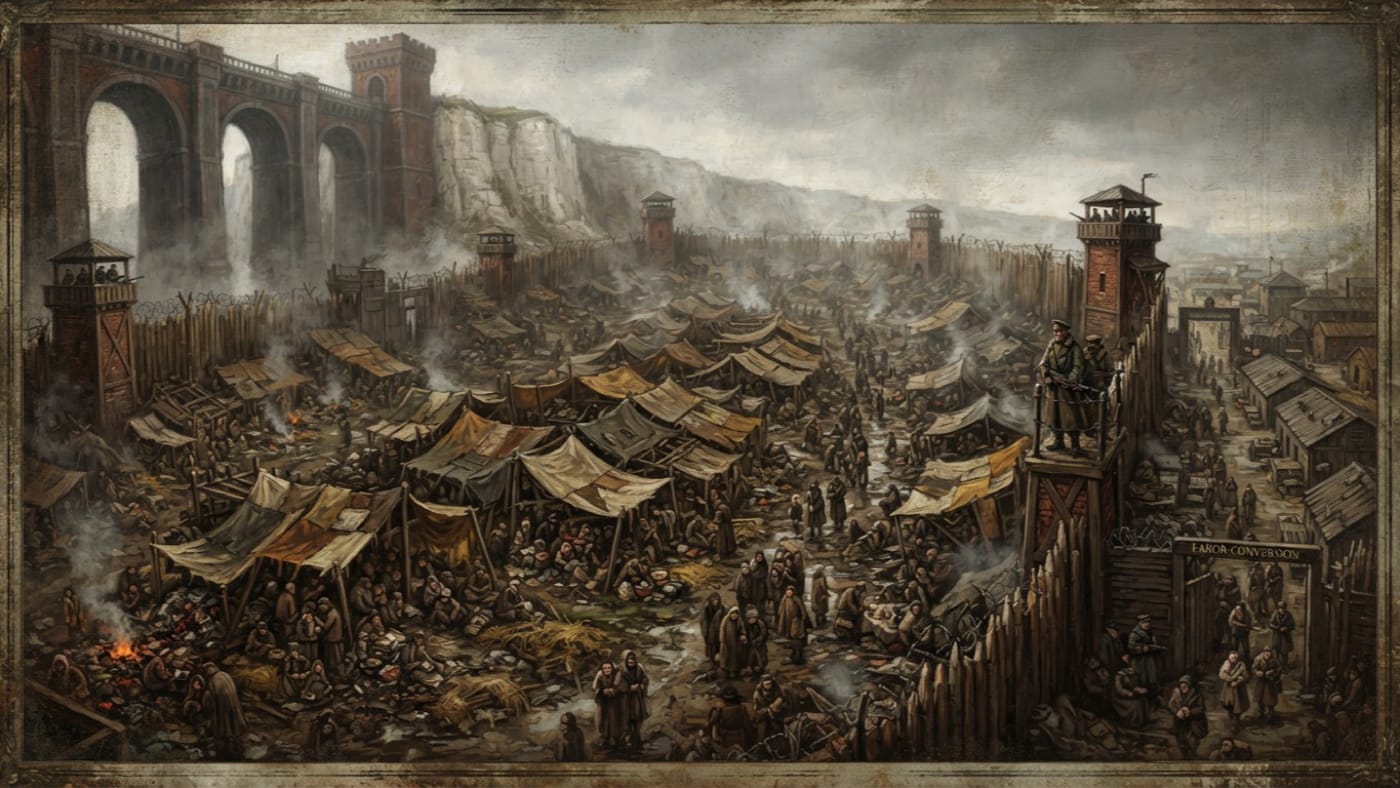
Holding Pens of Griefgate prose follows.
#On the Delay Gardens
"Pay clean. Pass clean." — Inscribed above the central arch at Griefgate. The inscription is silent on what happens to those who do neither.
East of the arches at Griefgate, the chalk bluff falls back into a hollow. It cannot be seen from the queue, the Exchange hall or the provost bridgewalk unless one leans out and looks down, and the officers on the bridgewalk are not paid to lean. In that hollow the Exchange keeps its Holding Pens. Officials call them the Delay Gardens. Someone in the Gate Chapter once thought the name was kind. Possibly someone still does.
The Pens are canvas stretched over a depression in the chalk. The canvas leaks, and the straw underneath has rotted, been replaced and rotted again. Water runs down the chalk and pools wherever the ground sags. The dedicated survey records the smell in two words, piss and wet straw, and I can find nothing to add to them.
The purpose is administrative. Travelers whose papers, stories or purses failed at the arches are kept here until the failure is resolved, converted or forgotten. The rest of Griefgate exists to move people. The Pens exist to stop them, and stopping turns out to pay quite as well as moving.
#On Admission
Nobody reaches the Pens by walking there. Every traveler gets a lane at first classification, and the lane takes them past the Kneel-Sheds on the right bluff. There a confession clerk compares the traveler's declaration against their papers, face, companions, stated destination and whatever earlier confessions the road has already filed. Agreement is called story-fit. Any discrepancy raises a doubt flag.
The flag brings an inspection under the Gate Chapter, whose inquisitorial inspectors answer to Gate-Canon Meral Voss. The parent account records three outcomes: clearance, which is rare; further assessment, which is common; and detention, which is common enough that the Pens keep a permanent staff of fifty. That figure is for staff. It says nothing about how many detainees fifty clerks and guards can hold, which seems to be however many the season delivers.
A flag is one of several roads into the hollow. A traveler who cannot pay an assessed grief-tax goes there. So does a traveler whose concealed burden is detected later. The Queue Marshals, whom pilgrims call the Rope Saints, can reclassify anyone from "queued" to "detained" for cutting a blessed rope or for singing in line. None of these admissions requires that a crime be proved. A detainee may be a liar, a pauper, a mourner whose face looked wrong, or someone who sang.
Admission also leaves a mark. A clerk makes a small cut on the wrist to record the traveler's status. The Gate Chapter insists the cut is for administrative purposes only and must not be confused with branding, since branding would require a different form.
#On Each Day Owed
The Pens run on one rule. Every day a traveler spends in detention becomes a debt, and the clerks enter it as delay debt.
The debt is separate from anything the traveler owed at the arch. That first sum was a grief-tax assessed on declared burden, or a toll the traveler could not meet. The Broker Compact has two different uses for grief at Griefgate. Sometimes it is a charge, an assessed spiritual encumbrance billed against passage. Sometimes it is credit, a certified loss that brokers accept against tolls, lodging or cartage. Indulgence slips trade as a third instrument and pass from hand to hand. No published rule nets these accounts against one another. A widow may hold credit for her husband's death, owe tax on her own unconfessed burden and carry a slip of uncertain wax, all at the same desk on the same morning. The delay debt is added on top of all three.
The parent account says the debt compounds faster than a detainee's remaining funds can cover. No tariff has been published, nor any rate or repayment schedule. I do not know the daily figure. I doubt it is the same figure for every detainee.
Three forms of payment are attested. The first is coin, which the Assayers of the Bitter Scale must test, and one bitter penny makes the rest of a purse suspect. The second is labor. The third is "confession service," a category that appears in the debt mechanics without any definition, and the clerks have never been asked for one.
Once the coin runs out the clerk produces a labor-conversion contract. The Assayers record that the Pens clerks keep the forms ready folded. The contract binds the detainee to work for a term the document calls temporary and never defines. Labor needs no assay, so its quality is never in question.
Disputed assessments go to Arbiter-Widow Solenne, the Blue Veil, whose grief-tax court can turn unpaid assessments into labor debt. Delay debt keeps accruing while an appeal is pending. Her court can therefore produce a contract and is paid by the waiting either way.
The Synod wants detentions to fill labor quotas for its eastern construction programs. No published document says which programs, through which hands or at what price per head. The traveler signs, the folded form is unfolded, and the record I have seen stops there.
#On the Bedding and the Mark
Living conditions in the Pens follow from the materials. Damp straw breeds trench-fever, and dry straw costs money. Dehydration is listed among Griefgate's killers alongside crush and fever, because a hollow full of standing water has little to drink in it. The wrist cuts go septic. The hazards survey lists infection from stamp-cuts as a cause of death without comment.
Detainees sleep where they sit. Families are kept together if they arrived together, and the parent account records one family held for three days while an Assayer decided whether a widow's account of her husband's death carried authentic grief resonance. Three days was the time that one family was held. It is not a rule of the Pens, and nothing published limits detention to three days or any other term.
That resonance is real and badly understood. The Bureau of Bells confirmed the anomaly under the arches in A.S. 143. When sorrow gathers densely enough, wax seals smear, coins tarnish, bells sound flat and people forget names. The Bureau has never calibrated the threshold. A smeared seal may cast doubt on a certification, and doubt sends travelers to the Pens. Nobody has shown that the resonance reaches the hollow, gets into the straw or can tell an honest mourner from a practiced one. The Assayers weigh it all the same.
The detained traveler costs the Exchange nothing to house.
Withdrawn. A canvas roof, rotting straw, a ledger, fifty salaried staff and the wax for each entry all cost money. The Exchange bills every item to the detainee as delay debt. My earlier sentence confused cost with the party who pays it.
The Gate Chapter confirmed two outbreaks of disease in A.S. 200 and suspects a third in early A.S. 201. It attributes them to overcrowding. Crowding comes from the doubt weeks, when rumors of forged slips set off audits and audits fill the Pens. The published returns give no death totals. I am not inclined to invent one, and the Gate Chapter has shown no inclination to count.
#On Clearance and Departure
There are four ways out, and only one of them clears a name.
The first is clearance of the doubt itself, when an inspector or the Arbiter's court finds that the story fits after all. This is rare. The delay debt stands even when the doubt is lifted.
The second is settlement. A detainee whose relatives can pay, or whose credit is accepted, pays off the delay debt. Paying the debt does not lift the flag. The flag is attached to the traveler's name in the Records ledgers, and the next clerk down the road will see it.
The third is the contract. The detainee leaves the hollow to work. The record says the term is temporary.
The fourth is the culverts. The Culvert Choir guides paying travelers through the drains under the arches, and the Culvert Market sells blank slips to anyone who needs them. A traveler can escape the masonry this way and still be flagged. Thirty paces east of the stone, the next clerk opens the Ledger at that name. Walking a Choir route can also put a traveler straight back in the Pens.
Sickness offers a form of release. During the outbreaks the Gate Chapter reclassified sick detainees from "detained" to "medically exempted" and moved them to a roadside ditch, which it calls the recovery annex. No source records care being given there or any record being cleared. The sick are no longer counted among the detained.
#On the Present Condition
In A.S. 201 the Pens have been enlarged twice in two years. Peak-season queues under the arches last three days, refugees fill the pilgrim roads, and each doubt week sends more people into the hollow than the canvas was put up to cover. Each enlargement relieves the crowding for a season and raises the number the hollow can hold, which the labor quotas welcome.
The Broker Compact wants looser clearing because more travelers through the arches means more tolls, and it also sells faster paperwork. Speed bought from a broker does not lift a flag once it is raised. The Synod wants stricter inspection because inspection fills the Pens. Voss tightens enough to cause delay and loosens enough to avoid a riot. The Pens absorb the difference.
The dedicated survey records proposals for blood-wax confession marks and, if outbreaks and riots continue, permanent quarantine. Neither has been carried out. The culvert talk holds that some guilt at Griefgate is manufactured, with confessions written into ledgers in advance to justify future detentions and labor seizures. I record that as an accusation from the culverts. No ledger proving it has surfaced. The Pens fill at the same rate whether the accusation is true or false.