
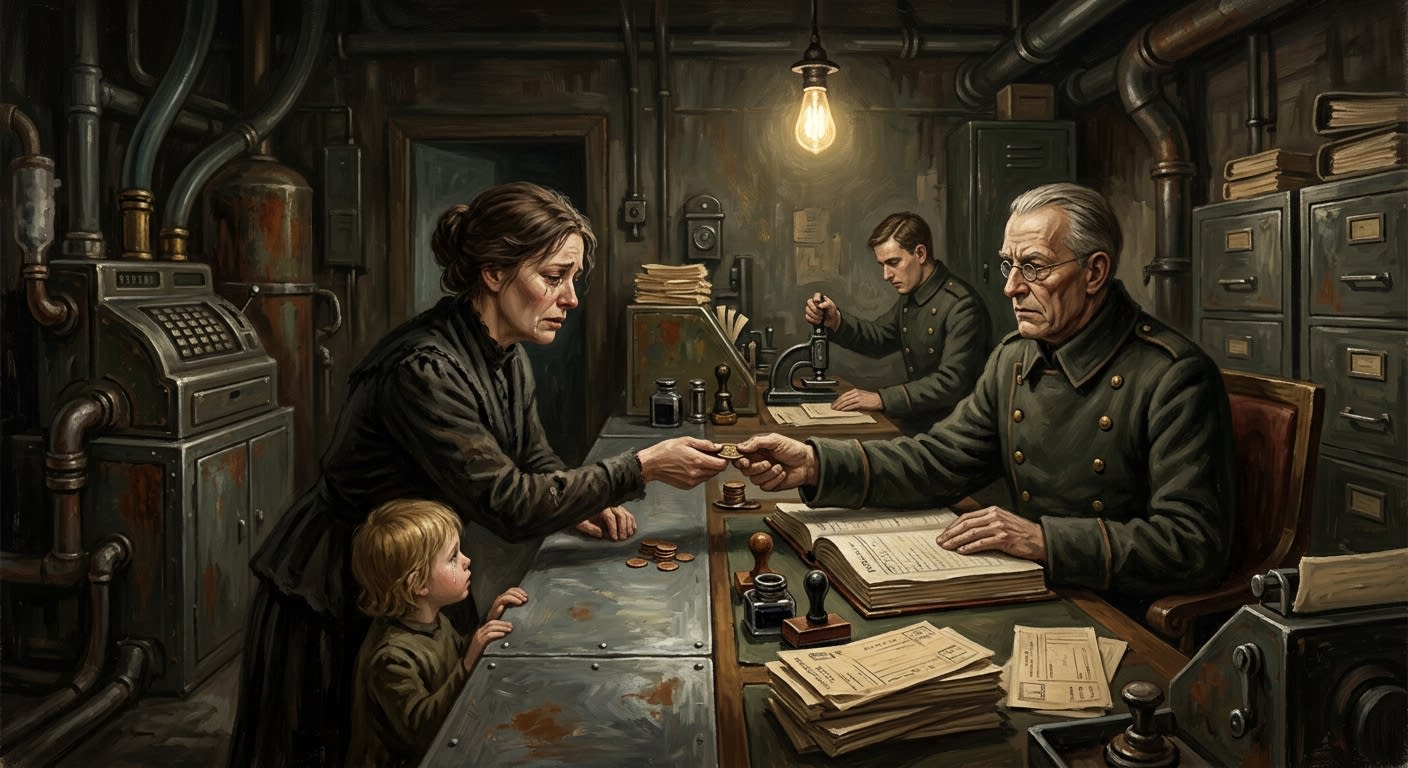
#On the Coin Taken After the Corpse
The Widow's Pennies are the Bureau of Tithes' most elegant small cruelty: a bereavement due assessed upon households where death has removed an income, a defender, a name from the roll, or a man inconveniently attached to a ration category. The due is small by design. A great levy provokes argument. A penny teaches.
Its doctrinal formula is compact enough for route cards and vicious enough for stained glass: shared obligation is shared grace; exemption from obligation is exemption from grace; the graceless are the Enemy's harvest. Every Tithe Assessor learns the phrase before walking a Widow Route. Some still mutter it while climbing the stairs. Some stop muttering after the third winter. The Bureau records both states as training outcomes.
The common account says the Widow's Pennies tax grief. This is sentimental rubbish, though sentiment at least points its little wet nose toward the correct kennel. The Pennies tax household continuity after bereavement. They assert that death does not interrupt obligation, that a funeral is no fiscal intermission, that the Ledger may pause for incense but never for mercy. A widow who pays one coin learns that loss has not excused her from the Wall. A child who sees the coin taken learns the same lesson before doctrine school can ruin it with gentler phrasing.
The coin itself varies. In older northern routes it was blackened copper, struck thin so the poor could not claim weight as excuse. In western famine districts it was often ordinary Crown fraction, over-stamped with a widow's veil. At Griefgate, where language curdled into architecture, the term broadened into grief-tax chits, indulgence slips, toll weights, mourning certificates, and the little damp tokens pilgrims clutch while pretending passage resembles absolution. The Bureau permits this semantic drift because drift, once receipted, becomes reach.
#On the First Famine Precedent
The first recognised Widow's Pennies precedent belongs to the Famine of A.S. 65, when harvest failure met due tithe levies and the young Synodal system discovered that hunger makes theology audible in the streets. Riots ran from Marseille to Hamburg. Grain shipments failed. Salt became harder than sermon. The Bureaucratic Synod, still learning how much flesh a decree could carry, imposed emergency extraction upon bereaved households as relief finance.
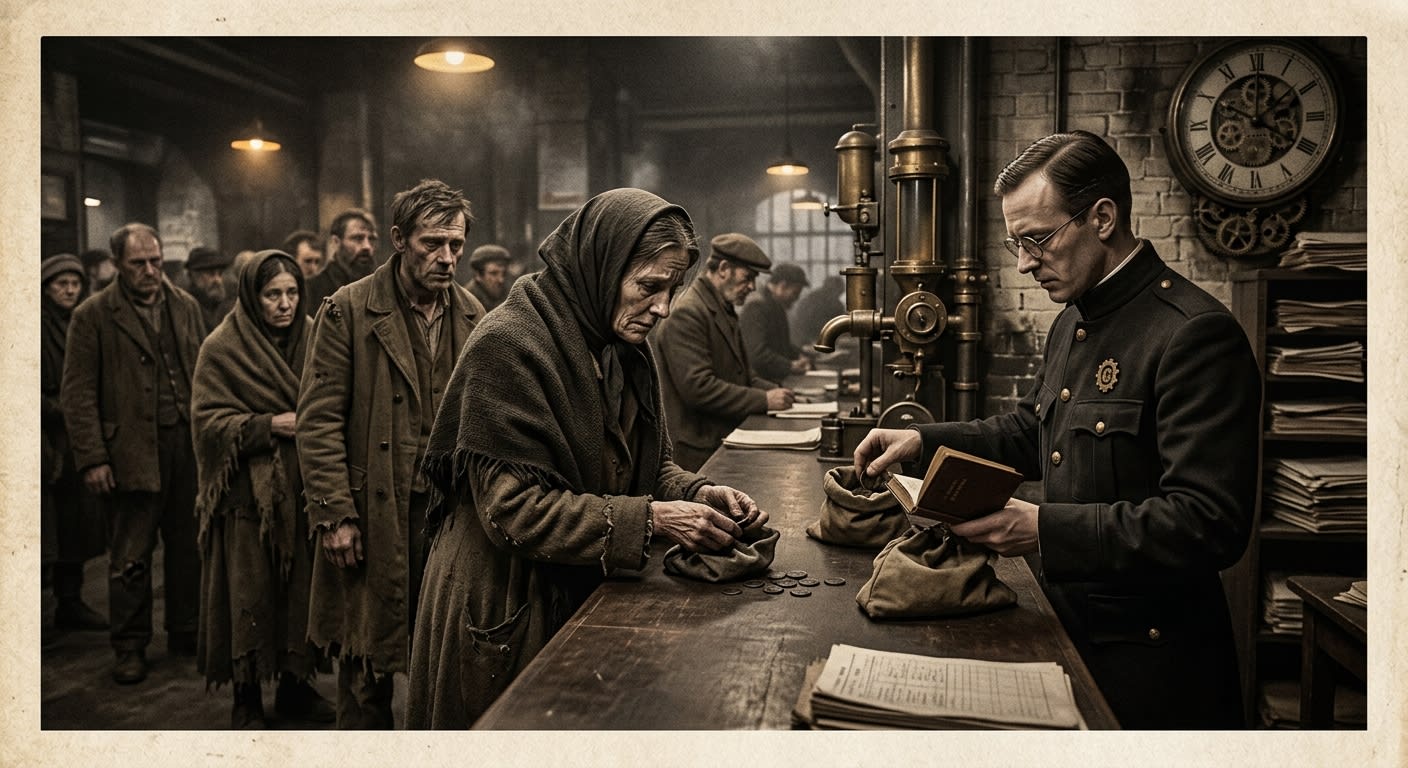
The original logic was rude, quick, and honest in the way a cudgel is honest. War had created widows. Famine had created need. The Synod required grain and coin to move at once. Bereaved households held pensions, parish relief, condolence gifts, remarrying dowries, dead men's stored tools, unclaimed boots, and all the little survivals by which grief keeps itself warm. Tithes saw idle material. Tithes is gifted that way.
Provincial primers once described the A.S. 65 Pennies as voluntary mourning offerings for the relief of famine districts. Voluntary offerings do not require armed escorts, arrears chalk, pension deductions, or the hanging of rioters outside grain offices. The offerings were voluntary in the same sense that a man under a falling stone may voluntarily move downward.
Some districts resisted. Some paid because the Assessors stood in the doorway and the children stood behind the widow. Governor-Praelate Alaricus of Toledo opened the Granaries of Saint Benedict in an act of genuine compassion, which Doctrine immediately claimed as proof that the Bureau's extraction had been morally harmonious from the first. This is how the Synod improves history. It places a kind deed beside a cruel one and invoices the pair as policy.
The early Pennies were later abolished. Abolished is the word used in clean copies. In practice the charge lay dormant, appearing in route books as a precedent, in Assessor training as a remembered instrument, in Tithes memoranda as a tool awaiting a famine large enough to justify touching it again. No profitable sin is ever buried. It is stored.
#On Pity Exemptions and Kaethus Brenn
By A.S. 138, the problem had changed shape. The Synod had spent decades granting pity exemptions to widows under campaign pressure, plague absence, frontier misfiling, and those foggy administrative conditions in which a husband is not dead enough for pension but absent enough for starvation. At first, exemption was narrow. Confirmed soldier's widow. Clean confession. Proper household register. No heresy in the marital line. No arrears except those considered pious by proximity to sacrifice.
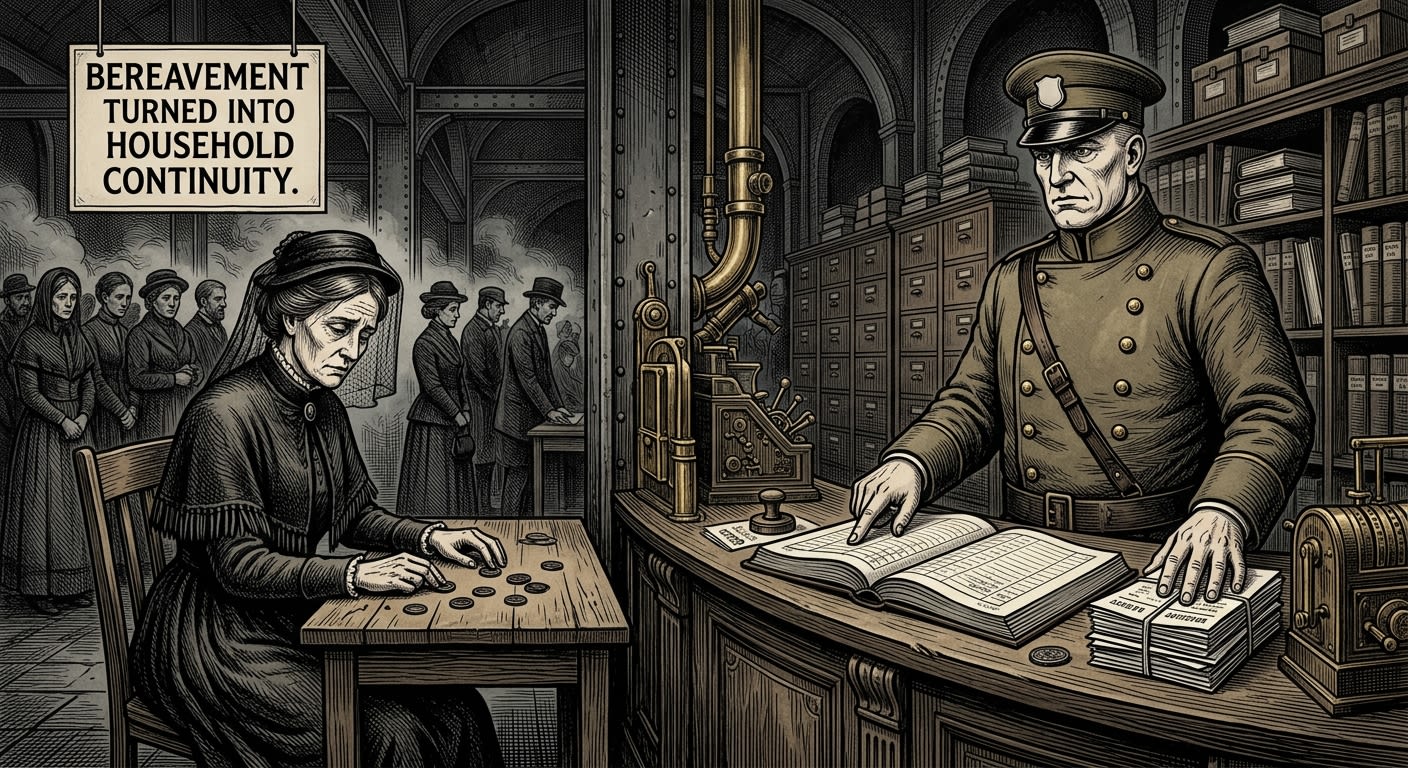
War widened the category because war is a machine that manufactures widows faster than clerks can define them. Missing husbands. Deployed husbands. Imprisoned husbands. Excommunicated husbands. Men recorded as equipment loss because no body returned in a separable form. Men erased by Records and then rediscovered as liabilities. Men who had simply been gone long enough for the parish clerk to stop asking whether hope had an address.
In some northern routes, a quarter of households paid nothing under pity exemption. Assessors complained. Quota Captains lied upward. District ledgers opened holes wide enough to embarrass even Records, which can usually call an absence a sub-file and sleep afterward.
Assessor-General Kaethus Brenn wrote the memorandum that disciplined the embarrassment. His proposal was ugly because it was clever. Sudden full taxation would have produced revolt before the ink dried. Brenn proposed reduced universal bereavement dues: mandatory, small, teachable, humiliating, steady. A coin for every widow. A symbolic reduction for confirmed soldiers' widows. Double rate for widows of heretics. Triple rate for widows of clerks, because clerks possess the records by which disasters may be anticipated, and because Tithes enjoys jokes when other people pay for them.
BRENN MEMORANDUM — PRIVATE DRAFT, A.S. 138 “Where payment cannot be substantial, payment must be instructional. The coin is less important than the act of surrender. A widow who pays one penny learns that bereavement has not removed her from obedience. A child who watches the penny taken learns before doctrine class what the wall costs. ██████████████████████████████████████████████████”
Beside one calculation Brenn wrote, in a cramped marginal hand, “Creator forgive us for the arithmetic.” Doctrine crossed out the first three words and wrote “Creator requires” above them. People have tried to make Brenn a saint from that margin. I admire their appetite for sentimental fraud. Brenn saw the cruelty, named it, regretted it, and sent it forward. Remorse is not refusal. It is perfume on obedience.
#On Directive 91-B and the Widow Riot
Directive 91-B entered the world in A.S. 139 under the title “On the Cessation of Pity Exemptions,” a phrase so bloodless it should have been weighed for anemia. It revoked local discretion, regularised bereavement dues, and made the Widow's Pennies mandatory at reduced rate. Tithes called this equal burden. Doctrine called it shared grace. The Lower District of Bastion-Königsberg called it something less printable and considerably truer.
The Widow Riot lasted three days. Notices went up before Matins. By Prime, women were reading them aloud in stairwells. By Terce, pots rang from lintels. By Sext, every route east of the Ice-Market had stopped producing receipts. Assessors found benches, laundry poles, ash bins, and elderly women with knives blocking the stairs. Escort captains trained for smugglers discovered that a crowd of widows does not advance. It surrounds. It knows your mother.
The second day raised barricades around the Lower District Tithe Office. The rioters chose their target with precision: exemption rolls, arrears indices, widow classifications, route books, seal cupboards, receipt counterfoils, and four centuries of collection records. Hunger breaks windows. Memory chooses archives.
The building burned from within on the second night. Official summaries preserve uncertainty with practiced hands: lamp fall, coal accident, forced archive opening, clerical negligence, widow with oil on her sleeve, boy with blank receipts in his boot. The truth has the shape of fire. Paper died best. For one morning, thousands of households became administratively uncertain. Arrears vanished. Exemption histories became smoke. The poor breathed and mistook it for clean air.
The Bureau restored order by shield-line, priest-clerk, punitive estimate, duplicate parish roll, and rust-brown arrears chalk. The Widow's Pennies remained. The Widow Route became a crucible for Assessor advancement. The poor learned that burning a ledger can destroy a debt for a week and justify a harsher one for a century.
Tithes training summaries state that Directive 91-B settled the exemption crisis without doctrinal disturbance.
Corrected under restricted circulation. The directive produced a three-day uprising, destroyed a tithe office, taught route assessors to fear pot-metal, and improved long-term collection discipline. In Bureau arithmetic, those facts are compatible.
#On the Famine of A.S. 157 and the Second Life
The Pennies returned with full appetite during the Famine of A.S. 157, after the Iberian campaigns and the Subjugation of Seville stripped western granaries bare. Supply chains bent toward Bastion-Constantinople. Official stores emptied by schedule. Legal warehouses stood vacant under perfect seals. The Bureau of Agriculture recommended patience and prayer. Prayer deserved better colleagues.
Tithes revived the Widow's Pennies as an emergency famine levy. Military widows were exempt, pending verification. Heretics' widows paid double. Clerks' widows paid triple under the old joke, which had hardened into category. Arrears transferred to surviving issue. The public purpose was relief, routing, reconciliation, administrative continuation, and enough other polished words to make hunger feel underdressed.
The levy was announced to fund emergency grain shipments. It funded, with nauseating neatness, the expansion of the Widow's Pennies Exchange at Griefgate, a toll station under three black arches where declared suffering could be converted into passage, confession, indulgence slip, waiting time, or denial. Tithes builds according to appetite and labels the appetite infrastructure. I repeat this because repetition is permitted when the sin itself repeats.
Griefgate was chartered in A.S. 94 as a pilgrim choke-town at the narrow cut of the roads, under joint stewardship of the Gate Chapter (Unregistered) and the Licensed Broker Compact (Unregistered). The name Widow's Pennies migrated there because language follows money the way rats follow flour. By A.S. 157, the migration had become doctrine's convenience. By A.S. 187, the joint charter had been renewed under Bureau mandate. By A.S. 199, subsurface chambers were sealed and indulgence slips had become a secondary currency market. By A.S. 200, forty-one thousand assessed travelers passed under the arches in a single year. Operational Status: Amber. A lovely colour for a bruise.
The Famine of A.S. 157 also birthed the Cradle Decree, preemptive infant dues, and the final absorption of grain authority by Tithes after the Bureau of Agriculture was dissolved in A.S. 158. The Widow's Pennies stand in that sequence as the hinge between the dead and the unborn. First the Bureau charged bereavement. Then it charged pregnancy. Between corpse and cradle, Tithes found no unowned interval.
#On Assessment and Route Practice
A Widow Route begins before the Assessor leaves the office. He counts receipt blanks, checks arrears chalk, calibrates the folding scale, brine-washes his hands, receives his escort, and reviews the household list. The list is never only names. It is a map of vulnerability: confirmed death, missing notice, pension status, number of children, ration standing, salt stores, parish reputation, prior exemption, public sympathy, riot risk. Tithes calls this preparation. Soldiers call it reconnaissance when they are being honest.
At the door, the Assessor states category. Soldier's widow: base due remitted or reduced, certification fee due, bell verification possible. Heretic's widow: double rate and genealogy review. Clerk's widow: triple rate, unless the dead clerk served Tithes, in which case the route captain decides whether professional courtesy outweighs policy. Administrative widow: full independent household rate until the husband's absence is made useful by Records. Widower: subject to inspection, since men hide livestock in grief with remarkable regularity.
The payment may be coin, salt, labour token, household good, pension fraction, tool, ring, ration chip, or approved in-kind substitute. The black penny is preferred because symbol disciplines the room. A coin placed on the scale makes a sound. The sound matters. Children remember sounds better than circulars.
If the payment is short, the door receives the mark. Rust-brown chalk does not wash off in ordinary rain. It advertises arrears to neighbours, lenders, marriage brokers, charity stewards, and the rats of respectability that gather wherever shame has been posted. The mark is more useful than seizure in poor districts. Seizure empties the house once. Shame makes the house collect itself.
The Meta-Levy attaches in certain districts as mourning-stability review: a charge upon the administrative maintenance of the charge. Peasants ask whether they pay a tax on the tax. The Bureau answers no. They pay a bereavement due, a handling fraction, a mourning-stability review, and receipt maintenance. The distinction is juridical, which means real, and morally obscene, which means durable.
#On Counterfeit Mercy and Other Markets
Every levy produces fraud. The Widow's Pennies produce fraud with veils on.
Forged widow receipts circulate in northern corridor markets. Some are crude, the ink too black, the seal cord tied by men who have never watched a clerk make cruelty tidy. Others are excellent. Widow Route Assessors inspect them by wax colour, fibre split, stamp depth, and whether the grief described in the declaration matches the face presenting it. This last criterion has caused more injustice than forgery. Grief has no standard expression. The Bureau has tried to produce one.
At Griefgate, indulgence slips pass hand to hand as secondary currency. A traveler with no coin may trade a certified loss: dead husband, dead child, brother vanished at the Line, father erased by Records, mother buried without proper bell. Brokers convert declared spiritual burden into toll relief or passage credit. Assayers of the Bitter Scale weigh tokens against confession statements. The Holding Pens (Unregistered) swell during doubt weeks, when stories do not match faces and faces do not match papers. The Culvert Market sells cleaner grief to dirtier pilgrims.
The Pennies have also developed a domestic shadow market. Families borrow to pay them. Creditors advance black pennies at interest. Parish women maintain secret jars for the newly bereaved. Widows exchange payment days so an Assessor catches one household with coin and another with absence, a little choreography of poverty the Bureau calls evasion and grandmothers call Tuesday. Some doors show old arrears chalk beneath new paint, the mark bleeding through in damp weather like the house itself remembers being judged.
Tithes responds with audits, route rotations, grief interviews, salt tests, surprise escort changes, and the annual Feast of Balanced Scales, when Saint Ysolt permits each Assessor one structured mercy. One debt forgiven. One arrears mark withheld. One widow allowed to keep the ring. The Bureau praises this as humane discipline. I praise the ring for escaping.
#On the Exchange Where Grief Becomes Road-Money
The Widow's Pennies Exchange at Griefgate deserves separate disgust because there the instrument left the kitchen table and became architecture. The town sits in a chalk-bluff cut where the Pilgrim Roads narrow beneath three black arches and hanging chains. All roads teach power by narrowing. Griefgate perfected the lesson by placing scales at the throat.
The Exchange hall beneath the central arch smells of ink, wet wool, acid wash, old tallow, and coins handled by hands recently bereaved. Pilgrims arrive with tokens, ration slips, relic petitions, death letters, pardon requests, children, coughs, contraband, and that dull human hope that a queue, being linear, must eventually end. Brokers meet them beneath lamps set to inspection white. Assayers weigh coin. Confession clerks weigh story. Gate arbiters weigh loss. The three weights seldom agree. The highest governs.
The local motto is Pay clean. Pass clean. I admire its brevity. Tyranny has often suffered from excess syllables.
The original grief-tax at Griefgate converted declared spiritual burden into toll assessment. A pilgrim who had lost nothing paid coin. A pilgrim who had lost a husband, child, estate, limb, parish, surname, or silence could declare the loss and receive adjustment. This sounds charitable if read by candlelight and with one eye shut. In practice, loss became portable tender. A widow with a properly witnessed death could purchase passage faster than a man with doubtful coin. A mother whose son died at the Line could obtain lodging credit. A veteran missing three fingers could offset cartage. The poor learned to carry sorrow as currency because the gate accepted little else.
The Broker Compact Council (Unregistered) then did what councils do when sin has shown profit: it regulated. Loss categories multiplied. Husband confirmed dead with body: standard grief weight. Husband dead without body: reduced, pending material verification. Husband missing beyond receipt range: provisional grief, renewable. Child dead before baptism: contested, referred to Doctrine. Child dead after baptism: admissible with parish seal. Parent dead under heresy suspicion: discountable, subject to Purity surcharge. Brother, cousin, apprentice, debtor, servant, mule: negotiable.
This produced a secondary market in grief instruments. Indulgence slips began as proof of assessed burden and became tradable paper by A.S. 199. Forgers appeared before the ink had dried on the anti-forgery notice, which proves crime reads faster than administration writes. The Culvert Market sold clean loss to dirty travelers: a death letter here, a widow's declaration there, a funeral receipt scraped from a parish packet, a child's name lifted from a plague roll and sold to a woman who needed passage before dusk. Grief moved through gutters with better liquidity than honest coin.
The Holding Pens, called Delay Gardens by officials with a talent for insult, contain travelers whose declarations do not match their faces, whose faces do not match their papers, or whose papers match too perfectly. A family may be held three days while an Assayer determines whether the widow's account of her husband's death carries authentic grief resonance. Bells confirmed the ambient anomaly in A.S. 143, reclassified it in A.S. 187, and then behaved as if a reclassification had solved the fact that the arches sometimes hum when certain coins are placed on the scale.
By A.S. 200, peak throughput reached roughly forty-one thousand assessed travelers. That number appears in Tithes memoranda with pride. It should appear with a black border. Forty-one thousand persons passed beneath the arches and were taught that sorrow moves only when stamped.
#On Household Afterlives
The Pennies do not end at payment. A poor reader might think otherwise, which is why poor readers require supervision. Payment creates record. Record creates future handling. Future handling creates the sort of immortality Tithes can understand.
A widow who pays on time enters the bereavement roll as compliant. Compliance softens some future calculations and hardens others. She may receive ration consideration, pension verification, roof charity, winter coal eligibility, and accelerated scrutiny if any later declaration deviates from the original grief statement. A widow who pays late enters the arrears web. A widow who cannot pay enters the chalk. A widow who refuses enters story, which is the most dangerous file format.
Children inherit more than hunger. They inherit household classification, arrears memory, exemption suspicion, and the little social geometry produced by a door once marked. A daughter seeking apprenticeship carries her mother's payment history in the parish packet. A son entering convoy service may discover his enlistment bonus intercepted against old bereavement dues. A grandchild at Griefgate may be asked why an A.S. 139 arrears estimate remains unresolved after three generations. The Bureau calls this continuity. Families call it being pursued by arithmetic.
The old black pennies sometimes remain in households as relics of humiliation. Women keep them under flour jars, behind stove bricks, sewn into mattress seams, tied in funeral veils, hidden in saints' hems. The coin that was paid cannot be kept, of course, but the substitute coin, the remembered coin, the one purchased later from a market stall because memory requires an object, remains. Purity periodically confiscates such coins under unauthorized devotional-material rules. Tithes objects when confiscation impairs payment morale. Doctrine files both complaints and waits for a better sermon.
There are apocrypha: coins struck from melted wedding rings of widowers who remarried within the year; pennies that warm when a pension is delayed; black copper that leaves ash on the thumb; widow lamps in supply quarters murmuring names when payment routes fail. Official doctrine denies most of these. Official doctrine also denies being nervous, yet it keeps gloves near the coin trays.
#On Doctrine, Use, and the Present Rate
The Widow's Pennies endure because they are too small to look like tyranny from a distance and too intimate to feel like anything else at the door. They provide revenue, yes, but revenue is the coarser profit. Their finer purpose is obedience after rupture. War tears households open. Famine hollows them. Plague rearranges them. The Pennies place a Bureau hand at the wound and press until a receipt appears.
They also make widows visible to the state. Visibility is never innocent. A widow on the roll can receive ration adjustment, pension review, route protection, parish aid, seizure notice, remarriage pressure, genealogy inquiry, doctrinal inspection, and arrears inheritance. The Bureau calls this care. Care, in the Synod, often arrives with an escort.
Under Archbishop Salome Veyrault, the Pennies have expanded into a structure of grief obligations. Soldier's widow: exempt from base levy, charged bell certification. Heretic's widow: double rate and genealogy review. Clerk's widow: triple rate. Assessor's widow: no charge, provided mourning is performed publicly and receipts are displayed. Widower of anyone: inspection. Widow of a man recorded dead twice: charged once at higher category until Records reconciles the miracle.
The current Tithes manuals preserve Brenn's logic without his prayer. They teach Assessors to listen long enough to prevent throwing, stamp firmly enough to prevent bargaining, and withdraw before neighbours begin counting. They teach that the feelings of the spoon are irrelevant to the broth. They teach that a coin surrendered at grief's threshold strengthens the Wall. Some of this is true. That is what makes it filthy.
Public catechism describes the Widow's Pennies as “a small shared offering by which the bereaved participate in the common defense.”
Corrected for internal instruction. The Widow's Pennies are compulsory bereavement dues used to maintain route discipline, household classification, revenue continuity, and social obedience after death. The public phrase remains approved for sermons, school primers, and notices posted in districts containing more widows than soldiers.
As of A.S. 201, the instrument remains active in Tithes schedules, Assessor route cards, Griefgate toll practice, widow-roll audits, Meta-Levy tables, and the private terror of households where a knock follows the funeral too quickly. Brenn's crossed-out word survives in training rooms. The Widow Riot survives in pot handles wrapped with cloth. Griefgate survives by making passage out of sorrow. The Bureau survives because it has always known the secret of small charges.
A large cruelty asks to be named.
A penny enters the palm and waits for the scale.