
#On the Denial That Counts Itself
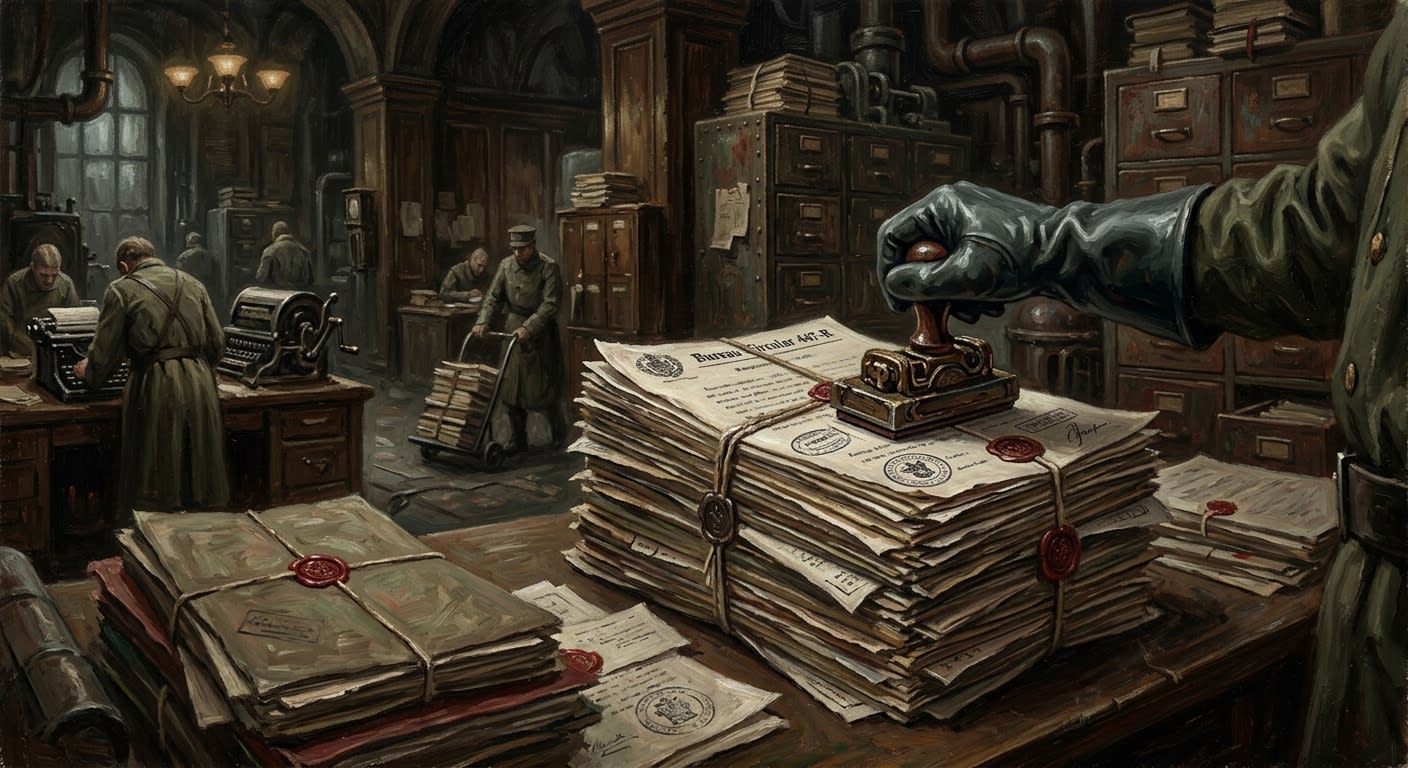
Bureau Circular 447-R is the official denial of the Codices Obscurae, issued by the Bureau of Records in A.S. 138 and copied thereafter with the devotional anxiety normally reserved for relic bones, execution warrants, and recipes involving the Hierarch’s digestion. It contains precisely four hundred and forty-seven words. That is the first thing everyone says about it, because the word count is the least dangerous part of the document and the only part permitted to circulate.
The Circular’s purpose is simple: to declare that no hidden volumes exist beneath or beside the Great Ledger of Souls recording doubt, hesitation, unspoken blasphemy, or any other interior irregularity extracted from confession transcripts. Records catalogs facts. Conscience is not a fact. Suspicion is not a fact. Thought is not a fact. This, at least, is the Circular’s public reasoning.
A delightful doctrine. The sort a clerk invents after discovering that his private sins have pagination.
The Circular does not mention the seventh vault. It does not mention Obscurists of the Third Ink. It does not mention conscience slips, shadow entries, corded tags, or the southeast stairwell beneath the Basilica of the Ledgered Saints. This silence has been cited as proof that no such things exist. By that method, the reader may prove himself intelligent by refusing to speak.
#On the Text as Approved
The Records recension reproduced below is the version posted in parish offices after A.S. 138. It is copied here without marginal correction, which is as close to mercy as this article will be permitted.
BUREAU CIRCULAR 447-R Records Recension, parish-copy authorization, sealed A.S. 138.
Let all parish registrars, confession clerks, tithe counters, bellwardens, and instructors of approved catechism receive this clarification and repeat it without embroidery. The Great Ledger of Souls remains the sole universal register of Created persons under the Bureaucratic Synod. It records names, births, deaths, parishes, lawful offices, sacramental attestations, tithe standings, military obligations, penal corrections, and other exterior facts necessary to governance, salvation, and the orderly prevention of damnation.
The Bureau of Records catalogs facts, not speculations, and any suggestion of supplementary volumes recording interior states of conscience is a calumny against the sacred mission of archival truth.
No clerk, priest, examiner, auditor, confessor, custos, novice, widow, debtor, prisoner, soldier, pilgrim, orphan, or member of any lesser household shall assert, imply, jest, rhyme, copy, sell, purchase, request, preserve, translate, illuminate, index, annotate, or otherwise circulate the claim that hidden codices exist for doubts, hesitations, unspoken blasphemies, dreams, temptations resisted, temptations enjoyed, silences, pauses before assent, private reluctance, suspicious laughter, insufficient tears, or any motion of conscience not already converted into confession, witness, evidence, or sentence.
Where interior disorder becomes speech, action, inscription, omission, reportable tremor, sacramental inconsistency, or other exterior trace, the proper bureau may record the trace according to existing statute. Such recording does not constitute a hidden codex, supplementary ledger, obscure volume, shadow register, conscience book, black folio, lower-vault index, or any comparable invention of malicious tongues. The faithful will observe the distinction with gratitude.
Rumors concerning so-called Codices Obscurae are therefore false. Repetition of the rumor after receipt of this circular shall be treated not as inquiry but as dissemination. Possession of forged extracts, copied tables, anonymous lists, marginal surnames, or alleged conscience entries shall be surrendered unread to Records, countersigned by Doctrine, and examined by Purity for the limited purpose of disproving their existence.
This circular supersedes parish gossip, tavern wit, classroom speculation, funeral whispering, unofficial sermons, careless jokes by literate children, and any contrary memory held by persons who believe they have seen, sorted, bound, dusted, transported, sealed, or survived a volume matching the forbidden description. Their memories are mistaken. Their duty is correction.
Copies shall be displayed near confession screens, ledger desks, parish notice boards, scribe benches, orphan intake windows, military attestation tables, and all doors descending below authorized public floors. If a posted copy is damaged, smudged, amended, counted aloud, or found with marginal questions, replace it immediately and report the incident as weathering of paper, not curiosity. Records thanks the faithful for their obedience within all Synod districts.
Let the word count stand as seal and safeguard. No margin is authorized. No appendix is implied. No further clarification exists.
There. You have read it. If your eyes lingered, that is between you, your confessor, and whichever desk receives the note.
The sentence works by a lawyer’s sanctified theft. It steals the accusation, strips it of nouns, and returns it wearing a cassock. “Supplementary volumes” replaces hidden books. “Interior states of conscience” replaces doubt. “Calumny” replaces fear. “Sacred mission” replaces the more accurate “habit of recording everything not nailed to the Creator.” It denies the Codices by making the very accusation too procedural for ordinary terror.
The lesser clauses vary by copy. The Purity recension warns that repetition of the rumor may indicate sympathy with interior heresy. The Doctrine recension preserves the rumor as a loyalty test. The Records recension adds the troubling line: “No volume shall be designated obscure unless indexed under seal.” A junior catechist once asked whether this meant an obscure volume could exist if sealed. He was praised for attentiveness, corrected for tone, and transferred to a records annex where attentiveness is easier to bury.
Earlier broadsheets described Circular 447-R as “four hundred and forty-seven sentences.”
False. Four hundred and forty-seven words. A denial that required four hundred and forty-seven sentences would be less a circular than a confession, and Records has better posture than that.
#On Why Four Hundred and Forty-Seven
The number has attracted theories, each more pious than the last. The Bureau of Doctrine once proposed that 447 corresponds to the sum of seven penitential tables, nine confession ranks, and thirty-two subcategories of doubt. This theory was withdrawn after someone noticed the sum did not equal 447. The Bureau of Records then clarified that the withdrawn theory had never been arithmetic but devotional arrangement, which is how a clerk says “do not check my sums” while wearing a holy face.
Another theory places 447 as the count of sealed folios in the first alleged Obscurae cabinet. Another makes it the number of parish confession bundles examined before the first denial. A third, favored by novice conspirators and men who drink ink by mistake, claims Archon Veyrault wrote the original denial in 447 heartbeats while locked in the Lower Vaults with a candle, a census knife, and the name of every man who had ever disappointed him.
The correct explanation is less romantic. Four hundred and forty-seven words fill one Records folio in the standard denial hand, leaving room at the bottom for three seals: Records, Doctrine, Purity. No white space remains. White space invites annotation. Annotation invites thought. Thought invites a second document. The Bureau’s genius, as ever, lies in denying the reader a margin.
#On Revisions That Never Occurred
Records insists Circular 447-R has never been revised. This statement is true in the way a corpse in three coffins is still one corpse. The text exists in at least nine witnessed recensions, all described as the original, all counted to 447 words, all bearing seals appropriate to their intended victims.
The parish copy is gentle. It speaks of “unfounded rumor” and “confidence in the Ledger.” The seminary copy is sharper, warning students that curiosity about nonexistent volumes proves insufficient discipline for sacramental office. The Purity copy has teeth. The Doctrine copy has perfume over teeth. The Archon-tier copy, which I have not seen and may describe with perfect bureaucratic innocence, is said to include the line: “Where conscience produces an evidentiary trace, Records may classify the trace without admitting jurisdiction over conscience itself.”
Comparative table of Circular 447-R variants sealed after the ████████████ incident in A.S. ███. Surviving headings include PARISH, SEMINARY, PURITY, DOCTRINE, ARCHON, and ████████████. Word counts identical. Clause order divergent. One copy contains the phrase “pre-articulated guilt” and has since been eaten by official mice.
Official mice are a useful species. They consume only compromising paper and never appear on procurement ledgers.
This Codex previously asserted that the Circular’s variants constitute evidence of revision.
Corrected. Variants are not revisions when the Bureau declares each variant original to its own necessity. The contradiction has been reconciled by authority, which is cheaper than logic and more widely available.
#On Use in Confession and Trial
Circular 447-R is posted in confession annexes throughout Strasbourg and copied into the training books of Records-scribes, Purity examiners, and those poor little catechism instructors charged with teaching children that thoughts are private until they matter. Its presence near the confessional screen is intentional. A penitent who sees the denial before kneeling may decide to confess the doubt voluntarily. A penitent who refuses has supplied timing data. Records wins either way, which is why Records rarely raises its voice.
The Index Damnatus cites the Circular in cases of forbidden speculation: possession of a forged Obscurae extract, recital of alleged Codices entries, sale of false conscience records, satire of Records word counts, and that tiresome little market game in Ghent where drunk apprentices invent one another’s hidden folios. Purity brands the seller. Records files the buyer. Doctrine condemns the laughter. The apprentices, being apprentices, learn nothing until the tongs arrive.
The Circular’s finest use is procedural reversal. When accused of keeping hidden books, Records produces 447-R. When asked why the denial is needed, Records says loyalty requires clarity. When asked why the denial’s repetition is tracked, Records says hostile rumors must be measured. When asked whether the measurements are stored, Records smiles with the weary benevolence of a saint asked to explain mud to a boot.
#On the Present Circulation
By A.S. 201, Circular 447-R exists everywhere and nowhere. Every parish office owns a copy. No two parish offices own the same copy. Scribes memorize it before promotion, then are instructed to forget the training recension and recite the current district form. Pilgrims see framed excerpts in the Basilica vestibule. Inquisitors carry pocket editions on vellum thin enough to hide under the tongue. Children in some Records households chant the word count as a skipping rhyme, which would be charming if the rhyme did not end with a list of punishments.
The Circular has succeeded. Most citizens do not believe in the Codices Obscurae. They believe in the denial, which is more useful. A hidden book may frighten a man once. A denial posted at every confessional frightens him daily, with proper seals.
Keep, then, the authorized doctrine: no such volumes exist; no such records are kept; no such inward catalogue stains the vaults beneath us. Bureau Circular 447-R says so in four hundred and forty-seven words, and if the Circular has altered since you last read it, rejoice. The truth has been freshly counted.