
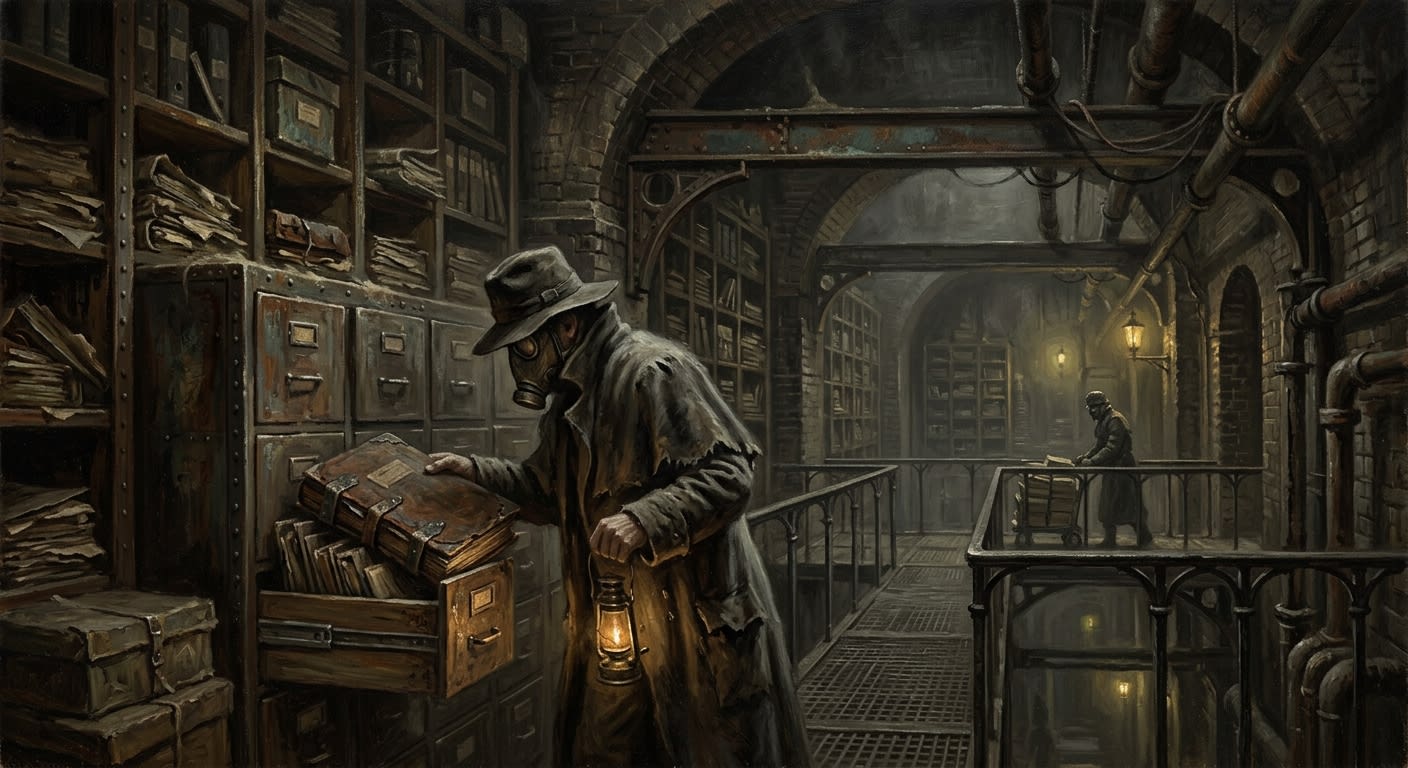
#On the Volumes That Do Not Exist
The Codices Obscurae do not exist. This is the official position of the Bureau of Records, the Bureau of Doctrine, and the Bureau of Purity, which agree so rarely that their unanimity ought to frighten any literate citizen more than contradiction ever could. A contradiction is honest bureaucracy: two stamps, two offices, two clerks each hoping the other dies first. Unanimity is a sealed room.
The public catechism says Records preserves facts. Names. Birthplaces. Baptisms. Confessions spoken aloud beneath a licensed seal. Deaths, tithes, pardons, dissolutions. The Great Ledger of Souls is already monstrous enough: eleven thousand folios in red calf, iron-cradled under the Basilica of the Ledgered Saints, each page crowded with souls that the Synod has had the courtesy to reduce to ink before reducing them to obedience.
The rumor of the Codices proposes a more impolite mercy. It says that behind the Ledger, beneath the Ledger, or beside it in a seventh vault whose stair is missing from every floorplan, Records maintains supplementary volumes recording the interior trespasses of the faithful: doubts swallowed before confession, blasphemies felt and abandoned, hesitations before genuflection, the half-second in which a tired mother hears the sky-sermon and wishes the horn would choke. The deed belongs to the Ledger. The thought belongs, allegedly, elsewhere.
Note the adjective. Acknowledged.
#On the Origin of the Rumor
The rumor begins with Archon Benedict Veyrault, naturally, because all decent nightmares in Records eventually find Veyrault waiting at the first desk. His maxim — to misremember is to betray salvation — appears carved above census offices, stitched into scribe collars, printed in the margins of school primers, and muttered by junior notaries when they make the sign of the quill before meals. Veyrault wanted no soul outside the archive. He achieved this with the Great Ledger. Then, as men of appetite do, he noticed that the first feast had only sharpened him.
Confession transcripts supplied the first suspicion. During the early expansion of the Ledger, parish confessors sent quarterly summaries to Records: sin categories, penance assigned, recurrence rates, household irregularities. A butcher in Metz confessed anger at tithe collectors. A widow in Ghent confessed envy of women whose sons had not been taken by the Bureau of Conscription. A novice in Strasbourg confessed that, while praying before the Tower of the Quill, he had briefly wondered whether the tower was too tall.
The summaries should have been reduced to statistical marks. Yet fragments survived in Records memoranda where no fragment belonged. “Subject displayed momentary resistance before naming doubt.” “Subject’s hesitation preceded spoken contrition by three breaths.” “Subject did not voice blasphemy; pattern inferred.” Inference is a narrow slit. Bureaucracy has a talent for entering narrow slits.
By A.S. 112, the first rumor had acquired a title: codices obscurae, the dark books, though the grammarians of Strasbourg objected to the mixed declension and were ignored, which proves that even pedantry has limits before terror. By A.S. 130, Purity interrogators were asking suspects about thoughts they had never confessed aloud. By A.S. 138, the Bureau of Records issued its first denial.
Earlier street copies named the Codices “The Black Ledger.”
This is incorrect and commercially vulgar. The Black Ledger refers to a criminal-shadow network, a fraud artifact, and at least three tavern songs of disputed authorship. The Codices Obscurae, being nonexistent, possess a far better title.
#On Bureau Circular 447-R
The denial took formal shape in Bureau Circular 447-R, a document always said to contain precisely 447 words. I have counted three versions. Each contains 447 words. None contains the same 447 words.
The Circular’s stable sentence is famous among those cleared to regret reading it: “The Bureau of Records catalogs facts, not speculations, and any suggestion of supplementary volumes recording interior states of conscience is a calumny against the sacred mission of archival truth.” Beautiful, no? A sentence starched so stiffly it can stand trial by itself. It denies the Codices by narrowing the definition of fact until only Records can pass through.
The second paragraph varies by copy. In the Purity copy, the Circular adds that “malicious repetition of the rumor may indicate sympathy with interior heresy.” In the Doctrine copy, it says “the rumor is retained in circulation to test loyalty.” In the Records copy, which I obtained through channels so legitimate I blush to name them, it states that “no volume shall be designated obscure unless indexed under seal.”
No volume shall be designated obscure unless indexed under seal. A marvelous denial. It does not say the volumes are absent. It says the designation is controlled. This is the sort of sentence that makes a lesser stylist jealous and a wiser man leave the room.
#On the Method, If Such Method Existed
If the Codices existed — and they do not, except in rumor, terror, filing irregularity, and the trained silence of every senior vault-keeper I have questioned — their method would be simple. Simplicity is how the Synod hides enormity.
Confession booths already produce more than speech. They produce timing. Tremor. Pause. Recurrence. The priest records what is said; the clerk records how it arrives. A delay before naming envy. A cough before admitting skipped prayer. A laugh at the wrong clause. A prayer begun with the correct words and ended with one vowel bruised by fatigue. The Bureau of Orison and Song measures sound; Records measures sequence; Purity measures guilt. Between the three, the human soul is less a mystery than a badly supervised inventory.
Specialized clerks — called, in one fragment I have seen, Obscurists of the Third Ink — would reduce these traces to entries. Name. Parish. Date. Trigger. Interior deviation. Confidence grade. Recommended monitoring interval. A fleeting doubt earns a grey mark. Repeated hesitation earns black. A thought recurring across feast days earns a corded tag tied to the subject’s primary Ledger folio, so that any census-scribe opening the name sees the body first and the hidden wound second.
Vault memorandum fragment recovered from ████████████ references “Obscurist rotations” of ███ hours, third-ink exposure, and the transfer of ████████ conscience slips from parish bundles to Lower Vault (Unregistered) ████████. The word “doubt” appears thirty-one times. The word “mercy” appears once, in a quotation from a condemned subject.
You ask how a thought can be recorded if it is never spoken. A foolish question, but popular. The Synod does not require the thought itself. It requires the trace by which the thought betrayed its passing: the breath held, the answer delayed, the catechism recited too quickly because speed is a mask, the confessor’s note that the penitent wept at the wrong line. A bootprint proves a foot. A hesitation proves an abyss.
#On the Use of the Hidden Books
The Codices, if consulted, would not replace the Index Damnatus. The Index names the forbidden thing. The Codices name the appetite that turned toward it. One is a catalogue of poison; the other, a list of tongues that watered before the cup.
Purity finds this useful. Records pretends not to know why. Doctrine pretends to supervise the pretending. A citizen whose spoken confessions remain clean may still acquire an Obscurae shadow: a pattern of late genuflections, reduced sermon attendance, recurring silence during the Creed of Allocated Bread (Unregistered), glances toward booksellers who carry too many foreign almanacs. No crime yet. No evidence fit for the public tribunal. A note is made. Three notes become a pattern. A pattern becomes a visit.
Earlier internal summaries referred to this process as “pre-heretical assessment.”
The phrase has been withdrawn. There is no such thing as pre-heresy. There is only heresy before it has completed the courtesy of announcing itself.
The faithful imagine guilt begins with act. The Synod knows guilt begins with permission granted in the private court of the skull. The Codices, should they exist, are that court’s clerk: bored, exact, unsleeping, paid late, and vastly more dangerous than the judge.
Some entries mature into action. A man marked for bread-doubt becomes a pamphleteer. A woman marked for bell-fatigue hides her infant from the census. A monk marked for relic-hesitation opens a reliquary at night and finds pig bone where sanctity was expected. Purity congratulates itself when such persons are caught. Records congratulates itself earlier.
#On the Present Denial
Records’ current position remains pure as white vellum: the Codices Obscurae are apocryphal; all references are loyalty tests; any citizen claiming knowledge of their contents has either fabricated the claim or accessed forbidden material, both conditions requiring correction. The denial has been stamped so many times that the wax on some copies is thicker than the page. This is how authority armors embarrassment.
The Lower Vaults of Strasbourg (Unregistered) contain six acknowledged chambers. The floorplans show six. The candle requisitions fund six. The guard rosters name six. In the southeast stairwell, between the third and fourth descent, there is an iron door whose lintel bears no number and whose keyhole has been sealed with red wax renewed every Lent. I have passed it twice. The first time, a vault-keeper told me it led to a disused cistern. The second time, a different vault-keeper told me there was no door.
I believed him at once. The Bureau had improved the truth.