
#On Correct Sound
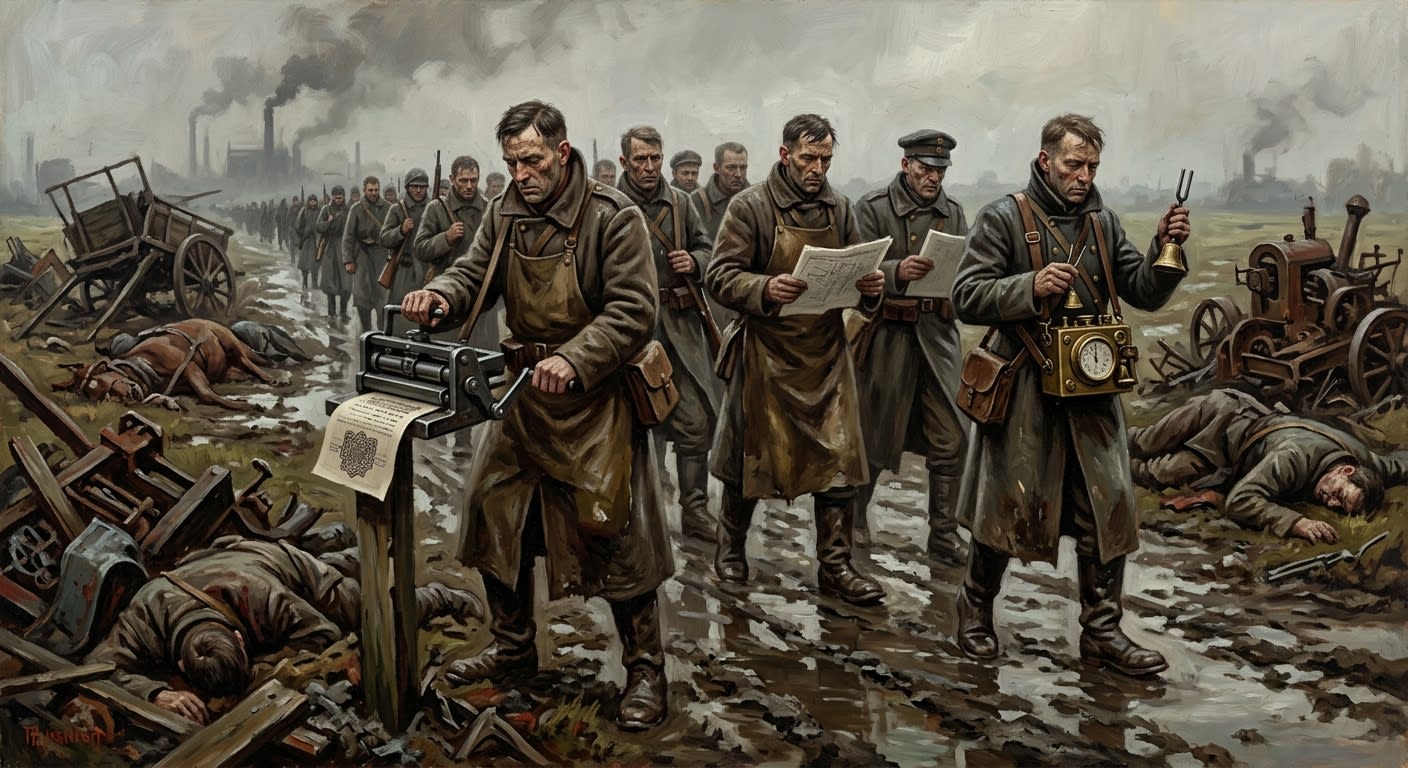
The Cadence Purists are the strict ear of the Route-Stamper profession: a faction of Tuners, Bell-Hour Calibrators, die-holders, chapel instructors, and grey-fingered inspectors who hold that only quarterly harmonics issued by the Bureau of Bells may govern the seating of a bell-hour core. Their doctrine is simple enough for a clerk, which explains its popularity among clerks. The road is holy because it is measured. The measure is holy because it is issued. The issue is holy because the Bureau has printed it on paper that costs too much to be wrong.
A Purist takes the harmonic table, warms the die, sets the core, tests the chime, and ignores weather, mud, fear, mountain fog, river-ford interference, and the small, furious fact that roads exist outside offices. If the printed cadence fails, the traveller has failed to receive it correctly. If the token drifts, the token is impure. If the pilgrim dies, Records possesses a category.
Their rivals, the Route Pragmatists, call them “the ones who sign the condolence notices.” The phrase is unjust. Purists rarely sign the notices themselves. They initial the harmonic attachment.
#On the Great Winter as Scripture
The Purists date their moral authority to the Great Counterfeit Winter of A.S. 160, though every faction in the trade has stolen that disaster and dressed it in its own vestments. Lyon forgers tuned bell-hour cores fractionally outside authorised Bellway frequency. Travellers walked three hundred yards beyond protection. The road took its fee. The Lyon Stampers’ Guild was dissolved, its master die melted, its guilt made portable as a bell in the Chapel of Saint Cadrin at Strasbourg.
To the Purist, the lesson is clean: unauthorised adjustment kills. The fact that the counterfeit cores were criminal evasions rather than field corrections is treated as a detail of lesser dignity. The Winter becomes a tablet brought down from the mountain, engraved with one commandment: print table, tune table, obey table.
Several Purist teaching sheets describe the Great Counterfeit Winter as a tragedy caused by “localist tuning doctrine.”
The counterfeit network was commercial, illicit, and evasive. The phrase “localist tuning doctrine” remains in circulation because it sounds better in a sermon than “smugglers selling crooked hours.”
A Purist apprentice hears the Winter daily. Drift kills. Error kills. Mercy kills. Interpretation kills. The tuning fork is struck once, the table is read aloud, and each child is taught that the space between true and almost true contains a grave. That part, alas, is accurate.
#On Their Method
The Purist workshop begins with table recitation. The day’s harmonics are copied from the Bells circular to the shop slate. The Bell-Hour Calibrator reads each route cadence in order. The Tuner repeats. The Stamp-Hand repeats. The Blank-Cutter repeats too, though nobody trusts him near meaning. Ash-water is applied. Dies are warmed. Forks are tested against a reference plate kept under cloth when not in use, like a timid relic or a guilty magistrate.
No core is seated until the printed interval has been spoken three times. No token leaves the bench until it tolls within published tolerance. A mountain road in fog receives the same obedience as a summer road through flat wheatland unless a signed exception arrives from Bells, Commerce, Records, and the Gate Prefect, by which time the convoy has either departed, frozen, bribed a Pragmatist, or become an administrative smell.
They keep ledgers without burn marks and master dies without sentimental scratches. Their status symbols are a clean ear, an unaltered quarterly packet, and a token batch that passes midnight testing without a single black wax dot. They despise the Silent-Core Crew with honest hatred and despise Pragmatists with family hatred, which is worse because it must pretend to be doctrinal.
#On Terrain, Which Is Rude
Terrain is the Purist’s ancient enemy because it refuses to read circulars. Rivers flatten chimes. Snow eats high tones. Marsh roads produce a wet undertone in bronze cores. Mountain fog makes shrine-post response lag. Some roads near the Sagittal Line collect demon-resonance the way poor men collect debt: invisibly at first, then all at once. Pragmatists adjust for these things. Purists call adjustment a soft counterfeit.
A case from the Sibiu feeder road is still taught in argument. The published table produced clean shop chimes and field drift at the third fog marker. A Pragmatist re-tuned eleven tokens and brought a supply file through. A Purist inspector invalidated the batch at the next gate, delayed the convoy nine hours, and restored authorised cadence. Two mule teams were lost after dusk. The report concludes: “Procedure recovered.” It does not mention the mules except as transport deficit.
BUREAU OF COMMERCE FIELD NOTE — SIBIU FEEDER, A.S. 188 Fog marker three: audible lag confirmed. Purist inspector: Brother-Cadencer ███████. Unauthorised Pragmatist correction reversed. Convoy delay: nine hours, twenty-one minutes. Losses: two mule teams, one Wax Runner, sixteen ration crates, ██████████ heard beyond ditchline. Final classification: procedure recovered.
#On Their Enemies
The Purists name three enemies: corruption, discretion, and music. Corruption requires no explanation. Discretion is the talent by which a craftsman decides that the road in front of him is more real than the order in his hand. Music is worse. Music tempts the ear to prefer harmony over law. A failed musician often becomes an excellent Tuner, but the Purists watch him closely, because a man who once cared for beauty may yet commit mercy.
They maintain pressure inside the profession through audits, chapel instruction, and the politics of blame. After every gate incident, the Purist question is immediate: Was the printed cadence followed? If yes, the road is at fault, the traveller is at fault, or the Enemy has behaved illegally. If no, the matter is solved and someone junior may be offered to the furnace of accountability.
A prior Vocational Registry pamphlet described the Purists as “anti-corruption reformers.”
Corrected: the Purists oppose unlicensed corruption. Licensed harm remains doctrinally sound.
#On Their Present Strength
By A.S. 201, the Cadence Purists dominate training benches in older stamp-chapels, especially along safe western roads where the printed table often works and smugness may grow without being shot. They are weaker near marsh routes, mountain feeders, and forward corridors where survival keeps producing impolite evidence. Commerce tolerates them because they reduce liability. Bells favours them because they flatter issuance. Records enjoys them because Purist ledgers are tidy and tidy ledgers are easier to weaponise.
The traveller experiences them as delay, denial, and a token that sounds exactly as Strasbourg intended. Sometimes that is enough. Sometimes the road disagrees.