
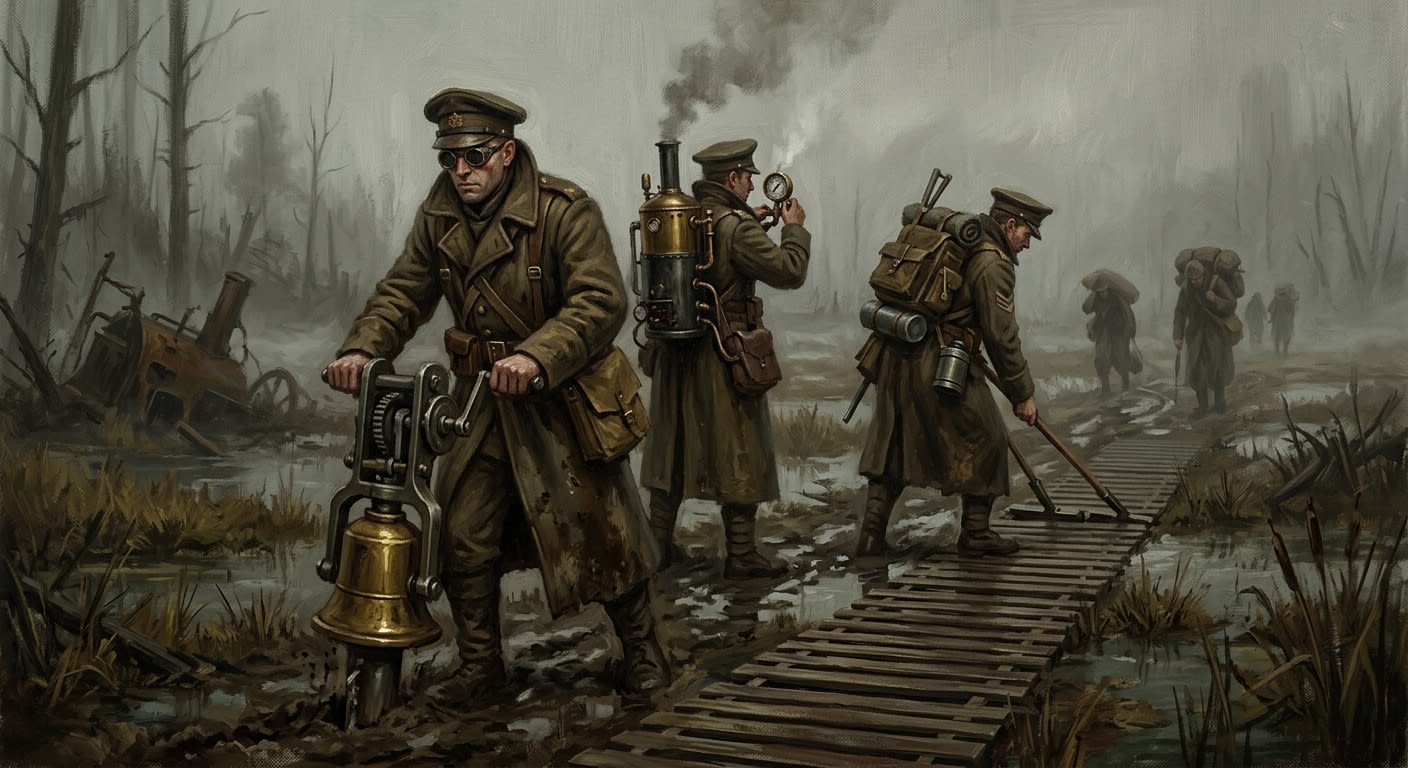
#On the Faction That Listens to the Road
The Route Pragmatists are the impolite salvation of the Route-Stamper profession: Tuners, Bell-Hour Calibrators, die-holders, gate-shop masters, and road-stained mechanics who adjust bell-hour cores to the road as it exists, rather than to the road as printed by a committee of old men with clean cuffs. They tune for mountain fog, river-ford interference, marsh undertone, demon-resonance drift, crowd panic, frost-lag, bad shrine-post alignment, and that most heretical of all conditions, experience.
The Bureau of Bells calls them heterodox. The Bureau of Engineering calls them field-expedient. Travellers who survive call them correct, when breath permits gratitude.
A Pragmatist begins with the quarterly harmonic table, because even rebellion in the Synod first salutes the document. Then he listens. He listens to the token in the shop, to the gate bell in wet air, to the road shrine after dusk, to the way a bronze core changes when brought near a river bend where three convoys vanished and Records discovered weather. If the printed cadence holds, he leaves it. If it drifts, he corrects. The correction is usually small enough to fit inside shame.
#On Their Ancestry in Error
The Pragmatists claim no founder because founders become icons, icons attract chaplains, and chaplains eventually discover paperwork. Their ancestry lies in benches where the printed sound failed. The Great Counterfeit Winter gave the faction its central wound. Lyon forgers produced crooked tokens, travellers died outside Bellway protection, and every sensible smith learned that fractional error kills. The Cadence Purists took from that disaster the command never to deviate from the authorised table. The Pragmatists took the uglier lesson: truth lives in the actual chime, not in the table describing it.
A counterfeit core drifts because a criminal wants freedom from the road. A corrected core shifts because the road itself has shifted. Bells treats both as disobedience when politically convenient. Engineering knows the difference and writes it down in pencil.
A Bells circular of A.S. 163 classified all non-table tuning as “counterfeit-adjacent acoustic presumption.”
Correction pending since A.S. 164. The Bureau of Engineering filed eleven field demonstrations, seven survivor statements, and three broken reference plates. Bells returned the packet with the note: “Terms insufficiently reverent.”
The earliest named Pragmatist cell appears in Commerce complaints from the Przemyśl feeder roads, where winter fog made gate-chimes arrive late and shrine-posts answer like drunk monks. Those smiths shortened the toll interval by a hair, enough to keep the Bellway sheath aligned through the pass. The convoy survived. The auditors fined the shop. The shop paid. Survival often arrives with a surcharge.
#On the Method of Adjustment
The Pragmatist method is procedure without permission, though Purists describe it with wetter vocabulary. First the table is read. Then the road is sampled: gate bell, waystone echo, river-hum, crowd density, weather pressure, known demon-risk, local death register. The Tuner walks the pacing lane with a test token and then walks the actual road segment if patrol conditions allow. If patrol conditions do not allow, he sends a Wax Runner with good ears and a poor sense of self-preservation. Many Wax Runners enter the profession this way. Fewer leave it by choice.
Adjustments fall into four tolerated blasphemies. Fog-shortening tightens the interval where wet air delays shrine response. Ford-lowering deepens the toll where water flattens the upper note. Marsh-hardening strips softness from a core that would otherwise answer with the famous wet undertone. Line-bending compensates near the Sagittal Line, where ambient demon-resonance chews at lawful sound like a rat at altar lace.
Their tools betray them: extra tuning forks not listed in shop inventory, route-stained reference plates, quiet-box slates wiped too often, wax dots in colours other than approved black, and small private maps showing where the road’s sanctified corridor has moved three yards left since the last inspection. A Purist sees contraband. A traveller sees a way home.
#On the River-Ford Problem
A river-ford is a jurisdictional insult to sound. Water steals the upper chime, mud swallows the low, bridge chains answer with their own miserable music, and the token becomes less a permit than a plea. The Night of the Three Bridges made river movement glorious in Bureau of War songs; the Route-Stamper knows that every ford is a little trial where bronze must argue against water and water has been winning arguments since before Strasbourg learned to stamp its name.
At the Danube feeder below Bastion-Irongate, Pragmatist shops learned to lower pilgrim-token cores before the spring floods. Bells objected to the alteration. Commerce objected to the delay caused by the objection. Records objected to both offices using ink from the wrong requisition series. The ferrymen continued crossing with Pragmatist tokens, because ferrymen possess a primitive affection for remaining alive.
RIVER-FORD INCIDENT LEDGER — A.S. 171 Route token batch: table-compliant. Ford depth: disputed. Upper chime: absent after midpoint. Convoy record: twelve entered, nine emerged, one emerged singing with no token in hand, two █████████████. Bells conclusion: improper listening conditions. Engineering margin: lower the core, you fools.
#On Their Legal Cowardice
Pragmatists survive by naming their actions badly. They do not “alter.” They “stabilise.” They do not “deviate.” They “compensate for local acoustic insult.” They do not “contradict Bells.” They “prepare a provisional field harmony pending formal ratification,” a phrase so swollen with obedience that it can smuggle three crimes through a checkpoint.
The Bureau of Engineering shelters them when it needs convoys to arrive. Commerce shelters them when dead customers would reduce taxable movement. Gate Prefects shelter them when the road outside the gate has begun making noises that the official table refuses to acknowledge. Bells prosecutes them when casualties become public. Records waits and notes which side will generate the cleaner file.
An earlier vocational appendix described the Route Pragmatists as “informal operators outside authorised practice.”
Current phrasing: locally corrective operators within disputed practice. The change was approved after three Engineering depots refused to certify winter movement without their services.
This cowardice is practical, not moral. A Pragmatist who writes the truth gets erased. A Pragmatist who writes half the truth with a signed attachment saves convoys for years. Doctrine may dislike the arrangement. Doctrine also dislikes dysentery, late ammunition, and dead pilgrims in picturesque heaps beside toll shrines. The Ledger has room for distaste.
#On Their Quarrels
Their quarrel with Purists is fraternal, technical, and ugly. Purists accuse them of counterfeiting with better excuses. Pragmatists accuse Purists of letting tables kill people so the margins stay clean. Both factions claim Saint Cadrin when useful. Both factions teach the Great Counterfeit Winter to apprentices. The Purist apprentice learns that drift is sin. The Pragmatist apprentice learns to ask who measured the road after the last flood.
Their quarrel with the Silent-Core Crew is sharper. A Silent-Core smith mutes a token to evade the Bellway. A Pragmatist bends sound to keep the bearer inside it. This distinction matters to the Pragmatist with almost devotional force, because he spends his life accused of being half a criminal and resents full criminals receiving the same vocabulary. The Silent-Core Crew laughs, charges double, and buys drinks for useful hypocrites.
#On the Present Condition
By A.S. 201, Route Pragmatists are strongest on mountain feeders, marsh roads, forward supply corridors, river crossings, and any district where the official table arrives after the first funerals. They are weakest in western stamp-chapels where roads behave, bells answer promptly, and a man may mistake ease for virtue. Their workshops smell of hot wax, rain-damp wool, brass filings, and anxiety. Their ledgers are too tidy in the wrong places. Their apprentices learn to hear what the form cannot name.
A traveller carrying a Pragmatist token may never know it. That is the faction’s highest praise. The token tolls, the road answers, the gate receives him, the cancellation stamp falls, and some exhausted Tuner in a back room scratches a private mark beside the batch number before the official ledger is closed.