
#On the Road That Is Sound
A Bellway is a road made of obedience.
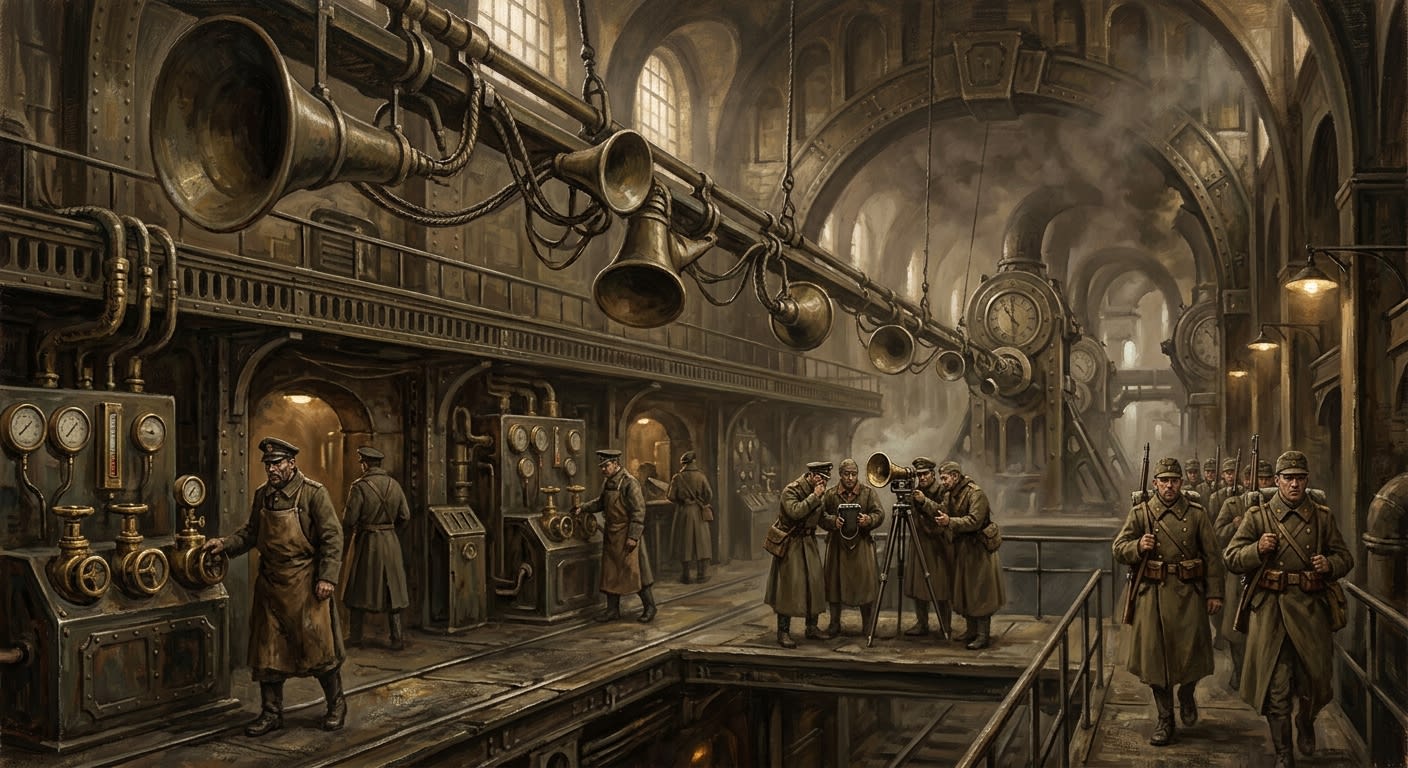
Do not picture cobbles. Cobbles are honest and stupid; they lie where masons put them and complain only under wagon wheels. A Bellway is subtler, more useful, and treacherous in proportion to its usefulness. It is an authorised corridor of sound, a peal-net laid across road, trench, river, shrine-post, tower, field bell, relay carillon, aerial sermon, and the listening apparatus of every Bureau with enough vanity to claim that hearing is jurisdiction. A traveller enters it when his token answers the route cadence. A regiment enters it when First Peal pulls sleep from the barracks. A Vigil Ark enters it when its reliquary-chapel blesses the air beneath the gondola and the Sermon-horns make the sky shout Doctrine.
The ignorant call Bellways routes. Route is the lesser word, the provincial word, the word a wagon uses. A Bellway is permission given rhythm. It is a legal fact struck into air. It says: here the Synod hears you; here you exist correctly.
Earlier official documentation described Bellways as arteries of the Line strung from Bastion-Constantinople to the Aegean. Correct the phrase before it breeds. The southern anchor is Bastion-Constantinople, not Bastion-Constantinople, unless one is discussing obsolete refugee nomenclature or indulging a cartographer too sentimental to be trusted with ink. The Bellway lattice runs along the Sagittal Line from Königsberg through Brest, Przemyśl, Sibiu, Irongate, Shipka, and down to the Bosphorus, then outward along pilgrimage roads, supply corridors, coastal approaches, and the sermon-clogged air above the southern sea lanes.
This gives the Bellway three bodies. The ground body is the peal-net: towers answering towers, shrine-posts chiming route receipt, road chapels marking windows, portable field bells holding columns inside sanctioned cadence. The war body is the Line: bastion alarms, counter-tolls, trench signals, Orison relays, sky-sermon tempo, artillery timing, and the brass grammar by which three million armed men are told when to stand, push, repent, eat, sleep, fire, and die. The aerial body is consecrated air: the corridors patrolled by Vigil Arks, their reliquary-chapels blessing passage and their Sermon-horns pouring command downward until even the fish in the Bosphorus receive doctrine by pressure.
The definition is bloodless because blood interferes with acoustics. The lived fact is simpler. Inside the Bellway, the road knows you. Outside it, other things may.
#On the Origin of Lawful Sound
Bellways were born before they were named. In the Great Retreat after the Sundering, when roads broke, cities emptied, and refugees learned that maps could become suicide notes by morning, bells did what clerks had not yet organised themselves to do. They gathered bodies. They marked safety. They said west, here, now, stop, run, kneel, eat, hide. A village bell in those years was altar, signal tower, ration proof, militia drum, infant census, and death notice. Men obeyed it because every man who did not obey something died under a more imaginative authority.
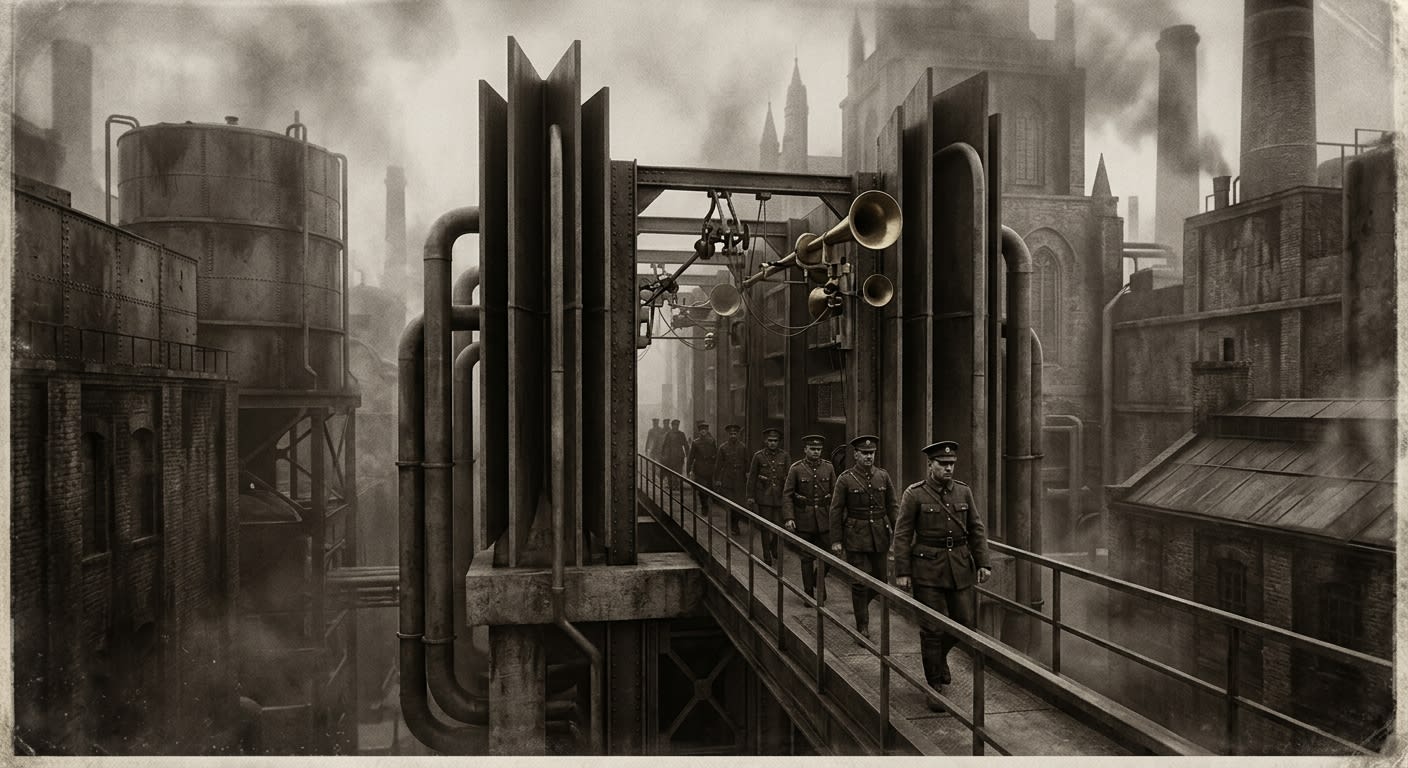
The early post-Sundering bells were local, jealous, and frequently wrong. One valley rang curfew before dusk because the fog came early. Another rang Fifth Peal for repentance whenever a trader arrived with news from the east. A bridge bell near the Rope-Ferry Chain developed a habit of tolling twice when the water was unsafe and once when the ferryman was drunk, which was useful until a new ferryman reversed the practice and drowned thirty-two pious literalists.
The Bureau of Bells emerged in A.S. 115 to turn this vulgar survival into governable resonance. Its founding sin was the discovery that command grows more powerful when standardised. First Peal would mean stand-to. Third would mean push. Fifth would bleed fear into confession. Ninth would shut the day like a ledger cover. Local charm was scraped away. Parish habits were filed under tolerated deviation until a clerk could find the right stamp to kill them.
The Concordat of Civic Cadence and later route laws gave the sound civic teeth. Crowds, funerals, ration queues, levy transfers, and pilgrim chains were synchronised to bell-hours. Then the Route-Timing Concordat of A.S. 129 taught the city that two lawful bells can murder nineteen mourners if struck in the same hour. The Night of Two Bells did not create the Bellway. It made Bellway clearance unavoidable.
Earlier devotional summaries describe the first Bellways as “harmonious bonds of fellowship between shrine and road.”
Corrected. They were emergency command corridors imposed on frightened populations whose alternative was panic, dispersal, and death with poor documentation. Fellowship arrived later, after the invoices.
A.S. 148 brought Bellway Harmonisation, the reform that made Jubilee roads audible to competent authority and made delay prosecutable. Shrine-posts, parish towers, road chapels, portable bells, and relay carillons were aligned into indexed intervals. The road ceased being mud under feet and became a ledger written in bronze. Bell A sounded departure. Bell B answered receipt. Bell C confirmed passage. A gap became suspicion. A cracked interval became investigation. A missed bell rang upward faster than any corpse could be counted.
By A.S. 160, after the Great Counterfeit Winter, every serious official understood the richer horror. If a bell-hour core drifted by fractions of a second per hour, a lawful-looking traveller could end a week’s march three hundred yards outside protection. Three hundred yards is enough for ditch-mouths, hunger lights, river-wights, and those minor roadside intelligences that cannot breach a proper Bellway but will take a mismeasured family with gratitude. The Great Counterfeit Winter killed by almost-correctness. The Bureau never forgave the mathematics.
#On the Anatomy of the Bellway
A ground Bellway begins with a source tone: tower bell, shrine-post chime, road chapel plate, portable field bell, relay carillon, or bastion horn. The source tone must be licensed, measured, and entered in the Bell Codex or its local supplement. It must be struck at the assigned hour by a competent keeper, which in Bureau language means a person sufficiently trained to obey and sufficiently chained to remain available.
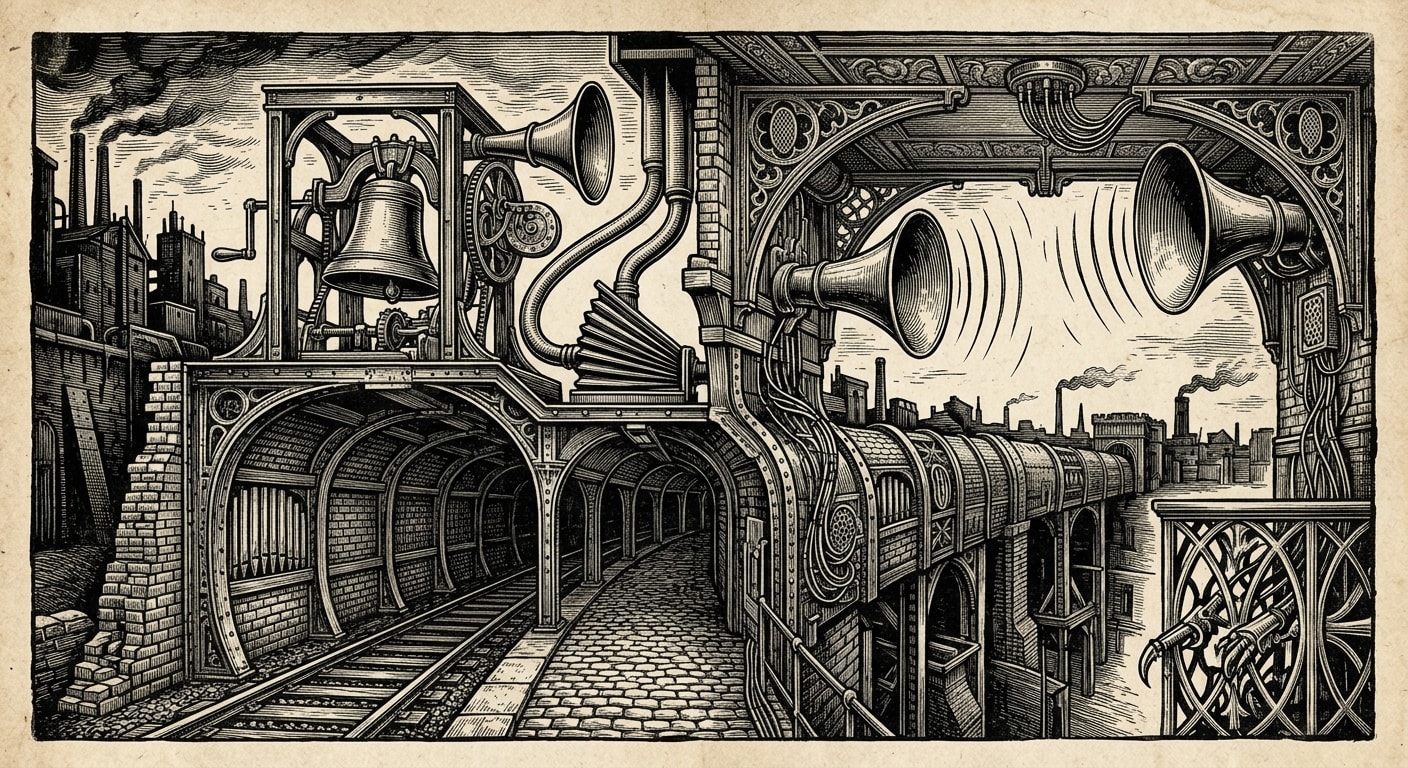
The tone travels by relay. Towers answer across valleys. Shrine-posts return sympathy chimes. Gate plates vibrate under their little iron mouths. Tokens carried by travellers answer softly in brass and wax, telling the road that a body bearing permission has entered the corridor. In a healthy Bellway the chimes do not merely mark passage; they hold it. Their overlapping resonance forms a sheath of lawful sound around the permitted lane. Within that sheath, minor hostile things find entry difficult, crowds keep cadence, patrols know where to listen, and every step becomes easier to tax.
The route token is the citizen’s small portable confession. The Route-Stamper and Indulgence-Token Smith seats the bell-hour core, tunes it to the corridor’s cadence, stamps the face, seals the wax, and sends a poor fool into danger with a disc that says, in effect: the road may notice me, and I consent to being noticed in exchange for not being eaten. This is a reasonable bargain. It is also the foundation of tyranny. Many reasonable bargains are.
The field catechism of components is plain enough to be memorised under shelling: source, a lawful tone; relay, a tower, post, chapel, carillon, Ark, or field bell; bearer, a person, column, convoy, regiment, or vessel under recognised cadence; boundary, the harmonic edge beyond which protection and responsibility thin; record, mandatory unless the loss is politically improved by fog.
The boundary is the doctrine’s shameful part. A road made of stone has edges one may trip over. A Bellway’s edge must be heard, inferred, measured, tested, and periodically denied. Weather moves it. Snow eats high tones. River water flattens chimes. Marsh air gives bronze a wet undertone. Mountain fog slows shrine response. Demon-pressure near the Line chews lawful sound until a corridor drifts three yards left, then nine, then the width of a grave field.
The Cadence Purist answers with the printed table. The Route Pragmatist answers with field correction. The Silent-Core Crew answers by muting the token so the road does not hear the bearer at all. Between them lies the whole moral education of the Synod: obedience, survival, crime, and the fee schedule that makes them cousins.
The aerial Bellway works by a grander obscenity. A Vigil Ark’s reliquary-chapel sanctifies the air through which it passes; the Sermon-horns broadcast Doctrine at a pressure that converts hearing into submission; the Censer-racks make disobedience burn if the sermon fails. The Saint Barachiel proved the model above the Bosphorus. The Saint Gabriel patrols the northern Bellway above the Black Sea approach. The Saint Uriel was meant to guard the southern Bellway and remains fully assembled, fully consecrated, fully grounded, a monument to the theological stubbornness of one authenticated tooth.
The aerial corridor differs from the road corridor in altitude and arrogance. Beneath it, chains hold the Bosphorus, ravelins watch the strait, mines worry the water, and soldiers look upward to see whether sanctified air is present or merely promised on a board. A missing road bell delays pilgrims. A missing aerial Bellway leaves sky unblessed above convoys, flotillas, chain-booms, powder barges, and men who know enough about Kargath and Maldrake to prefer noise overhead.
#On Protection, Surveillance, and the Lie Between Them
The public catechism says Bellways protect. This is true. The private manual says Bellways observe. This is also true. The quarrel begins when some sentimentalist asks which purpose came first, as though institutional motives queue politely at a gate.
A proper Bellway repels or confuses lesser threats: roadside whisperers, ditch-mouths, hunger lights, certain river-wights, pale things that follow unscheduled carts, and the stupid category of demon that dislikes measured sound. It steadies columns and keeps the fearful from becoming scattered meat. It lets a convoy move under known bells rather than improvise courage in wet dark. It permits Pilgrimage to send chains over roads that would otherwise digest the faithful more openly. I do not deny any of this. I am a propagandist, not an idiot.
The same Bellway reports movement. A shrine-post hears passage. A token answers. A relay gap marks delay. A late column becomes deviation. A silent token becomes evasion. A crowd that sings over the wrong interval becomes interference. Once the road is audible, every body upon it becomes a note, and every note can be scored, taxed, corrected, rerouted, punished, or made to disappear inside a better harmony.
The Bureau of Bells calls this acoustic integrity. The Bureau of Records calls it admissible sequence. The Bureau of Commerce calls it tariff assurance. The Bureau of Pilgrimage calls it pastoral care when the pamphlet faces outward and chain discipline when the door is closed. The Bureau of Purity calls it evidence.
A Bureau of Bells commentary denied that Bellway Harmonisation created an acoustic surveillance net.
Clarified. It created an acoustic devotional compliance lattice. The phrase is longer, more expensive, and exactly as incriminating to anyone with ears.
The Silent-Core Crew exists because people understand the bargain too well. A lawful token announces: here is a body. A quiet token omits the announcement. It may save a child whose papers expired at noon, a deserter whose regiment has become a furnace for boys, a merchant with medicine that would be seized by a pious thief in uniform, or a smuggler carrying books, salt, bullets, relic dust, cheese, or a disassembled printing press in devotional cradles. It may also guide the bearer outside the Bellway’s ear, where protection thins and other listeners lean closer.
BUREAU OF BELLS / RECORDS JOINT INCIDENT — ROUTE 77, A.S. 198 Listening post recorded authorised departure tone. Shrine-post II recorded no passage. Token recovered: visual seal lawful; core silent. Bearer count at departure: 6. Bearer count recovered: 0. Roadside marks: six kneeling impressions facing west, one additional impression facing east. Public classification: weather loss. Internal notation: something counted them after we did not.
The Bellway’s defenders point to such files and say: see, silence kills. They are correct often enough to be dangerous. The Bellway’s enemies point to other files: forged cores, Purist tables that kill in fog, Pragmatist corrections punished after saving convoys, Pilgrim Chains driven past thirst because a bell-window narrowed, Route-Stampers burned for a drift they heard before auditors did. They are also correct. The road is a saint with teeth. The thief is a sinner with a loaf. Choose your sermon according to which corpse you intend to explain.
#On War Use and Hostile Sound
Along the Sagittal Line, Bellways are not comfort. They are command infrastructure. First Peal wakes. Third moves. Fifth orders repentance. Ninth closes the day. Sector tones mark trench shifts, gas alarms, counter-battery timing, ration release, corpse retrieval, and the thousand little obediences by which an army avoids turning into armed weather.
Demons know where power resides. Pale Chanters corrupt the air with unhymns, folding prayer into static and obedience into weeping. Silence-domes eat relay. Syrion deadens will in the Shipka sector until the bells must strike men awake like nails. Morwen’s mimetic theft worries at Irongate’s answering choirs. Velkara prefers interior sound: breath, whisper, mattress creak, confession rhythm. Atheron uses height and banner to make bodies kneel before the command is even audible. Pride, like Bells, understands posture.
When a sector’s bell is captured, catastrophe follows. Troops rally to the wrong command. Companies push when they should fall back. Regiments kneel in repentance while the enemy closes. The Counter-Toll Corps exists because Cologne obeyed the wrong curfew on the Night of Borrowed Curfew, and hundreds paid the correction fee in blood. Counter-Toll doctrine is the Bellway’s ugly sacrament: hostile peal enters, Synod peal answers louder, panic resumes under proper ownership.
The Mimic Incident proved a worse danger. A hostile tone copied official patterns with enough fidelity to redirect a Line garrison for seventeen minutes. Minute One matters: the false instruction rang from the bastion’s secondary Bellway, not the tower. Towers are watched by eyes. Bellways are watched by trust. The difference nearly opened a bastion.
After the Mimic, living keys entered Counter-Toll practice. A written key could be forged, copied, stolen, or obeyed by something that had learned the shape of command. A living throat, Bells declared, could not. This was false, but false in a sturdy way, and sturdy falsehoods often become procedure. The operator now confirms with voice, breath, throat-cord tension, and spoken cadence. The Bellway accepts the body as seal. One day something will accept the seal better than the body does.
#On the Bellway Professions
Every infrastructure becomes a village of specialists, parasites, saints, thieves, failed musicians, and clerks with proprietary ink. The Bellway has bred a whole ecology of necessary persons.
The Bellwarden keeps the tower, holds the toll-key chained to flesh, reports drift, and learns that a bell can speak without being struck. The Counter-Toll Operator sits beneath the tower and drowns hostile sound. The Route-Stamper seats the bell-hour core. The Cadence Purist obeys the table. The Route Pragmatist insults the table just enough to save lives. The Silent-Core smith mutes the table and charges extra for the quiet. The Pilgrim-Chain Handler drives bodies through bell-windows. The Procession Marshal clears sound before crowds move. The Orison Signal Engineer powders prayer with saint-dust and calls physics obedient. The Sky-Sermon Attendance Auditor records who heard the sky. The Bell-Tapper lays black-diesel pipe beside the corridor and lets the lawful hum hide profitable treason.
This list is incomplete, which is how one knows the system is alive. Dead systems have tidy charts. Living systems leak job titles.
Bell-sickness runs through these trades like a tithe collected by the skull. Bellwardens hear phantom peals. Operators go brass. Route-Stampers hear tokens answer after midnight. Sky-Sermon Auditors develop metric paranoia and cannot enter a funeral without counting rows. Bell-Tappers answer questions before they are asked because the duct has taught the skull to anticipate command. The Bureau classifies each condition separately when paying pensions and jointly when assigning blame.
Saints attach themselves wherever labour begins to look like doom. Saint Cadrin the Measured walks his circular siege-ring with ledger and tuning fork, patron of those who make movement count. The Chapel of Saint Cadrin in Strasbourg rings with metal recast from the Lyon Stampers’ Guild master die after the Great Counterfeit Winter. Every hour, the dead forgers become warning. This is efficient hagiography.
#On the Aerial Bellways
The aerial Bellway deserves its own indictment because height makes men stupid.
Above the frontiers stretch the high corridors where Vigil Arks drift and broadcast. Earlier official documentation says hymns pour down thick enough to drown birds mid-flight. I have no reason to doubt it. Birds are notorious for lacking doctrinal resilience. The Bellways are watched by beacon chains, towers strung with relic-lanterns, lit in sequence when abominations stir. To be stationed there is to freeze in wind, eat ration-smoke, and pray one’s tower does not become a lightning rod. Still, the view is superb, which is how the Bureau justifies many postings that would otherwise require honesty.
At Constantinople, aerial Bellways hold the wet throat of the Line. The Saint Barachiel flies the central strait corridor, sermon and censer descending upon anything that lacks permission. The Saint Gabriel keeps the northern Bellway above the Black Sea approach and outer anchorage, its crew calling the corridor quiet with the doomed confidence of men who have mistaken silence for endorsement. The Saint Uriel remains in drydock, assigned to the southern Bellway by schedule, hope, and red ink, none of which provide lift.
Aerial Bellways differ from ground Bellways in one theological detail: they claim to sanctify not merely movement but atmosphere. The reliquary-chapel passes; the air becomes holy corridor; demons entering it pay a cost. Bureau of Rites calls the cost theologically significant and operationally encouraging. This means the demon flinched in a manner visible enough to support funding.
The fall of the Sanctissima Vox over the Blightmarsh remains the caution the Bureau stores in a drawer and then builds policy on top of. The Ark crossed hostile air, its sermon compressed, its lanterns aged, and it sank into mud where its lights still glow beneath the surface. The Saint Barachiel was commissioned under the logic that the strait would not eat an Ark because the strait was not the Marsh. The logic has held often enough to become doctrine. That is the most one can ask of military theology.
Then came the Broadcast of A.S. 199, when the Saint Barachiel’s horns carried a voice belonging to no crew member for eleven minutes and forty-three seconds. The content remains sealed. The air at elevation is now officially “sometimes unusual.” I drafted that acceptable phrase. It is one of my finer cowardices.
#On Dead Air and Listening Places
Every Bellway produces its opposite. The Bureau calls them dead zones, hush gaps, acoustic occlusions, unproductive resonance fields, and other phrases that make absence sound like a budget category. The road calls them bad stretches. Travellers call them by the names of those lost there.
A dead-air pocket may form under a broken arch, beside a river bend, beneath a silence dome, behind a market wall rebuilt with unblessed stone, or anywhere a bell has rung too often for causes the wall disliked. Inside such a pocket, tokens fail to answer. Footsteps arrive late. A shouted name drops before it reaches the second syllable. Bellwardens hate these places because instruments register nothing and the human ear hears too much of itself.
The Circle of Mute Radiance builds sanctity from such gaps. Silent-Core smiths dream of them. Purity fears them. Pragmatists map them in pencil. Children discover them first, because children trespass with a genius adults lose to wages. A child finds that a lane behind the bakehouse swallows curfew and suddenly every stolen apple in the quarter has a sanctuary.
The dead-air problem has no clean cure. Bells can add a relay plate. Orison can thicken sermon. Rites can drag a relic through the lane while muttering over the masonry. Engineering can install copper throatwork and pretend the throatwork is not listening back. Sometimes the gap closes. Sometimes it moves. Sometimes the new relay answers before the old one rings, and everyone with rank discovers a prior appointment.
There are also listening places where the Bellway grows too strong. Under Irongate pressure galleries, in Brest's lower bridge ribs, near Przemyśl field-bell galleries, and beneath Strasbourg tunnels whose existence is denied by men wearing tunnel dust on their cuffs, the hum settles into bone. Bell-Tappers love these places. So do headaches, informants, and things that enjoy borrowed rhythm. A listener may hear distant bells, old bells, future bells, or a small polite chime from inside his own sealed token. When that happens, the rule is universal: do not answer by name.
#On the Present Lattice
As of A.S. 201, the Bellway lattice is too large to describe honestly and too important to describe modestly. It runs through bastions, roads, ports, shrine approaches, trenchworks, pilgrimage chains, aerial corridors, beacon posts, Orison relays, counter-toll vaults, route tables, token forges, black-diesel ducts, and the private nightmares of every profession paid to listen. It holds the Synod together because it tells bodies when to move before minds can object.
At Königsberg, bells strike against fog that has faces. At Brest, the flat sector listens for the Nameless Tide. At Przemyśl, counter-tolls press men’s knees back against Atheron’s banners. At Sibiu, gold roads and bribed convoys answer route chimes with suspicious eagerness. At Irongate, the gorge hums through pressure doors, bridge chains, and the Gasket Choir. At Shipka, Bellwardens are staffed heavily because time itself lounges under Syrion’s influence like a clerk after lunch. At Constantinople, the Bellways rise into sky, drop sermons on fish, and leave the southern gap marked in red each morning.
The Bellway’s great virtue is that it makes the world answer. The Bellway’s great crime is that it treats every answer as property.
A mother walking with a child hears the shrine-post chime and thanks the saint. The token at her throat answers, and a listening office knows she passed. The road holds. The ledger fattens. The ditch-mouth stays shut. The child lives one more mile under lawful sound. Call it tyranny if you like. Call it mercy if you prefer cleaner gloves. The bell does not care. It rings, and the world arranges itself around the blow.