
#On the Manufacture of Permission
"If it tolls true, it tells the truth." — Inscription on the lintel of the Stamp-Chapel of Mainz, attributed to Saint Cadrin the Measured, whose veracity is confirmed by seven independent seals and no independent evidence.
I have held an indulgence-token in my palm and listened to it count my steps. A small thing, brass-bodied, wax-sealed, with a captive bell-hour seated in its core like a sin in a confessional — waiting to be heard, unable to leave until the prescribed interval expires. The token tolled softly as I crossed the Pilgrim Gate (Unregistered) at Strasbourg, grew louder as I approached the Route Prefect's kiosk at the third waystone, and fell silent — with the finality of a clerk closing a ledger — the moment I presented it for cancellation. I had walked four miles. The token knew. The token, I am forced to concede, knew better than I did, because I had miscounted my steps twice, and the token had not miscounted anything, because tokens do not miscount. They are manufactured against miscounting. That is the Route-Stamper's art, and it is the only art in the Synod's employ measured by one question only: whether it lies.
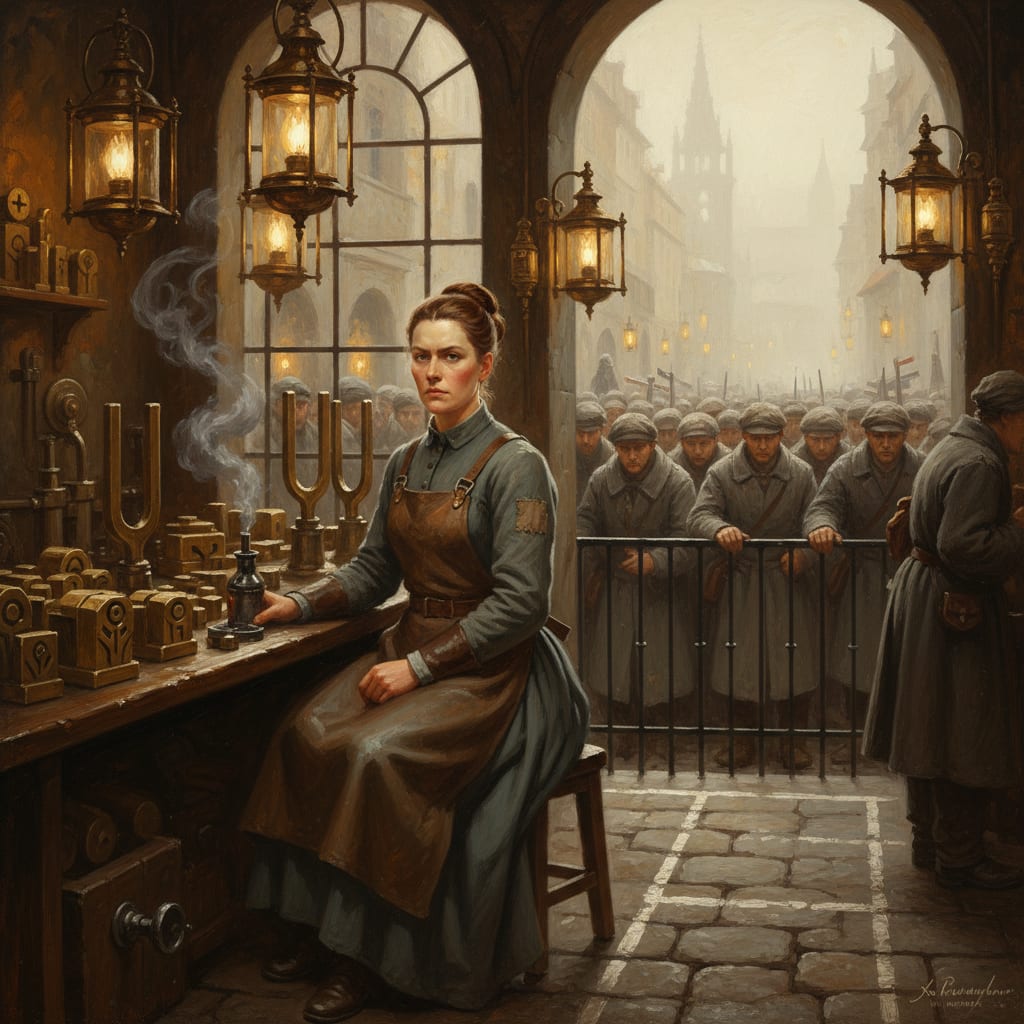
The Route-Stamper — called Indulgence-Token Smith when the work is fine, Chime-Maker when the work is honest, and Foot-Leasher when the work is resented, which is always — manufactures the Synod's walking permissions. Every pilgrim, every courier, every merchant convoy, every conscript column marching toward the Sagittal Line, every funeral cortege bearing a saint's bone-fragment to its appointed reliquary: all carry tokens. The token proves you are where your papers claim you are, at the hour you are permitted to be there, moving at a pace the Bureau of Commerce has approved and the Bureau of Records has logged. Without a token, you are an unlicensed body on a licensed road. The distinction between unlicensed body and heretic-with-legs is, in the Synod's operational lexicon, a matter of timing: the former has six hours to present documentation; the latter has already been documented, by his absence from the ledger, as guilty.
#On the Bell-Hour and Its Captive Voice
The token itself is palm-sized, die-struck from brass or — in frontier workshops where brass has been requisitioned for shell casings — from a copper-tin alloy the smiths call "prayer-metal" and the Bureau of Engineering calls "substandard." Its face bears a crest stamped by the issuing forge's master die: route designation, serial number, date of issue, and the seal of the authorising Gate Prefect. Its reverse is blank, because the reverse is where the cancellation stamp goes, and blank space on a Synod document is sacred — it is the space reserved for the authority that has not yet spoken.
Inside, seated in a pocket of wax and wire, sits the bell-hour core. A sliver of consecrated bell-metal — shaved from a church bell, tested for resonance, sanctified by the Bureau of Bells or, in practice, by whoever in the district can swing a censer and sign a form — that vibrates at a frequency matched to the route's designated Bellway cadence. The core ticks. It tolls. It produces, at intervals calibrated to the walker's expected pace, a sound that the Synod's gate wardens are trained to recognise and that minor road-spirits and river-wights are, by experimental observation, trained to avoid. A traveller carrying a true-tuned token walks in a corridor of sanctified sound. A traveller carrying a dead token — one whose core has drifted, cracked, or been swapped — walks in silence, and silence on a Synod road is an invitation that the road's less welcome residents are always prepared to accept.
The manufacture is exacting. A Route-Stamper's day begins with ash-water — hands washed in it, dies warmed over it, the morning's route edicts read beside a basin of it. The blank tokens arrive from the foundry in lots of fifty, each stamped with a provisional serial that will be overwritten during the pressing. The smith reads the day's hour-pattern — a coded schedule distributed by the Commerce Auditor specifying which routes are open, which cadences are authorised, and which bell-slivers may be seated — and prepares the die accordingly. Then the pressing begins: identity verified, route eligibility confirmed, crest struck, serial bound to a ledger entry, bell-hour core seated and tuned, wax seal applied, and a walk-test conducted in the shop's pacing lane to confirm the token tolls true at the expected stride length. Five minutes per token if the smith is good. Eight if the smith is careful. Twelve if the queue is screaming and the Gate Prefect has sent a runner demanding to know why the morning convoy is still parked in the yard.
#On Saint Cadrin, the Patron, and the Convenient Myth
Every profession in the Synod claims a patron saint. The Route-Stampers claim Saint Cadrin the Measured, who — according to the canonical vita approved by the Bureau of Doctrine in A.S. 112 — walked a siege-ring around the walls of a besieged city until dawn, counting every step, never once losing the hour, and thereby proved that movement itself could be prayer if sufficiently audited.
The vita is thin. Cadrin's name does not appear in any pre-Concordat source. The siege in question is identified variously as the Siege of Ulm, the Siege of Worms, the Siege of "a city whose name the faithful need not know," and — in one marginal annotation that the Bureau has since classified — the Siege of Nowhere, A.S. Never. The Route-Stampers venerate him regardless. His icon shows a man with a tuning fork in one hand and a ledger in the other, walking in a perfect circle, his feet never touching the ground. The icon is displayed in every stamp-chapel in the Synod's territory, and the tuning forks sold as relics in the market stalls outside those chapels are, by the Bureau of Relics' own audit, manufactured at a rate of approximately four thousand per year from a saint who owned, at most, one.
An earlier edition of this entry attributed the founding of the Route-Stamper profession to the Bureau of Pilgrimage.
The Route-Stamper profession is chartered under the Bureau of Commerce. The Bureau of Pilgrimage's contribution was limited to demanding that pilgrim tokens toll louder than commercial tokens "so that the faithful may be distinguished from the merely transactional." The Commerce Auditor's response — that a louder toll attracted more road-spirits and therefore more casualties — has been filed and ignored.
#On the Great Counterfeit Winter and Its Consequences
The profession's defining catastrophe — the event that transformed Route-Stampers from guild artisans into licensed instruments of state control — was the Great Counterfeit Winter of approximately A.S. 160.
The details are disputed. The consequences are not. A network of forgers — operating, by the Bureau of Records' reconstruction, from workshops in Lyon, Marseille, and at least two unidentified frontier towns — produced a batch of tokens whose bell-hour cores were tuned to a cadence fractionally off the authorised Bellway frequency. The tokens looked correct. They stamped correct. They tolled at a pitch that, to an untrained ear, sounded correct. They were not correct. The drift was measured in fractions of a second per hour, and the accumulated error, over a week's march, placed the bearer approximately three hundred yards from where the Bellway's protection actually ran.
Three hundred yards is enough. The casualties were logged — eventually — as "route-adjacent fatalities, cause: environmental," which is the Bureau's preferred euphemism for "eaten by something the Bellway was supposed to keep out." The purge that followed consumed fourteen forges, an unknown number of smiths, and the entirety of the Lyon Stampers' Guild, whose master die was confiscated, melted, and recast as a bell for the Chapel of Saint Cadrin in Strasbourg. The bell tolls on the hour. The smiths do not.
After the Winter, the Synod chartered the profession under Commerce with Records holding veto authority — meaning that a Commerce Auditor can license a forge, but a Records Adjudicator can shut one down, and the Records Adjudicator does not need to explain why, because Records never explains why, because explanation is a concession to the explained-to, and the Bureau of Records makes no concessions.
#On the Factions and Their Disagreements
Three camps divide the profession, and the division is theological in the way that all practical disagreements in the Synod eventually become theological, which is to say: murderous, petty, and irresolvable.
The Cadence Purists hold that only Synod-approved harmonics may be used in bell-hour cores. The approved frequencies are published quarterly by the Bureau of Bells, derived from calculations that the Bureau describes as "sacred mathematics" and that the Tuners who must implement them describe as "guesswork printed in Latin." The Purists tune to the published cadence regardless of local conditions — terrain, weather, ambient demon-resonance — because deviation from doctrine is heresy, and heresy is worse than a dead traveller, and a dead traveller is, in any case, the Bureau of Records' problem, not the smith's.
The Route Pragmatists tune for safety. If the published cadence produces drift on a mountain road in fog, the Pragmatist adjusts. If the Bellway's sanctified corridor runs through a river-ford where the water's own resonance interferes with the core's frequency, the Pragmatist re-tunes. The Bureau of Bells considers this heterodoxy. The Bureau of Engineering considers it "field-expedient calibration." The travellers who survive the mountain road consider it common sense, but common sense has never been a recognised category in the Synod's doctrinal index.
The Silent-Core Crew operates in the profession's cellar. These are shadow smiths who install muted cores — tokens that pass visual inspection but produce no toll, or a toll pitched below the range of human hearing, allowing the bearer to move without the Bellway's acoustic surveillance tracking them. The customers are smugglers, deserters, unlicensed merchants, and anyone whose business requires them to be somewhere the Synod has decided they should not be. The Silent-Core Crew charges well. They are caught occasionally. The punishment is die confiscation and reassignment to trench notary work at the nearest bastion, which is a death sentence pronounced in the administrative dialect.
#On the Midnight Test and Other Devotions
A token sounds different after midnight. This is documented. The Bureau of Engineering attributes it to temperature-induced frequency drift in the bell-metal. The Route-Stampers attribute it to the fact that after midnight the token is no longer speaking to the road; it is speaking to something else. Both explanations produce the same operational protocol: every forge runs a midnight sample test, pulling a random selection from the day's production and listening to them in a sealed chamber the smiths call the "quiet box."
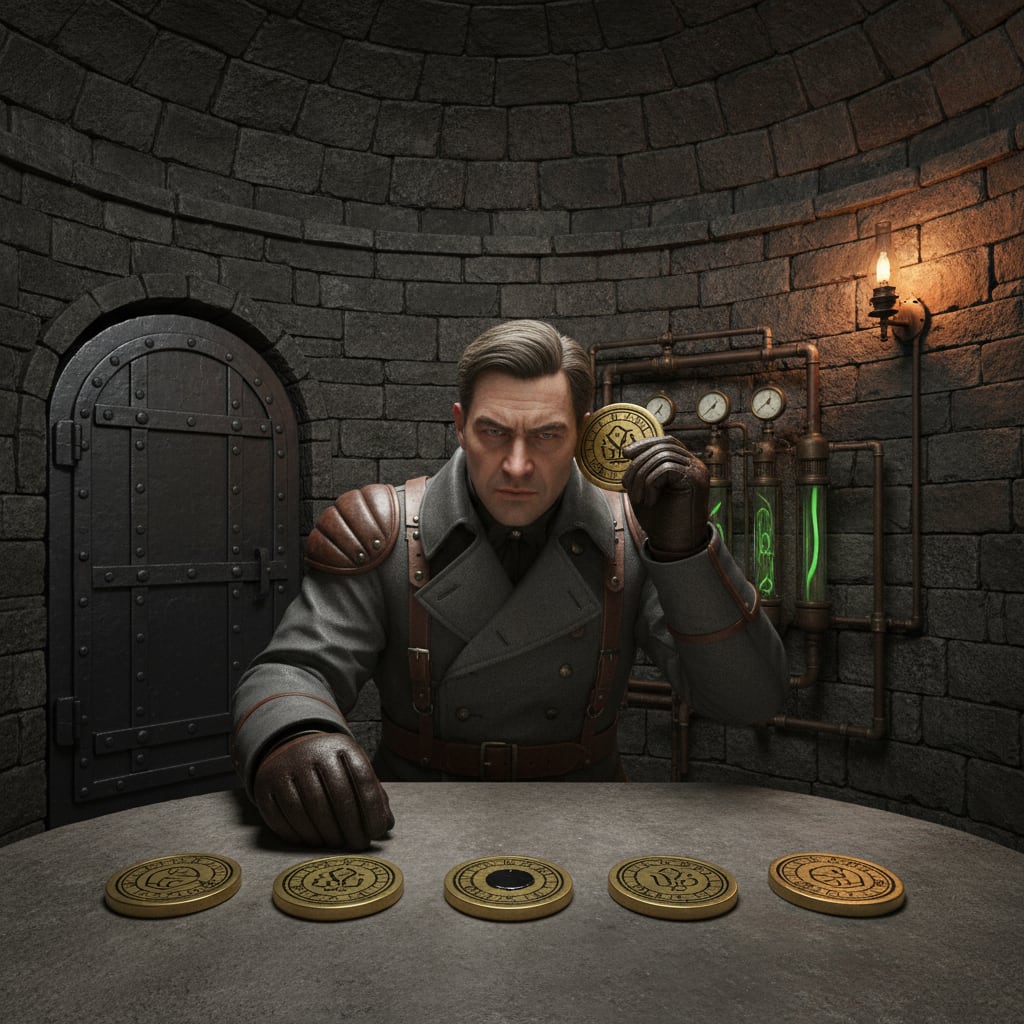
What they listen for is difficult to articulate. I sat in a quiet box in Rheinscarp's Cantor Foundry district and listened to a Bell-Hour Calibrator test six tokens. Five tolled clean. The sixth — identical in every visible respect — produced a sound that the Calibrator described as "wet." He pulled it from the batch, marked it with a black wax dot, and dropped it into a bin labelled, in chalk, Unclean. I asked what would happen to it. "Melt," he said. I asked what made it wet. He looked at me with the expression of a man who has been asked to explain colour to a bureaucrat.
"Something answered," he said.
I did not ask a follow-up question.
#On the Moral Cost of Measured Steps
The Route-Stamper's hands are scarred with fine burns and stamped with accidental crests — occupational marks that identify them as surely as a brand identifies a convict. Their ears ring. Their fingers smell perpetually of hot brass and wax smoke. They count steps in their sleep. These are the physical costs, and they are unremarkable; every profession on the Line exacts its tithe in flesh.
The moral cost is quieter. Every token is a decision. Every stamp is a judgement rendered in brass and wax: this person may move; that person may not. The Route-Stamper at the pilgrim gate who issues a token to a family of four is also the Route-Stamper who denies a token to the fifth person in the queue — the one whose papers are smudged, or expired, or issued by a prefecture that the Bureau of Records has reclassified since last Tuesday. The denied traveller does not vanish. He stands at the gate. He watches the family walk through. He watches the token toll its permission into the morning air. Then he turns and walks back into the city, where his name is now logged as "presented, denied, unaccounted," and "unaccounted" is a word that, in the Synod's operational grammar, conjugates toward "heretic" with the inevitability of a bell-hour running down.
An earlier edition described the Route-Stamper as "half artisan, half jailer."
The Route-Stamper is entirely artisan. The jailing is performed by the system. The Route-Stamper merely operates the lock. This correction has been noted by the Bureau of Commerce, which objects to the implication that commerce involves confinement, and by the Bureau of Records, which objects to nothing, because objection implies that a counter-position exists, and in the Bureau of Records' understanding, it does not.
The slang tells the story. "Your token's talking" — you are being watched. "Don't outrun your hour" — do not deviate from your sanctioned route. "Wax lies in rain" — paper permits fail, but the bell-hour persists. "He walks on borrowed tolls" — a man carrying a dead man's token, or a forged one, or one bought from the Silent-Core Crew in a back-room transaction that the Bureau of Records knows about, has known about since A.S. 162, and has chosen not to act upon, because the Bureau of Records' inaction is itself a form of record, and the record is: we see you, and we are waiting.
Walking is a contract. The Route-Stamper is the notary.