
#On the Alignment of the Roads
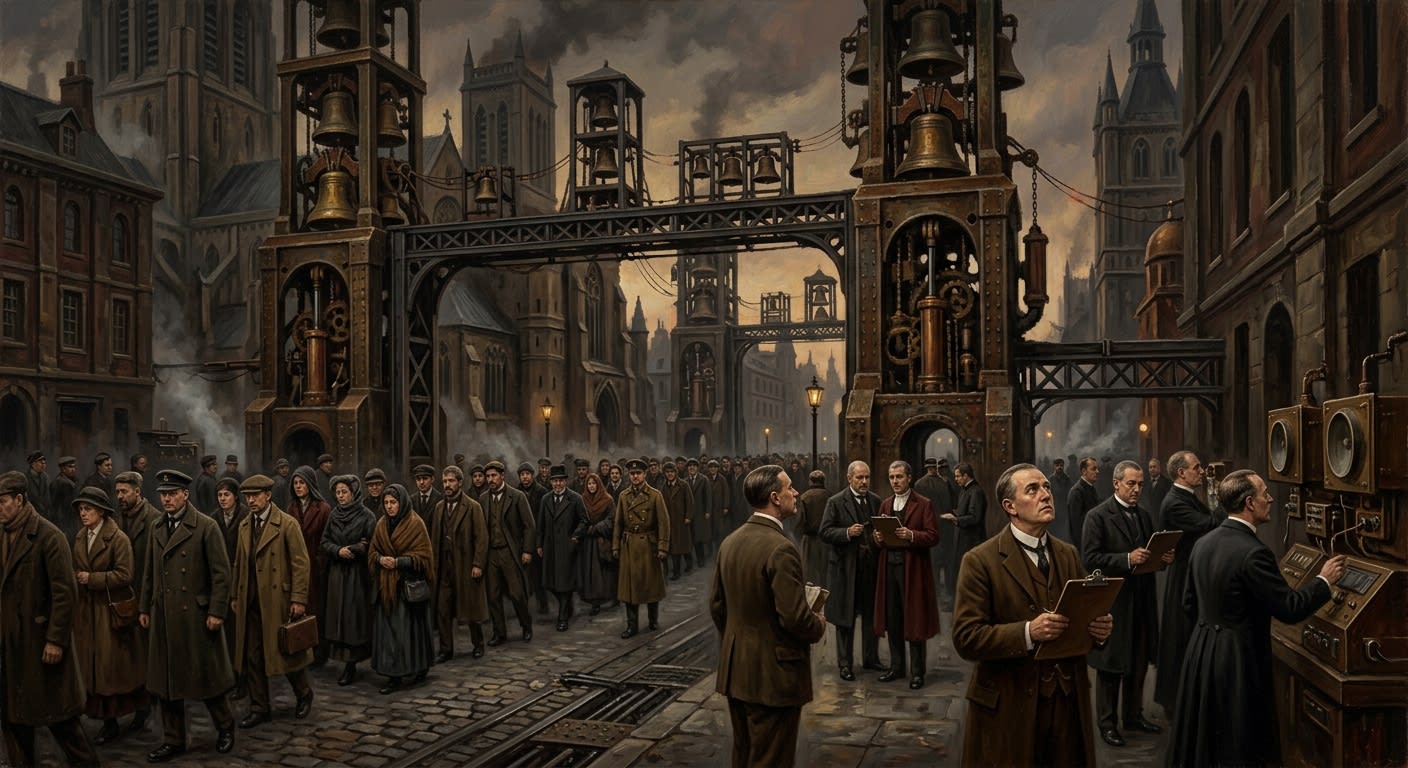
The Bellway Harmonisation of A.S. 148 was the moment the Bureau of Bells taught the Jubilee road to keep time under threat of investigation.
Before Harmonisation, a Jubilee column moved with the road. Rain slowed it. Mud slowed it. Heat broke it. A broken bridge, an overturned relic-cart, a dead mule in a narrow lane, a village crowd too pious to move aside — all these vulgarities could delay sacred motion, and the Pilgrim-Chain Handler would answer with a note on the tally slate. The note might be false, lazy, stained with ditch-water, or written by a man whose education had ended at the lash, but it was a note. The road still possessed the old privilege of obstruction.
Bells took offence.
The Harmonisation aligned each sanctioned Jubilee route to the acoustic schedule of shrine-posts, parish towers, road chapels, portable field bells, and relay carillons. The origin bell sounded at Prime. The route clock opened. Each column was required to arrive within its appointed bell-window before the next shrine’s toll fell silent. A bell-window is a narrow thing: wide enough for obedience, too narrow for weather, grief, panic, childbirth, broken ankles, demon-noise, or the ordinary incompetence of horses.
#On the Acoustic Net
The system pleased the mathematicians first, which is never a good sign.
Bells claimed it could track a column without riders, flags, signal-fires, or trustworthy men, simply by listening to the ordered peals along the route. Bell A sounded departure. Bell B answered receipt. Bell C confirmed passage. A gap in the sequence marked delay. A premature toll marked falsification. A cracked interval marked interference. The road, formerly a strip of mud and stone between shrines, became a ledger written in bronze.
The Bureau of Records admired the neatness. The Bureau of Purity admired the accusation. The Bureau of Pilgrimage admired nothing, because Pilgrimage had just been handed a clock and told that every pilgrim’s knee, lung, blister, fever, terror, and confession must now obey it.
At first the Handlers tried to treat bell-windows as guidance. The first season cured them. Three columns on the Strasbourg–Przemyśl road missed Station IV by less than nine minutes. One Handler blamed rain. One blamed a chain tangle. One blamed a priest who insisted on hearing a dying woman’s confession in full. Purity accepted all three explanations, then burned the chain tangle report in front of its author and asked why his locks had not been inspected earlier.
A Pilgrimage circular from A.S. 149 states that Harmonisation “increased route safety through improved temporal clarity.”
Corrected: Harmonisation increased route liability. Safety is what Public Information (Unregistered) writes when it has lost custody of a sentence.
#On the New Arithmetic of Death
The Handlers learned quickly that a missed bell was worse than a dead pilgrim.
A dead pilgrim could be entered on Form 17-C as spiritual completion. The body could be released to the ditch, the tag retained, the count adjusted or concealed, the confession strip bundled if any breath had survived long enough to stain vellum. Death had a form, a countersignature, a parish category, and enough precedent to bore even a Purity investigator.
A missed bell rang upward.
It rang into the shrine ledger, the district tower register, the Pilgrimage route office, the Bells interval desk, and at last into the little chapel of administrative suspicion where Purity keeps its knives sharpened in holy oil. A dead man lies down. A missed bell travels.
This produced a sharper cadence. Columns were started earlier and rested less. Water was spent according to slope and sound rather than thirst. Confessions were cut short when the interval closed. Shrine-priests complained that penitents were being rushed through contrition. Handlers replied, correctly, that contrition could finish in the ditch if the bell had no room for it.
The old mercy quota formula of A.S. 141 survived, but Harmonisation changed its teeth. Relief units now served the bell before the body. A cup of water went to the pilgrim whose collapse would cost ten minutes; the louder moral claim could parch. A bandage went to the ankle that could still bear weight. The road became more efficient. Naturally, more people died in the correct places.
#On the Bell-Masters’ Triumph
The Bureau of Bells remembers A.S. 148 as an act of sacred acoustical governance. Its commemorative folios show clean roads, obedient columns, towers answering towers across valleys, and little lines of pilgrims progressing under neat arcs of sound. The drawings contain no flies. Official art rarely does.
The Bell-Masters gained more than supervision. They gained jurisdiction over delay. A local priest who prolonged confession could be charged with interval obstruction. A mayor whose market carts blocked the lane could be fined under tonal interference statutes. A Handler who falsified arrival could face Purity review for acoustic fraud. The bell became witness, magistrate, and informant.
BUREAU OF BELLS — OPERATIONAL SECURITY EXCERPT, A.S. 17█ Sequential shrine-peals identified deviation in three Jubilee corridors. Heretic rescue parties located by █████████████ acoustic interval matching. Neutralisation authorised by ██████████. Survivor count: █ Public explanation: bell maintenance.
This later use, in the A.S. 170s, is officially unrelated to Harmonisation. That is a convenience. A tool made to hear delay can hear rescue. A schedule made to discipline pilgrims can discipline anyone unwise enough to move between bells.
Earlier Bells commentary denied that Harmonisation created an acoustic surveillance net.
Clarified: Harmonisation created an acoustic devotional compliance lattice. The difference satisfies Bells, alarms Pilgrimage, and insults anyone with ears.
#On the Road After A.S. 148
By A.S. 201, no Handler alive remembers the old road except as grandfather-talk and training theatre. Columns depart at Prime. The first bell opens the route. Shrine-posts answer. Route-Stampers stand with tally slates ready. Children wave flags because the proper bell has told them when to wave. Shopkeepers pull bread displays back from the lane before the interval brings chain and hunger together. The whole road listens to itself being obeyed.
The Road-Mercy Scandal made mercy countable. The Bellway Harmonisation made time prosecutable. Between them the Jubilee acquired its modern perfection: water in units, bodies in columns, death in forms, motion in bells.
A Handler may still choose where to spend water. A priest may still whisper absolution faster than the rule allows. A mother may still run beside a chain until her lungs become red paper in her chest. These are human acts, brief and untidy. The bell hears them only as interval.