
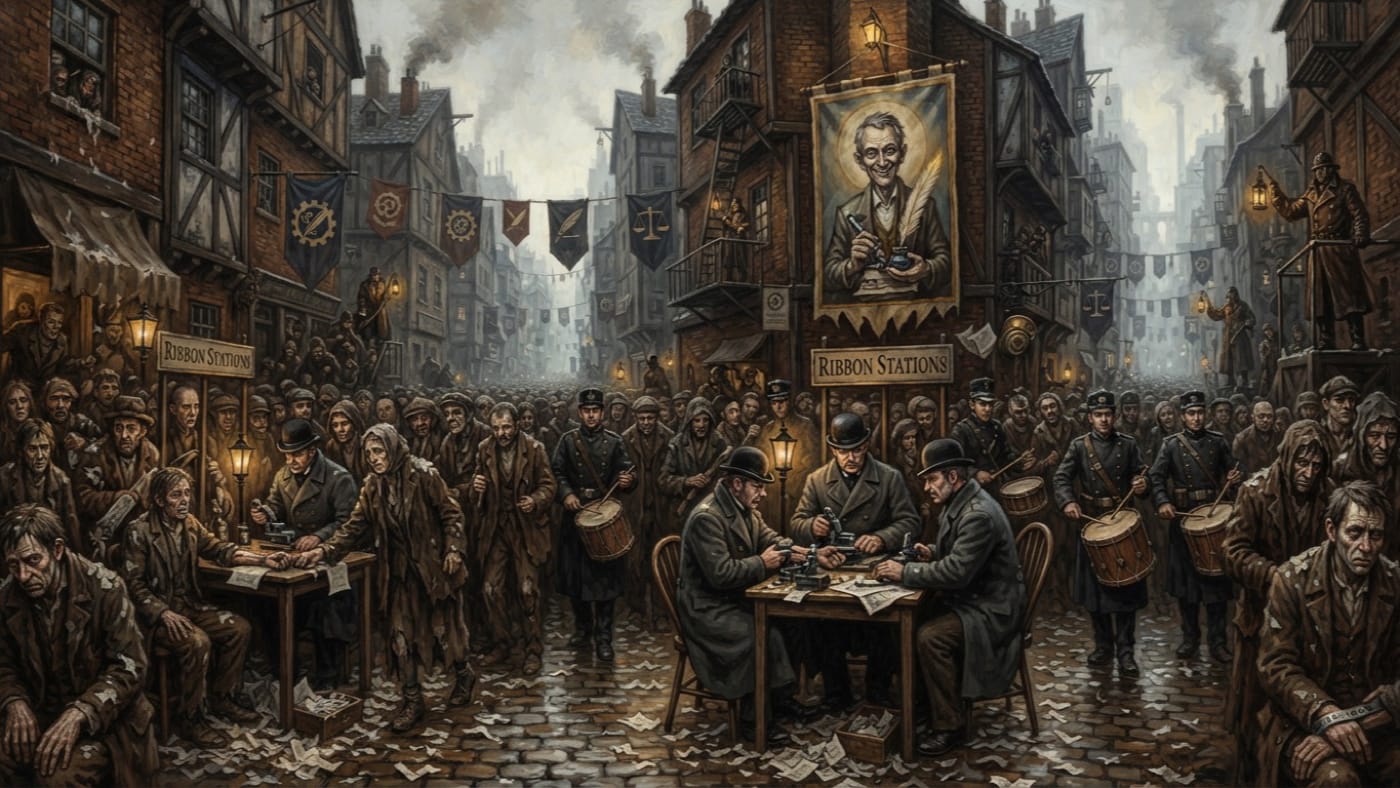
#On the Account and the Quarter
This is a survey, made in A.S. 201, of what survives concerning the Calming of the Marrow Quarter. It covers one procession in one district of Strasbourg and one claim about how that procession ended. The claim belongs to the cult of Saint Caldrin the Jubilant Scribe, who is credited with it as the first of his three miracles. The procession's year is recorded nowhere I am prepared to seal. The account places it after the Gray Week Famine, in streets "still sour with riot." That is all the chronology it has. Festivals would like a feast-day for it, Records would like a folio number, and the Ledger would like both offices to stop writing to me about it.
The famine's own year is still disputed between the Bureaus. Records dates it by harvest failure and Festivals dates it by decree. Neither method dates the Calming, and I will not let either office lend it a year it has not earned.
The Marrow Quarter needs little description beyond the one the sources give. During Gray Week its mothers boiled bone-broth thin enough to shame rainwater. Its households had eaten the meat, then the fat, and finally the name of the district. A quarter in that state makes a poor witness to its own counting. It is also very easy to count, if you come with the right instrument.
#On the Failure of Open Counting
Gray Week's open grain audits went into several cities at once: Strasbourg, Marseille, Munich, and a fourth city the files cannot agree on. The auditors carried household schedules, ration lists and escorts, and they had the confidence of men who had eaten breakfast. The citizens answered with cobblestones and stove hooks.
In the Marrow Quarter a Ledger Prefect was stripped of his sash, pasted with his own audit forms using fish glue, and paraded beneath the same windows he had come to inventory. He survived. In that week the Quarter seems to have counted this as mercy, and the Prefect counted it as a career.
Caldrin of Essen was then a junior clerk in the Bureau of Festivals. The dossier says he read the riot returns, marked where the audit had failed and noted the census gap that followed. His conclusion was simple and therefore dangerous. People who refuse a ledger at their own door will walk up to one in the street if a drum walks ahead of it. Inspection had failed because it looked like inspection. The fix was to make it look like a holiday.
The distinction matters to the Bureau even when it does not matter to the hungry. A citizen who joins a procession has participated. Nobody has asked whether he consented, and the procession is built so that nobody has to ask.
The earliest Festivals vita states that Caldrin "heard the people's distress and answered with joy."
Corrected per the Caldrin dossier: Caldrin read the riot returns, identified the census gap, and proposed an instrument by which hungry citizens could be gathered voluntarily under banners. Distress was the occasion and joy was the bait.
#On Ribbon, Scroll and Pause
Caldrin's first memorandum proposed three devices. The surviving account of the Calming assumes all three, and the procedure only makes sense if they are taken in the order a citizen meets them.
First comes the gathering: banners, music, free cider, and the promise of something that is not an audit. The crowd assembles itself, and it does so for the cider.
Second comes the Ribbon Runner, who works along the edge of the crowd carrying a punch-tool and a smile. The wrist-ribbon is punched through the skin of the wrist with a pattern that identifies the procession, the district and the feast-day. It hurts and bleeds a little, and it stays where it is put. A paper receipt can be forged, lent, burned, eaten or dropped in a gutter. A ribbon through the flesh can be checked against a route and a counting station by anyone with eyes and a list.
Third comes the gratitude pause. The procession slows beneath a banner, a painted saint, a cider table or a fall of confetti for long enough that the clerks can count wrists. The citizen thinks he has stopped to give thanks. The clerk knows the procession has stopped so that he can count.
The confetti was shredded audit paper. The failed instruments of the open audit came down on the Quarter as decoration, and children caught the strips.
Behind all this sits the receipt-scroll. The scroll belongs to the clerk and the ribbon belongs to the citizen, which is why the account can speak of both without contradicting itself. The ribbon proves that a wrist was present. The scroll carries names, and those names are reconciled against the parish ledgers until every household on the roll either answers or is corrected. Under all the cheer, that reconciliation is the purpose of the procession.
#On the Claimed Calming
The tradition makes three claims. A procession entered the Marrow Quarter while the streets were still sour with riot. It left with no deaths, four thousand wrist-ribbons and a complete household correction ledger. Pious copies set these out like the three loaves of a feeding miracle, and pious copies have rarely balanced a ledger.
I accept the account as an account and sign for nothing more. Each of its three figures says less than it appears to.
No deaths is a claim about this procession. It does not cover the famine before it, the riots before that, or the Prefect's glue. Gray Week had its own dead and kept them.
Four thousand wrist-ribbons counts ribbons. It does not count citizens, households or mouths fed, and it does not measure grain recovered. A ribbon is a mark on a wrist that passed a station. How many distinct wrists there were, and how many distinct households they came from, the figure does not say. The saint's later reputation for arithmetic suggests that nobody should assume.
A complete household correction ledger means the ledger was complete. Whether every entry in it was true is a separate question that the account does not answer. Completeness is an administrative condition, and truth belongs to another department, one that is understaffed.
The Caldrin dossier itself calls the event "less miracle than competent staging." I agree with this opinion, and I note that the Synod canonised Caldrin anyway, on claims thinner than this one. A procession went into a hostile quarter and came out with its count. In the Bureau's grammar that is a calming. Whether anything in the Quarter was actually calmed, apart from the books, the account does not record.
#On the Reform and the Lanterns
Devotional prints run three things together into one bright week, and this survey keeps them apart. They are the Calming, the Reform and the Accord.
The Receipt Reform of A.S. 138 / 1848 CE is dated, decreed and sealed. Synod Directive 88-F abolished paper receipts at sanctioned public celebrations and made wrist-ribbon stamps mandatory across Bureau processions. The Council of Prefects recorded no dissenting votes. With that directive Caldrin's expedient became law. The improvisation of a desperate clerk became the obligation of every licensed Receipt-Procession Pageant Captain, and his patronal recognition was entered in the same year.
The Calming has no such seal. The surviving account does not say whether it came before the Directive or after it, and I will not infer an answer to suit a feast-day calendar. Two facts are certain. The apparatus was used in the Marrow Quarter, and the Directive later bound the whole capital to it.
The Lantern Accord of A.S. 139 / 1849 CE came the following year and did a different job. Before it, the Lantern Brotherhood were tolerated local watches whose authority could be denied as easily as it was used. The Accord took them into the parade structure as official crowd escorts. Caldrin's system had shown that a crowd could be steered, so the Brotherhood accepted the collar. Caldrin did not put it on them.
A later devotional broadside credits Saint Caldrin with personally founding the Lantern Accord of A.S. 139.
Revised: The saint's hand appears on no surviving copy of the Accord. Festivals has displayed a "probable signature." It is very pretty and entirely too legible.
Caldrin's name was later used as the seal on expansions carried out by other hands. The dossier does not say how long he lived after the Reform, and this survey does not attribute any later annex to his pen.
#On the Surviving Use
As of A.S. 201, Caldrin remains one of the most useful saints the Bureau of Festivals has. His smiling, ink-blackened image hangs above ribbon stations and over the doors of Pageant Captains' barracks. Captains touch his badge before a route walk and pray that he will keep the smile on the count. The Calming of the Marrow Quarter is still told first among his miracles, because it is the easiest to tell. It has a hostile street, a smiling clerk, a happy ending and a clean total.
The total is the only part of it that a Bureau can audit, and it is the part the Bureau trusts. I trust it too, on the narrow terms set out above: four thousand ribbons passed through the hands of Caldrin's clerks, and the ledger was closed. The Quarter's own opinion of its calming was never taken down on any scroll.