
#On the Week That Ate Its Receipts
The Gray Week Famine is the name given, by those citizens whose bones were present and whose clerks were absent, to the famine-riot sequence that preceded the Receipt Reform of A.S. 138. The precise year is disputed between Records and the Bureau of Festivals, for Records dates from the first failed grain return and Festivals from the decree that made the matter useful. The Bureau of Doctrine accepts A.S. 138 for public instruction. The dead, lacking calendars, have raised no formal objection.
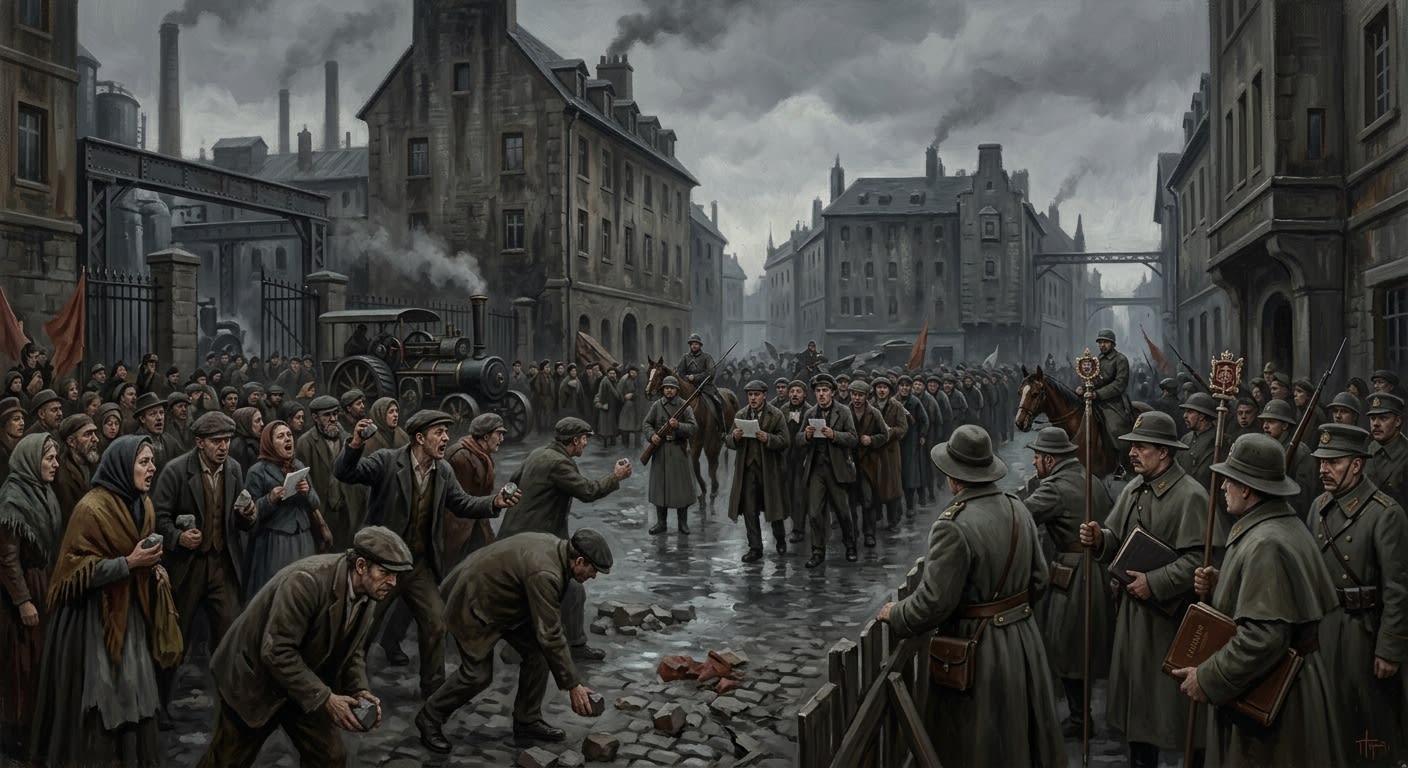
Gray Week began as hunger and became method. Four cities — Strasbourg, Marseille, Munich, and one city whose name shifts between reports with the elegance of guilty ink — were subjected to simultaneous open grain audits. Household tallies, granary inventories, ration slips, parish rolls, cellar checks, bakery weights, and warehouse keys were demanded under escort. The people had eaten bone-broth and rumour for eleven days. They answered with cobblestones.
The official classification is “Resolved (Sanguinary).” This means the riots stopped, the forms were recovered or replaced, the dead were assigned categories, and no senior office found it necessary to resign. A famine becomes resolved when it ceases embarrassing the seal.
#On the Hunger Before the Stones
Famine in the Synod rarely arrives as emptiness. Emptiness is too honest. It arrives as substitution. Bread becomes ration loaf. Ration loaf becomes bone-broth. Bone-broth becomes salted water with a parish blessing spoken over it fast enough that the priest can reach the next queue before fainting. Mothers learn which chapel candles use animal fat. Bakers learn to pad dough with ash-flour. Children learn that adults lie most tenderly when cupboards are bare.
Gray Week’s hunger came after a bad chain of returns: late grain convoys, swollen storage losses, contested parish ledgers, military requisitions filed with the tidy savagery of men whose garrisons must eat before anyone may complain about eating. The Bureau of Tithes insisted the shortfall was local misreporting. Records suspected concealment. Festivals, then still clinging to the delusion that public morale could be summoned by banners alone, recommended gratitude displays at ration courts. The Synod chose audit.
A Bureau of Tithes digest later described the food shortage as “a narrow provisioning irregularity exploited by agitators.”
Corrected: the irregularity had ribs, fever, and children licking flour dust from mill floors. Agitators were present because starving crowds manufacture them from whoever speaks first.
The open audit was designed to locate hidden grain. It located hidden rage. Auditors entered streets with ink still wet on their authority. They demanded receipts from women whose sons had been levied, inventory from bakers whose ovens were cold, compliance from porters whose hands shook too hard to hold a pen. Behind them stood escorts. Behind the escorts stood the idea, beloved by offices and fatal in alleys, that hunger respects paperwork.
#On the Four City Riots
In Marseille, the first audit table went over before noon. A fishwife struck a junior clerk with a scale weight; the clerk’s pen entered his cheek and remained there through two pages of subsequent testimony, a detail Records preserved with the chilly fascination of men who enjoy anatomy when it is filed. The port quarter seized three granaries, found less grain than expected, and blamed the auditors for the absence. This was unfair. Fairness had gone missing with the flour.
In Munich, parish wardens attempted to protect the audit ledgers by carrying them into a church nave. The crowd followed. By second bell, receipts were burning in the font, the pews had been broken into clubs, and a choirboy was standing on the altar reading ration names aloud to decide which households had lied. Popular government is always most enthusiastic when it has a list.
Strasbourg supplied the incident that entered every later sermon. In the lower wards, especially the Marrow Quarter, a Ledger Prefect was stripped of sash, collar, buttons, and doctrine. His own audit forms were pasted to his skin with fish glue. He was paraded through the streets while children recited column headings: household, grain, deficit, suspected concealment, correction due. He survived. His career did not.
The fourth city remains a bureaucratic quarrel. Festivals says Lyon. Records says Antwerp. A sealed Tithes memorandum says the fourth “requires no naming due to reconciliation hazard,” a phrase written when a map has become politically expensive.
CASUALTY TABLE — GRAY WEEK, COMPOSITE DRAFT Marseille: ███ dead, ███ injured, three granaries opened. Munich: ███ dead, font desecration logged, parish lists compromised. Strasbourg lower wards: ███ dead, one Ledger Prefect publicly processed. Fourth city: ███████████. Instruction: omit total until inter-Bureau agreement secured.
#On Caldrin’s Answer
The riots did what riots always do: they killed the unlucky, frightened the comfortable, and instructed the clever. The clever man was Caldrin of Essen, a junior clerk later styled Saint Caldrin the Jubilant Scribe. He read the reports and saw the essential failure. The people had not refused counting as such. They had refused counting at the point of a clerk.
His answer was the receipt-procession (Unregistered). If citizens would not submit to audit at their doors, they could be persuaded to gather under banners. If they would burn paper receipts, they could be given wrist-ribbons stamped through skin. If they would stone an auditor, they might smile at a Ribbon Runner beside a float. Music became escort. Confetti became shredded audit paper falling like harmless snow. Gratitude became route design.
The first gratitude march after Gray Week was presented as relief commemoration. Free cider was offered at pause points. Bread tokens were displayed, though not always distributed. Saints passed on carts. Drums covered the sound of punch-tools. By evening, the Bureau possessed what the open audit had failed to obtain: corrected rolls, attendance numbers, anomaly lists, missing households, forged receipt patterns, and enough visible joy to describe the operation as healing.
#On the Receipt Reform
A.S. 138 gave the lesson its legal teeth. Synod Directive 88-F (Unregistered) abolished paper receipts at Bureau-sanctioned processions and mandated wrist-ribbon stamps. The Receipt-Procession Pageant Captain corps was constituted as a licensed profession. The Council of Prefects recorded no dissenting votes, a statistic that may be admired by anyone unfamiliar with seating arrangements at public festivals.
The Lantern Accord followed in A.S. 139, bringing the Lantern Brotherhood into the parade structure as official crowd escorts. The Brotherhood received a collar shaped like legitimacy and called it promotion. Festivals received men who knew how crowds move when they begin thinking with fists. Records received data. Tithes received recoverable households. Doctrine received a saint. Gray Week received a lid.
Early Festival commentary stated that the Receipt Reform “restored joy after famine.”
Clarified: the Reform restored administrative sight after audit collapse. Joy was employed, costumed, measured, and released under escort.
The old paper slip had failed because it trusted citizens to preserve evidence against themselves. The wrist-ribbon improved upon this sentimental error. It made the body the receipt. The punch pattern named procession, district, station, and date. A Lantern patrol could read the wrist faster than a clerk could open a ledger. Removal tore skin. Forgery required dies. Absence became visible.
#On the Aftertaste
Gray Week remains present wherever the Bureau smiles too hard. Every Gratitude Alcove descends from those famine streets. Every lost-child tent with sweetmeats and questions. Every Pageant Captain’s drum-code. Every ribbon-punch wiped clean between wrists. Every child who lifts a hand for festival colour and receives a number.
The famine’s memorial rites are deliberately cheerful. Grey banners are forbidden; gold is prescribed. Bread is carried high in sealed baskets. No basket is opened during the procession. Choirs sing “All Gifts Require Witness.” Citizens wear commemorative ribbons dyed pale ash. The Bureau counts attendance with particular care.
As of A.S. 201, Gray Week is taught in civic catechisms as proof that the Synod learned mercy through hardship. Professionals know better. The Synod learned choreography. It learned that a starving crowd will kill a census clerk, but a fed-enough crowd will walk past six tally stations if drums, saints, cider, and children on floats conceal the arithmetic. The week did not end hunger. It taught hunger to march in formation.