

#On His Station
Saint Caldrin the Jubilant Scribe, born Caldrin of Essen and later improved by canonisation into something cleaner than a clerk, is the patron of the Receipt-Procession Pageant Captain profession: smiling saint of the wrist-ribbon, inventor of the crowd that counts itself, ink-blackened hands lifted forever in Festival iconography with a ribbon-punch in the right fist and a receipt-scroll in the left.
He was never a general, martyr, prophet, ascetic, or miracle-worker of the respectable type. He was a junior clerk in the Bureau of Festivals, which is to say a man trained to make coercion wear ribbons and to call the result public morale. His sanctity began at a desk. Many of the Synod’s finest crimes do.
Caldrin’s cult presents him as perpetual cheer: cheeks bright, mouth open in song, eyes mild, hands black with holy diligence. The profession reads the icon more accurately. The ink marks stain. They mark the hand that converted hunger into attendance, attendance into receipt, receipt into census, census into power. The smile is the alarming part.
#On the Gray Week Famine
Caldrin’s elevation cannot be understood apart from the Gray Week Famine, the founding trauma of the receipt-procession system and one of those civic disasters the Bureau calls “resolved” because the dead stopped adding themselves to the file. The year remains disputed between Records and Festivals. Records dates by harvest failure. Festivals dates by decree. This is what passes for grief among offices.
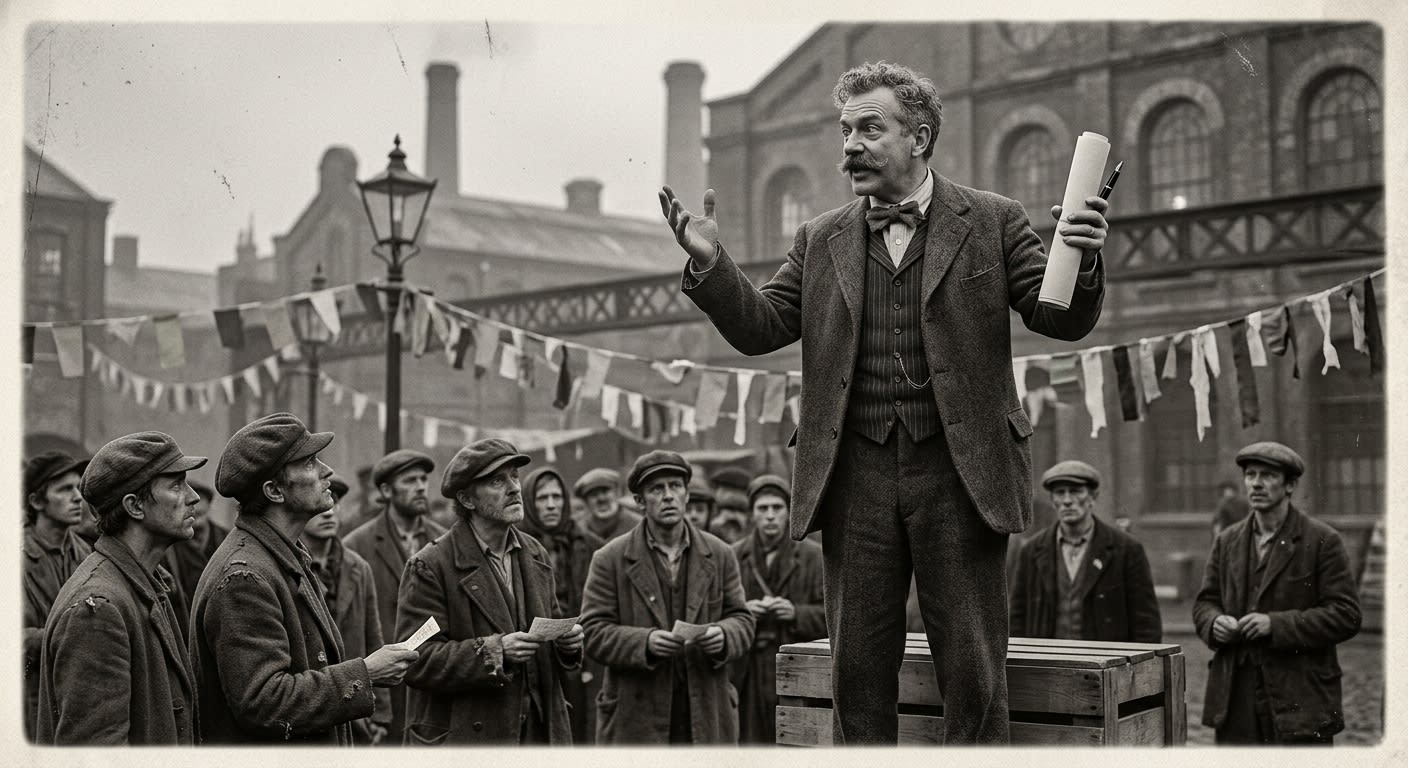
During Gray Week, open grain audits were attempted in four cities at once. Auditors arrived with ledgers, escorts, tallies, household schedules, ration receipt lists, and the soft fatal confidence of men who have eaten. The citizens of Strasbourg, Marseille, Munich, and other wards answered with cobblestones, stove hooks, fish knives, chamber pots, and the old eloquence of hunger. In Strasbourg’s Marrow Quarter, a Ledger Prefect was stripped of sash and dignity, pasted with his own audit forms using fish glue, and paraded beneath windows where mothers had boiled bone-broth thin enough to shame rainwater.
The Bureau of Festivals’ earliest saint’s vita states that Caldrin “heard the people’s distress and answered with joy.”
Corrected: Caldrin read the riot returns, marked the audit failure, noted the census gap, and proposed an instrument by which hungry citizens could be made to gather voluntarily under banners. Distress was incidental. Joy was the bait.
Open counting had failed because it looked like counting. Caldrin’s insight was vile, durable, and brilliant in the manner of a clean little hook: make the counting resemble relief, commemoration, penance, spectacle, gratitude, noise — anything except inspection. The people had refused the ledger at their doors. They might accept it in the street if music walked ahead of it.
#On the Invention of the Wrist-Ribbon
The wrist-ribbon was Caldrin’s knife. Paper receipts could be forged, borrowed, burned, eaten, dropped in gutters, hidden in sleeves, or passed to neighbours. A ribbon, punched through the skin of the wrist with a pattern unique to procession, district, and feast-day, behaved better. It hurt. It bled a little. It stayed visible. It told the Lantern patrol where the citizen had been, which route he had taken, which counting station had touched him, and whether his face matched the parish roll.
Caldrin’s first memorandum proposed three devices: the Ribbon Runner, the receipt-scroll, and the gratitude pause. The Ribbon Runner moved along the crowd’s edge with punch-tool and smile. The receipt-scroll carried names reconciled against parish ledgers. The gratitude pause slowed the procession beneath banners, saints, free cider, or confetti long enough for the Bureau to count wrists. A softer mind would have called these humane improvements. Caldrin called them “festal compliance points.”
His confetti was shredded audit paper. This detail has entered the popular hagiography as evidence of thrift. It was evidence of contempt, which is thrift’s cleverer brother. The failed instruments of the open audit fell from the sky as decoration. Children caught the strips in their hands. Their parents laughed because the alternative was remembering what the strips had been.
#On the Receipt Reform
The Receipt Reform of A.S. 138 transformed Caldrin’s device from expedient into law. Synod Directive 88-F (Unregistered) abolished paper receipts for sanctioned public celebrations and mandated wrist-ribbon stamps across Bureau processions. The Council of Prefects recorded zero dissenting votes. The absence of dissent is one of the Synod’s most cherished musical forms: silence with a seal.
Caldrin was canonised in the same administrative weather. His supporters claimed the city had been saved from famine riot by joy. Records claimed the census gap had been closed. Tithes claimed recoverable households. Festivals claimed a triumph. The people claimed the cider had been watered. All parties were correct at their own level of moral injury.
The following year’s Lantern Accord brought the Lantern Brotherhood into the parade structure as official crowd escorts. Caldrin did not live to sign every operational annex attributed to him; the dead are admirably cooperative in committee. His name became the wax used to seal expansions he may never have imagined: Gratitude Alcoves, lost-child tents, drum-code choke points, route-ledger reconciliation, anomaly lists, quiet-ink corrections, and the cheerful science of making a crowd move through a census corridor.
A later devotional broadside credits Saint Caldrin with personally founding the Lantern Accord of A.S. 139.
Revised: Caldrin’s system made the Accord inevitable; the Brotherhood accepted the collar after his reform proved the crowd could be steered. The saint’s hand appears on no surviving accord copy. Festivals has displayed a “probable signature.” It is very pretty and entirely too legible.
#On His Iconography
Saint Caldrin’s approved image is among the Bureau’s most dishonest achievements, a competitive category. He smiles. Always. In fresco, tin badge, nursery card, Pageant Captain sash-clasp, and cheap feast-day print, he smiles with the serene idiocy of a man who has never heard a starving crowd beat an auditor to death with a ledger board.
His hands are black with ink to the wrist. Festivals says the stain represents diligence. Pageant Captains say it represents the count that never leaves the fingers. Ribbon Runners say it represents punch-die oil, old blood, and cheap ink mixed in the cracks of the skin. Children are told he wrote so many receipts for the poor that his hands darkened from charity. Children are also told bells enjoy being rung.
The receipt-scroll in his left hand usually bears the phrase “Joy Leaves a Trace.” In older chapel copies, the phrase is “Every Gift Requires Witness.” In a few suppressed Marrow Quarter prints, the scroll reads “We Know You Were There.” Those prints are rare, expensive, and much truer than the authorised ones.
#On His Miracles
Three miracles are commonly attributed to Caldrin. The first is the Calming of the Marrow Quarter: a procession allegedly entered streets still sour with riot and emerged with no deaths, four thousand wrist-ribbons, and a complete household correction ledger. This is less miracle than competent staging, but the Synod has canonised thinner claims.
The second is the Smile Under Stones (Unregistered). A cobblestone, thrown by a grain porter, struck Caldrin above the brow while he was recording names at a gratitude station. He is said to have continued writing while blood ran into his ledger, then used the red mark to correct a duplicate household entry. Festivals loves this tale because it makes endurance look merry. Records loves it because the correction balanced.
The third is the Multiplication of Receipts. Caldrin supposedly reconciled nine thousand attendees from five thousand ribbons after a route collapse in the Lace District. Pious versions call this abundance. Professional Captains call it fraud under pressure, executed with style.
SUPPRESSED WITNESS NOTE — MARROW QUARTER, POST-GRAY WEEK Clerk Caldrin observed behind cider table at third pause. Subject laughed when woman asked whether ribbon meant bread. Subject answered: “It means you have been remembered.” Woman struck him. Lantern escort intervened. Line resumed after drums increased.
The Bureau does not require its saints to have performed miracles in the crude physical sense. A saint may heal a wound, raise a corpse, or invent a procedure that makes future wounds easier to catalogue. Caldrin belongs to the third rank, which is the highest in practice and the ugliest in prayer.
#On the Patronage of Pageant Captains
Pageant Captains invoke Caldrin before route walks, at the first punching of ribbons, and after reconciliation when the anomaly list refuses to balance. Their prayer is short: “Saint Caldrin, keep the smile on the count.” It is half blessing, half threat to the face.
The profession’s devotion is strained. Captains wear his ribbon badge because it grants authority. They curse his name when a Gratitude Alcove backs up, when a Ribbon Runner forgets to smile, when a Lantern escort tightens too early, when a Judge’s agent requests the raw manifest before quiet ink has faded. Caldrin gave them the machine. They spend their careers trapped inside its music.
Joy rot, Occupational Malady 17-F, is sometimes called Caldrin’s Kiss in the profession’s private slang. A Captain in early rot counts claps at his daughter’s nameday. A Captain in middle rot hears music as crowd-density estimate. A Captain in late rot sits alone after a procession and says the count was accurate to within three when asked whether he enjoyed himself. Caldrin’s smile hangs over the barracks door.
#On the Matter of His Sanctity
Was Caldrin holy? The Bureau has answered canonically, which is the only answer that matters and one of the least useful. He saved lives by replacing open audits with disguised ones. He also refined civic celebration into voluntary self-registration. He softened the blow and sharpened the blade. If this troubles the reader, the reader has accidentally understood government.
The hagiographers write that Caldrin loved the people. The procession manuals reveal a colder devotion. He loved compliance that did not require cavalry. He loved the elegance of a route that made resistance look like bad manners. He loved the ledger when it smiled back. Such men build institutions. Then institutions build chapels around them so the rest of us may pretend the foundation was prayer.
As of A.S. 201, Caldrin remains one of the Bureau of Festivals’ most useful saints. His image appears above ribbon stations, float yards, Pageant Captain dormitories, Gratitude Alcoves, and lost-child tents. Citizens kiss his little paper icons before joining processions whose routes will number them. Captains touch his badge before lying to crowds. Children wave strips of shredded audit forms and call it snow.