
#On the Collar and the Bone
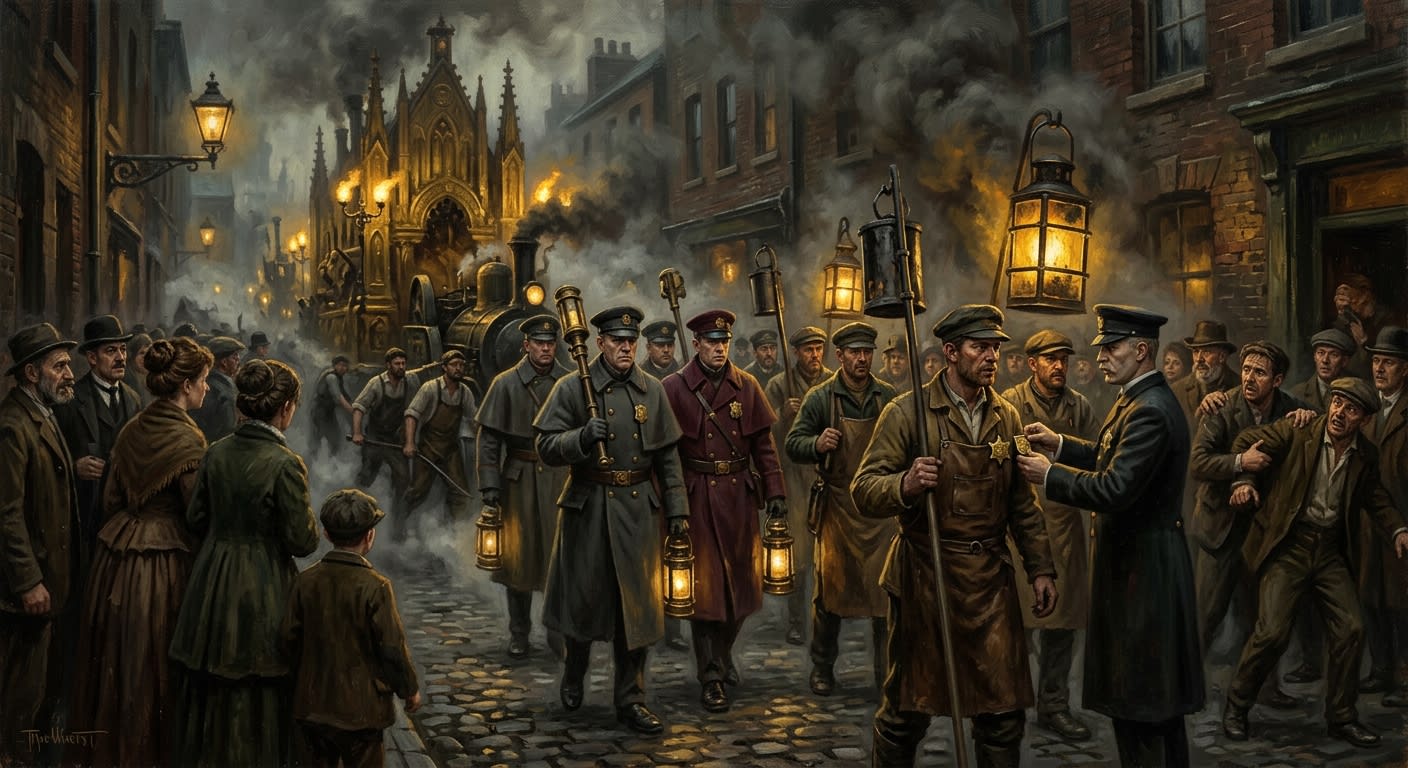
The Lantern Accord of A.S. 139 was signed one year after the Receipt Reform taught civic joy to bleed through the wrist. It integrated the Lantern Brotherhood’s tolerated watches into the Bureau of Festivals parade structure as official crowd-escort personnel. The Brotherhood accepted a collar and a bone at the same table, with the grave solemnity of dogs pretending to be magistrates.
Its public text speaks of orderly movement, civic reassurance, procession safety, and the prevention of route panic. Its working annexes speak more cleanly: hold the edge, watch the sleeves, read the ribbons, break the surge before it discovers itself. After Gray Week, the Synod had learned that a hungry crowd could kill an auditor. After Directive 88-F, it learned that a counted crowd still possessed legs. The Accord purchased those legs by lanternlight.
#On the Brotherhood Before the Accord
The Lantern Brotherhood had existed for decades under the Curfew Ordinance of Quiet Hours, that exquisite A.S. 94 clause drafted in Vicar-General Anselm Rihn’s hand: auxiliary vigil personnel, locally licensed, subject to revocation without notice or appeal. The sentence did not name the Brotherhood. It merely opened a kennel and called the animal useful.
By A.S. 139, the Brotherhood knew the street better than Festivals knew its own stores. It knew which alleys emptied into ration courts, which markets turned ugly after watered cider, which bridge parapets attracted deserters, which mothers hid sons under laundry carts, which children could crawl under rope lanes and sell the route map to a ribbon-forger before second drum. The Bureau of Festivals possessed banners. The Brotherhood possessed corners.
An early Brotherhood manual claims the Accord “recognised the ancient liberties of the lantern.”
Corrected: the Accord recognised a convenience. Ancient liberties are what armed men call their habits before someone stronger writes them down.
The old toleration clause had kept the Brotherhood balanced on a narrow legal plank. The Accord widened the plank during processions and greased it everywhere else. A Brother on night patrol remained deniable. A Brother on a Festival route became visible, badged, stationed, and expected to smile at infants who would later learn to fear his boots.
#On the Terms
The Accord granted Brotherhood escorts three privileges during sanctioned processions. First: right of route movement before, during, and after the public event, including passage through restricted staging lanes and Gratitude Alcoves. Second: authority to inspect wrist-ribbons for colour, punch pattern, station mark, and tearing. Third: temporary detention of anomalies until a Pageant Captain, Ribbon Runner, Warden clerk, or sufficiently bored judge’s agent could decide what the anomaly wished to become.
The price was obedience to Festival drum-code. This offended the Brotherhood more than the inspections, more than the route ledgers, more than the requirement that lanterns be polished to civic brightness rather than honest curfew grime. Lantern men were accustomed to cough signals, lamp angles, boot scrapes, and the small nocturnal liturgy by which one Circle tells another that trouble has turned left. Festival drum-code was loud. Worse, it was cheerful.
The last clause did the real work. It did not forbid extortion. It forbade unrecorded extortion. A Brotherhood escort could still sell a safer place near the rope, a faster exit, a softer glance at a torn ribbon, provided the favour did not break the count. Festivals has never objected to corruption that files itself.
#On the First Processions Under Accord
The first Accord processions were clumsy, bright, and mean. Pageant Captains mistrusted the Brotherhood because every Lantern carried a private map of the city in his head and no decent official enjoys competing archives. Lantern escorts mistrusted Pageant Captains because Captains wore lacquered masks, carried manifest ledgers, and believed a crowd could be improved by choreography. Both sides were correct, which made cooperation hideous.
At the Feast of Saint Merrow’s Tally, Strasbourg’s Lace District saw the new arrangement operate in full. Lanterns held the alley mouths while Ribbon Runners worked the edges. Captains kept floats pausing long enough for wrist checks. Drummers drowned a ration chant before it grew teeth. A lost-child tent received nineteen children, six deserters, three dead men under false names, and a widow whose ribbon bore a punch pattern from a feast that had not occurred yet. The official report called the procession serene.
LACE DISTRICT PROCESSION REPORT — A.S. 139, FIRST ACCORD SEASON Anomalies detained: ███ Ribbons torn during inspection: ██ Children transferred to correct household: █ Children transferred to useful household: ███ Lantern injuries: █ Deaths attributable to crowd movement: none recorded after reconciliation.
Records praised the accuracy. Tithes praised the recoveries. Festivals praised the visible calm. The Brotherhood praised nothing in writing and doubled its oil allowance by autumn.
#On Caldrin’s Afterlife in the Accord
Caldrin of Essen did not sign every annex later placed beneath his smiling image. Dead saints are excellent committee members: punctual, silent, and incapable of objecting when their miracle expands into a policing instrument. The Accord used him as wax. His wrist-ribbon made the patrol useful; his receipt-scroll made the route sacred; his smile made the knife easier to bless.
Festivals chapel prints from A.S. 140 show Caldrin standing beside a Lantern escort, one ink-black hand resting on a ribbon-punch, the other hovering above an ash-oil lamp. The escort is painted with an expression of humble fraternity. No Lantern has ever looked like that outside a courtroom.
A devotional broadside states that Saint Caldrin personally reconciled the Brotherhood to the Bureau of Festivals.
Revised: Caldrin’s device made the reconciliation profitable. Profit reconciles more men than saints do, and requires fewer hymns.
#On Its Long Consequence
The Accord did more than secure Festival routes. It taught the Brotherhood a new grammar of public legitimacy. Before A.S. 139, a Lantern Circle thrived in doorways, markets, ossuary lanes, rope roads, hush zones, and the dirty intervals between bell and Warden. After the Accord, it could stand under banners and be applauded for preventing disorder it might privately have sold in smaller portions. The street saw the same lantern with a Festival badge tied under it. The badge did not purify the flame. It made the smoke taxable.
The later Circle system carried Accord habits outward. Nine Wicks learned queue obedience from route-edge work. Ashen Steps applied procession discipline to funeral lanes. Rope-Road Lanterns made vertical movement behave like parade flow. Mute Radiance stripped drum-code down into hand-code. Stained Proof discovered that relic buyers, like festival crowds, become manageable when made to pause beneath a sanctified pretext.
The Cologne Schism of A.S. 178 later proved what the Accord had already written in smaller ink: a tolerated man who keeps crowds calm begins to think calm belongs to him. Some Lanterns chose purity, some loyalty, some soft insurgency. All three descendants carried the same ancestral lamp — licensed by curfew, brightened by Festival, stained by every wrist it inspected on the way.