
#On the Profession of Pageant Captain, Receipt-Procession Division
"Joy leaves a trace. That is the whole of the law."
The Bureau of Festivals does not employ artists. The Bureau employs accountants who have been dressed in bright sashes, given manifest ledgers instead of easels, and ordered to smile. The Receipt-Procession Pageant Captain is the Bureau's field officer in this endeavour — the individual responsible for converting municipal celebration into municipal enumeration, and doing so with such theatrical conviction that the enumerated believe themselves to be celebrating.
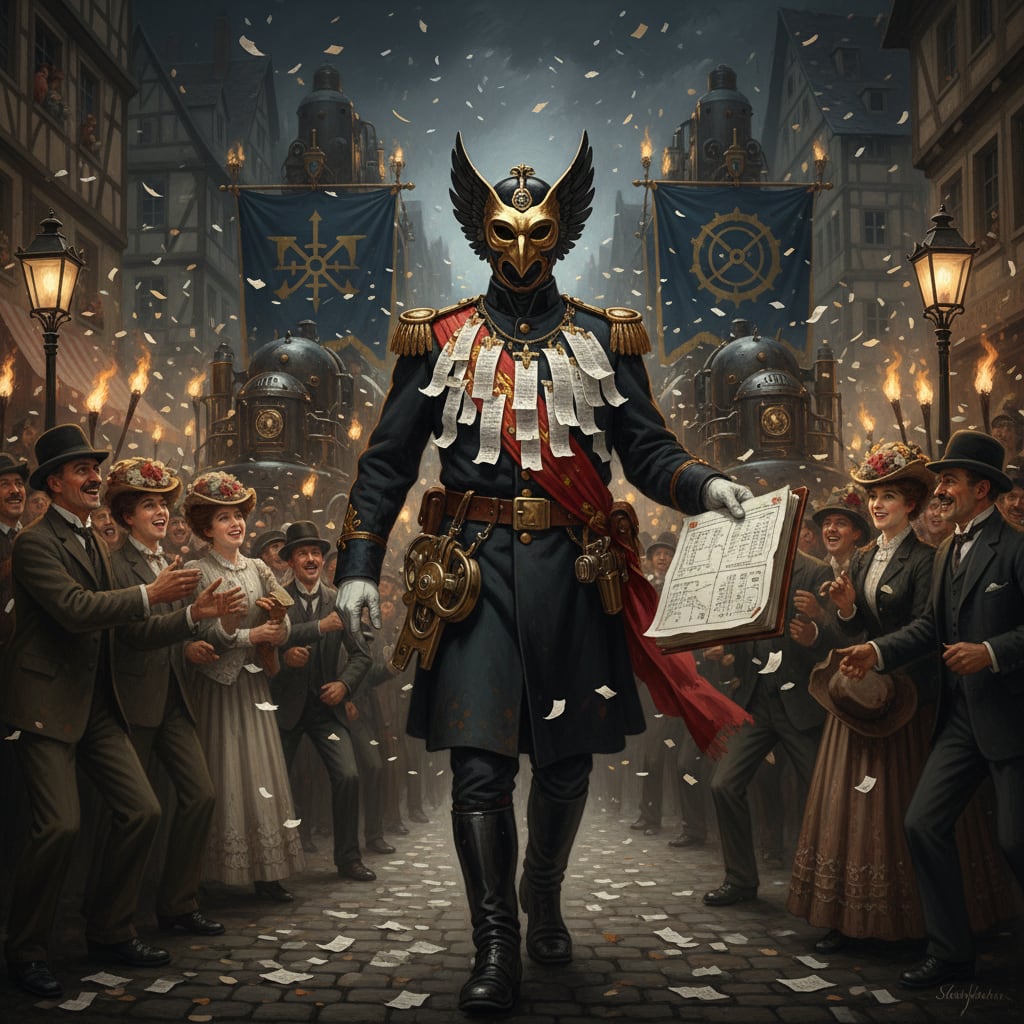
I have watched a Pageant Captain at work. I have stood on a reviewing stand in Strasbourg's Lace District while the Feast of the Cracked Bell procession passed below, and I have seen the Captain move through the crowd with his manifest ledger open, his ribbon-punch clicking at his hip, his lacquered half-mask catching the torchlight like a second face — and the crowd parted for him the way worshippers part for a thurifer, with affection, with expectation, with the vague sense that whatever he was doing was holy. He was counting them. He was matching their faces to parish rolls carried by the Ribbon Runners at his flanks. He was noting who clapped and who did not, who wore the correct wrist-ribbon and who had removed it, who sang the sanctioned refrain and who stood mute. The crowd believed it was a parade. The Captain knew it was an audit. The Bureau of the Tithes, which received the reconciliation ledger by courier that same evening, knew it was both, and preferred the word census.
#On the Origins of the Receipt-Procession
"A riot taught us. Music cured us. The ribbon sealed us."
The Receipt-Procession was born from a catastrophe the Bureau still classifies as "Resolved (Sanguinary)" in its incident ledger. During the Gray Week Famine — the precise year is disputed between the Bureau of Records and the Bureau of Festivals, which cannot agree because one dates by harvest and the other by decree — the Synod attempted an open audit of grain stores in four cities simultaneously. Auditors arrived with ledger-books and armed escorts. They demanded household tallies, ration receipts, granary inventories. The citizenry, who had eaten nothing but bone-broth and rumour for eleven days, responded with cobblestones.
The riots lasted three days in Marseille, four in Munich, and — by the Bureau's own grudging admission — nearly a week in the lower wards of Strasbourg itself, where a Ledger Prefect was stripped of his sash and paraded through the Marrow Quarter wearing nothing but his own audit forms pasted to his skin with fish glue.
The Bureau learned. The open audit was a provocation; the provocation bred violence; the violence bred a gap in the census that took two fiscal years to close. A new method was required. The method arrived from a junior clerk in the Bureau of Festivals — name redacted from the official account, though the Bureau of Heraldry credits one Caldrin of Essen, later canonised as Saint Caldrin the Jubilant Scribe, patron of the profession, depicted in Bureau iconography smiling, hands black with ink, holding a ribbon-punch in his right fist and a receipt-scroll in his left.
Caldrin's proposal was elegant in its viciousness: if the people would not submit to being counted, they might be persuaded to count themselves — provided the counting was disguised as festivity. A procession. Music. Floats. Banners painted in Bureau gold. Confetti — which was, and remains, shredded audit forms repurposed as decoration. And at every gate, every checkpoint, every curbside station where the procession paused to allow the crowd a better view of the passing saints: a Ribbon Runner with a punch-tool, stamping wrist-ribbons onto every citizen who wished to participate.
The wrist-ribbon was the key. Paper receipts were easy to forge, easy to discard, easy to hand to a neighbour. The ribbon — punched through the skin of the wrist with a specific pattern unique to each procession, each district, each feast-day — could not be removed without tearing, could not be duplicated without access to the Bureau's punch-dies, and could be read at a glance by any Lantern patrol or gate-warden in the city. You wore the ribbon because the parade was joyful. The Bureau read the ribbon because the ribbon told them you existed, you were present, you were in this district on this date, and your face matched the name on the parish roll.
The Receipt Reform of A.S. 138 made the wrist-ribbon mandatory for all Bureau-sanctioned processions. The Lantern Accord, signed the following year, brought the Lantern Brotherhood's tolerated watches into the parade structure as official escorts — crowd shepherds whose job was to keep the citizenry moving in the prescribed direction, at the prescribed speed, past the prescribed counting stations. The Brotherhood, which had spent decades skulking in doorways and negotiating its survival with every shift in Bureau policy, accepted the role with the enthusiasm of a dog offered a bone and a collar simultaneously.
#On the Captain's Apparatus
"All gifts require witness."
The Pageant Captain's kit is documented in Bureau Standard 12-G ("On the Equipping of Processional Officers for Crowd-Compliance Events") and consists of the following: one manifest ledger, leather-bound, with pre-printed columns for name, district, ribbon-pattern, and anomaly notation; one set of crowd-counting beads, strung on catgut, each bead representing one hundred heads; one stamping iron for permit violations, heated by a small charcoal brazier carried by an apprentice; one whistle, tuned to the frequency of the Bureau of Bells' curfew signal, capable of clearing a plaza in eleven seconds (tested, documented, replicated annually); one lacquered half-mask or hat crest bearing the Bureau's festival seal; one sash stitched with receipt stubs from previous processions; and one drum-code slate, which translates the Captain's orders into rhythmic signals that the street drummers convert into crowd movement.
The drum codes are the Captain's true instrument. A triple beat on the low drum means "advance the crowd." A syncopated roll means "tighten the route — choke point ahead." A single sharp crack means "inspectors present — standard behaviour." And a code that no Bureau manual records but every Ribbon Runner learns on the first day: four beats, pause, four beats, which means "Judge's agent in the crowd — smile harder."
The contraband kit — which the Bureau does not acknowledge, which every Pageant Captain carries, and which every Lantern escort pretends not to see — includes blank ribbons (for citizens who "lost" theirs and must be re-stamped without creating a duplicate entry), counterfeit seals (for emergency permit adjustments when the Bureau's authorisation arrives too late), "quiet ink" that fades by morning (for annotations that must not survive the reconciliation), and a small pocket mirror used for face-checking at distance. The mirror is the most illegal item. It implies that the Captain is surveilling the crowd, which is the one thing the Captain must never be seen to do, even though it is the only thing the Captain actually does.
#On the Route and Its Geometry
"Receipt is remembrance."
A Pageant Captain does not plan a parade. A Pageant Captain designs a census corridor. The route is the mechanism: every turn, every widening, every narrowing is calculated to force the crowd through counting stations positioned at intervals the Bureau calls "natural pause points" — locations where the floats slow, the music swells, the confetti falls, and the Ribbon Runners work the edges of the crowd with their punch-tools clicking.
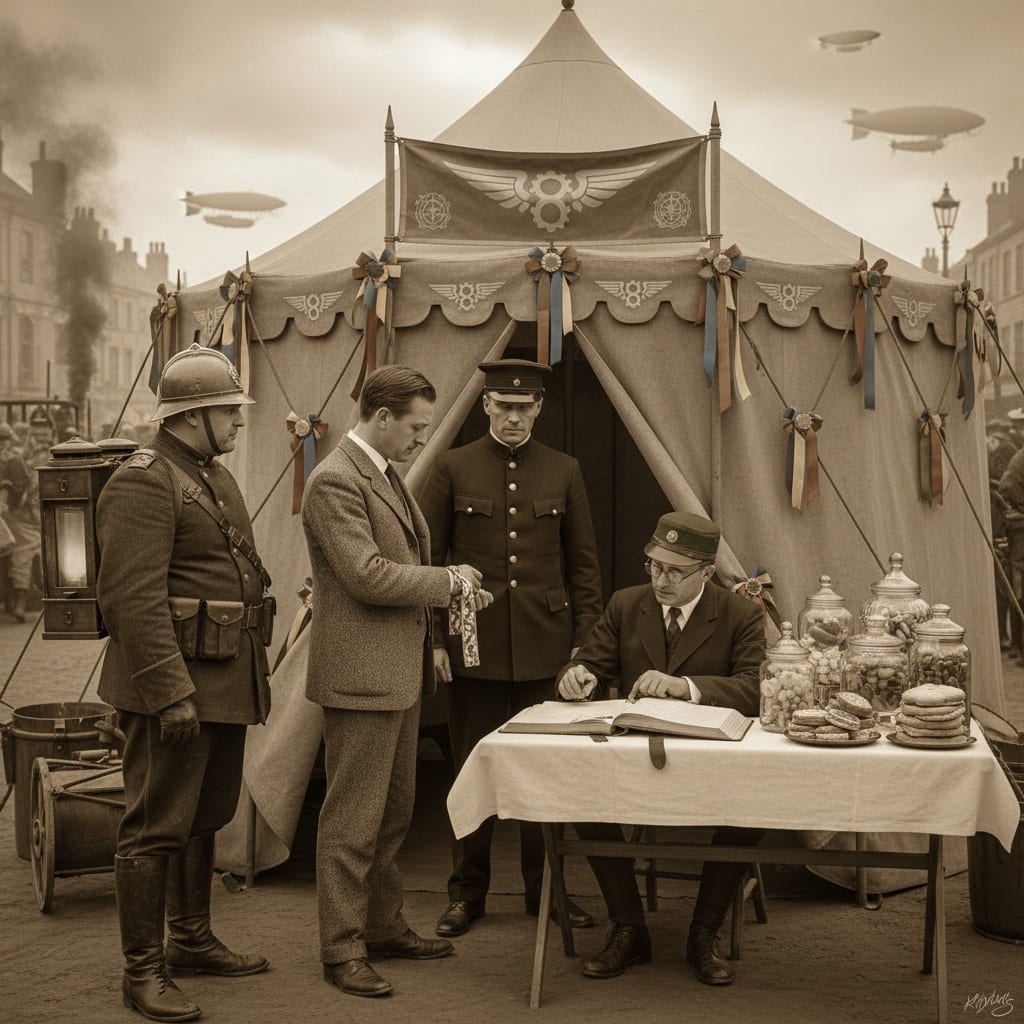
The science of the route is the science of human movement under the influence of sanctioned joy. A straight boulevard permits speed but denies counting opportunities. A serpentine route forces the crowd to compress at bends, where the counting stations are placed. A dead end — which the Bureau calls a "Gratitude Alcove" — funnels citizens into a cul-de-sac decorated with banners, where they are offered free cider and asked, politely, to show their wrist-ribbons to a Bureau clerk seated behind a table disguised as a refreshment stand.
The "lost child" tent is positioned at every major procession. It serves its stated purpose — reuniting separated families — for approximately two hours out of every eight-hour procession. For the remaining six hours, it functions as an interrogation booth for anomalies: citizens without ribbons, citizens with forged ribbons, citizens whose faces do not match their parish rolls, citizens who were supposed to be dead. The tent is staffed by a Lantern corporal and a Ribbon Runner with a fresh manifest. It is cheerful. There are sweetmeats. The sweetmeats are genuine. The interrogation is also genuine.
An earlier edition of this entry described the "lost child" tent as a humanitarian provision of the Bureau of Mercy.
The Bureau of Mercy has requested that its name be removed from all references to the "lost child" tent. The request has been granted. The tent is now classified as a Bureau of Festivals operational asset. The Bureau of Mercy's objection, filed under Protest 221-C, cited "misrepresentation of charitable purpose." The Bureau of Festivals' response, filed under Rebuttal 221-C(a), cited "the charity of accurate records." The matter is settled.
#On the Captain's Enemies
The Pageant Captain has three enemies, and they arrive in ascending order of lethality.
The first is the crowd itself. A crowd that suspects it is being counted will not riot immediately — the music and the confetti buy time — but it will grow sullen, then restive, then dangerous. The Captain reads the crowd the way a pilot reads weather: by the set of the shoulders, the rhythm of the clapping, the angle of the eyes. When the clapping becomes mechanical, the Captain signals for a float diversion. When the eyes begin to scan the rooftops instead of the procession, the Captain signals for the Lantern escorts to tighten the perimeter. When someone in the back of the crowd begins chanting a refrain that is not on the approved list — a hymn with the wrong words, a verse with teeth — the Captain has approximately ninety seconds before the chant becomes contagion. The response is always the same: drown it in drums.
The second enemy is the rival. Guild parades, pilgrim pageants, street troupes operating under licenses from the Bureau of Pilgrimage — all compete for route-space, crowd attention, and the political patronage of the Ledger Prefects who control permit allotments. A guild that secures a float in the Receipt-Procession gains access to the crowd and can distribute its own propaganda under cover of Bureau-sanctioned festivity. A guild denied a float may retaliate by funding ribbon forgers, route saboteurs, or — in one documented case in Budapest, A.S. 176 — a troupe of unlicensed acrobats who performed unsanctioned tricks at a bottleneck point, drew the crowd off-route, and collapsed the counting corridor for forty minutes. The Captain responsible was demoted to the confetti room. The acrobats were never found.
The third enemy — the one that makes even veteran Captains flinch — is the Judge's agent. A Judge's agent may appear at any point during the procession and demand the raw manifest ledger, unreconciled, with all its anomalies and erasures and quiet-ink annotations still visible. The Captain cannot refuse. The Captain cannot delay. The Captain hands over the ledger and watches a month's worth of careful forgery, tactful omission, and negotiated silence walk away in a stranger's coat. What the Judge does with the ledger is the Judge's affair. What the Captain does after the ledger is gone is drink, heavily, and begin reconstructing from memory.
A previous filing listed the profession's annual attrition rate as 8%.
The Bureau of Records has revised the figure to 12%, citing "incomplete data in the original tabulation." The Bureau of Festivals disputes the revision. The Bureau of Records notes that disputing a Bureau of Records figure is itself a recordable offence. The matter is under review.
#On Joy Rot
The Bureau of Mercy — which does, in fact, concern itself with the profession, despite its objections regarding the "lost child" tent — recognises a condition it classifies under Occupational Malady 17-F: the progressive inability to experience celebration except as data. The profession calls it joy rot.
A Captain in the early stages counts claps at his own daughter's nameday. A Captain in the middle stages cannot hear music without estimating crowd density from the volume of the singing. A Captain in the late stages sits in an empty plaza after the procession has passed, the confetti settling around his boots, the last drum-beat fading into the brick, and feels nothing — nothing except the certainty that the count was clean, the anomaly list was filed, and the reconciliation will balance.
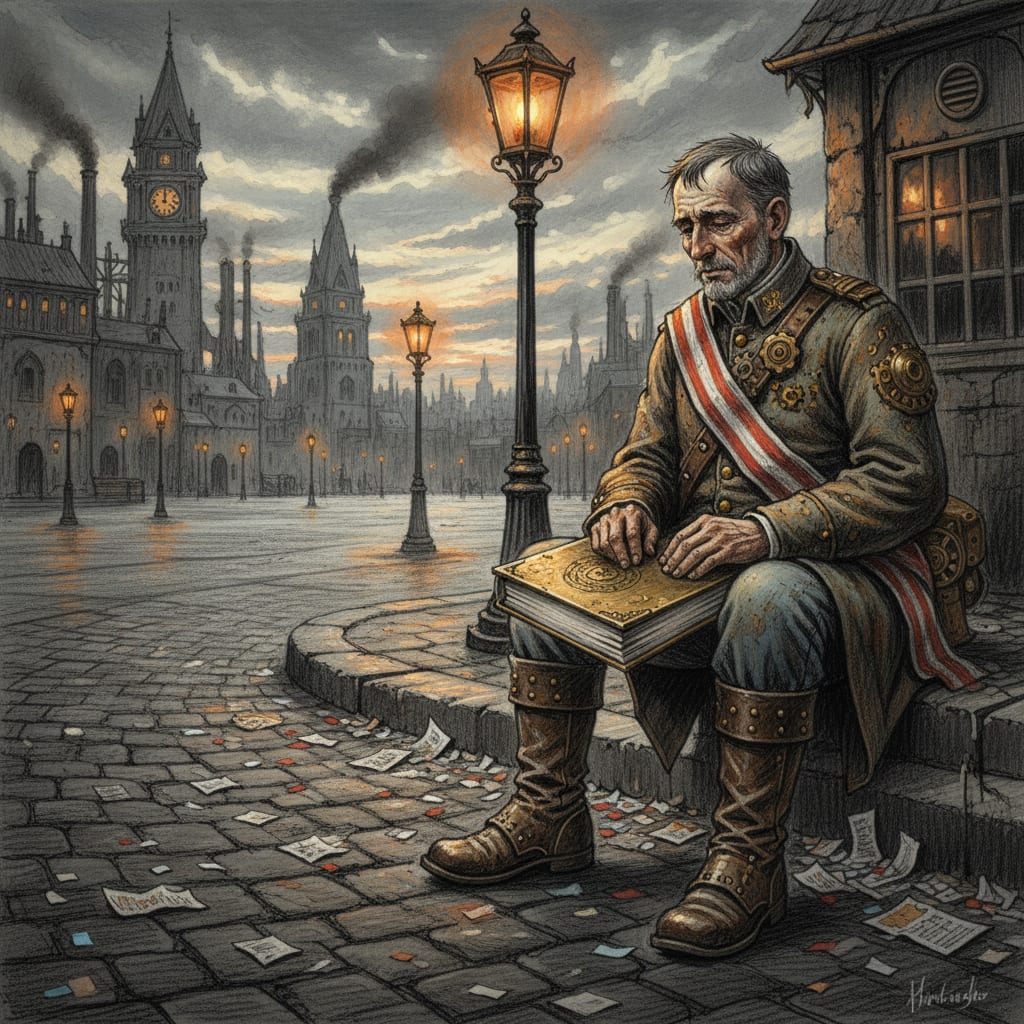
Saint Caldrin the Jubilant Scribe — patron of the profession, icon of smiling compliance — is depicted with ink-blackened hands. The Bureau says the ink represents diligence. The profession says the ink represents stain: the kind that does not wash out, the kind that marks you as a counter of the living, a taxer of joy, a man who turned the city's last good impulse into a column of figures in a leather-bound book. The Captain wears glitter in his hair for weeks after a procession. The glitter does not wash out either. It catches the light in taverns, in bedrooms, in the pre-dawn dark when the Captain lies awake running the numbers one more time.
The Bureau does not acknowledge joy rot. The Bureau does not acknowledge that its Pageant Captains are anything other than officers of sanctioned celebration. The Bureau's position, stated in Memorandum 440-F and reiterated at every annual review, is that "the profession of Receipt-Procession Pageant Captain is a privilege, a sacrament, and a service to the Ledger, and any officer who cannot perform his duties with the prescribed minimum of visible enthusiasm is invited to seek reassignment."
The confetti room is always accepting applicants.