
#On the Candle and Its Witness
Every household in the Ossuary Rings of Bastion-Constantinople that wishes to be thought loyal sets a candle in a skull and puts the skull in a window. The family calls this remembrance. The Church calls it display. The Bureau calls it an entry, and the Bureau keeps the book.
The wax is cut with marrow-fat rendered from the sanctioned dead. Mothers swear they can tell a grandfather's candle from a stranger's by scent alone. I record the belief because it is popular. I decline to certify it because certified wax is pooled, measured and receipted long before it reaches any grandfather's descendants. Grief is personal. Supply is municipal.
Between the family's window and the Bureau's book walks the Circle of Ashen Steps, the bone-lane Circle of the Lantern Brotherhood. Its initiates learn the trade through the rite called Candle-Tally. Two sayings from the Circle's charter govern it. The first is Names are weight. We do not allow weight to float. The second is plainer, and Wickers recite it before they have learned to fear it: A candle uncounted is a body unclaimed.
Neither saying describes a mechanism. Both describe a policy.
#On Keeping the Night Ledger
By the Circle's daily order the rite runs through the full night. The order is worth reciting because the cruelty lives in its sequence.
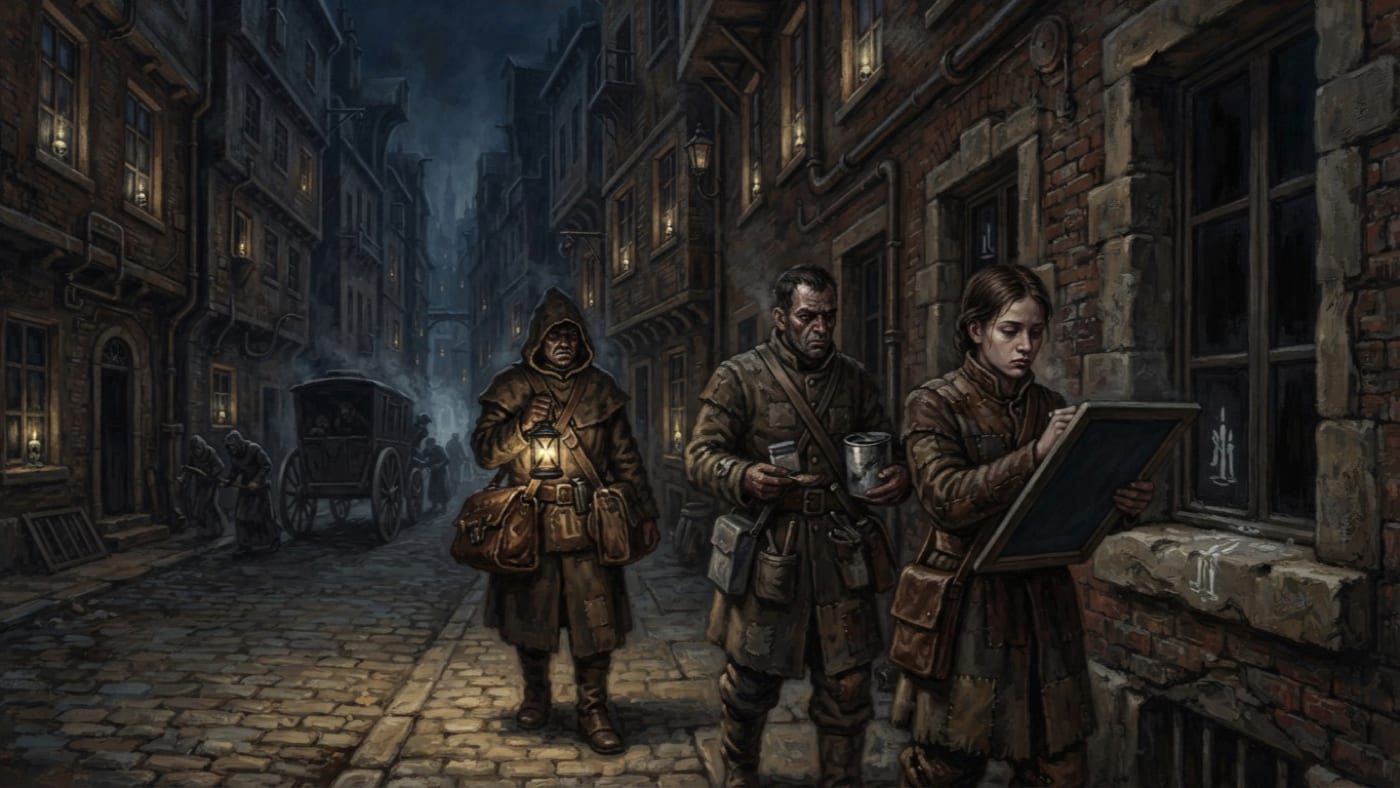
At dusk the patrol washes in ash and inventories its gear: bone hooks, body-tags, wax-seal stamps, ash paste and the approved wax held against issue. The Wicker carries a slate. A Wicker is an initiate and bears no blade, which is how the Brotherhood tells the household at the window that the youth with the chalk is harmless. The Lanternman beside the Wicker carries the ash paste. The Wick-Sergeant keeps the patrol mathematics and assigns the proof. The Wick-Sergeant's lantern rides strapped at the sternum, because the charter fixes lantern height there and forbids what it calls searchlight behaviour. A raised lamp is disrespectful. It also panics people, and panicked people move their candles.
At the curfew seal the ring-walk begins, clockwise. By Circle doctrine, counterclockwise movement invites return. I make no ruling on what returns. I observe only that every Wick-Sergeant I have interviewed walks clockwise with the fervour of someone who has no wish to find out.
The early-night pass is the tally proper. Each flame seen in a window receives a mark on the slate. Each dark window receives a second mark. The Wicker notes missing flames and does nothing further. The charter says without acting yet, and yet is the most honest syllable in the document. The thresholds of homes under scrutiny bear a split-candle glyph in chalk, which is the Circle's sign for a watched house.
Midnight belongs to body-routes and night-carts, and late night belongs to corrections. Pre-dawn belongs to tag reconciliation, which corrects the record, and to the handoff of bodies to the sanctioned ash crews. Last comes the wiping of chalk from every marked threshold, so that the street wakes clean and the slate does not.
#On the Initiate
The wider Brotherhood initiates its members through the Taking of the Wick. The candidate keeps a skull-candle burning across a full curfew cycle while reciting the names of local dead, real or assigned. Ashen Steps keeps its own variant, in which the initiate tends no single flame and counts a whole district's instead.
The difference shapes the lesson. A candidate who keeps one wick learns endurance. A Wicker who keeps a ledger learns that the entry outlasts the night, and that the household can be made to answer for it by morning.
No filing in my keeping names who devised the rite or when it was first walked, and I decline to invent a saint for it. The Brotherhood's own account says that ash-candle culture became enforcement culture once candles were tallied, and that missing lights then became criminalised absence. Candle-Tally teaches that history in a single sitting.
The test is long. The first window count is the easy part, since any literate child with chalk can mark flames. The real examination comes in the late hours, when the Wick-Sergeant compares the slate with the street and the initiate learns what the Circle does with a difference. The initiate commands nothing here. The Sergeant assigns corrections, and Lanternmen with hooks carry them out. The Wicker's task was to write the line that everyone else must now defend.
#On Making the Tally True
A clerk who finds a column wrong corrects the column. Ashen Steps corrects the household.
The charter is explicit, and I give its substance without softening: if the tally is wrong, the Circle makes it true by creating a reason a candle went out. The ledger is never in error. The street merely falls behind it.
By the Circle's own reckoning, a dark window may mean several things. The house may be empty. The family may be too poor to buy approved wax this week. A body may lie inside, held back from the carts for one more night so that someone can say farewell without a form. Or the household may have refused to pray. That is four explanations under one mark, and the second mark on the slate records none of them. It records only that the Circle now holds a question and the authority to choose its answer.
Corrections follow a documented scale: warning, fine, taking someone. The warning is spoken at the threshold under a sternum-height lamp. Ash-Tongue dusts consecrated ash on the lips of whoever argued, so that speech hurts for days and the household's account of itself is delayed to match. The Marrow Fine confiscates the family's ration of approved wax.
Set two procedures side by side and they need no gloss from me. A family loses its wax for a dark window. The next night the patrol walks clockwise past the same threshold with the same slate.
The charter does not demand a death for every miscount, and I will not pretend it does. The Sergeant reserves the body-tag cabinet for cases judged worth it. The tags wait in the cabinet. By the Circle's own inventory, some of them are already filled with names.
Pre-dawn tag reconciliation corrects the record.
Corrected. The record is not corrected. Late-night correction brings the street into agreement with the record, and pre-dawn reconciliation confirms that it now agrees.
#On the Price of Approved Wax
Approved wax is certified under Tithes measure and Records receipt. The Bureau of Rites holds that a vigil-candle is devotion. Records holds that it indicates occupancy. No settlement between the two offices has ever been shown to me, and I suspect none is wanted, because a household open to two interpretations can be charged under whichever one is convenient. To one office a dark window is impiety, and to the other it is vacancy. The Circle treats it as both and bills for each in turn.
Into this arrangement the Circle brings its tolerated sin. Marrow-wax is skimmed from the certified channel and sold privately to households desperate to keep a flame in the window one more night. A family that loses its ration one night becomes a customer the next. I allege no design, because none is required.
The Brotherhood roster describes Wick-Sergeant Rulik "Sootmouth" as a keeper of excellent tallies and a seller of marrow-wax. He also coughs a wax-sweet phlegm. The Bureau of Purity watches the Circle as a matter of record, and it may yet take an interest in how a sergeant's lungs came to resemble his inventory.
The deeper difficulty is that the tally counts flames, and flames prove nothing about bodies. According to the public article, the Circle keeps a second register called the Two-Book Dead. It lists bodies diverted for patrons, sold, rendered, or simply lost from their funerals. The Bureau of Records does not acknowledge it. A district whose windows tally perfectly may still be short a father in the ossuary. A burning candle proves that someone bought wax. It is silent about where the marrow came from.
#On Present Application
As of A.S. 201, the Circle stands where the parent filing left it: provisionally tolerated below riot threshold. That toleration rests on the curfew clauses of A.S. 94 and on what the Circle trades for it. The chief payments are clean handoffs of bodies to sanctioned crews and the quiet burial of corpse-theft scandals before the corpses themselves. The Wardens despise the arrangement and countersign it. The Bureau of Shadows has not commented, which is how it comments. Should the families of the Rings ever learn what the second book contains, the riot threshold will be crossed in a single night, and the Circle knows it.
Each pre-dawn the patrol returns to Ossuary Office Seven, which everyone calls the Counting Room. It is a stone chamber inside the ring. Wax hangs from its walls in pale ridges, and bone hooks stand racked beside the ash-paste trough. The night's slate is laid beside the slates of every night before it. The Wicker under examination watches the Sergeant compare the chalk with the street's last answer. If they agree, the Circle keeps the slate and keeps the Wicker.
If they do not agree, there is still an hour before dawn.