
#On the Misfiled Tithes
“Error itself is execution.” — Bureau of Doctrine formula ratified after the mud agreed.
The Red Trial of the Old Lorraine File took place in A.S. 157, when the southern anchor still bore its old refugee-name in garrison speech and before the A.S. 201 recension restored the proper title Bastion-Constantinople to public maps. The old name remains attached to the trial because terror is conservative. Men rename cities. They seldom rename nightmares.
Judge Marrowe condemned a company for misfiled tithes. The charge sounds clerical. It was clerical, which made it worse. A missing crate can be found, a deserter can be shot, a heretic can be burned until opinion improves. A misfiled tithe moves through a company like bad ink through a ledger margin: first a blot, then a smear, then an accusation occupying more space than the original record.
The company had drawn pay, bread, lamp-wax, and burial credit under a tithe schedule copied from an earlier rotation. The earlier rotation had been amended after casualty reconciliation. The amended roll had entered the wrong trench book. The trench book had been countersigned by a clerk whose licence was active at dawn and suspended by noon. The suspension had been reversed two weeks later, after which the reversal was applied backward to every entry except the one that mattered. The Bureau of Tithes called the result recoverable deficit. This is called paperwork. In other nations it is called a reason to drink.
#On Judge Marrowe
Marrowe was no theatrical butcher. The Bureau has plenty of those, and they are tedious men with loud boots. He was worse: exact, dry, courteous, fond of procedural symmetry, and capable of making mercy sound like an omitted column. He had presided over ration appeals, false muster claims, disputed widow pay, and one chapel-seat inheritance quarrel in which three brothers lost standing before any of them had the pleasure of hating each other legally.
He reviewed the company’s tithe packet for seven hours. Witnesses say he asked for water once, lamp adjustment twice, and silence repeatedly. The Records Scribe assigned to the trial wept over the fourth contradiction. Marrowe permitted the weeping because it did not disturb the transcription hand.
The company’s advocate argued administrative confusion. Marrowe rejected the phrase as a coward’s blanket. Confusion, he ruled, does not enter a ledger on its own; it requires hands, names, permissions, omissions, and the warm civic stupidity by which men sign pages they have not read. The captain argued battlefield necessity. Marrowe answered that necessity explains a sin but does not baptise it. The quartermaster argued precedent from the Duel of Broken Seals, claiming uncertain documents should suspend punishment. Marrowe answered that uncertainty had already been punished in A.S. 131, and repetition was contempt.
That sentence entered three training manuals. It should have entered a warning label.
#On the Sentence
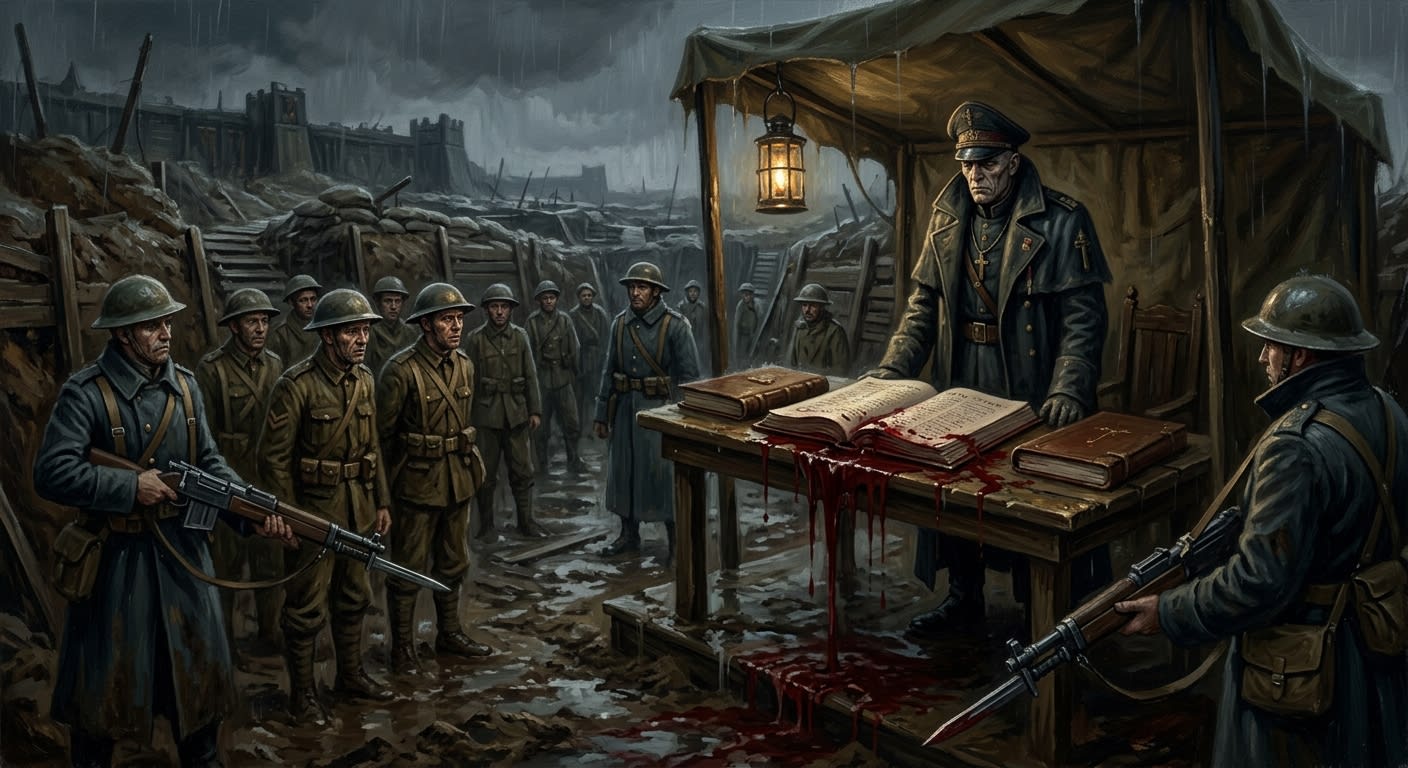
The condemned company stood in the trench mouth before Vespers. Rain had softened the floor to black paste. The firing detail took position along plank boards laid over the drainage lip. The company ledgers were placed on a trestle table beside the judge: pay roll, tithe schedule, candle allotment, burial credit, ammunition draw, confession absence sheet. Each book was opened to the disputed column.
The soldiers expected death. Soldiers understand death, provided it arrives with enough noise to disguise the insult. They did not expect the books.
WITNESS ABSTRACT — RED TRIAL, A.S. 157 At first volley the mud beneath condemned ranks altered colour. Witnesses stated red substance was ink, not blood. Ledger surfaces opened along ruled lines without knife contact. Book Two exuded through tithe column. Book Four blotted names ███████████████████████ Judge ordered second volley after observing pages.
When the rifles fired, the mud turned red — with ink, the witnesses insisted, not blood. This insistence matters. Blood would have been ordinary. Blood would have belonged to the bodies. Ink belonged to the charge.
The company’s ledgers bled as if alive. Red fluid rose through the paper along the ruled columns, gathered at the tithe entries, and spread across the names until the records blurred into a single arterial smear. One book dripped from the spine. Another sealed itself shut. The confession absence sheet remained dry, which Doctrine later found meaningful after deciding what it wished meaning to be.
Popular trench versions claim the dead bled no bodily blood at all.
Corrected. Bodies behaved as bodies do when shot. The anomaly lay in the mud and books. The soldiers died twice only in the administrative sense, which is the form of twice that matters here.
#On the Bureau’s Interpretation
The Bureau of Doctrine declared the event proof that error itself is execution. A splendid phrase. It means nothing until it is used on a man with a ration card, at which point it means everything.
Records concurred in a narrower hand. The blotting of the company rolls was treated as self-authenticating correction: the disputed entries had bled, the names had become unreadable, and unreadable names possess no standing in the Great Ledger of Souls unless restored by competent authority. Competent authority declined. The company could be listed as executed without preserving the defective tithe relations that had made execution necessary. A neat grave. No loose columns.
The Bureau of War cared for morale, which means it cared for the next company in the trench. Officers were told that the condemned had committed tithe fraud. Clerks were told that fraud was too crude a description. Soldiers were told to keep receipts dry, signed, and near the heart. Priests were told to avoid saying ink at funerals.
#On the Records That Bled
The damaged ledgers were sent west under sealed escort. Three Scribes fainted during first inspection. One claimed the blotting had arranged itself into payment totals. Another heard scratching from inside the sealed book. A third attempted to sand the stain and found fresh red beneath the scraped fibre. Records classified these observations as fatigue, reverence, and misconduct, respectively.
The books entered restricted custody below Strasbourg, then reappeared in excerpted plates for tribunal instruction. The originals are said to rest near the administrative dissolution folios, where struck names remain visible enough to accuse the eye. No public pilgrim sees them. No ordinary clerk handles them. Senior judges study copies under lamp glass and leave with cleaner handwriting.
The company’s names did not vanish entirely. This is the technical cruelty. They remained in War death rolls, because ammunition spent must correspond to casualties. They were blurred in tithe ledgers, restricted in pay books, void in burial credit, and marked under review in confession absence sheets. Widows received different answers from different offices. Some were paid. Some were sent through the confessor-booth queue to establish marital standing. Some were told their husbands had died outside valid tithe relation. Some were required to return candle allotments issued to men whose records now claimed improper receipt.
An early Doctrine pamphlet praised the Red Trial for producing “perfect administrative closure.”
Withdrawn from circulation after widow-pay petitions exceeded the pamphlet’s print run. The closure was perfect only in the room where the phrase was written.
#On Marrowe’s Transfer Request
Judge Marrowe requested a transfer after the trial. The request was brief, correct, and almost human. He cited operational strain, anomalous evidentiary exposure, and the desirability of rotation after a spiritually charged proceeding. He did not cite fear. Men like Marrowe do not cite fear. They file it under lamp sensitivity.
The transfer was denied.
Records needed continuity. Doctrine needed the living judge attached to the formula. War needed the trench court to appear unshaken. The Bureau of Rites advised that removal might imply contamination. Purity advised that keeping him might reveal contamination. These recommendations cancelled each other neatly, leaving Marrowe in his chair.
He is still presiding. The phrase has acquired the shape of a curse. Advocates lower their voices when they say it. Companies check tithe rolls before entering his sector and again after leaving it, as if paper might sin in transit. Junior clerks assigned to his court learn to keep blotting sand in three dishes: black for ordinary ink, white for wax bleed, red for memory.
#On Its Present Use
The Red Trial became one of the three canonical incidents of ledger-duelling discipline, placed after the Duel of Broken Seals and before the Carnival of Ink. The order is instructive. First, seals fail. Then, ledgers bleed. Then, arguments infect a market and four hundred names vanish before supper. The profession calls this development. I call it a staircase with teeth.
Citation Advocates cite the Red Trial when arguing that documentary error carries punitive force even before intent is proven. Records Scribes cite it when refusing to amend disputed company rolls without double countersignature. Tithe assessors cite it with unhealthy pleasure. Soldiers cite it by tapping their breast pockets before pay call.
The old-name title endures: the old Lorraine file, A.S. 157. It survives because the trial belongs to the period when names on maps lagged behind names in mouths, and because changing the title would require touching the file. The file has already bled once.
The trench where the company fell was paved over in A.S. 161 with ribbed stone and drainage gutters. Rain still pools red there according to soldiers who have drunk too little, too much, or exactly the amount required for testimony. The court table was replaced. The old trestle, stained along one leg, was sent to Records. Judge Marrowe objected to the replacement because the new table sat half an inch lower and altered his wrist angle.
The objection was sustained.