
#On the Record
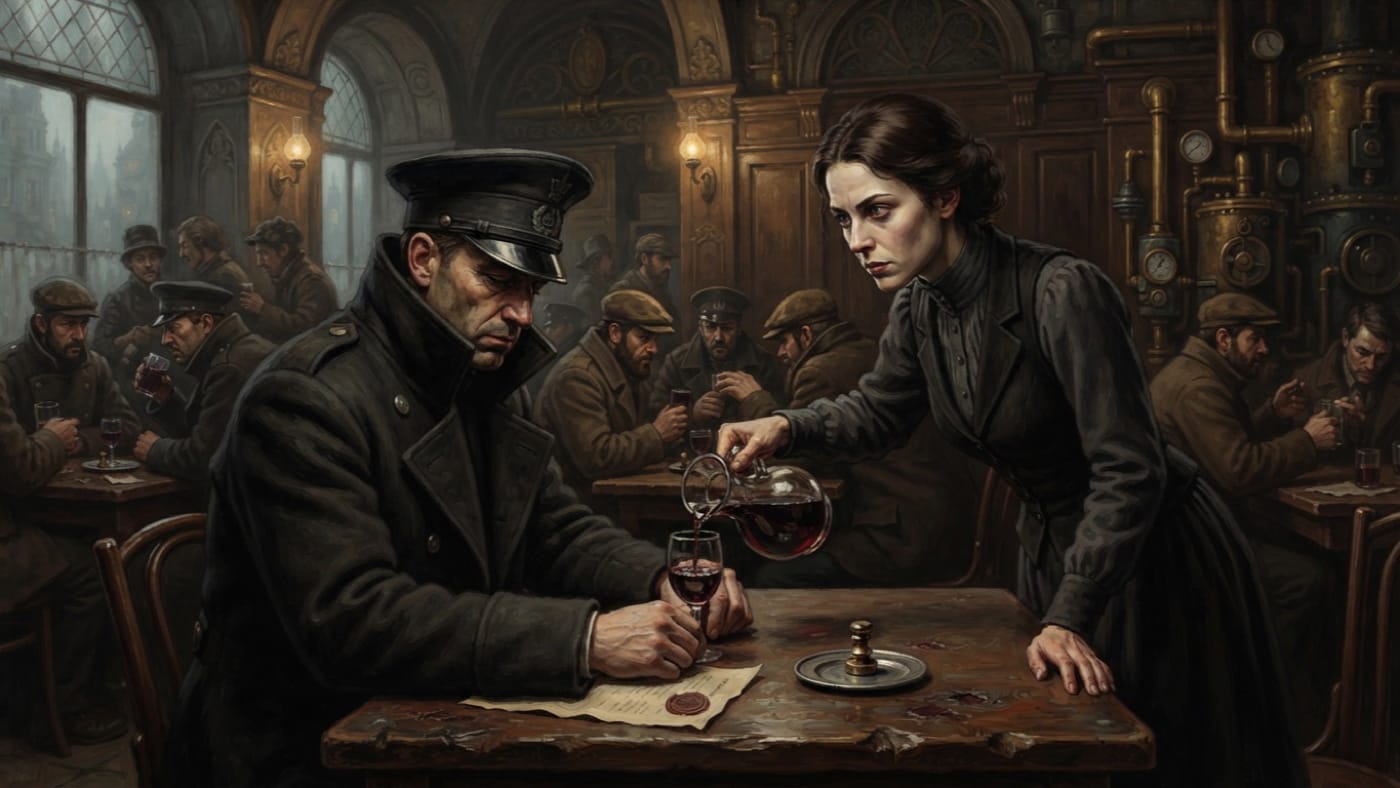
"The officer has not been formally identified. He has since retired." (caption to the reconstruction in The Velvet Choir)
Bureau of Purity Case File 197-K-9 entered the Codex as a caption. My entry on the Velvet Choir was compiled for the Bureau of Doctrine from classified sources of the Bureau of Purity. Under its principal illustration it carries four short sentences and a line of provenance. The file number appears in the first of those sentences, and I can find it in no other passage the Codex holds.
What the Codex holds can be stated briefly. A file designated 197-K-9 is attributed to the Bureau of Purity. An operative is identified in that file. A scene connected with the operative was reconstructed from testimony, and the reconstruction is attributed to A.S. 199. That year belongs to the reconstruction. It is not the date of the encounter, of the file's opening, or of any arrest, and the reader who moves it to any of those will find the correction entered against his own name.
This is therefore an entry about a record of a record. A Hieromnemon of my standing ought to be glossing councils. Instead I am glossing a carafe. The Ledger does not let a man choose his subjects. It only lets him do them well.
#On the Café Reconstruction
The scene is a café in the pilgrim quarter of Bastion-Constantinople. In the reconstruction a Choir operative pours wine for an officer of the Bureau, and the officer's second seal sits unchecked. The caption adds that the operative named in 197-K-9 was eventually traced to this district. It gives no date for the tracing and describes no method. The quarter is large, and its cafés are many and badly lit.
The illustration is oil paint. The painter was not in the room, but the testimony was, and the canvas is that testimony given colour, furniture and a plausible angle of light. The witnesses are unnamed in the record, as is whatever they swore and whatever the Bureau thought of it. Anyone who treats the painting as a photograph has mistaken a reconstruction for an exhibit, and for an Inquisitor that is the first sin of the trade.
The caption makes three statements about the officer, and none of them should be stretched. He is depicted as a Bureau officer. He has not been formally identified, which means only that the Bureau's formal process has named nobody. Corridor talk may have named somebody, but corridor talk has no seal. He has since retired. My Choir entry reports that retirement in its A.S. 201 account and gives no year for it and no reason.
Retirement is a pension. It is not a verdict. The Synod retires the blameless, the exhausted and the inconvenient on the same form, in the same ink, with the same small brass medal, and nothing in the caption says which of the three this officer was.
#On the Failure of Verification
The painting puts the whole case in one detail: a second seal that nobody checked.
The Codex does not say what the seal authenticated, who should have checked it, or what passed because it went unchecked. I will not supply those things. I note only that seals come in pairs for a reason, and that the Synod trains its officers to check the second with the same patience they gave the first. A man who skips it has saved himself perhaps eleven seconds. In those eleven seconds the instrument he serves has stopped working.
That is why the Bureau of Purity cares about a carafe. The Choir's documented method opens with a tolerated indiscretion: a glass past curfew, a conversation that runs longer than regulation permits, a procedure shortened because the company is pleasant. Further steps follow, each one small. A transgression gets documented and a favour gets asked. The Choir's most dependable tool, by the Bureau's revised reckoning, is attention, meaning the steady regard of someone who appears to see an officer as a man and not as a function with a stamp.
An unchecked seal fits the first rung of that ladder exactly. It also fits the career of every tired officer who has ever served the Synod. I have read nothing in the Codex showing that this officer was recruited, knowingly assisted anyone, or reached any rung past the first. A careless man is not thereby a damned one, and the Bureau's own canon law, when it remembers itself, says so.
The Bureau's briefing language holds that nobody returns from the third stage. That is the Bureau's despair entered as doctrine. The Church teaches that corruption can be reversed, and that men under every Sin-General's influence have turned back by their own choice. The briefing officers say the other thing because it frightens trainees into checking seals. It is a useful lie, and the Ledger records it as one.
Earlier editions of this Codex described the Velvet Choir's recruitment method as "seduction, primarily carnal in nature."
The Bureau of Purity has withdrawn that characterisation. Carnal seduction accounts for fewer than one-third of documented Choir recruitments. Readers who see wine, a café and an officer in 197-K-9 and conclude that it was a seduction are reasoning from the withdrawn edition. The reconstruction shows a pour. It does not show a purpose.
#On the Arts Alleged
Some readers will want sorcery in the café. They want the perfume, the glance that unfastens a man's judgement, and Velkara reaching through a wine glass. They will not get it from me.
The Mirror and Perfume Arts travel behind the Sagittal Line in a diminished form. In a Choir operative they show up as charm, as an unusual quality of attention, and as a scent the target later connects with safety. The joint advisory of Purity and Rites, recorded in my Choir entry, holds that this diminished form is not compulsion. The target's will stays intact. The Art changes the setting in which the target chooses, and the choice is still his.
The Bureau has also documented operatives who sincerely believe their cover identities and take their own faculty for being trusted as a natural gift. That pattern is real and attested elsewhere. Nothing in 197-K-9, so far as the Codex records it, shows that this operative carried a fragment of the Art, believed a cover, or worked any sorcery at that table. Wine is sometimes just wine.
The Sin-General stays offstage, where the Synod's theology and my editors both require her to stay. If the officer skipped the second seal, then the officer skipped it. Velkara may have arranged the circumstances in which a man finds that easy. She did not move his hand, and doctrine will not let anybody claim she did.
#On the Bureau's Wider Findings
197-K-9 belongs to a larger admission. The Bureau of Purity's classified Annual Review for A.S. 200 accepts as established fact that the Choir is present in Constantinople. In the same pages it concedes that the Bureau cannot determine the Choir's current membership, cannot locate its primary cells, and cannot say which officers are presently serving as Choir assets. An officer who is depicted but not formally identified sits comfortably inside that last clause, and the Review does not claim to know more about him than I do.
Two facts lie nearby, and careless readers will try to join them to this file.
The first is the A.S. 198 scandal of the southern theater. Three Confessor-Penals were stripped of office after their confessional records were copied, annotated and forwarded to a Choir dead drop in the same pilgrim quarter. That was a separate incident with its own dated report. Sharing a district is not evidence of sharing a case, and the pilgrim quarter is crowded enough to hold several crimes on the same street without their ever being introduced.
The second is the Crimson Concord, which the Bureau associates with the Choir's infiltration of military and administrative command in Constantinople. The two are associated. They are not the same instrument, and nothing in the caption assigns this encounter to the Concord.
The Index Damnatus lists seventeen confirmed Choir operatives apprehended, examined and executed between A.S. 188 and A.S. 200. The Codex does not record that the operative of 197-K-9 is one of them. It records a tracing. A tracing is a long way from the scaffold.
#On the Limits of the Entry
The asymmetry is all the record will support. The operative was eventually traced to a district. The officer, who sat at the same table in the same picture, remains formally unidentified and has retired on a pension. The Bureau of Purity found the guest. Its own man is still unnamed.
I do not know the charge, and I do not know whether there was one. The Codex records no hearing, sentence or release, and I will not invent one to give the entry a tidier ending. The case may be closed. It may be open. It may lie in a drawer under a classification nobody has bothered to update. Each of those is ordinary in the Bureau of Purity, and none of them is recorded here.
What can be certified is short. A case number exists. A café exists. A painting of an unchecked seal exists, made from the words of witnesses whose names are not in front of me. Somewhere a retired officer reads his Codex over breakfast, and he may or may not recognise the hand holding the carafe.