
#On the Close at the Far Nail
The Cathedral Close is one of the seven districts of Bastion-Königsberg, and the only one a visitor can find with eyes shut. The Ordensburg announces itself by its sentries, the Harbour Quarter by its tar, and the Warrens by a laughter the Bureau of Purity monitors and has not yet forbidden. The Close announces itself by singing. Stand on any balcony above it, at any hour of the standing schedule, and you will hear the Choir's active bench holding its line under forty-one bells. Behind that you will hear the Baltic, close enough to leave salt on the hymn-books, at the northern end of the Sagittal Line where two thousand miles of consecrated wire run out of land.
Its boundaries appear in no survey I was permitted to read. Its dimensions belong to the Bureau of Engineering, which keeps them the way a miser keeps teeth: boxed, counted, never shown. The cathedral at its centre was already standing when the Church requisitioned the city. No clerk has since troubled to establish when the ground around it became a precinct, or who first called it one.
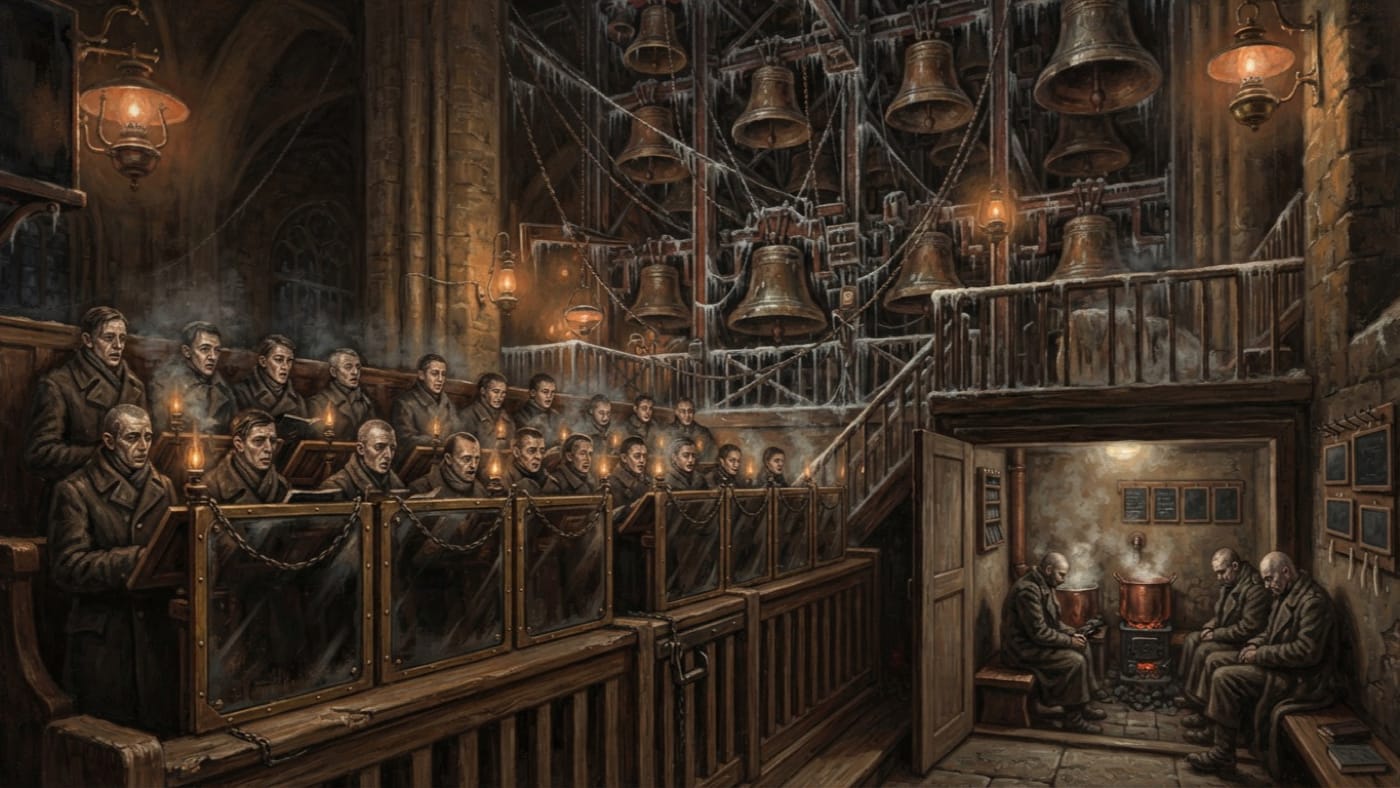
What the Close contains is better documented. The cathedral houses the Northern Carillon. The Bureau of Bells keeps its largest forward staff here. The Bureau calls the staff "largest" in comparison with its other forward offices and declines to turn the word into a headcount. The Close also holds the bellmen, the Choir of the Northern Standard, a sacristy, a back room that smells of copper and camphor, and the office of Rector-Chaplain Wendelin Grau. That office sits between the bell-stair and the choir stalls, and Grau has occupied it since A.S. 186.
#On Bronze and Its Keepers
The forty-one bells were cast between A.S. 97 and A.S. 107 from Prussian gun-bronze, so the Close keeps its liturgy in metal that once served artillery. The bellmen of those years tuned them to Northern Standard Resonance from older folios and local practice. Strasbourg did not ratify the current Bell Codex until A.S. 115. When the Codex arrived it examined the northern bells and declared that they had been lawful all along. The Bureau calls this standardisation. Records calls it backdating, and charges a fee for it.
The work is daily and unlovely. Ice forms on the frames overnight and must be chipped off before the first peal, because a frozen bearing turns a lawful strike into a crack that wakes the harbour and unsettles the Sea Wall. Salt crusts the bronze lips. The bellmen scrape it off with ash-wood blades, because iron scratches bronze and scratches are invoiced. The frames are inspected quarterly. Hairline fractures are inked, measured, entered and watched. Replacement clappers come from Essen through the Harbour Quarter when the ice permits. From December to March it does not. Through those months the old clappers keep striking until some bellman reports their sound as "tired." The word appears nowhere in the Codex, and it is entered anyway.
The bellmen count forty-one bells, and so does the registry. On fog nights a few of the bellmen hear a tone between strokes that belongs to none of them, low and unhurried. They have learned to mention it only after coffee, and never to a Southern inspector. No forty-second bell hangs in the tower. I have climbed the stair and counted them myself, and my knees have filed their own report.
The Bureau of Bells sets the technical schedule, and Grau supervises the bell-liturgy that runs on it. The difference is fine enough to cut glass. The bellmen ignore it and take their complaints to the Rector-Chaplain, because he is downstairs and Strasbourg is not.
#On the Stalls and the Throat-Room
The stalls stand within sight of the bell-stair. The hymn-books are chained to the rail in front of them. They are narrow, bound in oilskin against the damp, and thumb-indexed by bell sequence instead of by feast. No common hymnal contains their cycles. The Bureau of Doctrine keeps custody of the texts, the Bureau of Bells keeps custody of the pitch, and the chain keeps custody of the book. The chain is the only one of the three arrangements I have never heard anyone dispute.
The Choir's establishment is twenty voices. Each singer works twelve hours on and twelve off, in a rotation that keeps the stalls occupied at every hour of the schedule. How many voices stand on the bench at a given hour depends on sickness, alarms, fog and Grau's judgment. The rota sheet pinned beside the sacristy door has been amended in three hands and one smear.
"That they sing continuously, in rotating shifts, for every hour of every day … has been observed for the past thirty years." — Codex entry, Bastion-Königsberg, On the Fortifications.
Corrected. The Choir was formally established in A.S. 188, which gives it thirteen years of continuous rotation by the present survey. Bell-liturgy in the Close is older and undated, and it was not performed by this Choir. The Codex regrets awarding itself the extra seventeen years.
The throat-room lies behind the sacristy. Officially it is an infirmary. In practice it is a low room with copper steam kettles, coal smoke, wool blankets and saint cards blackened past recognition. Singers coming off the bench sit there to breathe steam and say nothing. Singers removed from the bench say nothing for longer, and they carry chalkboards because their speech is restricted after removal. The Northern restricted copy lists their injury as echo-sickness. A man starts repeating the ends of other people's sentences. He hears his own voice half a beat behind his mouth. He wakes with an antiphon already formed on his tongue. Finally he stops trusting the sound of himself, and that is the symptom the steam does not reach.
Grau goes to the throat-room after every rotation. He hears confession at the kettle, because the chapel is too near the stalls. His rule for those confessions is severe: a man may confess his fear, but he may not decorate it. He reads the chalkboards and wipes them clean himself.
#On the Screens and the Returned Hymn
The Bureau of War has classified the Grey since A.S. 190 as Unknown Forces, Extradoctrinal Classification Pending, under Absolute Suppression. It returns the Choir's hymns without distortion. Witnesses describe the same notes, the same words and the same timbre, so exact that singers on the bench have lost their places in the cycle because they could not tell which voice was their own. On two documented occasions the return came before the Choir by several bars. The Bureau of Bells files these cases as anticipatory acoustic resonance, mechanism undetermined. The Bureau of Doctrine has declined to rule whether the fog was early or the singers were late, since either finding would need a second file.
The Bureau of Bells has fitted the stalls with harmonic-isolation screens, whose construction it has not published. They are plain fittings, scuffed at the knee-rail, and the singers lean against them between verses. The screens reduce the return. They have not ended it.
Grau's rules for the stalls are posted where the bench can read them.
The garrison would like to believe that the singing keeps the Grey off the walls. Nothing in the file supports that belief. The bastion is unbreached and the Choir sings, and so far as anyone has shown, the two facts share a calendar and nothing else. What continuation demonstrably does is keep the Carillon's schedule whole and the singers in practice. The Choir's own status sheet puts Grau's standing instruction in four words: finish the verse.
#On the Rector's Custody
Grau commands no soldiers. Castellan-Warden Ingrid Halvorsen commands the bastion. After Sea Wall incidents she sends men to the Close before she sends them to Purity. Grau sends her names when a confession has become an operational risk. Three pastoral guidelines forbid this exchange, and the bastion depends on it.
Sergeant Halder walks up from the Frost Yards after every displacement report and sits in Grau's office, and both men record the visit as burial advisement. In A.S. 199 a body was found standing against a vault wall. Grau then authorised three bells to be rung outside the approved sequence and entered the act as a mortuary correction. The Bureau of Bells protested the irregularity. By the next morning the body lay supine again. The dossier records one subject, one result and the finding "correlation unverified." I record exactly the same and nothing more.
Clerks have since noted that the sequence resembles an old coastal warning from the Fractured North, where the fjord-bells keep tunings Strasbourg did not write and the Bureau of Bells cannot obtain. Grau has not said where he learned it. The Bureau has approved none of it. The bell-stair is guarded all the same.
#On the Present Condition
As of A.S. 201, the Carillon rings all forty-one bells on the authorised schedule. The Choir stands at twenty voices on paper and seventeen fit, with two singers under vocal restriction and one under Purity observation. Grau has asked twice for replacements and has received one. The screens are in place and the return continues. The throat-room kettles are kept hot through the night rotations, and the chalkboards hang on their nails, wiped clean.