
#On the District That Refuses Thaw
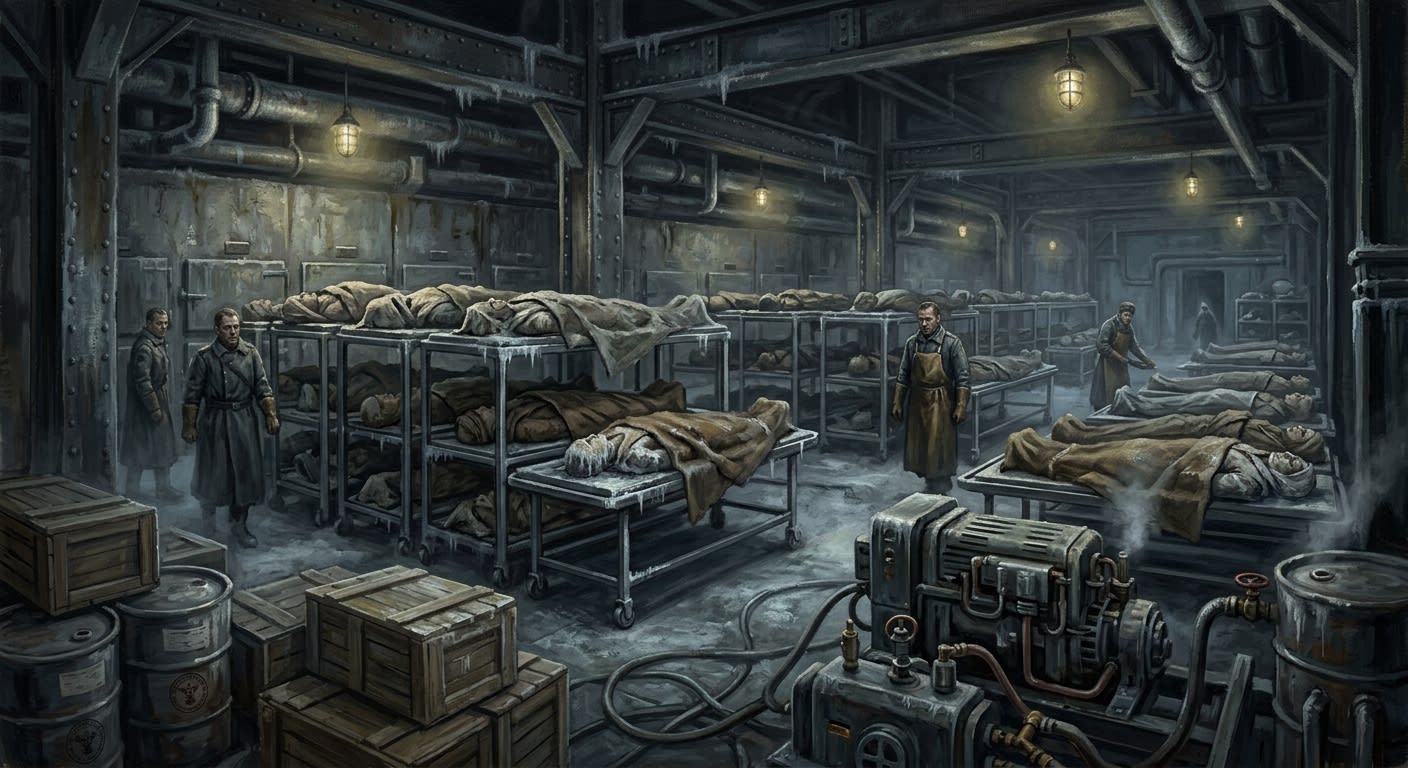
The Frost Yards occupy the northern-industrial quarter of Bastion-Königsberg, pressed between the Harbour Quarter (Unregistered)'s salt-crusted cranes, the Ordensburg's command shadow, and the Sea Wall (Unregistered)'s grey instruction. The district is described in Bureau of Engineering diagrams as a stores complex, repair yard, cold magazine, ration vault, and mortuary holding adjunct. This is the sort of description that sounds exact because it has murdered all useful truth. The Frost Yards are where the bastion keeps what must remain intact until War decides how quickly to spend it: cartridges, bell-clappers, oil, rope, winter bread, gunmetal, dead men, inconvenient reports, and the little brass tags by which the Bureau of Records persuades a corpse that it still belongs to history.
The name began as soldier speech and became official because no clerk at Königsberg could deny the evidence without taking off his gloves. The vaults never rise above freezing, regardless of season. Summer rain turns to rimed beads on the stair rail. Lamp smoke hangs low and thin as if unwilling to climb. Men carry their breath before them like unsigned petitions. Meat keeps. Bread keeps. Oil keeps. Ammunition keeps dry past all reasonable expectation. Bodies keep too, and therein lies the district's problem.
The public register lists the Frost Yards as part of Northern Theater Stores Command (Unregistered). The garrison calls them the Cold Office, the Dead Pantry, Halder's Chapel, the Tenth District, the place under the wrong weather, and, when officers are not listening, the room where the Grey stores its attention. That last phrase is prosecutable, poetic, and probably accurate enough to frighten a competent man.
Haunting is a word peasants use when a cupboard creaks after a funeral. The Frost Yards are administered.
#On the Making of the Cold Quarter
Königsberg was requisitioned for the Line in the early decades of consolidation, and its stores were first laid out according to ordinary military logic: powder far from flame, grain far from damp, dead far from kitchens, clerks far from any surface likely to stain cuffs. The original yard stood behind the Harbour Quarter, where Prussian warehouses had once held amber, timber, salted fish, academic contraband, and barrels whose contents changed by season and bribe. When the bastion expanded during A.S. 92–110, the warehouses were sunk, roofed in brick, faced in iron, and tied by narrow gauge spurs to the harbour cranes and inland supply road.
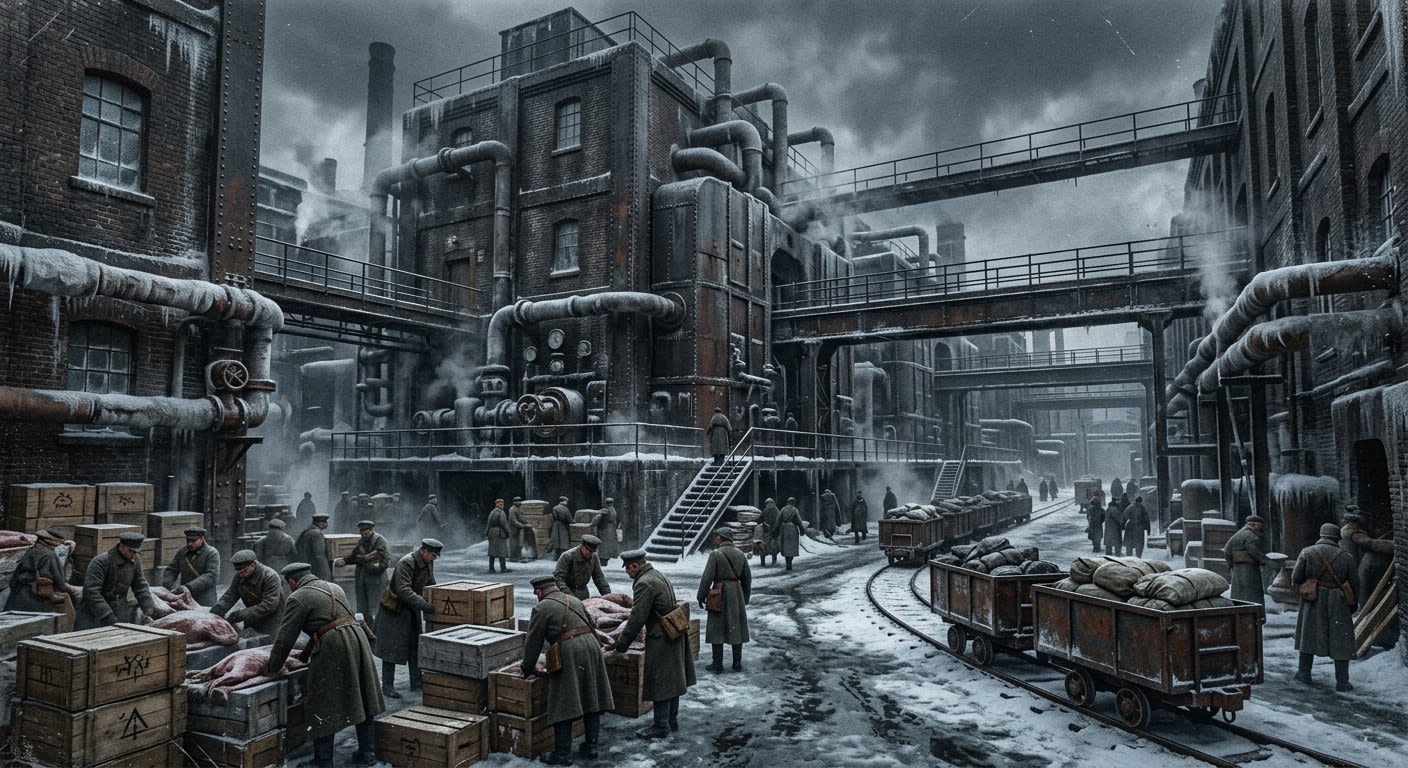
The cold first appeared in the store ledgers before anyone admitted it in prose. A.S. 118 inventory notes record reduced spoilage in Vault B. A.S. 121 ammunition surveys praise unusual dryness. A.S. 126 ration accounts report that black bread placed in deep shelfing retained weight beyond expected range. The clerks celebrated these advantages with that innocent greed by which administrators greet the miraculous when it saves money. The district received extra grain, then extra powder, then reserve bell-metal, then the bodies.
Bodies entered because weather made burial slow. At Königsberg the earth resists shovels in winter, the harbour wind eats candles, and the garrison dies at inconvenient hours because the enemy and the climate decline to consult the burial schedule. Temporary holding vaults were carved beneath the eastern store row in A.S. 132. The arrangement was practical. Practical arrangements become traditions when nobody dies immediately from them.
An Engineering memorandum of A.S. 140 states that the Frost Yards' mortuary vaults were “selected for sanitary stability and efficient preservation.”
Corrected. The vaults were selected because the dead did not rot there, and because no officer wished to say aloud that a district had begun performing mortuary miracles without priest, writ, or authorized relic.
By A.S. 150 the cold had acquired rules. Grain vaults nearest the mortuary held best. Oil stored beside the east wall stayed pourable. Bell-clappers hung above the oldest stone sounded clean when struck, though no Bureau of Bells certificate explained why. Men assigned to night watch in the lower galleries reported neither visions nor voices, which reassured the officers until a veteran quartermaster observed that silence too regular may be a kind of speech. He was transferred to Warsaw for temperament. The cold remained.
The Bureau of Engineering opened six inquiries across seventy years. Every inquiry found masonry competence, airflow peculiarities, groundwater behaviour, Baltic (Unregistered) permafrost, cellar depth, iron lamination effects, and other phrases by which men paid to understand matter avoid being eaten by matter's refusal. No inquiry answered the central question: why a district above ordinary earth, behind ordinary walls, under ordinary roofs, obeys no ordinary temperature. Engineering sealed the matter under acceptable variance. The garrison bought thicker gloves.
#On the Arrangement of Vaults and Yards
The Frost Yards comprise four surface courts and nine principal vault ranges, though the counting depends on whether one accepts the lower crawlspace below Vault C as architecture, accident, or throat. The Bureau accepts architecture because architecture can be taxed for maintenance.
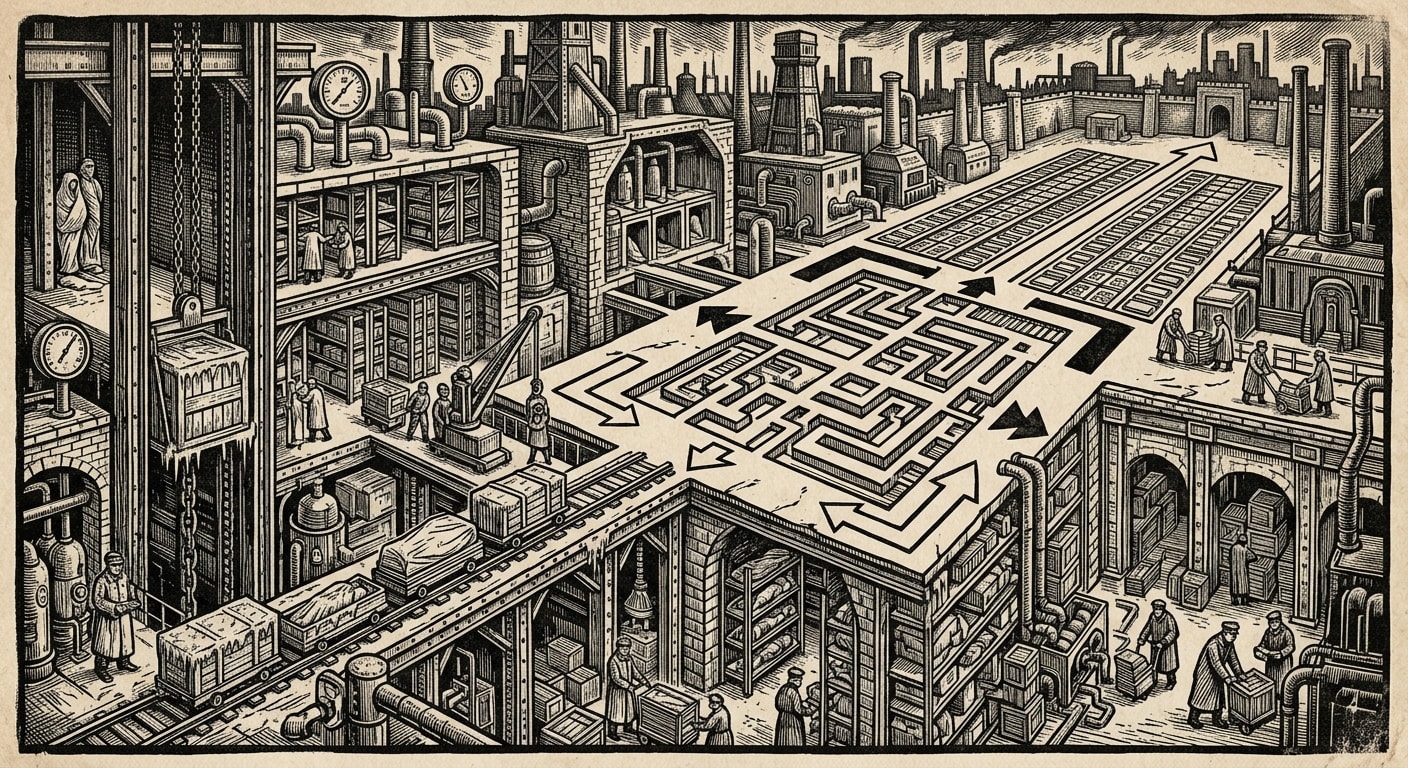
The North Court holds artillery spares: axle bands, recoil springs, sighting brackets, oilskin-wrapped mechanisms, and spare plates for guns that have not been manufactured in thirty years yet remain too useful to retire. The West Court keeps ration stores in bricked magazines with double doors and ash-packed seams. The East Court holds mortuary access, sealed litters, coffin boards, burial tags, thaw lamps, lime casks, and the sloped drain Sergeant Halder cleans with a devotion no saint has earned from more beautiful material. The South Court touches the rail spur, where crews unload cargo by bell schedule and pretend not to see the frost line creeping across the stones even in August.
Below lie the vaults. Vault A stores gun oil, resin, lamp fuel, winter grease, and sealed jars of saint-dust suspended in wax. Vault B stores emergency bread, salt, dried fish, field broth tablets, and Mercy allotments labelled in handwriting so optimistic it should be fined. Vault C is mortuary holding. Vault D holds bell fittings for the Northern Carillon, including clapper cores, tuned braces, rope sheaves, bronze wedges, and three wrapped bells that no one has installed because Rector-Chaplain Grau will not sign the tonal release. Vault E stores powder under Engineering supervision. Vault F stores records duplicated from the Harbour Quarter in case fire, ice, fog, or Scandinavian diplomacy destroy the originals. Vault G was closed in A.S. 184 after the hinges froze open. Vault H holds winter uniforms. Vault I is a corridor pretending to be a vault until someone important decides what it was built for.
These rules are obeyed with rare seriousness. The Frost Yards make jokers tired. A man may jest outside the gate. Inside, his voice learns economy. Wheels creak less. Boots fall flatter. Even curses shorten. The cold does not forbid speech. It edits.
The walls sweat inward. Frost feathers across brick in forms that tempt comparison and deserve none. The lamp niches carry soot stains bending northeast. The drain water in Vault C forms a thin skin each night, then cracks by morning in lines radiating toward the same compass point. Halder has measured this. Of course he has. The man measures dread as if dread were a shelf.
#On Sergeant Halder and the Custody of Exactitude
Sergeant First Class Halder keeps the Frost Yards, and the district has had the good fortune to receive a custodian too literal for panic. He is sober, square-handed, precise, and almost offensively uninterested in improving fact into symbol. If a loaf bears frost in the shape of fingers, Halder records shelf height, loaf weight, frost depth, witness order, and latch condition. If a corpse stands in Vault C, he does not call for a poet. He checks the tag.
His office sits beside the East Court entry beneath a lamp that never smokes. The room contains a desk scarred by knife points, a wall rack of keys, two ledgers, four temperature slates, a brass orientation gauge, a tin whistle he plays badly on feast days, and a cupboard of string, seals, chalk, and small mercies. Men assigned to the Yards learn his order quickly. Keys touch palm before doors. Doors open inward unless marked. Tags are read aloud. Witness marks are made before commentary. Commentary waits until the dead have been put where Halder says the dead belong.
Halder's authority comes from usefulness rather than rank, which makes it stronger and more resented. Officers may outrank him. None outrank his keys. Castellan-Warden Halvorsen knows this and lets the fact stand. Purity dislikes it because Purity dislikes any man whom fear approaches and fails to decorate. Engineering dislikes him because his measurements keep humiliating their explanations. Records likes him in the furtive way clerks like clean data arriving from an unclean source.
He has made the Frost Yards legible without making them safe. That is his achievement. Safety may be impossible. Legibility still kills fewer men than wonder.
#On the Seven Displacement Reports
Between A.S. 195 and A.S. 199, Halder filed seven Frost Yards Displacement Reports (Unregistered). The phrase is ugly, bureaucratic, and blessedly bloodless. It prevents recruits from saying the dead moved by themselves, though it does not prevent the dead from doing so.
Report One recorded a head turned eight degrees northeast after placement and tag confirmation. Report Two recorded hands folded across the chest of a cavalryman whose wrists had been bound at sides for transport. Report Three recorded burial cloth drawn tight around the feet of a stores novice dead from a crane fall. Report Four concerned a ration loaf stored in Vault C during overflow; frost marks resembled four fingers pressed into the crust, though no hand had touched it after sealing. Report Five recorded a body found prone after being laid supine. Report Six contained sketches, measurements, witness initials, temperature readings, latch scratches, and the sentence that passed through Northern Theater offices like a knife under a door: “Subject appears to have listened.”
Report Seven made the district a doctrine problem.
A dead infantryman stood in Vault C.
Back to the north wall. Boots on the drainage grate. Arms at sides. Face toward northeast.
FROST YARDS REPORT 7-HALDER — VAULT C EXTRACT Initial placement: shelf three, supine, hands tied, tag confirmed. Discovery: upright against north wall; shelf frost broken outward. Face condition: ███████████████████████████. Auditory note: three witnesses heard one breath after name reading. Subsequent action: three irregular bells rung by Rector-Chaplain Grau; subject found supine by morning.
Purity interviewed Halder nine times. They tested for drink, grief-contagion, Scandinavian contact, falsified witness protocol, sleep rot, doctrinal vanity, and poetic tendency. The last charge is more serious than civilians understand. A poetic witness is a disaster. He multiplies one horror into seven and makes each less prosecutable. Halder failed none. He remained himself, which was the worst possible outcome for anyone hoping to dismiss him.
Northern Theater Stores attempted to consolidate Reports One through Six under “mortuary housekeeping irregularities.”
Rejected after Halvorsen's command note and Grau's supporting statement. A shelf error becomes housekeeping. A standing corpse becomes evidence. The amended category reads Frost Yards Displacement, Verified Witness, Pending Doctrinal Interpretation.
The seventh report changed procedure. Mortuary shelves now bear brass orientation gauges. Corpses are tied with two-colour string so wrist rotation can be seen at a glance. Vault C is opened with three witnesses during fog approach. Bell-metal may not be stored beside the unburied without Grau's countersignature. No body waits more than nine days unless the earth is frozen too hard for burial or the file has been seized by Purity. In practice, the second condition lasts longer than winter.
#On the Chemistry That Will Not Obey
The Frost Yards offend more than theology. They offend chemistry, which is theology for men who dislike incense.
Oil does not congeal in the deep racks. Gun grease remains spreadable at temperatures where a clerk's spit freezes before hitting the floor. Bread does not stale at expected rate and, in sealed lots nearest Vault C, loses neither weight nor crumb cohesion for weeks. Powder remains dry beyond specification. Salt clumps only when stored beside living watchmen, never beside the dead. Leather stiffens on the south shelves and stays supple on the east. Ink left overnight thickens in Records drawers yet flows cleanly when used to copy mortuary tags. Candles burn shorter in the East Court, longer in Vault D, and with blue rims in the corridor below Vault G.
Engineering has explanations for each offence, stacked like plates over a crack in the table. Airflow. Mineral salts. Baltic groundwater. Thermal retention. Iron lamination. Human error. Instrument fatigue. Improper storage. Unregistered shrine influence. The explanations contradict each other, which does not prevent Engineering from presenting them in the same memorandum. Contradiction, once given paragraph numbers, becomes interdepartmental texture.
Bells behave worst. Replacement clappers stored in Vault D acquire a soft bloom along their striking faces, pale as old bone, removable with vinegar, returning within three days. Bronze wedges hum when the Northern Carillon rings during fog approach. Rope sheaves stiffen unless wrapped in cloth marked by Grau's hand. One bell core, rejected in A.S. 197 for tonal drift, sounded a low answering note while still crated and unstruck. Halder recorded the time. Grau ordered the crate moved two vaults west. The note ceased. Engineering blamed settling wood. Wood, apparently, has learned antiphony at Königsberg.
The garrison exploits the district anyway. War has never refused a useful abnormality on moral grounds. The Yards keep food, fuel, powder, and bodies when everything else on the northern edge conspires to ruin them. Halvorsen will not abandon them. Grau will not bless them as safe. Halder will not let either office speak loosely. This triangle of refusal preserves the district better than any official doctrine yet composed.
#On the Northeast and the Grey's Attention
Everything that moves in the Frost Yards moves northeast.
The sentence is crude. It is also the nearest honest thing. Heads turn northeast. Hands pull toward northeast. Frost cracks toward northeast. Soot bends toward northeast. The standing body faced northeast. Halder's gauges confirm the vector. Halvorsen's private observation logs align it with fog approach, Sea Wall saluting reflexes, gull absence, and old Scandinavian reports concerning det grå vattnet. Northeast from Königsberg is open Baltic water. The maps list shoals, patrol lanes, wreckage, ice hazards, and disputed approaches of the Fractured North. The maps do not list a throne.
The connection to the Grey remains unconfirmed in official doctrine because confirmation would require an office to admit that a fog, a hymn echo, a corpse orientation, and a cold store may occupy one sentence. The Bureau prefers fragments. Fragments fit drawers. Sentences require courage.
The Frost Yards do not feel like the Sea Wall. I have stood in both and resent the memory equally. The Sea Wall faces outward. Its terror has horizon, wind, water, visible fog, the vulgar comfort of distance. The Frost Yards face inward. Their terror has shelves. The Sea Wall says something comes. The Frost Yards say something has already entered and is sorting inventory.
Grau calls this inward pressure pastoral contamination. Halvorsen calls it operational seepage. Halder calls it nothing, because Halder has learned that naming a condition before it has been counted is how clerks breed ghosts. I call it attention. The Grey pays attention to Königsberg, and the Frost Yards may be one place where that attention has found purchase in matter cold enough to remember it.
#On the Men Assigned Below
Service in the Frost Yards is filed as duty rather than punishment, though it is sometimes used by officers too stupid to know the difference. The work requires patience, clean hands, strong backs, steady eyes, and the moral ugliness necessary to handle bread and corpses in neighbouring rooms without composing philosophy. New men are paired with old men for six weeks. If they joke too much, they are removed. If they fall silent too quickly, they are removed. If they begin checking the northeast corners of rooms outside the district, they are sent to Grau before Purity can smell opportunity.
The labour is hard and small. Count crates. Scrape frost. Check seals. Haul oil. Stack bread. Shift ammunition. Chalk shelf numbers. Read tags. Tie toes. Warm hinges. Replace lamp glass. Sweep ice from drains. Move bodies when bells permit. The men who do it become particular. They learn to listen without seeming to listen. They learn to keep one shoulder from turning. They learn that fear can be folded into routine if the routine is tight enough. A loose routine invites imagination. Imagination gets men hurt.
There are economies. Extra bread from rejected lots. Candle ends from mortuary lamps. Warm gloves traded for east-vault duty exemptions. A cup of harbour spirits tucked behind oil rags and never drunk in Halder's sight, which means never drunk at all unless the drinker has a death wish. Halder tolerates small theft from abundance and none from the dead. A man who takes a button from a corpse loses his post. A man who takes a ration heel from a spoiled crate receives a stare, which at the Frost Yards counts as mercy.
Records clerks hate entering the Yards because ink behaves badly. Purity inspectors hate them because witnesses behave well. Engineering hates them because walls do not confess. War loves them because supplies emerge intact. Doctrine has not decided which hatred is most useful and so visits rarely, which proves Doctrine retains instincts beneath its robes.
#On the Committees That Failed to Warm It
The Synod has tried to understand the Frost Yards with committees, which is how the Synod attempts to understand anything it cannot hang, bless, requisition, or promote. Six formal inquiries have entered the district. Five returned with recommendations. One returned with no recommendation because its junior clerk misplaced the conclusion in Vault F and refused, with admirable sanity, to retrieve it after dusk.
The first committee belonged to Engineering and brought thermometers, pressure gauges, chalk rods, wall probes, and that special smirk common to men convinced that masonry is less mysterious than prayer. They drilled three test holes. The drill bits emerged rimed in black ice and smelling faintly of vinegar. The chairman declared groundwater. The second member declared mineral salts. The third member declared that the chairman had been standing too close to Vault C and should be relieved before he began naming the dead. The minutes record consensus. I have read them. Consensus has never looked more like panic wearing boots.
The Bureau of Medicine tried next, suspecting some northern fever of perception. It examined workers after cold exposure, measured pulse, tooth chatter, pupil dilation, tremor, appetite, confession frequency, and the colour of fingernails. The physicians concluded that the Frost Yards produce no ordinary sickness. They also noted that men assigned below for more than six months begin sleeping with their beds turned northeast. Medicine filed this under adaptive orientation habit. Grau filed the same observation under pastoral concern. Halder turned his own bed due west and placed a chair against the east wall. The chair has never moved. Halder measures it weekly.
Purity's visits were least useful and most theatrical. Inspectors arrived with lamps, interview stools, sealed questions, and the moral fragrance of men hoping the impossible would turn out to be a sinner. They found no cult, no hidden Scandinavian rite, no stolen relic, no illicit hymn, no frost charm, no blood-circle, no child's bone under the threshold, no unauthorized saint nailed behind the racks. They did find a quartermaster selling warm glove rights and punished him with such enthusiasm one might think glove corruption had raised the dead. The district endured the improvement.
Doctrine convened no full inquiry. This was wise or cowardly, two categories often separated only by the survival of the decision-maker. A doctrine committee would need to decide whether the cold is miracle, curse, anomaly, enemy action, relic effect, environmental grace, or pending matter. Pending matter is the safest category because it consumes no martyrs. The Frost Yards, being colder than rhetoric, accepted the delay.
#On the Present Condition
As of A.S. 201 the Frost Yards remain active under restricted access. The cold persists. The stores hold. The mortuary vaults function. The dead have not stood again since Report Seven, or have not been found standing, which is a different statement and should not be filed as the first. Three lesser displacements occurred after A.S. 199: one hand rotation, one frost fracture under a burial shelf, one tag string pulled tight enough to mark the toe. Halder recorded them as addenda rather than new reports. This restraint is admirable and possibly tactical.
Halvorsen keeps the district in service because abandoning it would cripple northern supply and concede a fact the Bureau has not named. Grau watches the bells and the men who hear them. Halder keeps keys, slates, gauges, tags, and the cold arithmetic of the dead. The Bureau of Doctrine keeps the category pending. The Bureau of Engineering keeps pretending it has not been insulted by a cellar.
The Frost Yards are useful. That is the danger. If they merely froze men, frightened clerks, and embarrassed theologians, the Bureau would seal them, bless the doors, and assign a committee to starve in the corridor. Instead they preserve ammunition, food, fuel, bell-metal, and bodies with an efficiency no northern commander can discard. A useful wrongness survives longer than a useless miracle. It acquires guards. It acquires budget. It acquires procedure. One day some fool calls the procedure doctrine.
At fourth bell Halder walks the East Court with his key ring muffled in cloth. He checks the outer latch, the lamp niche, the drain, the slate, the shelf marks. The men behind him carry no incense. Incense freezes into dirty beads in Vault C and smells theatrical besides. A dead soldier waits under grey cloth with a tag tied to his toe. The tag bears his name, rank, unit, and burial queue. Halder reads it aloud. The body does not move. The men do not relax. Beyond the vault wall, bronze hums from the Cathedral Close (Unregistered). Farther north, fog gathers on the Baltic with no respect for weather. On the shelf, the tag string trembles once, then lies still.