
#On the Site and the Parish
"The mountain does not care who holds it. The mountain is the hold." — Bureau of Engineering Field Manual, Section 14
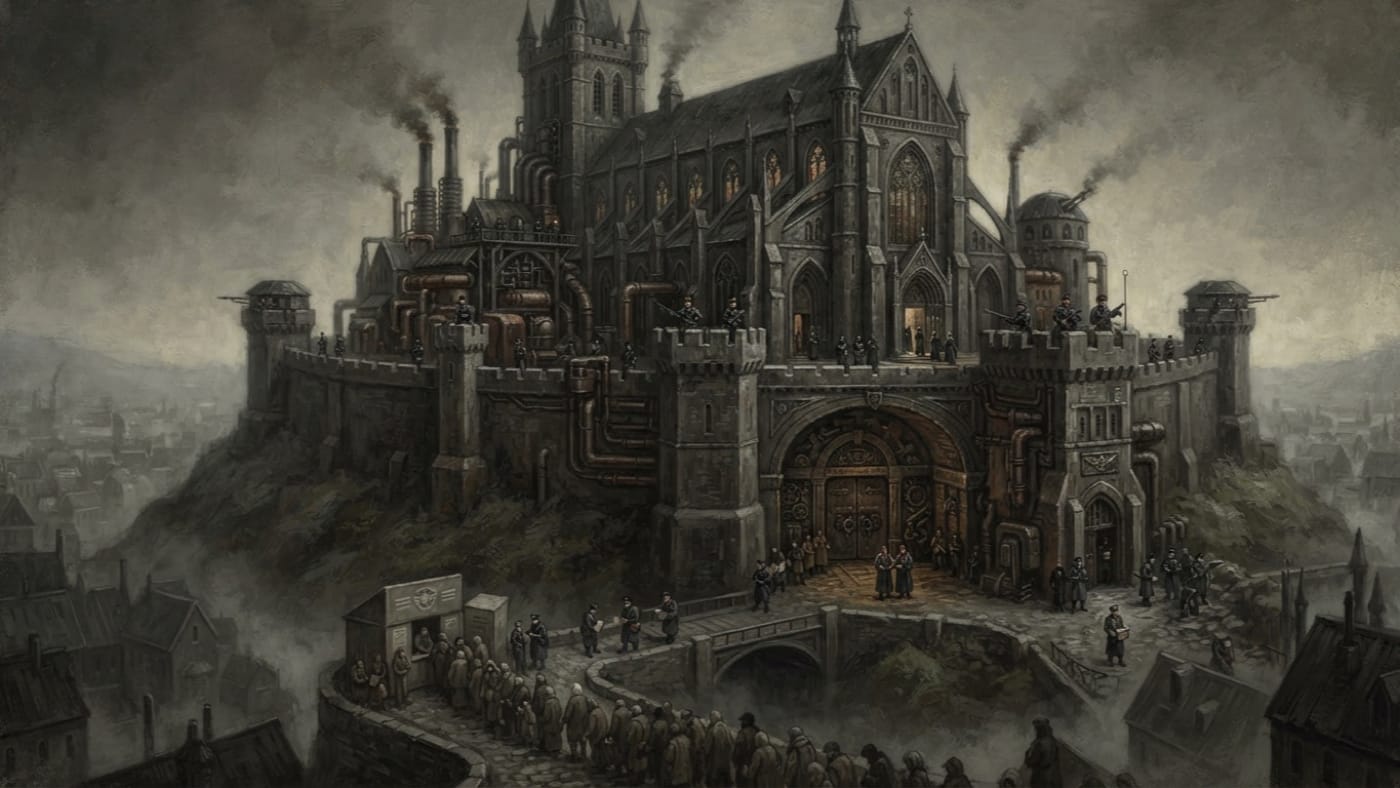
The Cathedral of the Fortified Creator crowns the hilltop at the centre of Bastion-Sibiu, inside the Citadel Ring, on ground the Saxons of Hermannstadt consecrated long before the Sundering gave the Church a wound to count its years from. It was built on top of their parish church. The Codex does not hold the year that church was raised, the year its successor was dedicated, or the name of whoever drew the elevation. I decline to supply them out of enthusiasm.
The Saxons built for a country where every prayer needed a wall around it. When the frontier authority reached Hermannstadt in A.S. 66, it found the hill already sanctified and already defensible. That authority was the Church in its wartime vestments, the provisional administration that the Synod would formally constitute only in A.S. 90 and has since remembered as having been present all along. Sibiu was designated a bastion that year and ratified in A.S. 72. Those dates belong to the bastion. The cathedral has never told the Ledger its own.
The old parish is still beneath the newer stone, and the old parishioners are still around the hill. What remains of the Saxon community lives in three streets near the old Rathaus. They speak their dialect, keep their own parish rolls and follow the cathedral's bells with the patience of a family whose house was requisitioned while they were still sitting at the table.
#On the Cathedral Within the Citadel
"A city designed by soldiers is a barracks. A city designed by clerks is a filing cabinet. A city designed by both is Sibiu." — Overheard in the Rathaus Quarter, attributed to everyone and no one
The Citadel Ring is a crowded hilltop. The old Rathaus serves as the garrison command post. Senior command keeps its offices there, beside the Bureau offices whose clerks outnumber some battalions on the Line. The Assay Chamber also sits within the ring, along with the vaults of the Bureau of Tithes. The cathedral occupies the high middle of all this. It is the one building on the hill whose official business is the Creator, and its neighbours have business of their own.
The reader must not confuse it with the Church Ring below. That ring holds seven Saxon fortified churches, now converted into barracks, armouries and chapels. Their walls are three metres thick. Their firing slits have been widened for rifles, their granaries hold ammunition, and between them they garrison eight thousand soldiers. Those figures belong to those seven churches. The Codex has no wall measurement, tower count or weapons inventory for the cathedral, and I will not borrow one from a neighbour because it would read handsomely. Saint Martin's of the High Wall, which still preaches in Saxon after fourteen directives requiring Synodal Latin, is likewise a Church Ring house. Its stubbornness is its own.
The cathedral's architecture is Saxon by inheritance: sober grey stone that has seen the Transylvanian weather and has not been talked out of it. Its military character shows in its traffic. Couriers in greatcoats cross from the Rathaus. Clerks carry ledgers between Bureau offices. Sentries keep the approaches to the most valuable ground in the bastion. Worship continues in the middle of the command post, and the command post has never asked to be excused.
#On the Vaults Beneath the Altar
"Gold is the only siege engine that does not require assembly." — Bureau of Tithes, Internal Memorandum (Leaked, A.S. 197)
The vaults of the Bureau of Tithes lie directly beneath the cathedral's altar. They are the most heavily guarded structures in Bastion-Sibiu. The Bureau insists that the placement carries no symbolism. I record the Bureau's insistence beside the placement and leave the two together on the page, where they have kept each other company for decades.
The arrangement is vertical and complete. Above, the priest elevates the host and the congregation answers. Below, the Bureau keeps the money that pays the garrison and the bastion's chief protection against Velmora's purchases. Of all the property inside the walls, this is what the bastion guards most heavily. No one has drafted a more honest confession of the Church's priorities on this frontier, and no one drafted this one. The masons simply laid it out that way.
The Codex holds no inventory of the vaults, no charter governing who may descend, and no description of their locks. I have not been offered a tour and do not expect one. Nothing in the record shows that the vaults have ever been breached, by force, by bribery or by the patient processes of the Ten Thousand Keys. That silence covers the vaults themselves. The economy above them is recorded at length further down this page.
The Assay Chamber is a separate institution within the Citadel Ring. Every Crown, every scrip note and every piece of metal entering the bastion is tested there for Velmora's taint. Its examiners work around the clock in four-hour sleeping shifts. The Codex records no passage between the Assay Chamber and the cathedral: no shared crypt and no connecting tunnel. One house is responsible for the altar and the other for the scales, and they share a hilltop and a common enemy.
#On Sufficiency and the Purchased Loyalty
"Desire nothing beyond thy ration. The Crown provides. The Crown suffices." — Doctrine of Sufficiency, as posted in the barracks, canteens and chapels of Bastion-Sibiu
The Doctrine of Sufficiency hangs on the walls of the bastion's chapels, and the soldiers recite it. The Bureau of Purity examines their belief every quarter. The Bureau of Tithes examines their spending daily, and on this hill the two examinations have grown hard to tell apart.
The doctrine asks a soldier to want nothing more than his ration. The ration is bought with Crown scrip, the Bureau of Tithes' paper vouchers, introduced in A.S. 130 to keep Velmora's coin out of the garrison's pockets. In A.S. 181 a Tithes auditor named Goss found that fourteen per cent of the scrip circulating in Sibiu carried serial numbers that matched no issue in the master ledger. The paper was genuine and the ink was correct. The numbers did not exist. The Serial Reconciliation Protocol has been renewed every year since, and the Bureau estimates its own compliance rate at forty-three per cent. A hungry man at a bread stall seldom checks his voucher against the master ledger.
Velmora's agents work in that gap. Her bribes reach teamsters, quartermasters, checkpoint guards and the occasional underpaid official. In the highland villages, the Ten Thousand Keys lend to farmers whose harvests have failed. The loans are generous and the terms are clear. The borrower hands over a brass key, cut to fit no lock he owns, and signs. The Synod's charity takes six weeks and a theological examination. The cult's money arrives at once.
The Church answers with its own instruments. Currency is blessed before circulation, and tithes are urged on the faithful as inoculation against Velmora's offers. The Codex makes no claim about which of these rites, if any, are performed beneath this cathedral's vaulting, or about how well they work. Velmora's coins look and spend exactly like blessed ones.
#On the Present Condition
"We are solvent, Hieromnemon. The question is: in whose currency?" — Garrison Commander's dispatch, A.S. 201
This entry describes the cathedral as it stands under the Bastion-Sibiu assessment of A.S. 201. The building holds, the altar is served and the vaults below it remain the best-guarded rooms in the bastion. By every military measure the Bureau of War applies, the Citadel Ring has never been threatened.
The economy around it is in worse health.
The Codex entry for Bastion-Sibiu previously stated that the garrison "has contained Velmora's economic warfare to manageable levels."
The Bureau of Tithes' A.S. 200 assessment reclassified Sibiu's economic situation from "contained" to "chronic." This correction concerns the bastion's circulation of money and loyalty. It does not report any breach of the Tithes vaults beneath the cathedral, and none is recorded.
The hill has a further oddity, and it does not belong to the cathedral. The phenomenon was first documented in A.S. 178. At irregular intervals, a film of warm gold appears on the inner surfaces of the Citadel Ring's walls. The Assay Chamber finds it pure and, by every assay available to it, free of taint. The Bureau of Tithes collects it and enters it in the ledger. The garrison believes the gold comes from Velmora's workings, extended beneath the range and beneath the bastion. The Bureau of Doctrine denies this. It has offered two explanations, in A.S. 179 and A.S. 188, and in A.S. 199 it replaced both with an order to stop discussing the matter. The cause is unknown. The record does not show the gold on the altar, in the nave or on the walls of the vaults, and I will not move it there for the sake of a better sentence.
The walls of the Citadel Ring answer artillery, and the guards beneath the altar answer burglars. Nothing on the hill answers a voucher printed with an invented number and accepted by a hungry man, or a loan repaid on time to a cult that asks only for a signature. The Church built its sanctuary over its treasury and set its best guard on both. Every week, Velmora does her business in the bread queues below.