
#On the Office Still Named
"Notable branches include Chancery of Keys, Red Lanterns, White Mercy, Black Oath, Chamber Penitentiary." — glossary entry for the Inquisition, unamended
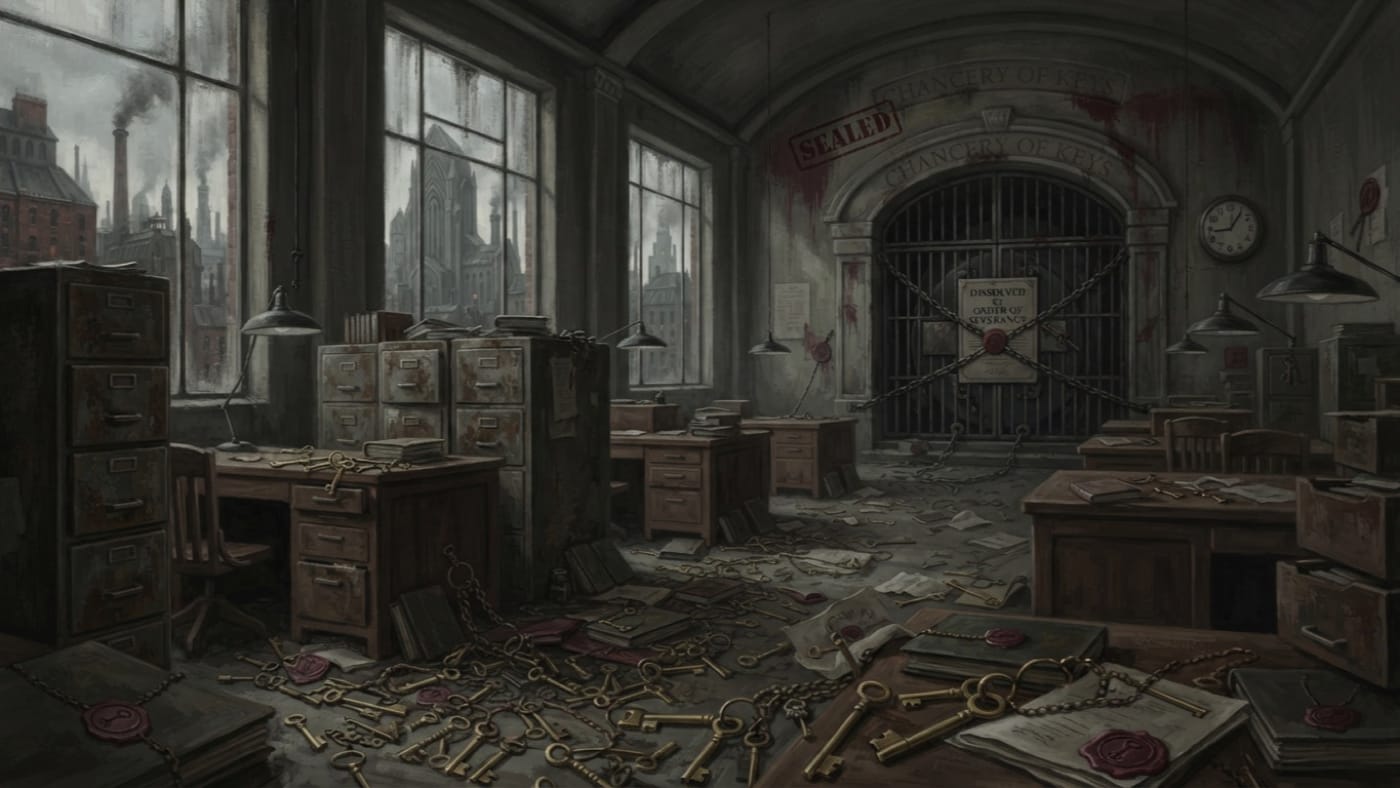
The Chancery of Keys was an inquisitorial bureau of the Church. Its name stands first in the standing list of the Inquisition's notable branches, ahead of the Red Lanterns, White Mercy, Black Oath and the Chamber Penitentiary. The list has never been revised. The office it names has been dissolved.
In Strasbourg this is an ordinary condition. A glossary outlives a department the way a tomb inscription outlives the bishop's appetites. The Order of Severance closed the Chancery under a charge recorded as "joyous irregularities." Since then the bureau has existed chiefly as a name other entries cite in passing. The Red Lanterns entry uses it as company in a list. The Bureau of Shadows entry uses it to show readers what Severance can do to an office that believed itself safe.
Two articles refer to it. Neither owns it. Sharing a line in a list creates no chain of command, and appearing in a cautionary tale makes no one a parent. The Chancery answered to whomever it answered to. That particular, like most of its particulars, is sealed.
#On Its Mandate and the Seal
"Functions overlap with Doctrine; specifics sealed."
After the name, the authorised entry runs to seven words. I have read all seven with the attention another man gives a will. The Chancery was inquisitorial. Its functions overlapped those of the Bureau of Doctrine. Its specifics are sealed. There the secure record ends.
The overlap deserves a moment's indignation. Doctrine defines what the Church holds true. The Bureau of Purity and its inquisitorial branches enforce it. An office that sat across that line, enforcing while also handling definition, was either a convenience or a trespass, depending on which Archon's clerk drafted the memorandum. My articles go out under Doctrine's seal. I have opinions about trespass.
The seal answers the question of what the Chancery did with its keys by declining to answer. The only fuller account belongs to this Codex's own entry on the Order of Severance, which I set down. It describes a minor Strasbourg office that kept duplicate key registries for Bureau storehouses, archive cabinets, reliquaries in transit and penitential holding rooms. Those particulars are published testimony. No docket I can produce confirms them, and the seal on the Chancery's mandate has not been lifted to let me try.
If the account is accepted provisionally, its logic is plain. A duplicate key is a second door into every room the Synod has locked. Whoever keeps the duplicates decides who may be trusted to open them. The Church has always required that trust be witnessed, paired, signed and entered, because unentered trust is merely affection with access.
#On the Neighbouring Authorities
The Inquisition is a household of jealous rooms. Doctrine writes the definitions. Purity carries them out, and the Bureau of Records files proof that it did. The Red Lanterns carry crimson glass into the lanes and make correction visible on a cheek. The Bureau of Shadows, which does not exist, makes correction invisible in a ledger. The Chancery shared a classification with the first and a cautionary paragraph with the second. As far as any open record shows, it shared duties with neither.
Severance is the neighbour that matters. Its assignment is hidden heresy inside the Synod itself: the clergy, the clerks and the offices that enforce orthodoxy and have quietly begun enforcing something else. The Lore Book records that senior officials become suddenly available for interview when its sigil approaches, and that even the Bureau of Shadows grows audible. Being an inquisitorial bureau protected the Chancery from nothing. The office that holds the instruments of scrutiny is the one best placed to exempt itself from them, and Severance exists because the Synod knows it.
#On Joyous Irregularities
"Joy is not heresy by itself. This is the official position."
The charge is the one secure sentence about how the Chancery ended: Severance dissolved it for joyous irregularities. The original legal meaning of the phrase lies under the same seal as the mandate. I have spent seventeen years construing Synodal phrases, and I cannot construe this one with confidence. Joy is licensed at festivals, at canonisations, and at announcements of victories that actually occurred. Irregularity is never licensed. Put together, the two words suggest an office that had grown happy in a way nobody had filed.
The Severance account supplies the irregularities, and its provenance is the one stated above. Festival wine was found in a cabinet rated for tribunal keys. Three clerks sang a secular round while re-cutting seals for a Mercy ward. Trusted clerks borrowed key blanks without paired witnesses. A private bell-skip moved the office's lunch away from the hour when Purity couriers arrived. The vault access ledgers were altered to spare an elderly Canon who had misplaced a relic-cabinet key and wept about it in a corridor.
As an indictment, this is a list of small mercies. As the administrative logic of the accusation, it describes witnessed procedure being replaced, piece by piece, with personal trust. A blank lent to a friend needs no second signature. A colleague's grief earns a quieter ledger. The rule stays on the wall, and the office decides warmly, among itself, when the rule applies.
The account cannot tell me whether the clerks meant only kindness, and I will not pretend it can. Severance did not ask about motive. It asked who had been trusted, by whom, and without whose witness.
Older Bureau summaries recorded the Chancery of Keys as dissolved for "procedural laxity."
Corrected to the recorded charge: joyous irregularities. "Procedural laxity" is a later and politer noun, suitable for dinner and useless for theology. Laxity is the absence of a rule. This finding concerned the presence of another rule, loyalty among colleagues, operating inside the Church's own locks.
#On the Missing Peal
"The only record left of that office was the gap in the bell-schedule it used to maintain."
The Lore Book is blunt, and I repeat its claim as the institutional position. When the Chancery was gone, what remained was an interval. The office had maintained a bell schedule. After the dissolution, the schedule kept a gap where the Chancery's peal had been, and the gap outlasted everything that carried a name.
The seal does not say why a key office kept bells. The Bureau of Bells holds the Synod's hours, and any department that kept its own interval inside them did so by sufferance or by negotiation. Once the Chancery's interval was struck out, nothing filled it. Strasbourg's timing ran on with a hole in it.
The Severance account adds more. The office was closed at third bell. Every active key was recalled. Each clerk sat a Signature Silence interview. Three records rooms were sealed from the outside, and the dust beneath their cabinets was copied before anyone went in. The remaining functions were divided among Masks and Seals, Records, Relics and a sub-desk whose title translates roughly as Keys Without Companionship. The account also claims that a warehouse peal ran early by thirty-seven breaths for eleven days, and it dates all of this to A.S. 149.
I report these claims. I do not certify the breaths, the days or the year. Nor can I set the account's detail beside the Lore Book's "only record" without one of them giving way. The Church has lived with worse.
#On the Record That Remains
The present survey certifies little. The Chancery of Keys was an inquisitorial bureau. Its mandate touched Doctrine and remains sealed. The Order of Severance dissolved it. No reinstatement is recorded, no surviving staff are listed, and this office knows of no present premises. The branch register carries the name in the present tense all the same.
The Red Lanterns entry may keep the Chancery's company. The Bureau of Shadows entry may keep its warning. Citing the Chancery gives neither of them any claim to it.
Applications to inspect the sealed particulars should be addressed to the Bureau of Doctrine. They will be received.