
#On the Crimson Glass
“Bring them into the light.” — Bureau of Purity street order, whose mercy lies in its brevity.
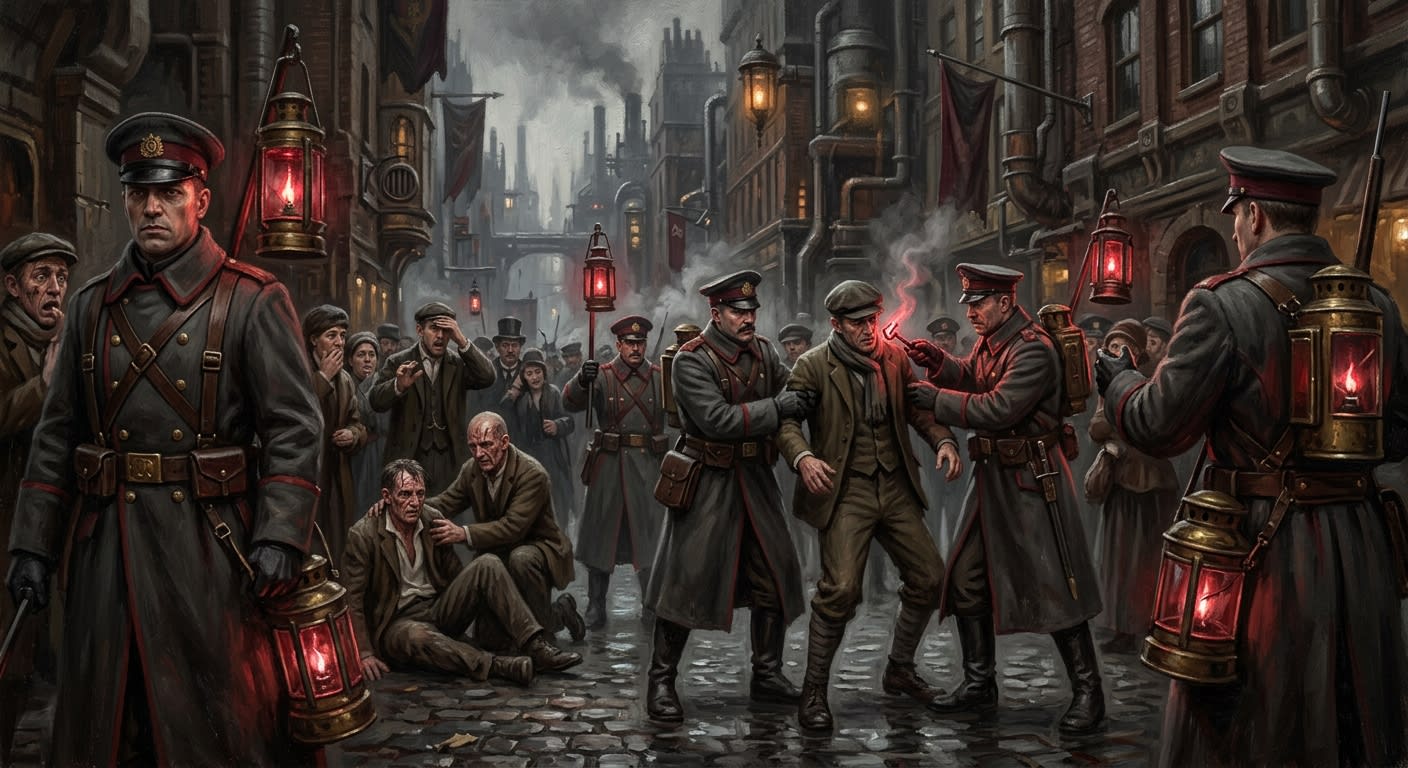
The Red Lanterns are the Bureau of Purity street squads assigned to sudden revelation: seizure, branding, witness shock, corridor panic, alley doctrine. They are listed among the Inquisition’s notable branches with the Chancery of Keys, White Mercy (Unregistered), Black Oath (Unregistered), and the Chamber Penitentiary (Unregistered), though the list flatters them by proximity. The Red Lantern is no scholar of forbidden language like the White-Mantled Inquisitor, no flesh-calligrapher like the Lictor. He is a hand around a lantern handle and a boot at the knee-joint. Refinement comes later.
Their instrument is the crimson-glass lantern: Bureau-issue, brass-ribbed, crosshatched at the guard, heated for field use by a sealed oil core and a coal capsule fitted beneath the lower ring. The glass is red because Purity enjoys symbolism in the same way butchers enjoy knives: practically, intimately, with little appetite for criticism. When lit, the lantern stains faces the colour of verdict. When pressed against skin, it leaves the guard’s pattern burned into the cheek.
The mark identifies the offender as illuminated — brought into the light of correction. The scar also tells every neighbour, employer, parish clerk, queue captain, toll examiner, child, and future accuser that the Bureau has already touched this face and may wish to touch it again. A brand is cheaper than surveillance. The street does most of the watching for free.
#On the Office and Its Lie
The Red Lantern office was built for proximity. Inquisitors require paperwork. Lictors require braziers, custody, and surfaces stable enough for legible inscription. Red Lanterns require suspicion and a lane narrow enough to make escape embarrassing. Their squads haunt fog districts, ration queues, shrine steps, ossuary gates, chapel porches, print-cellar stairs, and the warmed corners where grief collects after curfew.
They have become known chiefly through their mirror-war with the Lantern Mercy Preachers. The pairing irritates the Bureau, which insists that “Lanterns” as rebels and “Red Lanterns” as Purity personnel share no doctrinal ancestry. The erratum is famous. The coincidence is instructive. One lantern warms. One lantern brands. Both stand in the fog and claim the citizen’s face.
Earlier glossary tables co-classified “Lanterns (rebels)” and “Red Lanterns (Inquisition)” under a single street-movement heading.
Corrected. The Red Lanterns are an enforcement branch of the Bureau of Purity. The Mercy Preachers are a proscribed heresy. Shared nouns do not imply shared purpose, except where the comparison embarrasses the Bureau, which is the wrong sort of implication.
Their public formula is simple: heresy thrives in concealment; correction must be visible; the face is the public copy of the soul. The formula is rubbish of high administrative value. A branded cheek does not reveal belief. It rearranges social traffic around fear. The Bureau, being wiser than its slogans, knows this.
#On Squad Practice
A Red Lantern squad usually numbers four. The Bearer carries the lantern and owns the brand. The Hook takes the arm, wrist, collar, braid, veil, satchel strap, or any other handle Providence has provided. The Clerk records the cause, names witnesses, and notes whether the suspect screamed, prayed, laughed, or remained silent in a manner requiring later analysis by a Codex Doubt Auditor. The Wall stands where flight would like to occur.
The best squads move without shouting. Shouting gives the street time to decide whether it is a crowd. The Bearer raises the glass; the Wall closes the alley mouth; the Hook folds the suspect down; the Clerk asks one question whose answer is already unnecessary. If the matter is minor, the cheek receives a warning brand at half heat. If the matter is recurrent, seditious, or interesting, full heat is applied and the suspect is carried to a Purity station before the smell has left the lane.
Red Lanterns attend Fog Preacher districts after second citation, after phrase recurrence, after chalk recurrence, after one mother too many leaves a levy queue with her eyes arranged toward courage instead of compliance. They watch for warmth. Warmth is difficult to prosecute, so they brand what warmth gathers around: the Consolator’s cheek, the listener’s hand, the chalking boy’s ear, the tavern door where the phrase returned three nights running.
They also train against Faronite variation. Phrase rotation robbed Purity of repeated wording; Red Lantern instruction now compares meaning across unlike phrases, looks for excessive local fitness, and arrests Preachers whose sermons are too clean for too long. A clumsy rebel repeats herself. A careful rebel sounds approved. The Red Lantern, being half cudgel and half ear, must distrust perfection.
#On the Brand as Public Document
The brand’s crosshatch is not decoration. Each district uses a guard pattern registered with Purity and cross-entered by Records so a cheek may be read backward into jurisdiction. The mark’s angle tells which hand held the lantern. The depth records heat. The scarring tells whether the accused fought, fainted, or was held by someone competent. Flesh becomes paperwork with poor margins.
The branded person receives a slip when convenient. The slip says illuminated, warned, pending, corrected, released, detained, escalated, or no further action. The scar says more. Landlords evict before reading the slip. Parish clerks move names to watch columns. Employers discover doctrinal caution. Suitors withdraw. Children stare. The Red Lantern does not need to follow the branded man home. The brand arrives before him.
RED LANTERN INCIDENT REPORT — RHINELAND DISTRICT (Unregistered), A.S. 200 Subject: Licensed Consolator, name withheld Cause: approved phrasing, crowd effect inconsistent with approved phrasing Brand applied: left cheek, full guard Witnesses: █████████████████ Crowd response: kneeling, then silence, then █████████████████████████ Clerk note: “The silence moved west.” Disposition: transferred before dawn.
The Bureau prefers cheek branding because it cannot be hidden without announcing itself. Neck brands are for soldiers, palm brands for oath-breakers, forearm brands for ledger offences. The cheek belongs to the marketplace. It attends confession, ration, marriage, arrest, and funeral without needing invitation. A citizen may forget a posted decree. A scar meets him at eye level.
#On Doctrine, Cruelty, and the Mercy Preacher Mirror
The Mercy Preacher’s amber lantern says: you are seen. The Red Lantern’s crimson glass says: you are seen. The theological difference between the two consumes tribunals, training rooms, and several hundred pages of Purity memorandum each year. The practical difference is temperature.
Against the Soft Insurgents, Red Lanterns are at their cruelest because the Soft Insurgent turns enforcement into sermon. Every seizure proves fear. Every branding proves the words mattered. Every erased chalk line leaves a cleaner rectangle on the wall. The Red Lantern despises that economy. He brands to end speech and finds the brand has acquired grammar.
Against Tongue-Smiths, the squads are less effective. A written catechism can be seized; a trained emphasis cannot. Red Lanterns arrest the mouth that performed it and the child who carried its altered saint-name, then file success. The sentence has usually left before them. Language is a rat in the walls. Fire helps. It does not solve architecture.
Training Memorandum 44-L (Unregistered) claimed illumination branding “prevents recurrence by creating immediate social clarity.”
Amended after District Seven recurrence studies. Branding prevents some recurrence, spreads some recurrence, and makes other recurrence more memorable. The Bureau retains the practice because mixed outcomes are still outcomes, and because the alternative would require admitting that faces can become banners.
#On the Bearer’s Cost
The Bearer’s occupational sickness begins in the hand. A tremor after long heat exposure. Red lines along the thumb. A tendency to hold mugs by the rim as though checking guard temperature. Then comes the eye: he sees cheeks as blank forms, queues as brandable surfaces, mercy as unprocessed sedition. Veteran Bearers can identify a previous Red Lantern mark from twenty paces and judge whether the first application was sloppy. They discuss it over soup. The soup cools.
Some become artists, which is worse. They angle the lantern for a cleaner hatch. They complain about struggling suspects ruining a good impression. They pride themselves on symmetry. Purity discourages this officially and rewards it through promotion, that old Synodal harmony between sermon and salary.
The Red Lantern remains useful because he makes doctrine immediate. No pamphlet can outrun a squad in a narrow lane. No mother weighing rebellion in a ration queue can ignore the smell of a cheek burned five feet away. No Mercy Preacher can pretend the Bureau did not hear when crimson glass turns the corner.