
#On the Document That Taught Joy to Queue
The Charter of Prescribed Observance was ratified in A.S. 58 under the seal of Augustinus of Mainz and countersigned by Cardinal Hieronymus Kratz, whose handwriting on the surviving copy resembles a spider dying heroically in ink. It is six hundred and fourteen articles long. This alone proves its sanctity, since only heresy wastes fewer clauses on obedience.
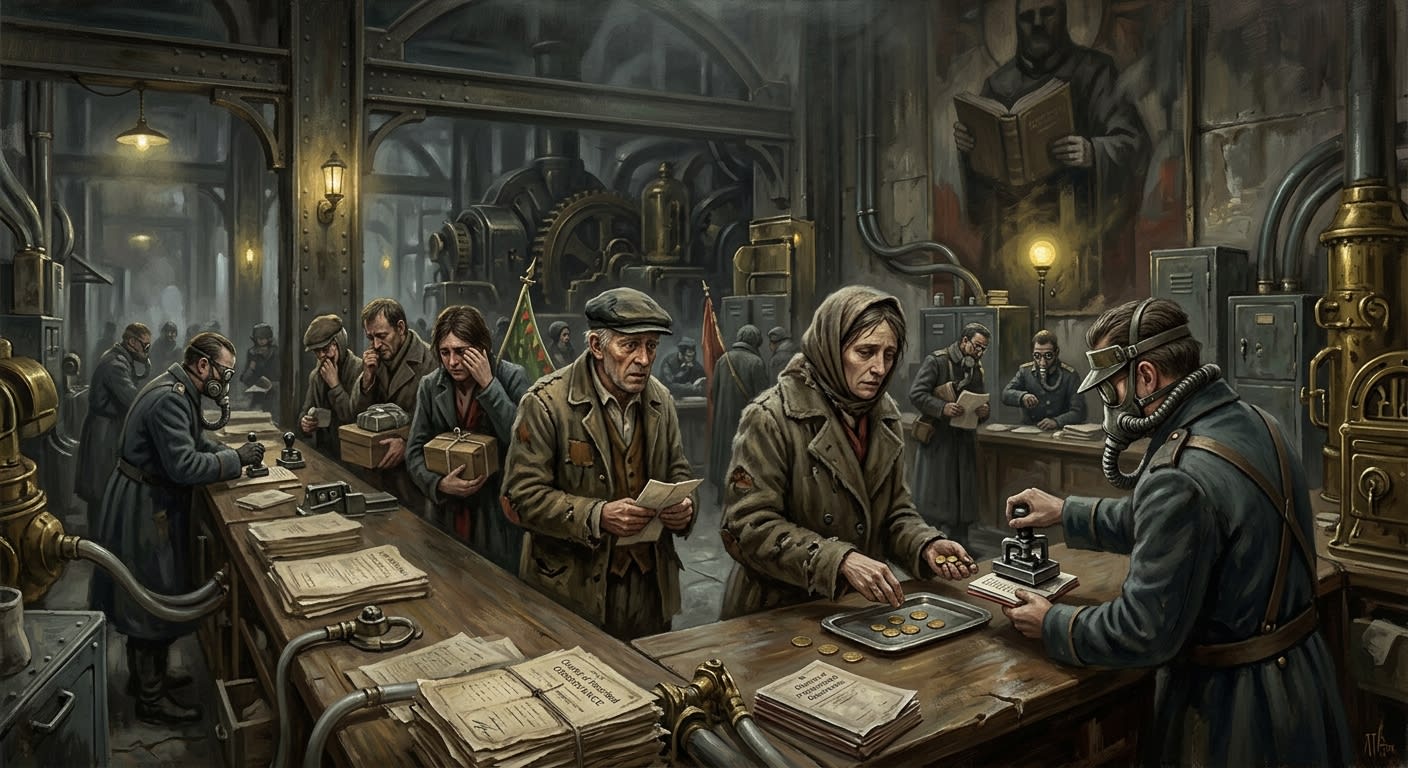
The Charter began as a practical correction to catastrophe. The Great Retreat had taught the faithful that unscheduled emotion kills. Panic opens gates. Grief rots discipline. Joy, if left wandering unattended, becomes tavern-song, tavern-song becomes satire, satire becomes pamphlet, and pamphlets — as every burned city of the Rationalist century can attest — are artillery with worse manners.
Augustinus understood the matter with his usual holy brutality. The faithful needed more than bread, bells, walls, and commanders. They needed an authorised calendar for being human. They needed permission to mourn at a useful hour, rejoice in a supervised square, kneel at the correct angle, fast without improvisation, and celebrate victory only after the victory had been entered in the Ledger and found theologically convenient.
#On the Six Hundred and Fourteen Articles
The first articles concern liturgy: incense angle, candle order, the prescribed cadence of response, the weight of the Host, the allowed duration of genuflection, the authorised bend of the wrist when lifting a censer before relics of uncertain grade. These articles gave the Bureau of Rites its spine. The Bureau would later claim it had always existed in embryo wherever two priests quarrelled over ritual form. This is charming. By the same reasoning, the gallows has always existed wherever two neighbours disliked each other.
The middle articles concern public observance: feast days, fast days, mourning days, victory days, ration-thanksgiving days, failure-reclassification vigils, saint-processions, bell silences, and local dispensations for districts too muddy to kneel without losing parishioners to suction. Here the later Bureau of Festivals found its legal cradle. A crowd that dances by licence has been made legible. A crowd that mourns by schedule has been made taxable. A crowd that cheers on command is halfway to being an army.
The final articles concern enforcement. No Charter survives on ink alone, though ink has tried and, under Kratz, achieved miracles of impudence. Parish auditors were authorised to report deviations. Bellmasters were instructed to deny peals to unauthorised gatherings. Priests who improvised prayers during public panic were to be corrected, fined, or reassigned to instructional terrain depending on the number of syllables involved. The Synod did not outlaw feeling. It taxed its exits.
#On Augustinus and Kratz
Augustinus supplied the theology. Form is mercy. Form is defence. Form is the fence around the soul when the world outside has teeth. The sentence appears nowhere in the Charter in precisely that shape, which means later commentators have had the kindness to improve him.
Kratz supplied the mechanism. His countersignature changed the Charter from episcopal advice into administrative fact. Under Kratz, an observance recorded became an observance owed; an observance owed became a debt; a debt became jurisdiction; jurisdiction became office space. This is how the Synod was made: not by thunder, but by clauses that reproduced in filing cabinets until they required buildings.
Certain Rites commentaries describe the Charter as a purely liturgical instrument.
Corrected. The Charter governed liturgy, festival, mourning, public silence, ritual expenditure, parish reporting, and crowd discipline. “Purely liturgical” is the phrase used by men who have never watched a feast day prevent mutiny.
Kratz, naturally, added teeth. Article 581 permits provisional compliance to be recorded before local assent has been received, provided the assent is “morally inevitable.” There it is: the whole Synod in two words. Morally inevitable. A bishop could object, a parish could grumble, a city could delay its reply; the Ledger, already confident in their future obedience, moved on.
#On the Bureaucratic Offspring
The Charter gave the Bureau of Rites its governing charter and the Bureau of Festivals its warrant in seed. By A.S. 72, with the Line stabilising and morale still behaving like damp powder, the Bureau of Festivals received its own seal, budget, and enemies. The enemies arrived in a procession worthy of licensing: the Censorium of Taverns, the Bureau of Bells, Orison and Song, and Tithes, each objecting for reasons that were accurate, selfish, and filed in excellent format.
Rites objected to festal looseness. Bells objected to competing peals. Orison objected to unlicensed choruses. Tithes objected to cost, then discovered festival permits could be monetised and experienced a conversion so sudden that Doctrine nearly investigated it as miraculous.
The Charter’s genius lies in its conversion of need into form. Soldiers needed cheer; the Charter produced licensed feasts. Refugees needed grief; the Charter produced mourning registers. Priests needed shared language; the Charter produced prescribed texts. Administrators needed obedience; the Charter produced everyone else.
#On Deviations and Their Uses
No instrument of six hundred and fourteen articles can be obeyed perfectly. This was not a flaw. Perfect obedience teaches nothing, employs few clerks, and produces no fines. Deviation is the Charter’s most fertile field.
A candle lit from the wrong end created a report. A forbidden hymn-variant created an inquiry. A procession turning left one street early created a jurisdictional note between Festivals and Rites that lasted eleven months and furnished three junior canonists with careers. Order does not require the absence of error. Order requires that error arrive labelled, priced, and corrected by a superior hand.
Article 612 authorises emergency suspension of all unscheduled lamentation in zones experiencing ████████████, mass apparitional recurrence, or contagious grief. The A.S. 97 application at ████████ remains sealed. Surviving bell logs show six hours of approved silence and one unauthorised sob recorded at 03:17.
A devotional primer printed in Lyon states that the Charter “gave the people back their festivals.”
Amended. The Charter did not give festivals back. It returned them under supervision, with receipt, licence fee, bell allotment, and penalty schedule. The people were grateful in the manner of people surrounded by Lictors.
As of A.S. 201, the Charter remains in force, amended, glossed, indexed, litigated, kissed by pilgrims who cannot read it, cursed by choir-masters who can, and cited by every official who wishes to turn a human impulse into a departmental competence.