
#They Do Not Punish
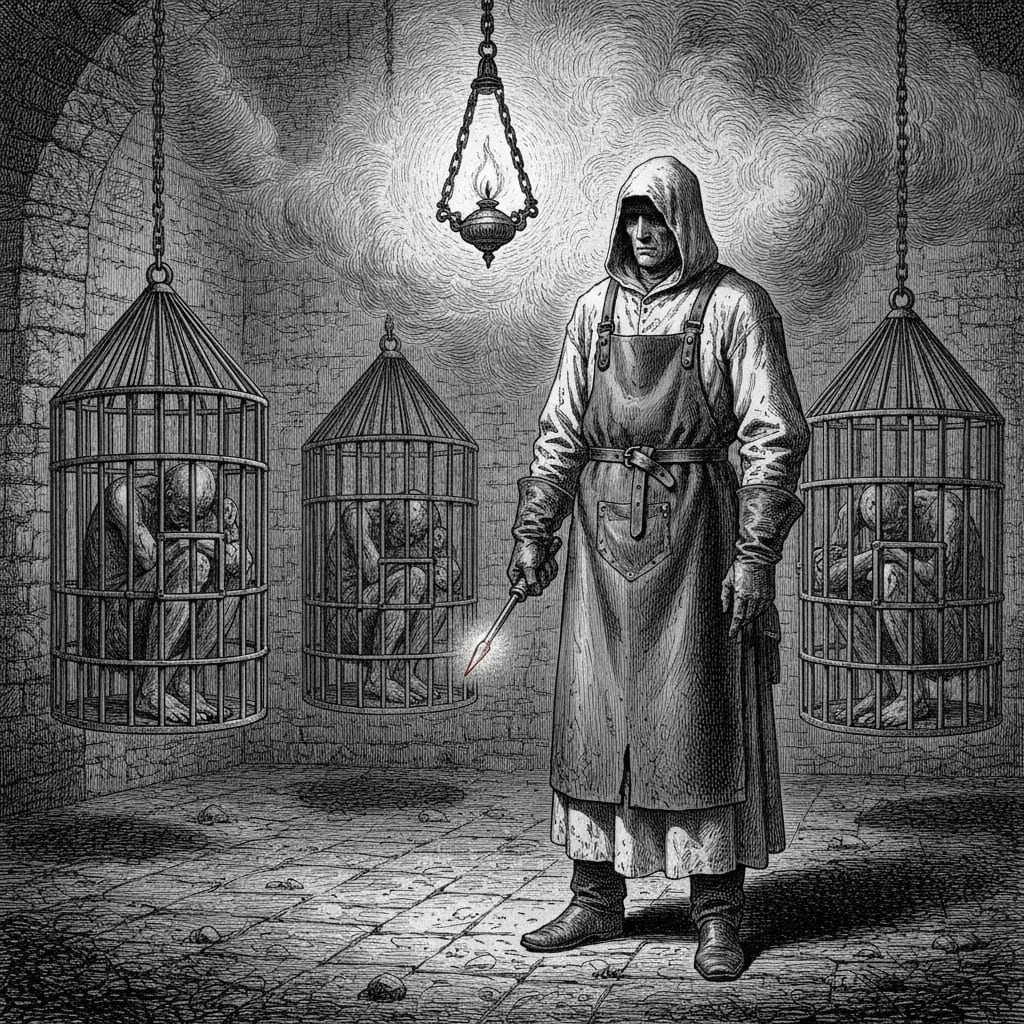
I am Valerius Drax — Hieromnemon of Strasbourg, Warden of the Sacred Ledger, and a man who has spent the better part of his career standing close enough to the Bureau of Purity to smell the iron on its breath. I have written of the Bureau. I have written of its Index. Now I must write of its hands — or, more precisely, its fingers: the Lictors of Purity, the sub-order that does what the White Cloaks pronounce and what the Shadows discover. The Lictors do not discover. They do not pronounce. They inscribe.
Let me correct a common error, one I find repeated in taverns, in barracks, in the whispering corridors of the Bureau of Records where clerks who should know better murmur that the Lictors "punish." The Lictors do not punish. Punishment is crude — a lash, a cage, a severed hand flung to the dogs. What the Lictors do is record. They take the guilt that the Inquisitor has pronounced and they commit it to the only medium the Bureau trusts absolutely: living skin. Paper burns. Vellum rots. Stone cracks under artillery. But a branded man carries his confession wherever he walks, and every literate eye that falls upon his flesh reads it without the aid of a clerk.
Caro Testis Est — the flesh is the witness. That is their motto, and it is not metaphor.
#Origins in the Fire
Later Lictor histories trace branding methods to the Witch-Hunts of Toulouse in A.S. 3, long before a formal Synod or Bureau of Purity existed. The personnel and continuity of that precursor remain uncertain. As Purity grew, its marks became a script used to encode charges and clauses of the Index Damnatus, especially after the Index's A.S. 80 expansion. The later division made that older practice its origin story.
Earlier editions of this Codex attributed the founding of the Lictor system to Procurator Hildegarde of Mainz.
This is false. Hildegarde refined the glyphic script during her tenure, but the practice of flesh-inscription predates her by forty years. The Hieromnemon responsible for the confusion was himself branded — on the left forearm, glyph 117, "clerical negligence in matters of attribution." He survived. His career did not.
Two hundred and fourteen glyphs. A man's forearm, wrist to elbow, accommodates approximately forty in the standard hand. Both forearms: eighty. Chest and back: a further two hundred, if the Lictor is economical. I have been informed — by a Lictor of the Second Precinct, over wine I later regretted sharing — that the record for a single condemned man stands at three hundred and twelve distinct inscriptions, covering every surface of skin from collarbone to ankle. The man lived. He was displayed in the Iron Choir of Mainz for nine months. Pilgrims came to read him. The Bureau of Records sent a delegation to index him.
#The Instruments of Inscription
The Lictor carries three things, always, in a leather roll that smells of tallow and hot iron.
The Stylus. A steel rod, tapered to a nib thinner than a quill-point, heated in the brazier until it glows the precise shade of cherry the Bureau calls veritas ruber — truth-red. Too hot, and the skin chars beyond legibility. Too cool, and the scar fades within the year. The Lictor's training — seven years, from apprentice to journeyman — is principally the mastery of temperature. Everything else is penmanship.
The Glyph-Press. For field work, where braziers are impractical and speed outweighs artistry, the Lictor carries a set of interchangeable iron stamps, each bearing one of the two hundred and fourteen glyphs in reverse. Press, heat, apply. The result is functional, legible, and — in the estimation of the senior Lictors — vulgar. A stamped brand is bureaucracy. A hand-drawn brand is scripture.
The Brazier. Portable, brass-fitted, burning a proprietary fuel the Bureau compounds from coal-dust, rendered fat, and three ingredients it declines to name. The smoke is sweet. The sweetness is a lie. Lictors who have worked the brazier for a decade carry the scent in their clothes, in their hair, in the skin of their palms. You can identify a Lictor in a crowd by scent alone, if you have ever stood close enough to learn it — and if you have stood that close, the Bureau already knows your name.
#The Three Traces
Where a Lictor has walked, three marks remain. I described them in my account of the Bureau and I shall not repeat myself in full, because I am vain but not wasteful. A summary for the Ledger:
Branded Flesh. Confessions burned into skin: word, date, clause. The condemned may be paraded through market squares, displayed in the Iron Choir, or sealed into the Pillars of Glass at Zaragoza where they stand behind translucent stone, their inscribed bodies visible to pilgrims as permanent monuments to the Bureau's thoroughness. A walking confession. A breathing archive.
Severed Tongues. In districts where speech exceeded its permit — the Laugh Riots of Seville, where taverns exceeded their mirth quotas; the Sermon Excess of Bruges, where a preacher spoke forty-seven minutes beyond his licensed allocation — it was the Lictors who carried the brazier and the knife. They are not executioners. Executioners end. Lictors edit.
Errata in Flesh. When the Bureau of Purity issues a stamped correction — a relic reclassified, a doctrine amended, a phrase struck from the permitted lexicon — the Lictors visit those who used the older wording in public. The catechisms change. The bodies follow. A man branded for speaking the word gratia in the street may find, when the Bureau amends the Index, that his brand is no longer current. The Lictor returns. The old glyph is struck through with a single heated line. The new glyph is inscribed beside it. The man now carries both his crime and its revision — a palimpsest in scar tissue, an erratum stamped not on paper but on the only document the Bureau cannot misfile.
#Hierarchy of the Gloved Hand
The Lictors maintain their own internal ranks, nested within the broader architecture of the Bureau of Purity like a blade nested in its sheath.
Apprentice-Lictor. Three years. Permitted the glyph-press only. No freehand work. No brazier of their own — they tend a senior Lictor's fire and learn temperature by watching skin react. Many wash out. Some are branded themselves, for errors of pressure that rendered a glyph illegible, which in the Bureau's accounting is a form of vandalism against the Ledger.
Journeyman-Lictor. Four years beyond apprenticeship. Permitted the stylus. Assigned to a Precinct — Strasbourg maintains six — and given a quota. The quota is classified. That it exists is not.
Master-Lictor. Appointed, not promoted. A Master-Lictor has inscribed a minimum of one thousand confessions without a single glyph disputed by the Bureau of Records. One thousand. Without error. In a script of two hundred and fourteen symbols, on a medium that flinches.
Earlier editions of this Codex stated that the rank of Lictor-Primus was hereditary.
This is false. The Lictor-Primus is appointed by the Procurator from among the Master-Lictors, and the appointment is made on the basis of calligraphic excellence alone. The Bureau does not care who your father was. The Bureau cares how you hold the stylus.
Lictor-Primus. One. Answerable to the Procurator of Purity alone. The current Lictor-Primus has held the post for eleven years, has never been seen without gloves, and is known to the Bureau's lower ranks only as the Left Hand — because the right hand, in the Bureau's theology, belongs to the Creator, and the left is for correction.
#On the Iron Choir
No account of the Lictors is complete without the Iron Choir — those hymn-singing cages suspended from cathedral rafters in Mainz, Strasbourg, Cologne, and a dozen lesser cities, into which the branded condemned are placed for public display. The Choir is not the Lictor's invention, but it is the Lictor's gallery. Every body in the Choir is the Lictor's work, hung for the faithful to read as one reads a posted decree.
The condemned sing. This is mandatory. Hymns of contrition, on a schedule fixed by the Bureau of Doctrine, from matins to compline. Those who refuse are not fed. Those who cannot — whose tongues have been edited — are given bells. The sound of the Iron Choir at vespers, in a city like Mainz, is a thing I shall not describe to you, because I am a prose stylist and not a torturer, and the distinction, however narrow in Strasbourg, is one I maintain with what remains of my professional pride.
The Iron Choir of ████████████ was decommissioned in A.S. ████ after an incident involving ████████████████ in which ████████ branded prisoners ████████████████ the cages ████████████████ resonance frequency ████████████████ structural collapse of the ████████████████ nave. The Bureau of Records has classified the event as "an act of architectural piety." ████████████████ survivors ████████████████ rebranded.
#What the Lictors Leave Behind
A city visited by the Lictors does not forget. The branded walk its streets for years afterward — marked, legible, a living Index that the Bureau need never print. Children learn to read the glyphs before they learn their catechism. Merchants check forearms before extending credit. A branded man cannot marry without dispensation, cannot hold office, cannot enter a church without presenting his scars to the door-warden for inspection. The brand is not a punishment. The brand is a status — a reclassification of the person from citizen to document, from soul to evidence.
I have heard it said, in quarters of Strasbourg where the Bureau's censer-smoke does not quite reach, that the Lictors are cruel. This is imprecise. Cruelty implies a choice — the possibility of mercy withheld. The Lictors do not withhold mercy. They inscribe whatever the Bureau instructs them to inscribe, with the dispassion of a scribe copying a writ. That the writ is written in flesh rather than ink is a matter of medium, not morality. The Bureau settled this question in the second year of its existence and has not revisited it since.
The flesh is the witness. The stylus is the quill. The scream — and there is always a scream, however briefly — is the sound of the Ledger accepting a new entry.
The Codex of the Age of Heresy has spoken.