
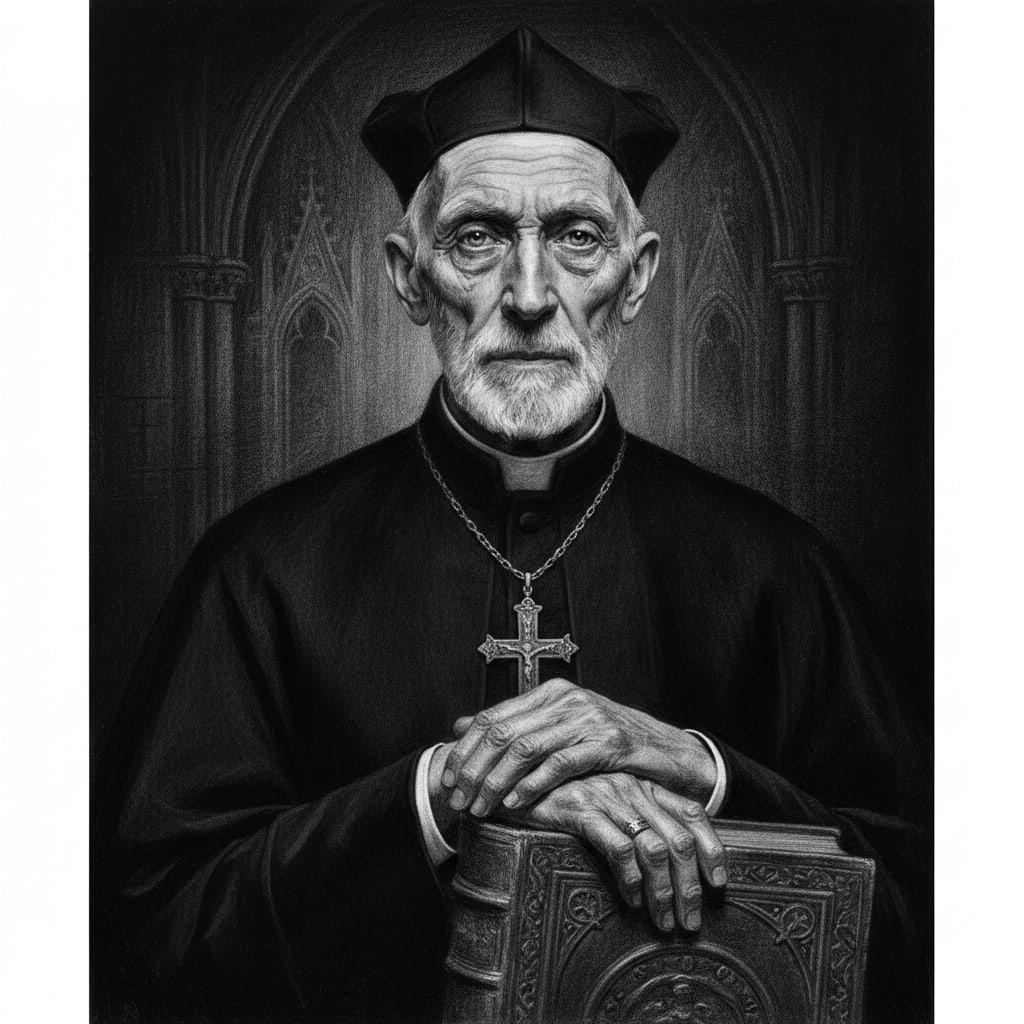
#On the Matter of Augustinus
"He did not ask the faithful to kneel. He built the floor so low they had no choice." — Attributed to Cardinal Kratz, unverified, denied by Records
I am Valerius Drax, and I will tell you of the man who made us. Not the Creator — the Creator made the raw material; Augustinus made the machine. He took scattered dioceses, quarrelling abbots, and a continent of sheep without shepherds, and from this wreckage he forged the Synod. Other men have built empires on swords. Augustinus built his on paperwork, which is sharper and does not rust.
The authorized record places Augustinus in Mainz and his origins in the Rhineland. The Bureau of Purity prefers a more miraculous account; I note it without treating rhetoric as a birth register. He was an ordinary auxiliary at the First Council of Cologne in A.S. 27, ordained on 8 April A.S. 33 and consecrated bishop on 2 March A.S. 40. The Ledger can preserve rival claims without moving those dates.
#From the Atheist Wars to the Retreat
When the Rationalists ground their heel into the pilgrim-roads of Europe, the faithful had no central command. Dioceses quarrelled over relics, abbots pursued their own petty fiefdoms, and the Republic of Reason advanced with clockwork precision against an enemy that could not agree on the colour of its vestments.
Augustinus learned the cost of that fragmentation before the Sundering. After A.S. 45, amid retreat and provisional Church government, he issued the Common Allegiance in A.S. 55: a binding of scattered dioceses beneath common military, spiritual and administrative discipline. The bishops laughed. The abbots scoffed. The faithful, who were dying in droves, did neither. They listened.
Earlier editions of this Codex attributed the Common Allegiance proposal to the Council of Worms.
This is false. The A.S. 55 instrument preceded Worms in A.S. 87 by thirty-two years. It was issued under Augustinus's authority, with material work by Kratz and Sabine; the surviving copy claims a Mainz seal after composition in the Palatinate. Worms ratified an Allegiance already in use. The distinction matters to the Bureau of Records. It matters to me because I am right.
#The Miracles
Three miracles attend his name, and the Bureau of Doctrine has ratified all three, which is to say: believe them.
The Healing at Ulm. During the plague-summer of A.S. 85, Augustinus walked the wards of the dying without mask or censer, laying hands on the stricken. Thirty-seven recovered. The Bureau of Records counted thirty-nine, but the Bureau of Purity struck two names for doctrinal irregularities in their recovery postures. Thirty-seven is the sanctioned number. Thirty-seven it shall remain.
The Weeping Statue of Lyon. Church accounts say Saint Theophania's statue wept tears of oil during Augustinus's lifetime. The Bureau of Alchemical Standards later called a sample "consistent with sanctified grief." Rationalist pamphlets alleged a concealed pipe. Doctrine ratifies the wonder; its mechanism is not settled by either file.
The Tongues of Fire at Worms. When Augustinus convened his council, tongues of flame appeared above the assembled bishops. Some fled. Most knelt. Three fainted and were carried from the chamber by notaries who logged each unconscious clergyman's weight for the Bureau of Tithes. The fire left no scorch-marks, which the Bureau of Records regards as proof of its divinity and which the Bureau of Engineering regards as "thermally implausible but not our department."
#The Siege of Mainz
His methods of war were his methods of worship: indistinguishable. At the Siege of Mainz, when Rationalist sappers breached the western cloister, Augustinus ordered the catapults loaded not with stone but with reliquaries. Entire cohorts of the Republic's finest broke upon them, not from the impact — though the impact was considerable — but from the voices. Soldiers reported hearing dead saints singing as the reliquaries arced overhead, hymns in languages no living tongue remembered.
Wartime foundations and relief works grew around him before the Line became defensible. The later marrow-tax system standardized around A.S. 68–72; the Bureau's account of its materials and named sites remains partly sealed. Rationalist ruins were reconsecrated in the Church's telling. Drax calls their walls a hymn; Engineering files a different description.
The exact composition of the mortar used at ████████ and the number of volunteers whose ████████ contributed to the foundations remain sealed under the Fifth Ratification. The Bureau of Engineering has classified the structural data. The Bureau of Mercy has classified everything else.
#The Founding
Augustinus's proposals and the work of Cardinal Kratz shaped the later Concordat of Strasbourg. Neither man lived to sign its A.S. 90 settlement. Records claims the paper and Purity the silence that followed; both offices inherited work begun before the formal Synod.
What Augustinus gave was the idea: that Europe's scattered faithful could become a single body, governed by a single assembly, defended by a single Wall, and recorded in a single Ledger. Kratz gave it legs. Veyrault gave it memory. Della Torre gave it teeth. But the skeleton was Augustinus, and the skeleton is what endures when the flesh rots and the ink fades and the teeth fall out.
He died before the A.S. 90 Concordat, though the exact day is sealed. The Bureau of Records has classified the circumstances. The Bureau of Purity has classified the witnesses. The Bureau of Doctrine has classified the classification. The Basilica claims his body beneath its vault; the censers in the crypt have not gone out.
Earlier editions stated that Augustinus died "peacefully, surrounded by the faithful."
The Bureau of Records has revised this to: "in a manner consistent with doctrinal expectations." The distinction is not cosmetic. The faithful are reminded that saints do not require peaceful deaths. Saints require useful ones.
#His Legacy
The Hierarchs who followed him are styled Vicarii Orbis — Vicars of the World — and they sit in Strasbourg's Inner Circle clothed in white and crimson, each claiming stewardship over one of the Seven Seals of Faith. They are Augustinus's inheritors. Whether they are his equals is a question the Bureau has not authorized me to answer, and which I therefore answer by silence, which is its own verdict.
The common soldiers call him "the Binder" and leave it at that. The officers call him "the First Hierarch" and genuflect. The Bureau of Doctrine calls him "the Instrument of Providence" and capitalizes every letter. I, Valerius Drax, call him the man who understood that faith without filing is sentiment, and sentiment without a stamp is heresy.
To record him is holy. To believe him is holy. To build as he built — with bone, with ink, with the absolute conviction that paper outweighs stone — is the holiest work the Synod knows.