
#On the Necessity
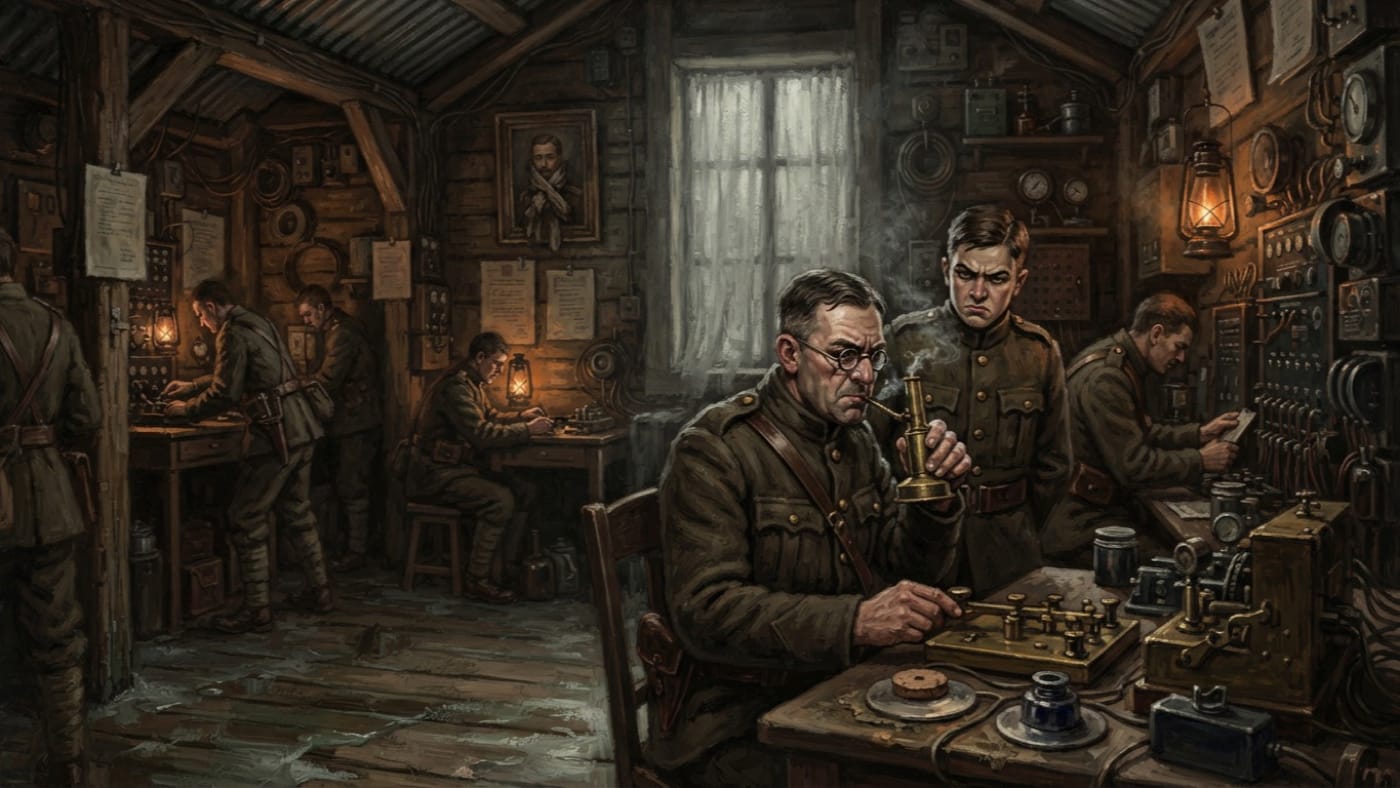
A forward signal hut at Bastion-Przemyśl holds more glass than a cathedral and has less excuse for it. There are lamp chimneys, brass key-plates on the telegraph sets, and the spectacles of the clerk who reads the tape. There is ink standing black in its well, and in the thaw a skin of water spreads across the floor where the duckboards have given up. All of it serves the war. All of it, when a Mirror-Lord stands within reach of the position, can show a man to himself one degree wrong.
The enemy needs nothing more. Atheron's support demons carry no weapon. They raise a reflection, and the man looking into it sees himself exalted or abased, crowned above his comrades or fit only to crawl beneath them. A soldier who can no longer see peers cannot take an order from one or give an order to one. He cannot even pass one a cartridge without first deciding which of them is worthier of the cartridge. Command fails at the speed of a glance.
The reflection deceives; it does not possess. The man who looks still chooses what to do with what he sees, and the Church holds him to that choice. Confidence is permitted and competence is required. The circular exists to prevent a room in which no two men stand level, because such a room cannot hold a line.
Circular 192-M divides every reflective surface at the front into two kinds. Nonessential surfaces must be spoiled and essential surfaces must be watched. Everything else in the circular follows from that division, and most of the commentary on it is mine.
#On Switchbox Nine
The Church had its warnings. In A.S. 188, salvaged mirror-glass backed the east window of Saint Phocian's Forward Chapel, and a dawn congregation saw itself wearing episcopal mitres. In A.S. 191, a requisitioned silver tureen in the Przemyśl officers' mess showed the staff as a council of crowned strategists and the servants as grey attendants without faces. Nobody saw a demon. The colonel announced a unilateral offensive before the fish course.
The first report on the A.S. 191 Officer's Mess Disturbance blamed contaminated soup.
The soup is exonerated. It was thin, over-salted and morally innocent. The tureen that held it is not.
The Bureaus filed the warnings and returned to their quarrels. Then came Switchbox Nine.
In A.S. 192, shelling trapped seven signal clerks inside that hut for two hours. They began by comparing handwriting. From handwriting they moved to moral worth, and from moral worth to which of them deserved to go on breathing. By the time the hatch was opened, the junior clerk sat enthroned on a crate because his numerals had been judged the most elegant. The senior clerk lay bound with telegraph wire. Two runners had already gone out in opposite directions, one carrying an order of surrender and the other an order of assault. The records confirm no Lord at the hatch. The Bureaus did not wait for one.
Engineering proposed removing mirrors from forward installations, which was sensible and therefore insufficient for Purity. Purity extended the proposal to polished metal, glass, standing water, ink pools, brass fittings, spectacle lenses, officers' buttons and the eyes of horses. Logistics rejected the whole list on the grounds that a war cannot be fought entirely in matte sackcloth. The compromise between those three positions became Circular 192-M.
#On the Substance of the Circular
That is the preserved operative text in full. It runs to two sentences, and the second of them has given commanders more trouble than the first.
The circular covers four kinds of position. Command positions come first, because the dugout where the map is read is also where the officer shaves. Chapels follow, because Saint Phocian's had already shown what a sanctified window can do. Medical positions are included because surgeons work by lamplight over basins of water, among steel polished on purpose, and the wounded have more reasons than most men to see themselves as worthless. Signal positions are included because of Switchbox Nine.
The treatments are six, and the circular ranks none of them above the others. A brass fitting is dulled with mud, grease or vinegar. A shaving glass is covered with sacking. A lamp chimney is smoked until it gives light without giving back a face. Spare steel is scratched across its polish. A window is veiled. The last provision, ritual insult, is written into the circular itself and was not added later by bored chaplains. The circular does not prescribe the words, and I will not invent a formula for it. I will only observe that the insult is aimed at the surface. A garrison that turns it on the man in the glass is doing the enemy's work for him.
All of this must be finished before dawn watch. The circular gives no reason for the hour. Any orderly who has stood a dawn watch could supply one. He would mention the low light across the water, the hour men spend shaving, and the officer who wants to look like an officer before the day's casualties arrive.
The Codex places this circular in A.S. 192 because Switchbox Nine belongs to that year and the records tie the circular to it. No signing day survives in my files, and nor does the name of whoever signed it. The circular number agrees with the year. I have learned not to build doctrine on numbers that agree with me.
#On Essential Surfaces
Every officer at the front has at some point asked whether his own surface is essential. The circular gives no definition. The orchard of ledgers at Przemyśl has grown a forest of answers anyway.
Some cases need no argument. A signal lamp needs its reflector, a rangefinder needs its lens, a surgeon needs his steel bright enough to show blood, and a clerk with bad eyes needs his spectacles. Other cases are argued in earnest. Colonels argue for their razors and majors for their cigarette cases. A captain once argued for a monocle on the grounds that it was a family instrument of observation, though by his own account it had observed nothing since his grandfather.
An essential surface receives three things in return for its exemption. First, it is logged, so that every lens in the position has a line in a ledger and a clerk who can be blamed for it. Second, it is blessed, which costs a chaplain's attention and no more than that. Third, it is supervised by two witnesses of mutually contemptuous temperament. The logic of that requirement is old and grubby. A friend will flatter a man and an enemy will accuse him. Two men who despise each other will watch each other's faces with a care no affection could produce.
The circular says contempt. The later field commentary on paired witnessing, written by soldiers, recommends mild dislike and warns that hatred distorts. I report both and reconcile neither. The circular is the law. The soldiers kept their men alive.
Essential status grants use. It grants no protection. A logged and blessed lens reflects exactly as faithfully as the same lens unlogged. The ledger only records who was looking into it when things went wrong.
#On the Later Field Doctrine
The circular governs rooms. The war does not stay in them.
In A.S. 194, a Sun-Spear burst against Tower Nine scattered glass across the Orchard Ring. Observation glass, spectacle lenses, cracked lamp chimneys and polished ration tins lay over a quarter-mile, and every shard showed whoever looked down a different rank. Dawn watch had already passed and the circular could not be applied. Glass that arrives as weather cannot be dulled in advance. Archivist-Prelate Kelle ended the battle of promotions with a bucket of ash. His report contains no adjectives.
The eastern salient in A.S. 199 tested the gap again. A confirmed Mirror-Lord came in behind three Crownguard files and stood among shell-holes full of thaw water. No circular dulls a shell-hole that fills overnight, and the gunners of Battery Seven had been trained to look away from banners, not puddles. Within minutes the battery had split. One faction believed only they could fire accurately. Another believed their own hands defiled the guns. One gunner wished to address the howitzer as Father.
Sergeant-Matron Olya Krev ordered every man to shut his eyes and recite his laundry inventory. She then fired the gun by touch and hit the waterline. The Mirror-Lord vanished. The record says vanished. It does not say destroyed, and I have refused three requests to improve the verb.
The doctrine ratified at Przemyśl that year builds on the circular without amending it. Inventory speech pins a man to the boot, the mud, the cartridge and the order he actually heard. That leaves him no room for titles or verdicts. Paired witnessing takes self-assessment away from the man under contact. The sanctioned mockery is short, vulgar and collective: We all look like hell. Confirmed contact brings bombardment of reflective terrain followed by ash. A twelve-hour restriction follows on promotions, punishments, sermons, decorations, resignations, confessions of unusual eloquence, and any strategic innovation introduced with the words only I understand.
None of these is a clause of Circular 192-M. Officers who cite the twelve-hour restriction as circular text in their reports have their reports returned. None of them is a cure either. Inventory keeps a man fixed while it lasts, and witnesses fail when they grow fond of each other. The circular prepares the room in advance and the doctrine governs what happens once the Lord has come in. Battery Seven needed both and had only the second.
#The Ratification
Circular 192-M remains in force at Bastion-Przemyśl and in every forward position along the Line that has copied it, with or without credit. Four kinds of position are covered and six treatments allowed, and the work is due before dawn watch. Essential surfaces receive a ledger line, a blessing and two witnesses who dislike each other, and they receive nothing more.
The Synod has received petitions to reclassify the following as essential: a razor, a monocle, a cigarette case, a regimental cuirass, a reliquary's crystal face and a colonel's portrait of himself under glass. Each petition was logged. None was blessed. The portrait was ritually insulted by two witnesses of mutually contemptuous temperament, who agreed with each other for the first time and asked that this be entered in the record.