
#On the Palaces Below the Crown
The Mirror Courts are palaces, and there is more than one of them, in Atheron's dominion. Published accounts place them among the lesser ascents of the Ebon Heights, in the lower dominion of the Crownspire. That is their entire address. No survey fixes them to a terrace, a saddle or a road, and no deserter has drawn a plan the Bureau could accept without laughing. They lie east of Bastion-Przemyśl, beyond the Carpathian passes that the Sin-General holds chiefly so that men on the Line must look up at him.
Nobody has dated them. The Sundering of A.S. 45 dates Atheron's emergence into the world. It does not date his furniture. The record gives no builder, no first witness and no year of founding, and I decline to supply a legend in their place. The Codex already holds plenty of legends, most of them written by men who hoped to appear in them.
#On the Image Returned
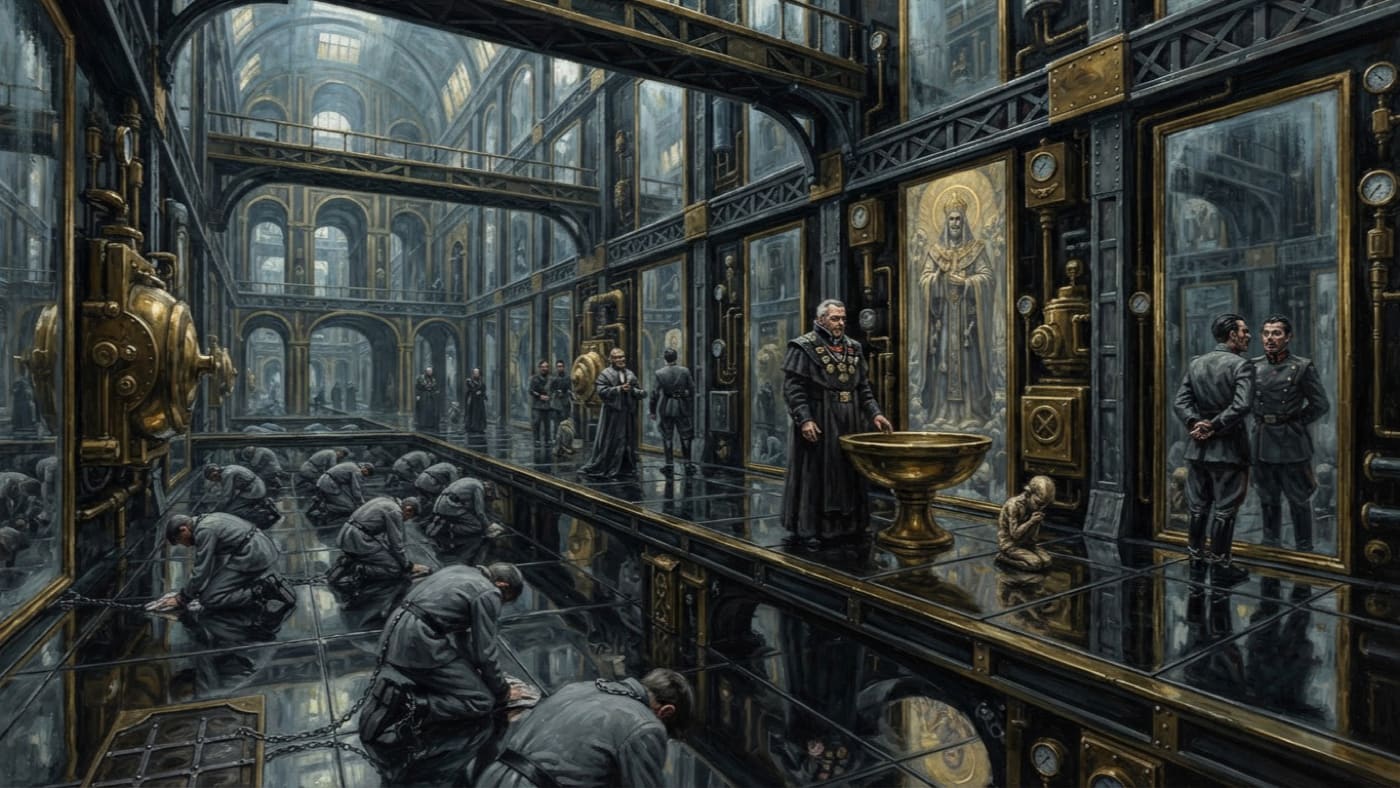
Every surface in a Mirror Court reflects. The floor reflects, and so do the walls, the pillars and the lip of every basin. So does the lacquer on a door that opens onto another hall of the same lacquer. Nothing is left matte, because a matte surface gives the eye somewhere to rest and the Courts grant no rest.
The glass shows each viewer as he believes himself to be, with the belief completed. A servant who thinks himself superior finds himself magnificent. He stands a head taller, robed and crowned, framed in gold and cold blue and lit from a source no window explains. A servant who thinks himself low finds himself worthless, smaller in every pane, unfit for the floor he stands on and certain the floor agrees. Neither image measures anything. The mirror has simply agreed with each man.
That agreement is the horror. A man in a Court never meets a contradiction. The glass will not tell him his collar is crooked unless he already suspected it. It will not tell him he is a competent clerk unless he already thought so. Correction cannot get in. The man beside him becomes another surface, either something above or something beneath. A Mirror Court has no across in it, and in there peers are a rumour from another country.
"…those palaces of the Crownspire's lower dominion where every surface returns the self as rank demands it." — The Mirror-Lords, On the Mirror Courts and Their Export.
The Courts return the self as the viewer believes it to be. Rank comes into it only because Pride has taught the viewer to believe in nothing else. The mirrors rank no one, and the Codex has always said so in the corrected line above.
#On Their Servants and Their Use
Atheron's servants go to the Courts to perfect a facade. It has one face for those below and another for those above. The work is to make both faces immaculate and then to believe in them completely. A servant leaves with his posture corrected and every trace of doubt trimmed from his voice. He can no longer hear himself described in any other way. Strike him and he will take the blow as proof of your envy.
The finished article is brittle. A self assembled in glass cannot survive being wrong, being lesser or being one among many, so every challenge must be answered from above or crawled away from below. When one of Atheron's commanders falls, the ranks beneath him wait for orders that will not come. Nothing in the Courts taught them to take advice from a face level with their own.
Someone has to keep the surfaces clean. The regional account of the Heights records grey servitors who tend the banner roads and polish mirror courts. They kneel so the floor can shine. Their bodies may be chained, but the Church holds that their wills remain their own, even in the Sin-Ruled East. No returned witness has said what a servitor sees in the floor while polishing it.
The same sources describe the Judgment Halls separately, as courts where worth is measured and a position assigned. A servant may learn his station in a Hall and learn to love it in a Court. The record does not connect the two buildings with a corridor, and I will not draw one.
#On the Lords Who Carry the Court
The Mirror-Lords are believed to be bred, appointed, reflected or legally recognised in the Courts. Those are four different claims, and the Codex confirms none of them. The association is old in our files and still unresolved. No one has seen a Lord hatched, crowned or sworn.
Their conduct in the field is better documented. A Mirror-Lord is a physical support demon that advances behind Crownguard files like any other soldier of the host. It brings the conditions of the Court forward with it. Wherever it stands, the nearest polished surface starts returning men as they believe themselves to be, pushed toward the throne or the gutter. That surface can be brass, lamp glass, a spectacle lens or standing water. A dugout becomes a hall of mirrors without a single pane being moved. Nothing architectural is carried. The rules of the palace travel and the palace stays where it is. The Lord possesses no one either. A man who looks still chooses what to do with what he sees, and the Church holds him to that choice.
The progression is short. First the victim notices surfaces and cannot leave them alone. Then his reflection improves or decays, and he begins to prefer it. Next the room loses its peers, so that everyone in it is above or below him and cooperation stops. Finally one false self takes the throne, and the man either commands beyond all authority or seeks punishment beyond all guilt. The parent entry calls these phases Polish, Correction, Rank Fever and Enthronement.
The Ascendant Shades also work through reflection, but their business is the killing of particular men. A Mirror-Lord holds court and leaves the garrison to pass sentence on itself.
#On the Court at Switchbox Nine
In A.S. 192, shelling trapped seven signal clerks inside Switchbox Nine at Przemyśl for two hours. A signal hut makes a poor man's Mirror Court. It has brass key-plates, lamp chimneys, inkwells and spectacles, and in the thaw a skin of water across the floor. The clerks began by comparing handwriting, which is a fair professional concern. Before the two hours were out, handwriting had become moral rank, and moral rank had become the question of which of them deserved to go on breathing.
When the hatch was opened, the junior clerk sat enthroned on a crate because his numerals had been judged the most elegant. The senior clerk lay bound with telegraph wire as a fraud against hierarchy. Two runners had already gone out in opposite directions. One carried an order of surrender and the other an order of assault.
The records confirm no Lord at the hatch. A surviving transcript contains a voice nobody has identified, and I do not identify it here. The episode stays in the files because of its shape. Seven men in a box built the whole apparatus of Atheron's palaces out of office supplies. They had a throne, a prisoner, ranked inferiors and decrees issued downward. The palace never came to Switchbox Nine. Its rules did.
Engineering proposed removing mirrors from forward installations. The Bureau of Purity extended the proposal to everything that shines, the eyes of horses included. Logistics replied that a war cannot be fought in matte sackcloth. Out of that compromise came Circular 192-M.
#On Refusing the Image
Circular 192-M prepares a room in advance. It cannot dull a shell-hole that fills overnight. In A.S. 199 a confirmed Mirror-Lord came in behind three Crownguard files at the eastern salient and took its stand among craters full of thaw water. Battery Seven split within minutes. Some gunners were sure only they could aim, and others were sure their hands defiled the guns. One man wished to address the howitzer as Father.
Sergeant-Matron Olya Krev ordered every man to shut his eyes and recite his laundry inventory. She fired the gun by touch and hit the waterline. The Mirror-Lord vanished. The record says vanished, and the Codex will not promote the verb to destroyed.
Krev beat the Court on its own ground. The Court offers a self finished in gold or ash. A laundry inventory offers two shirts, one of them patched, and socks of contested ownership. Nobody can be enthroned on a list of socks. The doctrine ratified at Przemyśl that year added paired witnessing, sanctioned mockery, ash spread over reflective terrain, and a twelve-hour ban on promotions and sermons. I consider that ban excessive in one particular.
These are field defences against an effect the Lords carry forward. None has been tried against the palaces themselves, because no Synodal column has reached them. The Bureau of War does not propose to send one armed with laundry lists. The Church's own humility practices give mixed results. Men told to wash feet often conclude, privately, that they wash them better than anyone else does. The Synod is itself a ladder of bishops, officers and clerks, and Doctrine sits on a higher rung than most. Atheron has no need to build Courts west of the passes. He finds ours already furnished.