
#On the Water and Its Blessing
"Offer water first." — Peregrine Row courtesy, observed by every household that can afford it and enforced by none that cannot
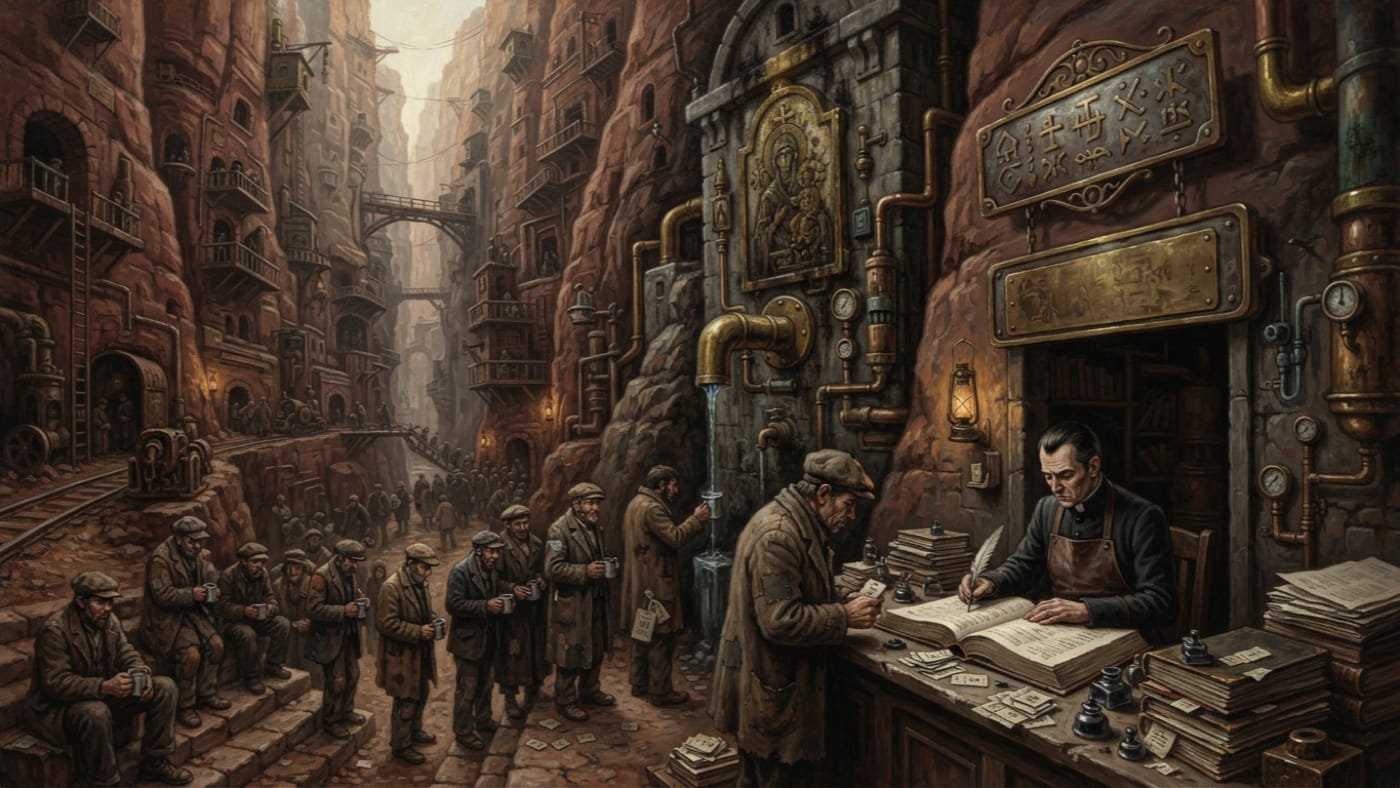
The Cistern Chapel of Peregrine Row is where the Pilgrim Roads make a pilgrim thirsty enough to be governed. It stands in the only natural hollow of a canyon waystation built otherwise from switchback, cliff and contract. That waystation is classed of First Classification under the Bureau of Pilgrimage. The chapel keeps the one commodity the Choir-Broker Hall cannot manufacture. The Hall sells safety. The Bead Courts sell reconciliation. The chapel dispenses water, blesses it, and writes down who received it.
The rite is called the Cistern Blessing. A ration is drawn, the ration is pronounced sanctified, and a water clerk enters the transaction in the ledger against a chit. In this way the Creator's mercy is rendered in cups. The cups are counted. The count is filed.
Every traveller in the Row needs that ration, whether bound for the sanctuary cities or the eastern approach. Every traveller learns at dawn that need is the first stage of procedure. The gate opens, the creed lines form, the water is rationed, and the three arrive together each morning like clauses in the same instrument.
#On the Hollow and the Older Shrine
Peregrine Row is laid out as a narrow column of commerce. The Hall stands at the centre, with the Bead Courts to the north and the Escort Yards to the south, and the Tinmarket Arcade crammed into every remaining gap. The chapel occupies the hollow because the hollow is where the water was. Thirst decided where the building stood. Doctrine followed the building, and the brokers followed both with a ledger.
Before the Synod there was a rest shrine and a spring-fed cistern. There were also three families, Peregrin, Voss and Haelke, who understood that whoever holds the only water in a canyon has no need to hold a sword. They taxed mule-trains. After the Sundering of A.S. 45 the mule-trains became refugee columns, and the tax became a government. In A.S. 94, four years after the Concordat of Strasbourg, the Road Chapter of Peregrine was chartered over "all matters of transit, devotion, and syllabic compliance." The chapel falls under that charter. The charter did not build it, and no record I have seen says who did.
Old shrine stones survive. So do tunnel pockets in the rock and hymn fragments carved there in a form the Church no longer sings. The archive does not say whether the present chapel stands on the shrine's foundations, reuses its stones or merely inherits its spring. I decline to improve on the archive.
Inside, the chapel smells of damp stone and incense, and in a canyon of red dust that is a sermon in itself. The steps outside are among the Row's few gathering places. Pilgrims sit there to wait, to trade rumours about the gate, and to watch whoever is drinking.
#On the Clerk's Account
The water clerk decides who drinks and who confesses first. Local lore spends a single line on the office, and that line is enough.
Confession and water share a counter here. The locals call a ration paid for with a confession tithe-water. The Road Chapter has never used the term in correspondence and has never needed to. The water tithe is levied alongside gate tolls, contract fees, confession receipts, and the processing charges collected in the detention pens beneath the Tinmarket Arcade. The pilgrim pays each of them in turn and may call the sum devotion.
Water chits circulate as currency. They buy bread, lodging and rumour. They also buy the inattention of a proctor at the Gate of Clean Tongues who might otherwise listen too closely. A chit is a promise of water drawn on the chapel's ledger, so a bribe paid in chits is paid in the chapel's credit. So far as the Bureau has determined, the chapel has never objected.
Two customs govern the steps. Water is offered to a guest before anything else, and water is never wasted in public. Both customs are older than the Road Chapter, and both entered its economy without amendment. A courtesy that already makes a man grateful for one cup requires no further legislation.
A pilgrim who fails reconciliation at the Bead Courts is still thirsty. A pilgrim sent to the Quiet Pens leaves a family on the chapel steps, and they are thirsty too. Every fee levied elsewhere in the Row eventually reaches the cistern in the person of someone who can no longer afford a chit.
#On the Returned Words
The Echo Creed is the canyon's habit of returning a recited prayer with one vowel altered. The Bureau of Alchemical Standards classifies it as a Category Two Localized Acoustic-Doctrinal Disturbance. It has no congregation, keeps no pew and pays no tithe. It reaches the chapel the way it reaches everything else in the Row, through what comes back wrong.
Spoken words came back altered before written ones did. Early misrecitations were blamed on dust, wind, crowd noise and the accents of western peasants. After the Year of Ash Rain in A.S. 143 the disturbance worsened, and the Bureau formally classified it and placed it under review. Then the paper began to change overnight.
The chapel's contribution to this literature is a single reported entry. A water chit marked "two cups" came back from the Cistern Chapel ledger reading "two cuts." The clerk consulted the books, found an old penalty schedule for ration fraud, and applied it with tears in his eyes.
The report gives no date. It leaves the schedule's prescription unrecorded, and I decline to supply what the record withholds. The Bureau has not settled whether other entries have shifted, or whether any shift was meant. The procedure holds no mystery at all. A wrong word appeared in an official book. The book was believed over the pilgrim. A rule was found to fit the wrong word, and the rule was enforced.
Doctrine holds that an echo has no authority. Practice in the Row holds that a ledger has every authority. When the stone edits the ledger, Practice prevails, as it generally does when a schedule is to hand.
This office's entry on the Choir-Broker Hall gives the Echo Creed in its administrative record as "ongoing since A.S. 143."
CORRECTED. Altered echoes were reported at Peregrine Row before A.S. 143 and filed under dust and wind. A.S. 143 marks the worsening and the formal classification and review. The canyon was misquoting pilgrims for years before the Bureau found a category for it.
#On the Passage Below
The cistern tunnels run beneath the Row, cut into the canyon floor in an era no one has troubled to date. They are the one place in Peregrine Row the ridge lanterns cannot see. The black market moves into them at night, and a hidden tunnel connects the chapel to that market.
The stock is forged escort vouchers, fake syllable tokens, and quiet passes for avoiding the gate. The dice games are unsanctioned. Somewhere in the dark, a syllable forger teaches pilgrims to breathe through the vowel the canyon likes to steal. He takes payment in water chits and silence. Nothing makes him the chapel's keeper, yet his fees are drawn on its ledger all the same.
That is the chapel's quiet second office. Every chit spent below is water the chapel has promised above. A pilgrim who buys a forged voucher in the tunnels is paying, at one remove, with the Cistern Blessing. The market observes one limit of its own: it cannot sell true Synod absolution after a public creed failure. It sells nearly everything that might stand in for it, and it prices those goods in the chapel's currency.
The tunnels and the Quiet Pens both lie under the Row, and both feed on the gate. No record I can cite joins them by any passage. Pilgrims believe otherwise. Pilgrims believe a good many things in the dark.
#On the Present Condition
As of A.S. 201, Peregrine Row remains at Amber. The status was revised in A.S. 199, after a leaked Broker Compact ledger described certain "demonstration ambushes" in the eastern canyons. The Bureau of Doctrine keeps the waystation under review, and the Echo Creed remains under review as well. Neither review has yet reached the cistern.
The cistern holds and the water flows. Each dawn the gate opens and the creed lines form. The clerks draw the rations, bless them, and enter them against chits that may or may not say tomorrow what they said today. The chapel's hazard listing names riot as a risk, which is the Bureau's way of conceding that thirsty men can count. No record shows the reservoir ever failing. The Road Chapter calls this providence. The brokers call it an asset.
The pilgrims on the steps keep their mouths shut, the safest posture a canyon of echoes allows.