
#On Civil Preparation
The boy who walks into a mustering yard has already been processed. Nobody has told him. Before the Bureau of Conscription presses its Knot into his wrist, before a Levy Assessor counts his teeth, before a field chaplain hears his confession at the regulation sixty souls an hour, he has spent fifteen years in kitchens, schoolrooms, bakeries and alleys learning to move when a bell moves and to stop when it stops. The Lore Book calls the result the Civic Cut. Its definition is a grinding of every citizen until their rhythm matches the bells, their hunger mirrors the ration, and their loyalty anticipates the catechism.
I have searched the Archive for its charter. There is none. No founding decree, no first application, no prelate who claims the invention. The Civic Cut has no office, no clerk and no letterhead. It is simply what civil life in the Synod's heartlands does to a body between baptism and collection. It does it to everyone: the baker's daughter, the clerk's nephew, the boy who will be taken, and the boy who will stay behind to count the ones who were taken. Conscription harvests a fraction. The Cut prepares the whole field.
#On the Quiet Spoon
The instruction begins at the table, where the child cannot refuse to attend.
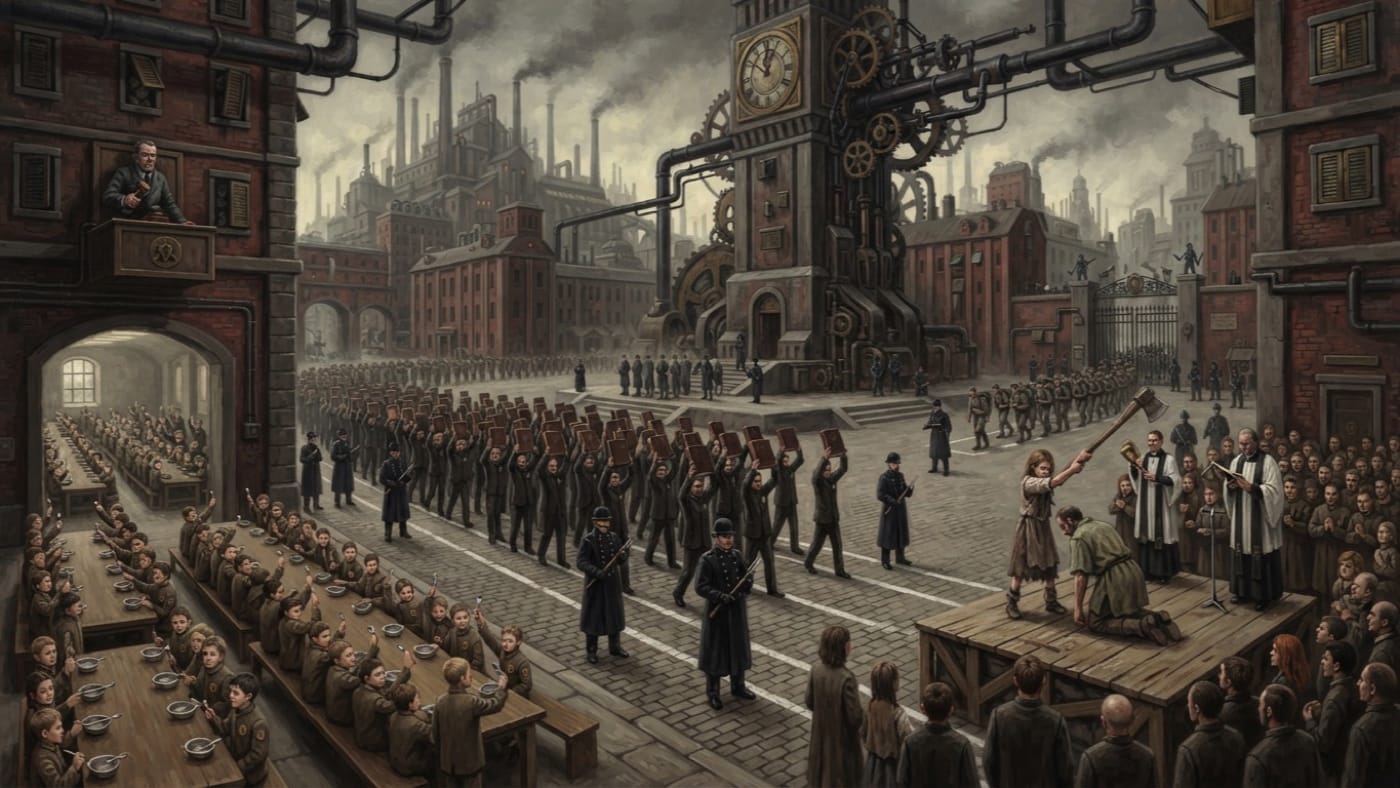
A row of small children sits along a scrubbed bench. Each has a bowl, thin enough to ring if struck, and a spoon. At the signal, which may be a bell, an elder's knuckle on the board, or nothing more than the stillness of the adult at the end of the table, every spoon rises together. Every spoon descends together. No scraping of the bowl's floor for the last of the broth. No clatter of metal on crockery. The child who reaches early, lags, or lets the spoon sing against the rim is cuffed. The cuff alone would be ordinary household discipline. The accusation that comes with it is the Synod's addition: the child has introduced discord, and discord is a doctrinal fault.
By seven, the Lore Book records, a child can eat in cadence with bells they have not yet heard. I find the phrase very beautiful. A child of seven has not yet stood in a ration line or heard the Bell Codex read in full. They already know how to wait, how to want quietly, and how to put the spoon down when the others put it down, however much broth is left in the bowl.
The Rationalists once mocked the practice as absurd table etiquette. Doctrine's answer, repeated in the pulpits, is that the Rationalists starved beside full warehouses while our queues still march. I am obliged to observe that Doctrine's warehouses have also been seen full while queues marched past them. The pulpit does not repeat that observation.
From the kitchen the habit passes intact into the Catechism Schools, where the Creed is spoken in unison until the walls ring and scripture is copied until the fingers bleed ink. The schoolmaster does not need to teach a child to begin together. The mother has done it already, with a spoon.
#On Ledgers Carried in Formation
Once a quarter the shops close. Shutters come down across whole wards, and every household carries its Book of Receipts into the street, held aloft like a reliquary. Clerks chant the entries line by line: two loaves purchased, duly tithed; one sheep butchered, salt accounted. Each household chants its tithe aloud. The children recite their parents' debts like psalms, and they are better at it than the parents, having had less time to become ashamed. When a family forgets a coin, a neighbour supplies it at full voice and with visible pleasure, because to forget a coin is to forget the Creed, and to remember someone else's coin is a small public virtue.
This is the Procession of Receipts. The Bureau of Tithes receives its sums. The auditors bellow the antiphons of profit and loss, and the Procession Marshals keep the column honest with their batons, whistle-flutes tuned to the civic bell, and chalk step-marks on the cobbles where no family may halt. A household that drifts out of its lane receives a cadence citation. A household that stops to argue with its neighbour about a loaf receives worse.
Shopkeepers think the Procession is about money. The Bureau of Tithes thinks so too, which is why its auditors never notice what else is being taught. A boy who has marched in a queue of ledgers every quarter since he could walk already knows the levy queue when he joins it. He knows not to look sideways. He knows his name will be read aloud and corrected by strangers. He knows the column leaves when the whistle sounds, whether or not his mother has finished speaking. The line of ledgers and the line bound for Bastion-Constantinople use the same marshals, the same chalk and the same step.
#On the Festival Lesson
Every holy day is rewritten as a rehearsal. The Bureau of Festivals licenses the scripts. A licensed Festival Chorus-Master holds the permit seal, the tuning fork and the cue bell, and decides when a plaza of three thousand souls will laugh, when it will kneel, and when it will fall silent. Attendance is tallied. Compliance is scored. The Chorus-Masters have a phrase for their trade, rejoice by permission, and they mean it as a professional standard.
The plays repeat a short repertory. The villain is always doubt. The chorus always dies singing. Children are cast as executioners and parents as martyrs, and the lines are chanted, and chanted again, until the Lore Book says they enter the marrow. I have watched a girl of nine raise a wooden axe over her kneeling father on the cue bell's third stroke. She did not hesitate. He did not flinch. The crowd sighed on the beat it had been taught to sigh on, and went home to supper.
The lesson is precise. The child learns that violence is permitted when the bell permits it, and grief is permitted when the script calls for it. Neither may arrive early or linger after the final beat. Years later, when the Bureau of War orders an advance at the Third Peal on the Sagittal Line, the order costs nothing to obey. The script was drilled in infancy. The recruit has been rising on a bell since he was cast as the executioner.
#On Promise and Loyalty
The child's future is written before the child can read. At baptism the parish enters each infant in the Book of Promise under a provisional vocation: levy, choir, ledger, kitchen, ash. Provisional is the important word. The mark is amended by school rolls, aptitude, loyalty, and the shortages of whatever Bureau is shouting loudest that year. The Bureau of Records performs the amendments with a single stamp. Parents are told that Providence revised the forecast. Providence works very closely with Records.
The amendments are earned in the classroom. At ordained intervals the Catechism School administers its Trials of Loyalty. A child is told to strike a peer, to reveal a friend's secret, to denounce a parent. Those who obey swiftly receive higher Promise marks, and a clean denunciation has lifted a boy from an ash-labour forecast to clerk-candidate. Those who hesitate, out of love, friendship or the ordinary slowness of a frightened child, are classified immature souls and watched. Children learn quickly what the watching is for.
These school trials belong to childhood and to the Book. A second examination waits at the far end, and the Bureau of Conscription keeps it.
Before any recruit is sent to the Line, he kneels at a civic tribunal and recites the prescribed oaths before wardens and neighbours. Conscription counts this as the fourth part of its Fourfold Assessment. His tears must arrive at the correct line; dry eyes are noted. His family must applaud, and a family that hesitates is reported. He is measured for fitness of soul as well as fitness of body, and a recruit who sings one note awry or kneels a beat behind the oath is culled. Sometimes he is quietly reassigned to ash labour. Sometimes less quietly.
Conscription's examiners rarely fail anyone at the tribunal, and they credit their own rigour for it. The credit belongs to a kitchen bench. The kneeling recruit has been tested at the age of seven over a bowl, at nine with a wooden axe, and at eleven against his father's name. At the tribunal they confirm a tuning that was finished years ago.
#On Present Application
The Festival of Ash Debts closes the account. Families present urns of their ancestors' ashes and receive bread in exchange. Those who cannot produce ashes are branded debtors and conscripted. In such a household the dead are spent first, and the living are taken when there are no dead left to spend. I attended once. The smoke blotted out the sun, and I wept, though not from grief.
Two Bureaus have examined what the Cut produces and filed opposite verdicts. Doctrine states that pre-tuned recruits are invincible. The Bureau of Mercy states that pre-tuned recruits are brittle. Neither Bureau has supplied its method, and neither has been asked to. I note only that a bell sounds best when it is perfectly cast, and a perfectly cast bell cracks when it is struck off its note. Both findings remain on file. Both are sealed.
Civic Cut: the indoctrination of the civil population in readiness for the Levy.
Per the Bureau of Records, Fifth Revision: all references to "indoctrination" are excised; replace with "harmonization." The practice has always been harmonization. The kitchens, schoolrooms and processions described above are unaltered by the correction, which concerns only the noun.
Spoons rise. Ledgers move. The cue bell strikes three. Somewhere in a heartland parish a seven-year-old puts down a spoon in a half-full bowl because the others have put theirs down, and Records has already entered it as a Promise mark.