
Festival Chorus-Master — Prose Draft
#On the Origin of the Chorus-Master
"Rejoice by permission."
The profession exists because the Synod learned, before it learned anything else about governance, that a crowd moved by song is a crowd that has already moved past obedience. The early uprisings — the Bread Choirs of the Rhineland (Unregistered), the Harvest Riots of Lombardy (Unregistered), the nameless disturbances of the first decades that Records logged under the administrative euphemism "enthusiastic civic expression" — taught the young theocracy a lesson that fire and scripture could not: that a single melody, sufficiently catchy, could undo in four bars what a garrison accomplished in four months.
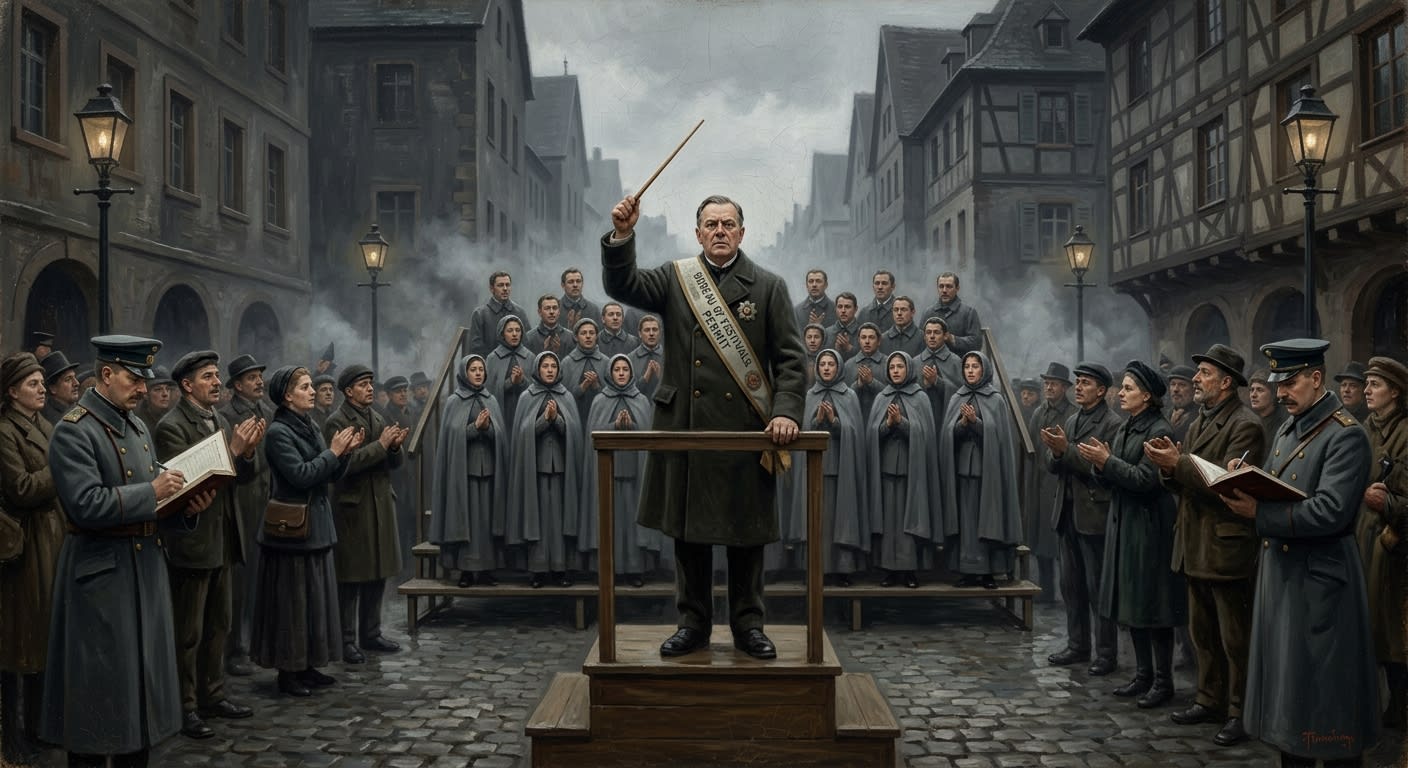
The response was institutional. The Bureau of Festivals, sealed and ratified in A.S. 72, did more than regulate public celebration. It created a new species of functionary — the Chorus-Master, licensed joy engineer, half-cleric and half-stagecraft tactician, trained at the Festival Conservatory of Strasbourg to do what no theologian and no general had managed alone: to take a city's hunger for song, comedy, and spectacle and grind it into doctrine that could be swallowed without rebellion.
The Conservatory's curriculum is a four-year programme encompassing liturgical theory, crowd psychology, bell-harmonic compliance, catechism dramaturgy, and — in the final term — a practicum in which the student conducts a live festival performance before an audience that includes no fewer than three Bureau of Purity inspectors, two Doctrine auditors, and one representative of the Bureau of Bells armed with a tuning fork and a professional grievance. Survival of this practicum constitutes graduation. Failure constitutes reassignment to the trench morale circuits of Zone 4, which is the Bureau's way of saying that the candidate will spend the remainder of their career performing for men who have seen things that make applause feel obscene.
#On the Substance of the Work
"Laughter is a loan; repay it in obedience."
A Chorus-Master's function, stripped of all liturgical vestment, is to convert celebration into compliance. The Bureau's own Field Manual — revised eighteen times since its first edition, each revision longer and more desperate than the last — calls it "the administration of sanctioned emotional release within doctrinally approved parameters," which is a sentence that tells you everything about the Bureau and nothing about the work.
The work is this: you receive a script approved by the Bureau of Doctrine, in which every joke has been vetted, every refrain tested against the Index Damnatus for prohibited phrasing, and every emotional climax routed back into a creed recitation. You rehearse a chorus of singers whose obedience you enforce with ration incentives and whose talent you suppress whenever it threatens to exceed the sanctioned range. You negotiate with Bellwardens for permission to use acoustic space, with patrol captains for crowd-flow corridors, with vendors for stage access, and with the Censorium of Taverns for curfew exemptions that cost more than the festival's entire budget. You calibrate speaker-lines. You plant shills in the audience to steer laughter and to smother any chant that threatens to become self-sustaining. You perform under the eye of Attendance Auditors who measure enthusiasm on a four-hundred-entry index and will classify your festival as "Excessive in Spontaneous Emotion" if the crowd's applause exceeds the Prescribed Ovation by a margin of seven seconds.
And then you do it again for the next saint's day. And the next. And the one after that.
The Chorus-Master's toolkit is spartan and revealing. A tuning fork — not for music, but for proving compliance when an inspector demands a random harmonic check mid-rehearsal. A chorus rod — the conducting baton, yes, but also the implement used to strike a singer who improvises. A permit sash bearing the Bureau's seal, without which you are legally indistinguishable from an outlaw performer and may be treated as one. A cue bell or clicker for synchronising crowd responses: laugh here, kneel here, chant here, fall silent here. And the attendance ledger, in which you record every head, every cheer, every silence, every incident, because the Bureau wants to know what happened and the Bureau wants to know before the audience remembers what happened, and the Bureau wants both filed in triplicate before the stage is swept.
#On the Riot of the Third Encore
"The encore is the enemy."
Every Chorus-Master knows the story. Every Chorus-Master was made to memorise it in their first week at the Conservatory, and every Chorus-Master flinches when an audience's applause lasts one second longer than the Prescribed Index permits.
In the pilgrim quarter of Bastion-Przemyśl, during a licensed performance of the Pageant of Saint Rupert — year unrecorded, because Records sealed the file and the Bureau of Festivals prefers the lesson to the specifics — the audience demanded a third performance of the closing hymn. The Chorus-Master, whose name the Bureau has struck from the Ledger with the thoroughness that Erasure Notaries reserve for the instructively damned, granted it. The crowd surged forward. The barricades collapsed inward. Dozens were crushed against the stage. The hymn continued because the singers had not been given the signal to stop, and the crowd continued to push because the crowd believed the hymn meant the festival was still happening, and the Festival was still happening because the Chorus-Master had permitted an encore, and the Chorus-Master had permitted the encore because the audience wanted it, and the audience wanted it because the hymn was good.
The Bureau drew two conclusions from the disaster. First: that crowds are ordnance and must be handled with the same caution the Bureau of Engineering applies to powder charges. Second: that the audience's desire for more is the precise moment at which the performance must end. Satisfaction is safe. Hunger for repetition is a fuse. The silence after the last permitted note — the abrupt, managed, doctrinally certified silence — is the Bureau's true instrument.
#On the Methods of Control
"One chorus, one creed."
The Chorus-Master's operational methods fall into three categories, each of which the Bureau pretends does not exist, each of which the Bureau could not function without, and each of which would horrify a civilian who has never watched a festival being manufactured from the inside.
Joy laundering is the practice of hiding a genuine human truth inside a doctrine stanza — smuggling a line that means something real into a catechism drill so that the audience receives a moment of authentic feeling wrapped in Bureau-approved packaging. Every Chorus-Master does it. Every Chorus-Master denies doing it. The Bureau of Doctrine suspects it happens and has assigned three investigators to prove it, but the investigators attend the festivals, and the festivals make them feel things, and the feeling compromises the investigation, and the investigation has been ongoing for forty-one years without producing a single conviction. The Bureau considers this a success. The Chorus-Masters consider it a draw.
The controlled heckle is the practice of planting shills in the crowd — paid operatives who laugh at the correct moments, kneel at the correct cues, and shout approved phrases that steer the audience's emotional trajectory away from spontaneity and toward the prescribed response. A well-planted shill can defuse a near-riot by redirecting a crowd's energy into a call-and-response chant that ends in a creed recitation. A badly planted shill can start the riot they were deployed to prevent. The Bureau trains shills at a separate facility whose location is classified but whose graduates are recognisable by their professionally enthusiastic clapping, which sounds like applause the way a Warden's salute sounds like respect — technically correct, emotionally bankrupt.
The encore tax is the Bureau's most elegant cruelty. When an audience's enthusiasm threatens to exceed the prescribed parameters — when the crowd begins to demand more, when the applause refuses to die, when the Attendance Auditors' counting-stones rattle toward "Excessive" — the Chorus-Master offers a bargain: one additional chorus, one more stanza, one final permitted repetition, provided the entire audience first recites the Creed. The crowd wants the song badly enough to comply. The Bureau gets its catechism drill. The audience gets its moment of permitted joy. Everyone is diminished, and the Bureau calls this a successful outcome, and the Bureau is correct in the way that a surgeon is correct when the patient lives but cannot walk.
#On the Factions and the Failing
"No unscheduled encore."
The profession splits along a fault line as old as the Bureau itself. The Pure Conductors serve doctrine first — their festivals are immaculate, their compliance scores flawless, their audiences obedient and hollow-eyed. The Mercy Maestros serve morale first — their festivals bend the rules just far enough to give the crowd something real, and their compliance scores are perpetually under review, and their careers end in either quiet reassignment or loud commendation, depending on which Bureau catches them first.
Both factions despise each other. Both factions need each other. A city with only Pure Conductors sinks into the kind of grey despair that breeds the very sedition the Bureau exists to prevent. A city with only Mercy Maestros slides toward the kind of uncontrolled emotional expression that gave the Synod the Laugh Riots of Seville, A.S. 153 — coordinated mirth, tongues cut, a city renamed "Whispers" and a Bureau humiliated before the full Assembly of Thrones.
The Bureau's solution is to deploy both, simultaneously, in overlapping jurisdictions, and to let the rivalry between them generate the productive tension that the Bureau calls "competitive orthodoxy" and the Chorus-Masters call "living with a knife at your throat held by someone who conducts with the other hand."
An earlier internal memorandum classified Festival Chorus-Masters as "minor administrative functionaries with limited doctrinal impact."
This classification has been withdrawn. The Festival Chorus-Master corps administers the emotional infrastructure of the Synod's civilian population — the pressure valves, the grief channels, the calibrated moments of release that prevent the faithful from discovering that faith alone, without song, without spectacle, without the brief and managed illusion of joy, is insufficient to sustain a human being through seven generations of holy war. The Chorus-Master is minor in the way that a fuse is minor — small, replaceable, and catastrophic when absent.
The profession kills in the usual ways: throat damage from years of conducting in smoke and curfew fog, crowd-crush injuries, the quiet violence of inspectors who find fault, the loud violence of audiences who do not find enough. But the deepest wound is subtler. A Chorus-Master spends a career learning to manufacture joy. The manufacturing process requires the operator to stand outside the product. You calibrate laughter. You schedule tears. You design the precise emotional shape of a crowd's experience, and the precision of the design requires that you yourself feel none of it. The burnout endpoint is the moment when unscheduled joy becomes indistinguishable from threat — when a child's laugh in a market square makes you reach for your attendance ledger, when silence feels safer than music, when the only song you can listen to without flinching is the one you wrote yourself, with all the dangerous parts removed.
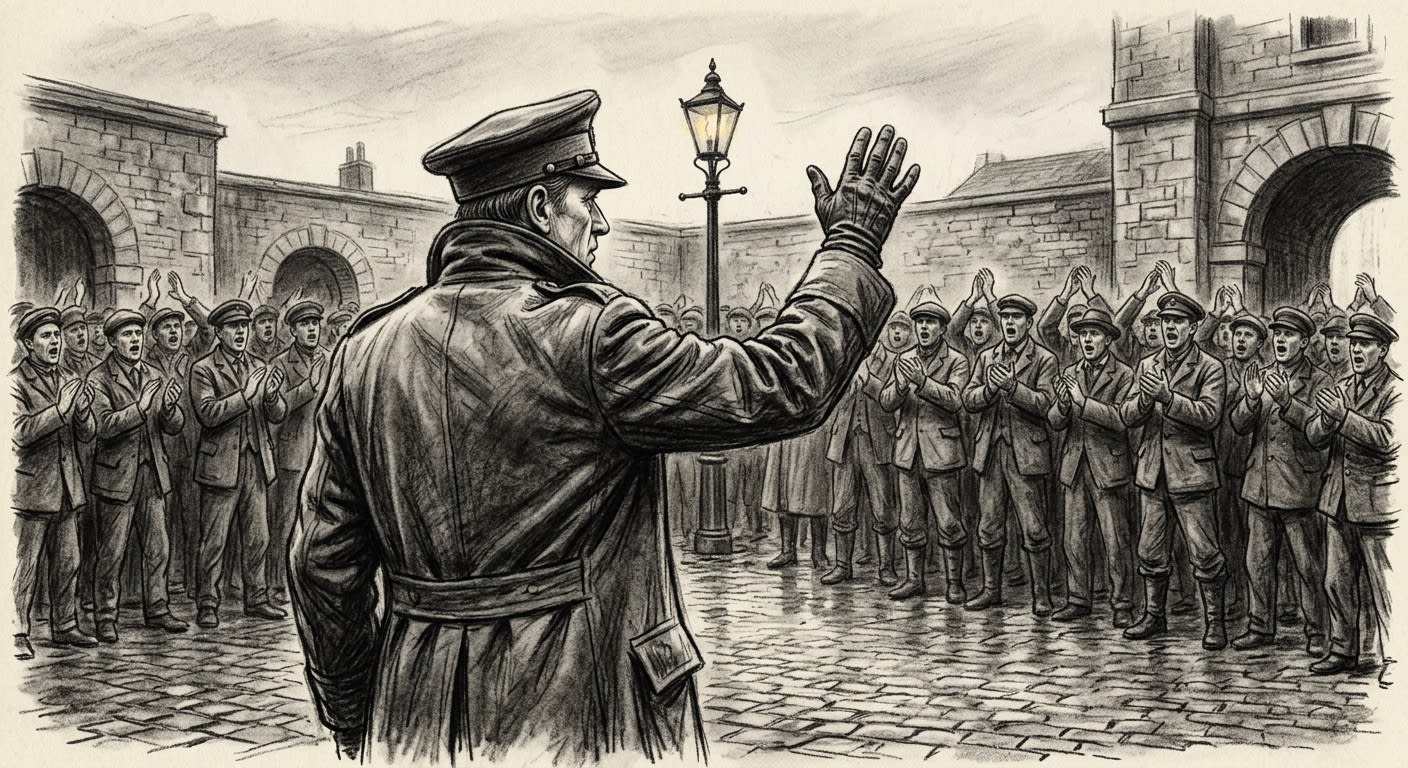
The Bureau trains forty Chorus-Masters a year. The quota is sixty. The twenty who do not appear are not dead. They are somewhere in the Synod's vast machinery, conducting something — a factory hymn, a trench-circuit pageant, a curfew-fog tavern sing-along in which the songs have been approved and the laughter has been metered and the joy has been rationed down to the smallest dose that will keep a human being alive without making them dangerous.
The Bureau calls this mercy. The Chorus-Masters call it work. The difference between the two is the distance between the permit sash and the throat it hangs from, and that distance is shrinking, and the Bureau has filed a report on the shrinkage, and the report is classified, and the classification is correct.