
#On Their Nature
"Crescit, et non expenditur."
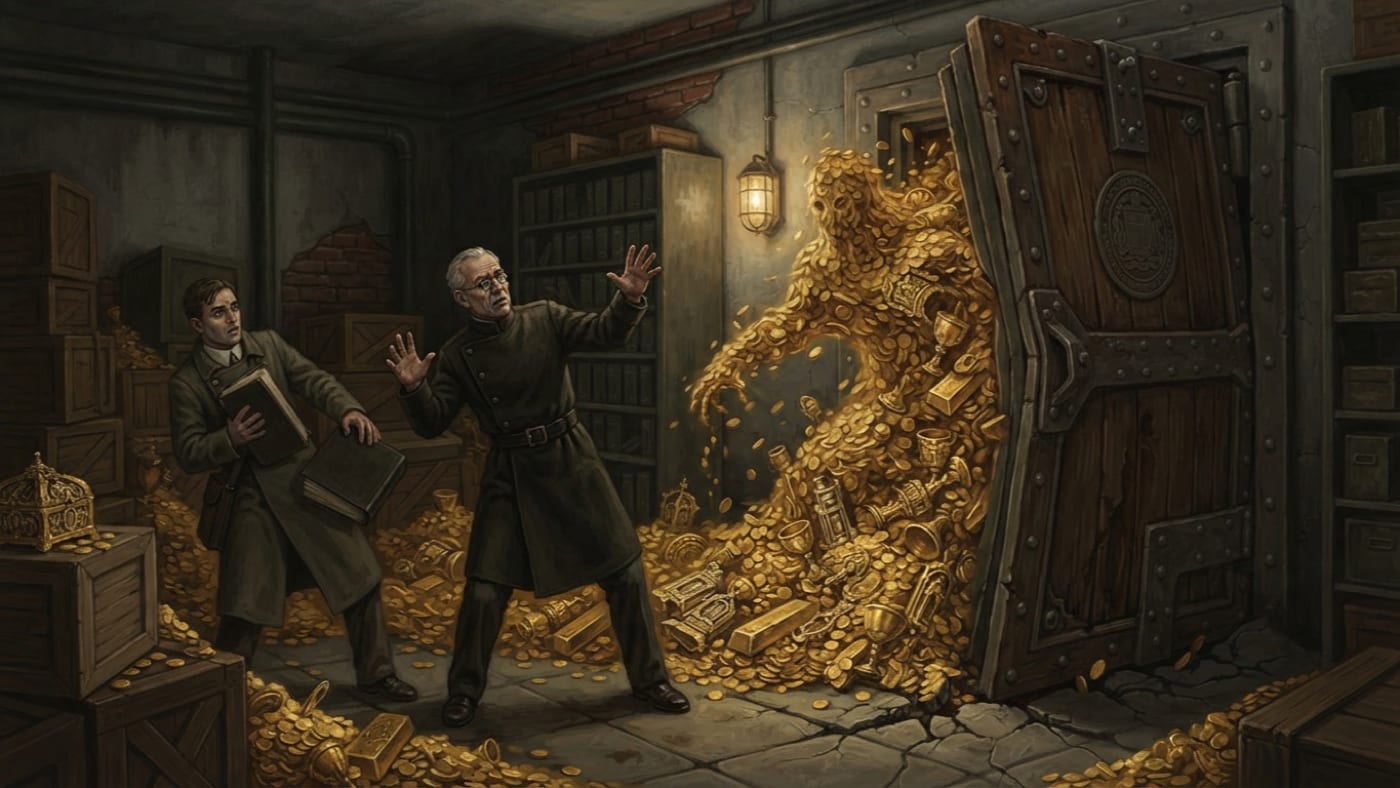
The Coinbound are demons of Velmora, the Covetous Serpent, Sin-General of Greed among the Seven. They appear as wealth itself: animated treasure, the walking hoard, the entity of pure currency. They cannot be spent. They can only be accumulated.
Accumulation is the trap. Every other property in this file serves that one.
This entry belongs to the current bestiary survey, commissioned and sealed by the Bureau of Doctrine in A.S. 201. It records the class as the Bureau presently understands it. It does not record when the class first manifested. No document in the Bureau's keeping establishes that date, and I have refused every invitation to estimate one. In this office an estimate acquires the authority of a seal within a fortnight and keeps the accuracy of a rumour forever.
Velmora presses the Transylvanian highlands facing Bastion-Sibiu, and the treasuries on the Synod's side of that wall are the readers this file most concerns. That says where the instruction is needed. It records no outbreak.
Bandits rob. Collectors bargain. The Coin-Sworn Shades open throats in the dark. A Coinbound sits in a strongroom and lets its keeper feel clever. It wants to remain. It wants more of itself. It wants its keeper to add to it, and a keeper who never tries to spend it can go on adding for years without learning what is in the strongroom.
#On Their Forms
The dedicated taxonomy of Velmora's demons gives three manifestations and declines to rank them: treasure that moves, the hoard that walks, currency with no coin beneath it. The survey honours that refusal. Nothing on file supports a fixed anatomy, a standard height, a denomination, a count of limbs or a manner of increase, and I will not have this office inventing a stud-book for a heap of gold.
The sources do record their motion. The Coinbound flow like liquid gold. Then they solidify into whatever form might tempt the one who is looking.
The second clause is the troublesome one. If the solid form answers to its observer, then appearance identifies nothing. A coffer, a chain, a plate of good weight: the survey can name the category and nothing narrower. Each narrower description would be written by the appetite of whoever stood in the doorway, and appetites differ.
"Liquid gold" is a report of movement. The survey holds no account of a Coinbound scalding a hand or spitting molten metal. Wounds that weep hot gold belong to the Gilded Sentinels of Velmora's line and to another file. The sources do not say whether the flowing state is the creature and the solid form its costume, or the reverse. I have read them twice. They still do not say.
#On the Growing Treasury
The Codex entry on Velmora, under On Her Instruments, supplies the account the field relies upon. A garrison infiltrated by Coinbound finds its treasury growing in ways no audit can explain. On examination the new wealth's provenance is entirely unclear. It resists removal from the premises with what that entry calls "a stubborn, almost gravitational insistence."
I quote the phrase so that nobody promotes it. It describes how the resistance feels to the porters at the handles of the chest. It establishes no power over weight, and the survey assigns none. The same entry adds that the wealth keeps "a careful account of who has touched it and for how long." The survey files that observation as reported. No source explains how the account is kept, where it is kept or what follows from it, and I have struck three of my own draft paragraphs that tried.
The concealment begins in the counting-house. A shortfall brings an inquiry. A surplus brings a commendation, a better posting and possibly a dinner. The Bureau of Tithes has spent generations training its auditors to hunt the missing Crown. The extra one is entered as good fortune and initialled.
Later in the same paragraph, the Velmora entry makes a claim this survey cannot carry.
"The wealth is real. It will spend."
The sentence contradicts the definition at the head of its own paragraph, which states that the Coinbound cannot be spent. It contradicts the dedicated taxonomy, which states that they can only be accumulated. For the purposes of this survey, the Coinbound are unspendable. The quoted sentence stays in the record as a conflicting account. It supplies no exception, second currency, detachable portion or method of paying out a demon, and readers who need one of those will not find it here.
Anyone who tries to use a Coinbound finds the wealth resistant. It does not want to leave. Doctrine holds that within Synod territory no demon governs a human choice, and the survey grants the Coinbound no exemption. The resistance belongs to the treasure. The chest refuses the door, while its keeper remains free to refuse the chest. Keepers seldom do. That is a finding about keepers.
#On the Other Instruments
Velmora's quieter demons are routinely confused by officers who file everything under gold, suspicious. The survey separates them by function.
The Collectors acquire particular things, such as a pair of eyes, a firstborn child, a summer afternoon or a regret, through trades that seem fair. A Collector wants something of yours. A Coinbound is itself the thing wanted.
The Assessors look at a person and see value: what that person would pay, accept or sell. They compile it. It enters the ledgers. The survey has no record of a Coinbound appraising anything, and I will not lend it the Assessors' eyes because both are found near money.
The Ledger-Keepers record every deal and debt in Velmora's territory. They appear hunched over books, with quills that never stop, entering transactions that have not yet happened. That foresight is theirs. Nothing on file grants it to a Coinbound.
The Guarantors enforce contracts and have their own file, along with their own difficulties. The sources attach no contract to the Coinbound.
Assessors and Ledger-Keepers are also ranks among the human cultists of the Ten Thousand Keys. Every such name in this section refers to the demon. A clerk who confuses the two will arrest an accountant and leave a demon in the strongroom.
Three further confusions require correction. The Coin-Sworn Shades are spirits bound to cursed currency and employed as assassins. Their handling of coin makes them neighbours of the Coinbound in the index and nothing more. The Avarice Engine is a war-golem of fused gold and silver. The Velmora entry calls it "a walking treasury", and the taxonomy calls the Coinbound "walking hoards". The two classes share that vocabulary and nothing else. Finally, the victims of Greed whose skin takes a metallic cast, and who are said to join the collection, have not become Coinbound on any evidence before this survey. Whoever has been turned toward treasure remains whoever they were, and the Bureau will thank officers not to inventory them.
#On Scrutiny and Refusal
The audit remains the instrument of detection, because all three marks the field can rely on are audit findings. Something grows and nobody can explain it. Something arrives and nobody can trace it. Something is ordered out and does not wish to go. I would have every garrison treasurer report a surplus with the dread usually reserved for a deficit. This is my recommendation. It is not yet procedure.
The wider measures against Velmora deserve less confidence than their sponsors spend on them. The Bureau of Tithes promotes tithing as inoculation, on the principle that a person who gives cannot be bought. Whether this works is unclear. It has not been shown to remove a Coinbound, and any attempt to give one away would meet the resistance described above. Value fasts require soldiers and citizens to surrender their possessions to communal custody. They have mainly produced the desperation her agents exploit. The Mark of Poverty, a vow of absolute destitution, rests on the belief that ownership is her doorway. Its takers may be right. They are also poor, and the Church has never mistaken poverty for sanctity.
Wealth is neutral. A Crown weighs the same in the poor-box as in the strongroom. The forge tests applied to every Crown of Grace catch coin that whispers. The survey holds no record that ash, song or silence melts, purifies or defeats a Coinbound, and it records none. It likewise records no rite of extraction or method of destruction, and it approves no containment protocol. If such things existed, this office would have heard of them, and so would the Bureau of Tithes' accountants.
That leaves refusal. The keeper can stop adding. The keeper can report the surplus and decline the next pressure to acquire. None of this persuades the chest toward the door. It does not return the years spent feeding it or guarantee a clean ledger at the next inspection. It is available. Each morning it is available again. By Doctrine's reading, that is all the Creator asks of a keeper, and the survey promises nothing more.
#The Ratification
The class is entered. Its manifestations, its unspendability and its resistance to removal are confirmed on the sources cited. Its first manifestation is left blank. The blank is deliberate and will be defended.
Treasurers who find this entry tedious are invited to explain their surplus instead.