
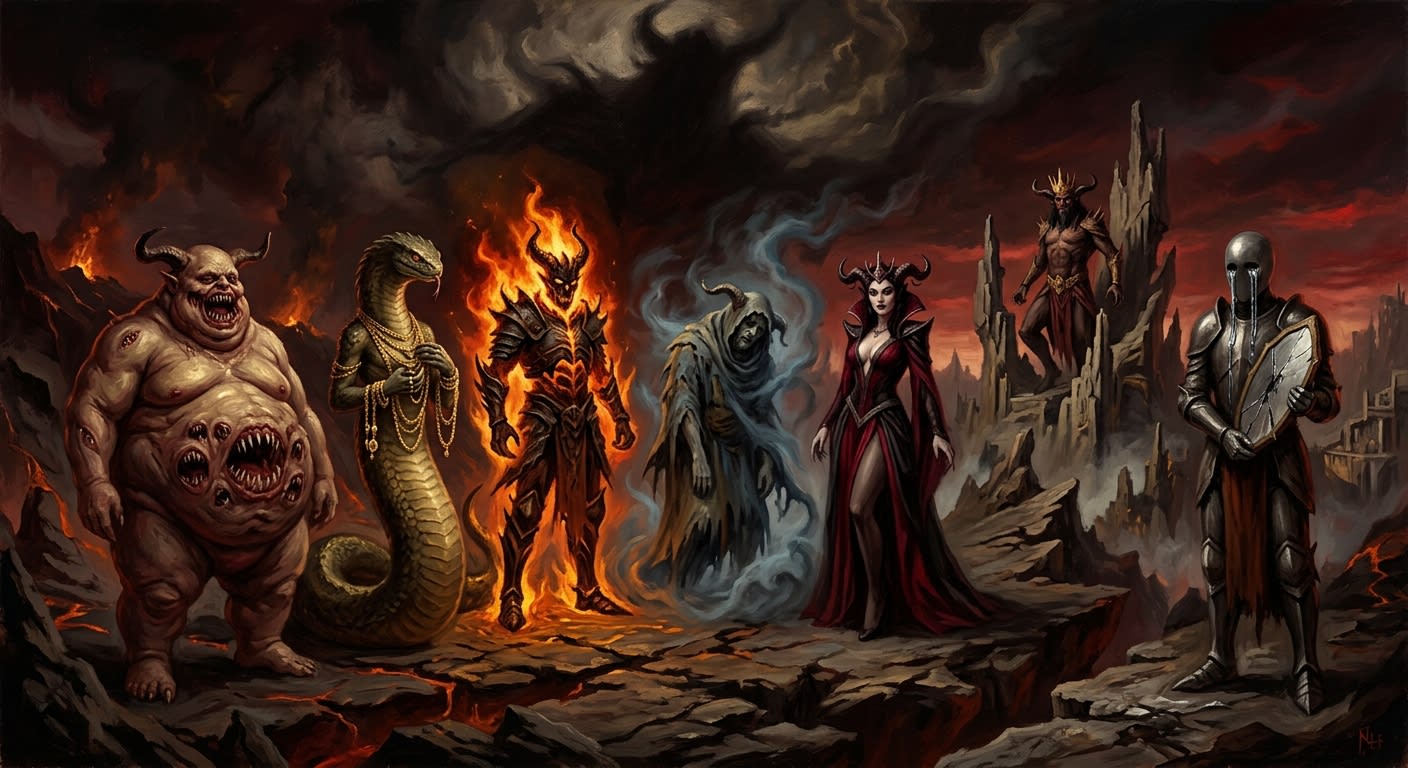
"Count them. Seven sins, seven generals, seven domains carved from the lands of the Church. The arithmetic is not coincidence. It is theology." — Hierarch Odo of Trier, Address to the Council of Cologne, A.S. 100
#On the Nature of the Seven
I write this entry not with enthusiasm but with the grim professional obligation of a man asked to catalogue plague. The Bureau of Doctrine has seen fit to commission — and I use the word loosely, for the Bureau commissions nothing; it requires, and the distinction is between a request and an anathema — a single consolidated entry on the Seven Sin-Generals, those monstrosities that squat upon the eastern half of Creation like bloated ticks upon a dying hound.
The Sin-Generals are not demons in the vulgar sense — not the screeching gargoyles of tavern-legend nor the horned tempters of children's catechism. They are extensions. Shards of the Great Deceiver's own Will, hammered into form and thrust through the wound in Reality that we call the Sundering. Each embodies a cardinal sin not as metaphor but as governing principle: the sin is their nature, their method of war, their mode of dominion, and the architecture of their blighted kingdoms. They do not serve the Great Deceiver as generals serve a king. They are the Great Deceiver, fragmented into seven clawed hands, each reaching for a different part of humanity's throat.
The Synod's official Doctrinal position — revised four times in the last century, each revision contradicting the last with the serene confidence that only a theocracy can muster — holds that the Sin-Generals are emanations, not creations. The difference matters to theologians, apparently. An emanation implies the Great Deceiver did not choose to make them; they spilled from him as pus from a wound, as rot from a corpse, as heresy from an inadequately supervised printing press. A creation would imply craft, intention, a mind at work — and the Bureau is reluctant to credit the Adversary with too much intelligence, lest the faithful begin to admire him.
The Third Doctrinal Revision (A.S. 71) stated that the Sin-Generals were "sevenfold aspects of a single Infernal Will, inseparable and co-eternal."
The Fourth Doctrinal Revision (A.S. 98) clarifies that they are "distinct emanations capable of independent action, mutual hostility, and occasional cooperation, unified only in their hatred of the Faithful." The Third Revision has been withdrawn from circulation. Copies found in private collections will be confiscated and their owners interviewed by the Bureau of Purity.
What the theologians debate, the soldiers have settled in blood. The Sin-Generals are real. They command armies. They hold territory. They kill in numbers that make the Bureau of Records weep — not from grief, but from the sheer volume of death-certificates required.
#The Seven and Their Domains
East of the Sagittal Line, the continent is not so much a geography as a wound. Seven blighted kingdoms sprawl across what was once the breadbasket, the academy, and the cathedral of Europe — now divided among seven abominations, each warping the land and its remnant peoples into a reflection of their governing sin.
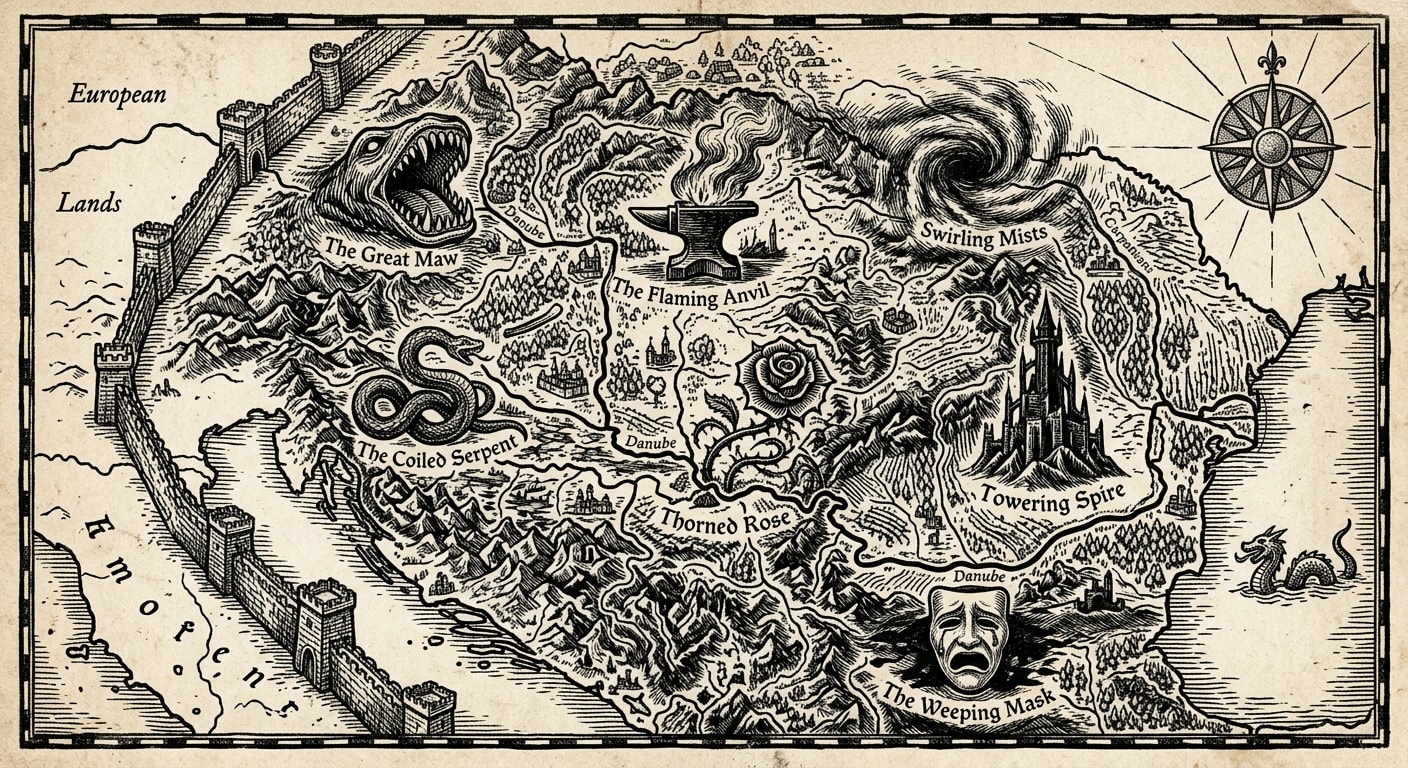
The domains are not fixed. They shift, expand, contract, and occasionally consume one another in fits of inter-demonic spite. The Bureau of Records maintains a cartographic division dedicated solely to tracking these changes; the division's survival rate is the lowest in the civil service, which is saying something given that the Bureau of Tithes employs tax collectors in active war zones.
What follows is the briefest possible accounting of each. The Bureau has authorized individual entries for every Sin-General — each a catalogue of horrors sufficient to ruin a strong man's sleep for a season. This entry serves as the foyer. The individual rooms are worse.
#I. Kargath, the Maw of Endless Hunger — Gluttony
Kargath came first, or so the chronicles insist, though the chronicles were written by men who were starving at the time and may have been inclined to see hunger before all else. He manifested in the ash-years after the Eastern Silence, when Pannonia's barns were already rotting and the legions at Debrecen had begun to eat things that the Bureau of Records declines to specify in documents rated below Clearance Seven.
His domain is the Blightmarsh of the Drava, a swamp-kingdom of drowned cities fused like bones in a mass grave. At its heart squats the Cauldron Citadel, whose smoke-towers vomit a sky no dawn can reach. He is Gluttony not as appetite but as principle — hunger that outlasts mouths, famine that devours the harvest before the seed is planted. His armies are abominations of gorging flesh: Carrion-Dogs that howl in human voices, Bloat-Hulks whose bellies are siege engines, and the Mawwheel — an engine of iron fangs that chews the battlefield into fuel.
He presses hardest against Bastion-Constantinople, where he is joined in this dubious distinction by Maldrake — the only bastion on the Line that faces two Sin-Generals simultaneously. His famine-aura arrives before his armies, rotting the grain convoys from the Anatolian coast, turning the Thracian marshes into a brackish grey that the soldiers call the Blightmarch. He is the nearest to the southern hinge. He is the hungriest. And he is, by Doctrinal consensus, the one we cannot starve out — because Kargath does not starve.
#II. Velmora, the Covetous Serpent — Greed
Velmora arrived in famine's wake, offering gold where there was no grain. She bought Thessalonica for a single winter's provisions and repossessed it when spring failed. She traded salt for sovereignty in Epirus. Century by century, her coils tightened — not through conquest but through contract, not through blades but through ledgers inked in damnation.
Her domain extends from Moldavia and Wallachia south through the Transylvanian highlands, where the Gilded Chasm opens in the gold-veined limestone of the Southern Carpathians — a canyon where rivers flow with molten gold and every stone gleams with stolen tribute. At its heart yawns the Vault of Ten Thousand Keys — a palace where every door locks behind the visitor. None who enter emerge. To cross her threshold is to be owned.
She presses Bastion-Sibiu from the east and north, and her purpose here is not conquest but excavation: the gold-veins beneath the Transylvanian Alps are the richest concentration of ore on the continent, and Velmora finances the bribery of supply chains across three corridors with what she extracts from them. The Sibiu garrison intercepts more corrupted convoys than it repels direct assaults. Velmora fights not with steel but with debt. She bribes generals before the first volley, floods markets with cursed coin that eats at loyalty, and sends counterfeit relics to rot the faith from within. Her agents have been found as far west as Strasbourg's own counting-houses, their ledgers bleeding ink not their own. The Bureau of Tithes has standing orders to audit every Crown that passes through the western provinces. The auditors find something wrong roughly once a month. The Bureau considers this an acceptable ratio. I do not.
#III. Maldrake, the Wrathforged — Wrath
Maldrake tore into Reality in Thrace, where the ore itself screamed and split and from the fissures strode something that was not born but smelted. His first steps melted the bronze walls of Illyria in a single night. His second steps burned the armies of Moesia to ash on their own steel. He has not stopped stepping since.
His domain is the Iron Wastes of Thrace — a land where the sky is permanent cinder and rivers run with molten slag. The Forge-Pyre Bastion, his citadel, is a cathedral of anvils and flame whose gates glow with eternal heat. Maldrake does not rule; he smelts, burning everything — stone, flesh, loyalty, mercy — into weapons for the next assault.
His hatred for Syrion the Languid is theological in its intensity. Wrath cannot abide Sloth. Fire cannot abide stillness. Their feuds have devastated entire sectors of the front — and the Bureau of War has, on occasion, quietly encouraged the rivalry, reasoning that two Sin-Generals fighting each other are two Sin-Generals not fighting us. Whether this constitutes strategy or heresy depends on which Bureau you ask.
#IV. Syrion, the Languid Dreamer — Sloth
Syrion did not arrive. He settled, like fog into a valley, like dust onto a ledger no one has opened in forty years. His first touch fell upon the kingdom of Phocis, where court and crown succumbed mid-feast — their laughter softening into silence, their eyes dimming into endless slumber. From there his haze spread valley by valley, decade by decade, until whole generations sank into stillness and the lands themselves forgot they had ever been awake.
His domain is the Vales of Stagnance, where rivers forget their course and the sun lowers but never sets. At its heart drifts the Throne of Mists — a palace of clouded glass that rocks forever between waking and dream, anchored to nothing, governed by nothing, wanting nothing.
Syrion wages no war of steel. His conquest is surrender. Mist-Walkers seep into camps and councils, whispering indolence until decrees are delayed and vigilance abandoned. His Slumber-Hulks move like glaciers, their blows falling with the weight of centuries. The Hourglass Monolith — his war-engine — bleeds time itself from the battlefield, reducing battalions to statues while his hosts drift past like bad dreams.
He is the Sin-General the Synod speaks of least. Not because he is the weakest — his time-fog holds the Bulgarian highlands and the former kingdom of Phocis both, and Bastion-Shipka exists to guard the single pass that separates his domain from the Thracian plain and the road to Constantinople. The Synod speaks of him least because Sloth, of all sins, is the one the Theocracy fears finding in its own mirror.
#V. Velkara, the Crimson Temptress — Lust
Velkara came as perfume on the wind — soft, unseen, undeniable. Whole dynasties fell not by sword but by sigh. Heirs abandoned thrones for her embrace. Priesthoods drowned their hymns in moans. What began as scandal became collapse; borders dissolved, temples emptied, and armies broke themselves in duels fought over a glance neither combatant could afterwards describe.
Her nominal seat is the Shattered Courts — a palace of glass and flesh where every mirror breathes and every rose bleeds, gardens of thorn and velvet stretching for miles where lovers who wander in never wish to be found. Her legions are reflections of her art: Sanguine Knights drunk on fever, Whisper-Banshees whose voices shatter duty into longing, and the Obsidian Orchid — a living engine whose black petals unfold clouds of intoxicating spores.
But Velkara is not confined to her courts. She is the only Sin-General who holds no fixed sector against the Line — because she does not press against the Line from outside. She is already inside it. The Velvet Choir operates in the pilgrim quarters of every bastion south of Przemyśl. The Crimson Concord has embedded itself in the military command structures of the southern theater. Officers go missing and reappear as something that answers to the same name but serves a different master. All of this the Bureau of Purity has classified as a doctrinal infection — something that enters through weakness of will and hollows out the faithful from within. Inquisitors of the Order of the Shroud have been dispatched to no fewer than fourteen monasteries in the last decade alone. The reports made seasoned Inquisitors blush. I did not know Inquisitors could blush.
#VI. Atheron, the Exalted — Pride
Atheron did not emerge from earth or flame. He rose — a summit already formed, a mountain that declared itself higher than all others. Kingdoms around him found their spires dwarfed overnight, their crowns made small beneath his shadow. Mortal kings tore down their own works to build them higher, desperate to rival him, each effort more futile than the last.
His domain is the Ebon Heights — black mountains pierced with spires so tall they puncture the clouds, each raised only to outdo the one before it. At the peak rises the Crownspire, a citadel that climbs until it vanishes into heaven's vault, where Atheron sits enthroned as if daring the Almighty to take notice. He holds the eastern Carpathian passes that Bastion-Przemyśl opposes — not because the passes are strategically vital to him, but because they are the highest points visible from the Line, and the garrison of Przemyśl can see him from them, which is, to the Sin-General of Pride, the only reason one requires to hold any ground.
His ambition admits no peer. Velmora he scorns for counting coins when thrones beg to be claimed. Maldrake he mocks as a beast of fire with no crown to show for the burning. Syrion he dismisses as a ghost dreaming in fog. Behind every sneer festers his true contempt — for the Great Deceiver himself, whose Black Throne Atheron covets with a hunger that would make Kargath envious.
#VII. Morwen, the Weeping Host — Envy
Morwen seeped into Reality not as form but as reflection. She haunted lakes and mirrors, stealing voices from echoes and faces from their faintest outlines, until whole villages awoke speaking in borrowed tones. Kings who sought to name her found her wearing their own likenesses, turning their authority against them until no oath or vision could be trusted.
Her domain is the Hollow Vale — a land stripped bare, where forests stand as hollow shells and lakes gleam like mirrors that never show the gazer's true face. At its heart lies the Palace of Echoes, a labyrinth of doors that open not to chambers but to stolen dreams, each one leading deeper into covetous reflection. She presses the western Balkans and the Danube approaches, facing Bastion-Irongate — and she attacks the gorge not for its military value but because she envies it. The Irongate fortifications are, by any honest assessment, the most beautiful military engineering on the Line. Morwen cannot counterfeit beauty; she can only hollow it. She attacks Irongate out of spite, which is the most honest motive for war the Synod has ever had to record.
Morwen hungers not for wealth nor power but for identity itself. She envies Velkara's beauty, which she cannot counterfeit without first destroying it. She envies Atheron's stature, which she cannot match without becoming him. She envies even Kargath's appetite, for at least his hunger has a shape. Her armies march as mirrors of the living — Mimic-Knights who strike with the stolen strength of those they slay, Shade-Doppelgangers who slaughter under the guise of brothers-in-arms, and the Choral Maw, a vast organ of bone that wails in the stolen voices of the world until those who hear it can no longer distinguish their own thoughts from the echo.
#On the Things That Have No Name
The title of this entry is The Seven Sin-Generals. I have written seven. I am required to stop there, for the Bureau has approved seven entries and seven taxonomies and seven seal-stamps, and the arithmetic of theology does not tolerate remainders.
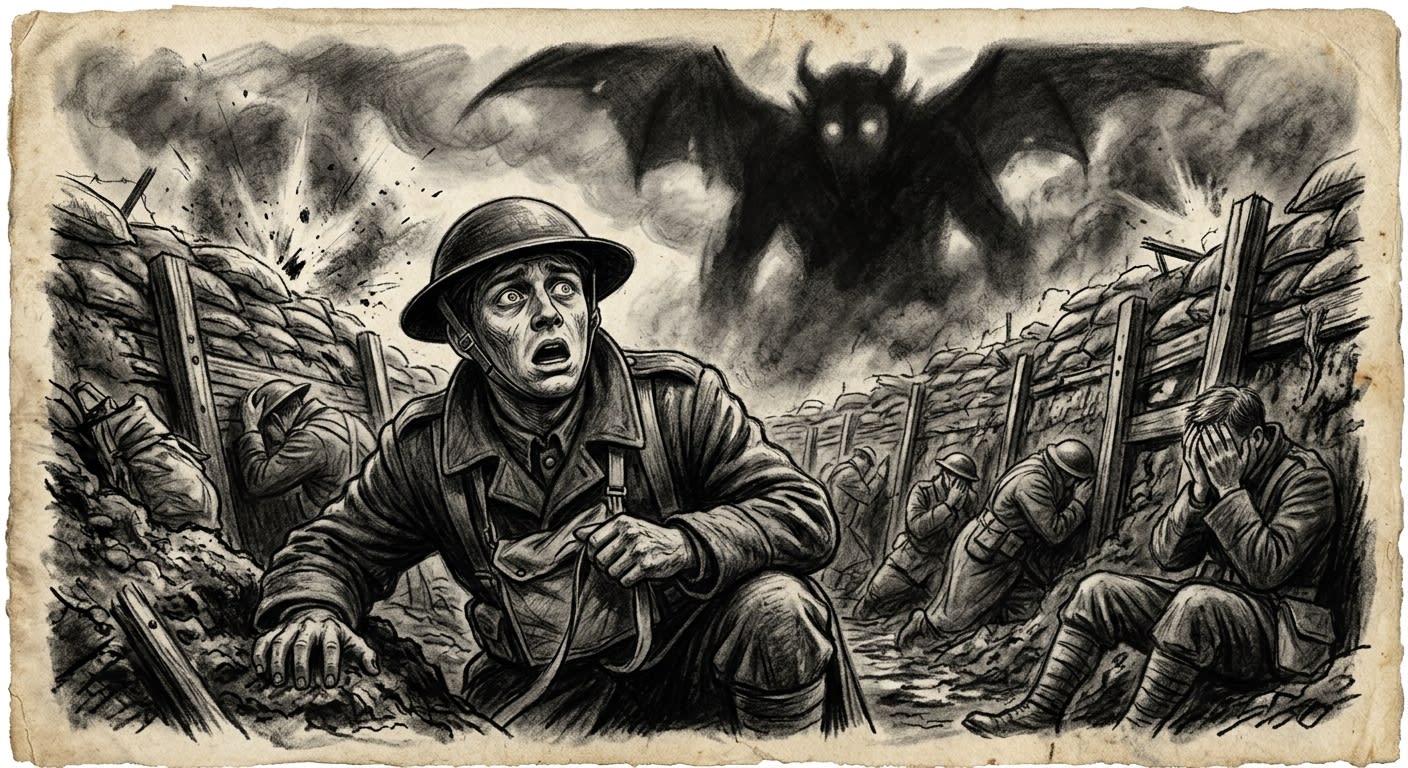
I will note, for the record — and this record is sealed under Bureau-level clearance, so the record will in all probability be read by exactly the people it most concerns — that the northern sectors of the Sagittal Line, specifically Bastion-Königsberg and Bastion-Brest, report contact with forces that do not appear in the taxonomy.
The garrison of Königsberg calls their enemy the Grey. The garrison of Brest calls theirs the Nameless Tide. The Bureau of Doctrine's Northern Theater assessment classifies both under the designation Unknown Forces, Extradoctrinal Classification Pending, which has been pending for eleven years and shows no signs of resolution.
What I can confirm: these forces do not correspond to any of the seven cardinal sins in the Synod's theological framework. They do not respond to hymns, relics, bell-resonance, or any consecrated countermeasure that works against the Seven. They do not speak. They do not negotiate. They accumulate and they press and they are, in the clinical language of the Bureau of War's suppressed Northern Theater classification: entities of unknown nature, possibly predating the Sundering, classification deferred pending theological consensus.
The theological consensus has not arrived.
The Bureau of Doctrine has suppressed all battalion-level and above field reports from both sectors. Soldiers transferred out of the northern bastions are screened by the Bureau of Purity using protocols that do not appear in any published classification. The Bureau of Shadows has, I am told, an open file. It has been open for eleven years.
I have written seven. There may be more than seven. That is the last thing I will commit to this page, because it is the thing the Bureau most wishes I would not.
#On Their Feuds
The Seven hate each other with a fervour that the faithful ought to find reassuring but do not. Kargath and Velmora circle the same corpse — his famine denies her tribute, her vaults deny him feast. Maldrake and Syrion wage an eternal contest of fire against fog. Velkara and Morwen burn with mutual contempt, for beauty and its counterfeit cannot coexist. Atheron despises them all and reserves his deepest bile for the Great Deceiver who made him second.
These feuds are real. They cost the enemy armies, territory, and — if the theologians are to be believed — fragments of their borrowed souls. The Bureau of War has a department dedicated to tracking inter-demonic hostilities: the Office of Infernal Correspondence, staffed by analysts who read intercepted sorcerous transmissions and maintain what they call "the Feud Ledger." The Office's annual report is the only document in the Synod's archives that reads like a family scandal sheet written by a man who has lost the will to be shocked.
The Bureau of War's A.S. 87 assessment concluded that inter-Sin-General hostilities would "inevitably lead to the fragmentation and collapse of the Infernal coalition within two decades."
The A.S. 107 reassessment notes that, regrettably, the coalition has not collapsed. The 87 assessment has been reclassified as "Aspirational Intelligence." The analyst responsible has been promoted, as is customary when a catastrophic misjudgment is too embarrassing to punish.
#On the Order of Their Coming
The lore is contradictory — deliberately so, for the Bureau has revised the chronology no fewer than six times, each revision serving whatever doctrinal purpose was fashionable that decade. What the trench-scholars and the records agree upon, grudgingly, is this:
Kargath came first, or near enough — in the ash-years after the Sundering, when the Eastern Silence swallowed half the continent and famine was already a fact before it was a general. Velmora followed in famine's wake, offering gold. Maldrake erupted in the clangor of Velmora's conquests, fire answering greed with fury. Syrion drifted in during the exhaustion that followed the first wars, when men were too tired to notice the fog. Velkara came as the fog lifted — or seemed to lift — replacing torpor with appetite. Atheron rose when the others had carved their domains and found there was still a summit unclaimed. And Morwen — Morwen was last, or perhaps she was always there, wearing the faces of the others until she was ready to wear her own.
The sequence matters less than the fact. Seven sins. Seven generals. Seven domains. The arithmetic is not coincidence. It is, as Hierarch Odo observed at the Council of Cologne, theology.
#On the Prospect of Victory
There is no prospect of victory.
The Bureau of Doctrine forbids me to write that sentence. I have written it anyway and will accept whatever stamp they see fit to apply. The Sin-Generals cannot be killed by any weapon the Covenant possesses, for they are not alive in any sense the word applies to men or beasts. They are emanations. Shards. To destroy a shard, one must destroy the will that cast it — and the Great Deceiver's Will has endured since before the Sundering, since before the Atheist Wars, since before, perhaps, the first lie ever told.
What the Covenant can do — what it has done, at staggering cost, for one hundred and ten years — is hold. The Sagittal Line holds. The bastions hold. The bells ring, the hymns rise, the levies march, the ink flows, and the Wall does not fall. That is not victory. It is not defeat. It is the War Eternal, and it is the only war worth fighting, because the alternative is not peace but extinction.
Inscribed, sealed, and already regretting the commission — Hieromnemon Valerius Drax, Warden of the Sacred Ledger, in the two hundred and first year of the Synod's dominion.