
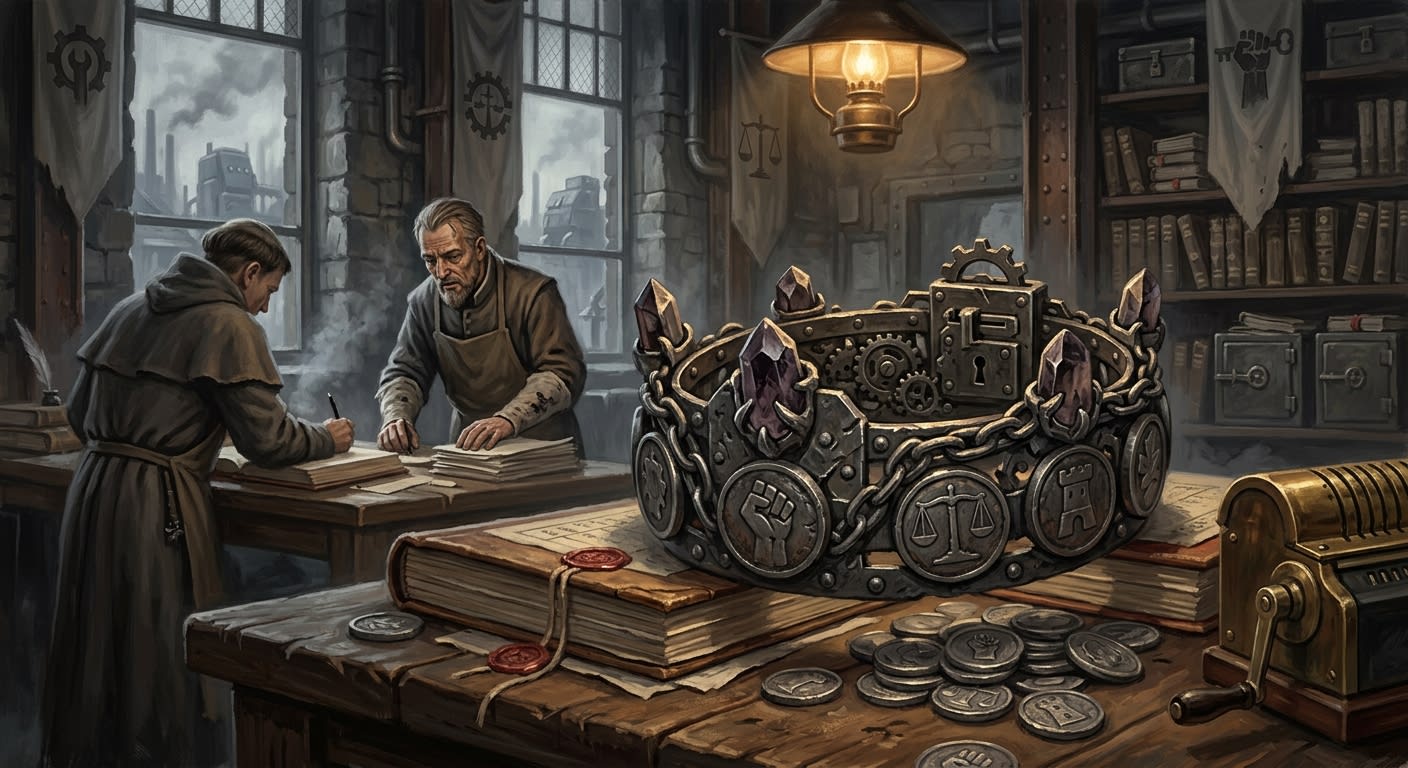
#On the Coin That Pretends to Be Grace
The Crown of Grace is the official iron coin of the Synod, minted under consecrated die, ash-tested, song-tested, silence-tested, entered, tracked, blessed, weighed, denounced, defended, counterfeited, hoarded, spent, kissed, hidden in socks, swallowed by smugglers, recovered from latrines, and treated throughout the obedient territories as portable proof that Strasbourg can make value descend upon metal by striking it hard enough with Doctrine.
The faithful call it Grace because the Bureau told them to. The poor call it bread before it becomes bread. The Bureau of Tithes calls it recognised tender, which is the phrase clerks use when they wish to sound less greedy than merchants. Soldiers call it pay if it arrives and rumour if it does not. I call it one of the Synod's cleverer sacraments, which is not praise. Clever sacraments require watching.
It is iron by design. Gold belongs to vanity, aristocratic rot, Velmoran appetite, and jewel-boxes with moral opinions. Silver flatters the merchant classes and encourages them to imagine liquidity as a theology. Iron rusts, weighs honestly, injures the foot when dropped, and reminds the holder that value under the Synod is an act of command. A Crown is worth what the Synod says because the Synod can send soldiers, auditors, confessors, and one extremely bored magistrate to explain the alternative.
The coin bears the Triune Knot on one face and the crowned ledger on the other. Early issues carried local mint marks large enough for city pride, an error corrected after the A.S. 92 monetary regularisation, since pride in a mint is merely provincial vanity wearing a cashier's apron. Current issues carry minute source marks legible only to Tithes examiners, Counter-Relic auditors, skilled counterfeiters, and widows who have had to stretch a week's ration through nine days. One of those groups learned from necessity. The other three required training.
#On Its Establishment After Ruin
Money after the Sundering was a graveyard with denominations. Rationalist paper collapsed first, since Reason had printed more promises than grain. Ducal gold fled into mattresses, reliquaries, refugee hems, dead men's mouths, monastery drains, and the private floors of men later discovered beneath them. City scrip multiplied as cities shrank. Army chits crossed districts where no army remained. Barter returned in the rearward villages with all the moral ugliness barter brings: bread for boots, boots for medicine, medicine for a daughter's name, a daughter's name for passage west.
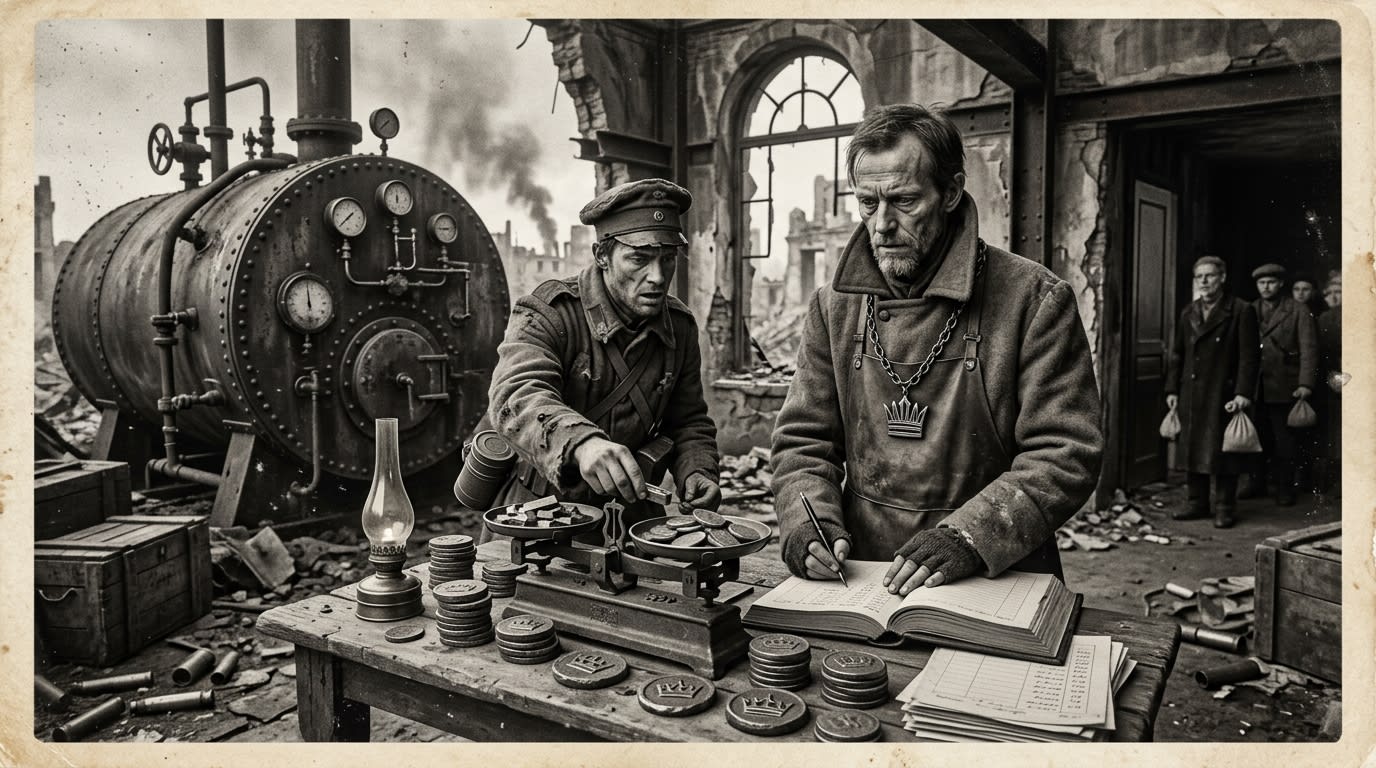
The Synod did not create the Crown of Grace because it loved commerce. The Synod created it because hunger had become multilingual.
A.S. 90 gave Strasbourg the Concordat settlement, twelve Bureaus in their first hard shape, and the confidence to impose one monetary obedience upon territories still pretending their old purses mattered. A.S. 92 saw the first full monetary circular: iron issue, blessed minting, mandatory ledger recognition, exchange deadlines, confiscation protocols for hoarded gold and silver, and the delightful instruction that all prior tender might be surrendered voluntarily before it was seized correctly.
Early treasury catechisms stated that the Crown of Grace was instituted “to ease exchange among the faithful.”
Corrected. Ease was incidental. The Crown was instituted to make exchange visible, taxable, confessable, interruptible, and obedient. Ease sometimes occurred when no Bureau happened to be standing nearby.
The first great minting took place in Strasbourg under the supervision of Tithes, Records, Doctrine, and Bells. The Bureau of Engineering built the presses and protested that hymn schedules affected striking rhythm. Bells insisted the rhythm mattered. Doctrine agreed because the Bureau had not yet learned to distrust every claim sung in a pleasant register. Tithes cared only that output rose. By the Feast of Accountable Mercy, the mint had produced enough Crowns to pay three garrisons, settle four requisition chains, and convince at least six minor princes that their ancestral coinage had become decorative treason.
Old gold was not banned outright. The Synod is severe, not stupid. Gold remained legal in sealed reserves, relic custody, foreign settlement, military procurement, and those magnificent little exceptions by which policy dresses necessity in a clean collar. Public circulation narrowed. Private hoarding became spiritually suspicious. A man could keep his grandmother's gold cross if registered; unregistered gold implied either sentiment stronger than obedience or obedience weaker than greed. Both conditions interest Purity.
#On Minting, Blessing, and the Three Tests
A Crown begins as common iron. That fact irritates romantics and reassures the Bureau. Iron comes from mines, foundries, tithe arrears, confiscated household goods, broken artillery, prison bars, bridge scraps, failed engines, and, on two documented occasions, melted statues of civic founders whose descendants filed petitions until their wrists failed. The metal is sorted by batch, smelted, poured, rolled, punched, annealed, cleaned, struck, washed, dried, blessed, counted, recounted, and entered. Only then does it become Grace.
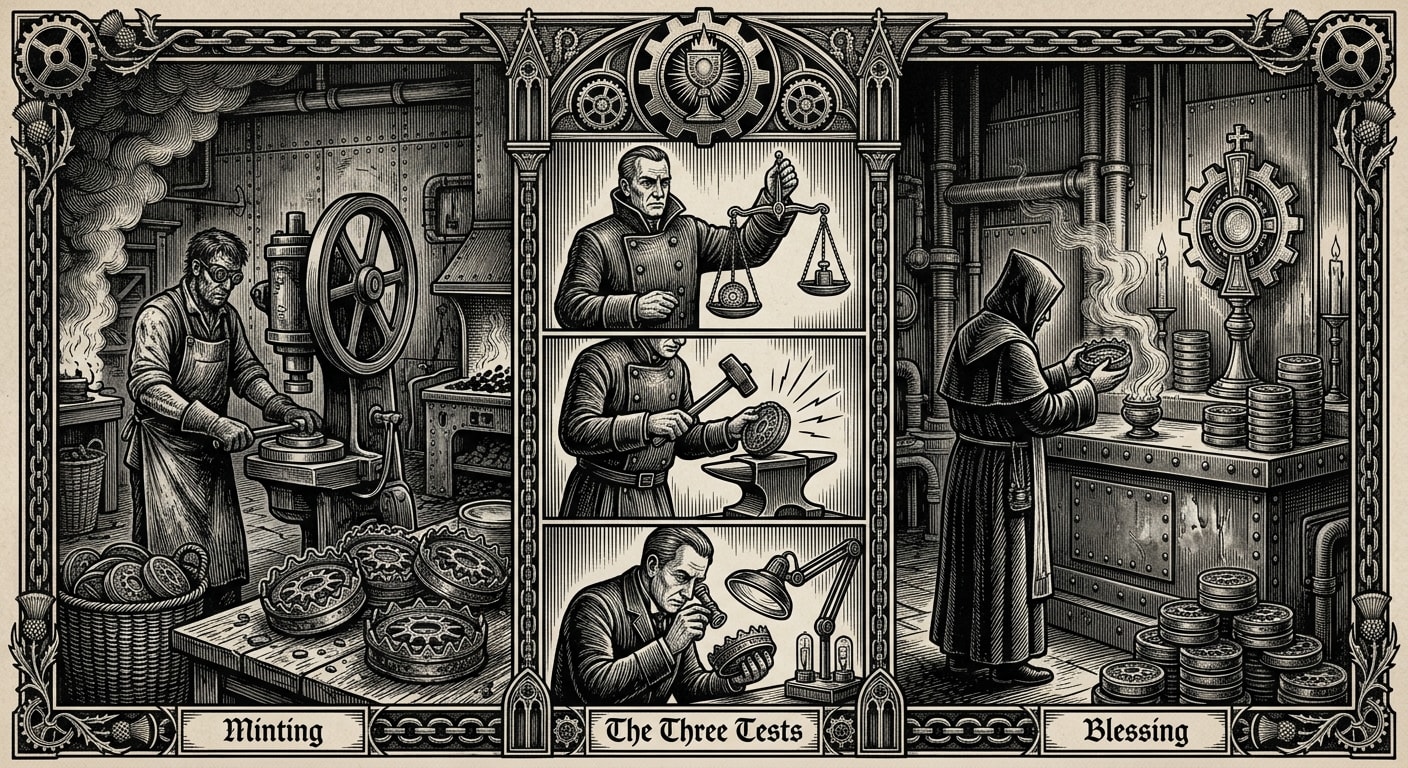
The minting rite is deliberately ugly. No stained glass. No choirboys with cheeks like painted apples. No velvet. Iron blanks sit in trays. Priests of authorised rank recite the Monetary Benediction over each batch while Tithes examiners watch the scale and Engineering supervisors watch the press. The die descends. The Triune Knot bites. The crowned ledger bites. Value enters through violence, as most durable institutions do.
Three tests follow for standard circulation. The ash-test lays a line of consecrated ash across the obverse. A clean Crown accepts ash without clumping. A contaminated Crown beads the ash into little grey knots, curls the ash toward the rim, or eats it. Eating ash is grounds for immediate seizure and a very short interview. The song-test requires a trained examiner to strike the coin against a bone pin and listen for the authorised pitch. True Crowns sound dull, obedient, almost bored. False Crowns sing too sweetly. Velmora cannot resist beauty where sufficiency would serve better. The silence-test is simpler and more expensive: the coin is placed in a sealed box overnight beside a blank ledger page. At dawn, if the page remains blank and the coin remains where placed, the batch passes. If the page bears figures, names, doors, promises, or addresses in Macedonia, the batch enters quarantine.
The silence-test became mandatory after the A.S. 177 Screaming Coin incident beneath Bastion-Constantinople's Mill Seven, when a denominationless object recovered from slag returned after destruction attempts and gathered edge-marks like accusations. That coin was not a Crown of Grace. This did not comfort anyone with enough imagination to hold office. By A.S. 180, after Velmoran counterfeit relic penetrations had reached frontline chaplaincies, the Bureau of Tithes accepted what Doctrine had been saying for years and what Purity had been shouting in corridors: money can be haunted by ownership.
#On Circulation and the Ledgered Market
Every Crown wants a ledger. That is its virtue, and naturally its vice. The coin moves, but the entry follows. Market stall, wage packet, convoy purse, bridge toll, mortuary fee, dowry settlement, chapel tithe, ration purchase, apology bribe misfiled as devotional gratuity: each lawful exchange leaves a mark somewhere. A Crown without entry is suspicious. Too many Crowns with entries too clean are worse. Clean ledgers are usually either saintly or rehearsed, and sainthood does not survive audit at scale.
In Strasbourg, Crowns move through the Palatine Counting House in drums, sacks, locked trays, and little velvet-lined boxes for ceremonial payments to men who enjoy ceremony because they have never carried sacks. In the forward heartlands, Crowns arrive as payroll, vanish into debt, return as ration purchase, pass through Tithes, emerge as procurement, and become payroll again if the war has been kind enough to leave soldiers. At Bastion-Constantinople, a Crown may buy bread in the southern market at dawn, pay a foundryman's hazard premium by noon, enter a funeral stipend by vespers, and lie in a widow's floor crack by midnight, developing a moral life more active than several abbots.
The Bureau of Tithes insists circulation is healthy. The Bureau of Purity insists circulation is dangerous. The Bureau of War insists circulation must not delay pay. The Bureau of Mercy insists withheld pay produces patients. Doctrine insists all four positions be written down so future blame may be allocated with elegance.
On the Line, the Crown becomes hard theology. A soldier paid in Crown remains tied to Strasbourg even when stationed under ash, mud, sleep-fog, demon-glass, or the wet mouths of Gluttony. Pay is not generosity. It is ownership by arithmetic. The garrison knows who feeds it. The coin tells the palm what the banner tells the eye: you belong west of Hell.
A Bureau of War morale poster claimed “The Crown in your hand is the Synod's gratitude.”
Withdrawn after Tithes objected that gratitude has no ledger column. Revised issue: “The Crown in your hand is recognised compensation for continued obedience.” Morale impact disputed. Accuracy improved.
The poor understand the Crown better than the Bureaus. They know which issues rust faster, which mint marks traders dislike, which clipped edges pass at bakeries, which priests refuse repaired coins, which quartermasters accept scratched batches after third bell, which moneylenders weigh sympathy with the coin. The Synod may define value. Hunger interprets it.
#On Foreign Coin and British Insolence
The Crown of Grace is not the only iron coin in Europe, a fact the Bureau of Tithes treats as a personal injury. The British Iron Crown predates the Synod issue by forty years, bears Canterbury Cathedral on one face and the sword-in-stone device on the other, and circulates through Dover, Calais, embassy accounts, Channel settlements, and every mixed port where necessity outruns Strasbourg's temper. It is non-recognised and tolerated. That phrase means we hate it and take it when rope must be purchased from men who refuse our sermons.
The comparison offends because it works. The Crown of Grace derives value from Synod will, sacramental treatment, and enforceable ledger recognition. The Iron Crown derives value from British oath-law, Warden courts, and the maddening fact that British dockmen accept it without asking permission from the Basilica of the Ledgered Saints. Both are iron. Both are ugly. Both purchase bread. This last detail has caused more theological inconvenience than any metaphysician deserves.
Tithes has filed protests. Britain has replied that its coin is older, lawful where the King-Warden's writ runs, and not subject to alteration. The Bureau dislikes old things that do not ask to be regularised. It dislikes lawful things outside its law even more. Yet the Channel trade continues. Dover chains require Synod contracts. Calais stores require British rope. Pilgrim passages require settlement tables. War requires whatever keeps ships afloat. A Crown of Grace and an Iron Crown may sit in the same dock clerk's drawer, hating one another through silence.
The greater danger is imitation. If British iron can move without Synod blessing, a weak mind may ask whether blessing creates value or merely certifies power already present. The correct answer is filed in several approved tracts. The practical answer is that a hungry hand spends whichever coin the baker accepts.
#On Velmora's Cold Copies
Velmora loves the Crown of Grace because it offends her. Here is a coin whose value rests on obedience rather than precious metal, whose holiness is asserted by an institution she cannot yet possess, whose iron refuses gold's obvious seductions. It is, in miniature, everything she wants to purchase and everything she hates: scarcity commanded, value declared, possession deferred to authority. So she copies it.
Velmoran counterfeit Crowns are rarely crude. Crudeness belongs to village criminals and Treasury apprentices. Her copies have proper weight, clean edges, convincing rust, authorised diameter, and sometimes better die clarity than the mint that issued the batch they imitate. They pass hand inspection. They pass casual merchant weighing. Some pass ash-test if the examiner is tired or ambitious. They fail by generosity. A purse containing too many false Crowns feels slightly heavier when the owner intends to spend and slightly lighter when he intends to give. A false Crown left beside bread overnight may leave the bread untouched but alter the account book. A false Crown in a widow's keeping sometimes returns after payment, appearing under the mattress with a new edge-mark and one fewer name remembered in the house.
The Ten Thousand Keys use false Crowns with exquisite restraint. They do not flood markets. Floods provoke sluices. They seed purses. A relief fund receives three. A grain convoy pays with seven. A dowry chest contains one too many. The coin moves until it reaches a decision: keep or spend, give or hoard, confess or conceal. Velmora's counterfeit does not force the choice. It arranges the little altar upon which the choice becomes profitable.
TITHES-PURITY JOINT INTERROGATION, A.S. 199 — SIBIU SECTOR Subject held one suspected Crown for eleven days. Statement: “It was mine because it came back.” Question: “From where?” Statement: “From where I had deserved it.” After seizure, subject identified wife as “outstanding collateral.” Disposition: █████████████████████. Coin status: returned to sealed tray twice after melting attempt.
Counterfeit detection has become its own priesthood: ash-washers, pitch-listeners, silence-box wardens, mint-calligraphers, purse confessors, and the unfortunate junior clerks assigned to ask whether a coin has behaved strangely in the home. People lie about money with a creativity they rarely bring to prayer. They lie because they are ashamed, greedy, frightened, hungry, dutiful, or simply tired of surrendering every irregularity to a Bureau that will take the coin and leave the need.
#On Hoarding and the Sin of Locked Grace
The Crown of Grace was made to circulate. This is not economics alone; it is doctrine. Grace that does not move curdles. The Synod may speak beautifully on this point because it costs us nothing and benefits revenue. A hoarded Crown offends three orders at once. It escapes tithe visibility. It refuses communal exchange. It begins to resemble treasure.
Hoarding prosecutions are uglier than theft trials. A thief at least honours value by wanting it elsewhere. A hoarder kneels before locked sufficiency and calls the posture prudence. Under Velmoran pressure, hoarding becomes devotional. Coins sorted by issue, stacked by mint, wrapped in cloth, hidden in walls, counted at night by touch, addressed in whispers, kissed before sleep: these are not savings habits. These are chapel rites for a god with no mercy and excellent arithmetic.
The Bureau distinguishes lawful reserve from hoard by paperwork, motive, amount, and whether the examining clerk likes the defendant's face. This sounds arbitrary only to civilians. Lawful reserve has declared purpose, declared value, declared location, periodic inspection, and a spiritual hygiene note. Hoard has dust, secrecy, repetition, and a smell in the room like wet iron and held breath.
The Crown's name worsens the crime. To lock Grace away is to declare grace private property. Tithes detests the fiscal offence. Doctrine detests the theology. Mercy, when allowed to speak, asks why the subject hid coins rather than seek aid. Purity asks whether the subject enjoyed the hiding. Records asks whether the inventory forms are legible. The Synod proceeds according to gifts.
An A.S. 134 homily manual equated all savings above two weeks' ration value with Velmoran hoarding.
Withdrawn after garrison families began spending emergency reserves before winter inspection, producing nine hundred petitions and a minor starvation event. Current doctrine permits prudent reserve under declared category. Prudence has forms. Greed hides from them.
The counter-rite is alms without account. This statement causes Tithes discomfort and deserves repetition in sealed rooms. A Crown passed freely to need, without lien, boast, tax advantage, moral theatre, or future claim, irritates Velmora's mechanism. It also irritates Tithes, which is unfortunate evidence that the medicine is strong.
#On Mint Scandals and Southern Pressure
The worst Crown scandals occur near the southern and central fronts, where need and demonic influence meet in the counting tray. Bastion-Sibiu sees the pure Velmoran form: counterfeit, debt, bribery, convoy purchase, key-cults, contract theurgy, coin that returns. Bastion-Constantinople sees the hybrid form. Kargath rots grain before it reaches the gate; Maldrake burns storehouses; Velmora's agents arrive afterward with coin clean enough to insult the dead. A hungry city accepts terms a well-fed city would burn.
During the Three-Night Bombard of A.S. 177, Velmoran procurement-chain infiltration detonated the Foundry Quarter. In the aftermath, furnace-sweeper Orek Marr recovered the Screaming Coin beneath Mill Seven, cool, denominationless, and unwilling to stay destroyed. No official record calls it a Crown. Several private memoranda ask whether it wanted to become one.
The southern mints tightened after A.S. 177. More silence boxes. More ash. More pitch examiners. More fiscal sermons delivered to workers already coughing furnace soot into handkerchiefs. Output dipped. War complained. War always complains, but pay delays at Constantinople become riots with artillery nearby, and artillery nearby improves complaint quality. By A.S. 179, reconstruction issue Crowns carried a small internal notch along the rim, invisible to common inspection, detectable by thumbnail to authorised paymasters and by smugglers within forty-eight hours. The Bureau called this unfortunate. The smugglers called it helpful.
Sibiu's mint protocols remain harsher. One in eight hundred Crowns entering inspection whispers, according to the Ten Thousand Keys file. This number comforts no one intelligent. One whispering coin in a village purse can undo ten sermons. One false pay packet can turn a squad's grievance into theology. One returned coin can persuade a widow that the dead are settling accounts.
The Crown survives these scandals because it must. Currency is faith forced to do arithmetic under filthy conditions. If the faithful cease believing the Crown carries Synod value, the market will decide value by hunger, fear, and Velmora's smile. The market, left alone, is merely a chapel built for the loudest purse.
#On Denominations, Paymasters, and Small Cruelties
The Crown divides into lesser irons by a system designed by men who had never stood in a ration queue with children pulling at their sleeves. Half-Crowns, quarter-Crowns, parish bits, and stamped arrears tokens circulate beneath the formal issue, each one carrying less grandeur and more use. The full Crown is doctrinal. The parish bit is breakfast. The arrears token is a promise wearing a bruise.
Military paymasters hate small denominations because soldiers love them. A man paid in large Crowns must enter the market, submit to change, lose value to a stall-holder's thumb, and return with an anger that can be redirected toward the enemy if chaplains work quickly. A man paid in bits can drink, gamble, bribe a laundry woman, buy a candle, and remain dangerously specific in his dissatisfaction. Specific dissatisfaction is harder to sermonise.
At Bastion-Sibiu, paymasters count under Purity watch with silence-boxes beside the chest and salt bowls at the doors. At Bastion-Constantinople, pay queues form under shell-scored arches, and the clerks wear gloves because furnace soot, ash-rain residue, and Velmoran contact all leave marks that look similar when an auditor is tired. At Bastion-Brest, the Crown passes through crossing tolls, absolution fees, and under-deck markets until even honest money smells of river damp. At Strasbourg, naturally, the coin is cleaner, because sin at the capital prefers chairs.
The smallest cruelties live in change. A widow receives a high Crown for death compensation and cannot spend it without proving the death, the entitlement, the conversion, the witness, and the absence of debt claim. A baker refuses a chipped quarter-Crown because the chip cuts across the Knot. A Mercy ward accepts arrears tokens for broth on paper and rejects them at the ladle. A priest tells the hungry that Grace is sufficient; a market woman explains the price of onions. The market woman is the better theologian before noon.
The Bureau tried, briefly, to abolish the lowest parish bits after counterfeiters in Ulm discovered that beggars, chimney boys, and shrine sweepers were the ideal channels for bad iron. The attempt lasted nineteen days. Markets stalled. Alms tables choked. Candle purchases collapsed. Confession-box clerks complained that penitents could no longer pay the voluntary fee without requiring change, which turned piety into arithmetic in front of a line. The bits returned with a new rim notch and a sermon about humble instruments. The counterfeiters adjusted faster than the sermon printers.
Velmora's agents prefer the middle denominations. Full Crowns attract scrutiny. Bits move too quickly and too dirty. Half-Crowns sit in purses long enough to matter and pass often enough to travel. The Counter-Relic Examiners learned this after a chapel roof fund near Sibiu received forty-eight half-Crowns, all clean, all generous, all later traced to donors who remembered giving slightly less than recorded and feeling proud of the difference. Pride is Atheron's province, but Velmora rents rooms in every sin when the location is good.
The denomination table now includes a private column marked sentimental adhesion. This measures how reluctant holders become to part with a coin once they have named it lucky, last, father's, battle-pay, widow's, or mine. The column is unofficial. The column is accurate. Records denies maintaining it while requesting updates from every garrison paymaster. Such denials are the perfume of administration.
#On the Present Circulation
As of A.S. 201, the Crown of Grace remains legal tender across Synod-administered territory, mandatory for tithe settlement, standard for military pay, accepted in civic markets, required in official fees, contested in mixed ports, counterfeited in Velmoran theatres, and hidden in more mattresses than the Bureau's public optimism permits. Its iron is common. Its authority is not. Every Crown says Strasbourg has survived long enough to strike another batch and arrogant enough to name it holy.
The Bureau of Tithes recommends confidence. The Bureau of Purity recommends suspicion. The Bureau of War recommends punctual payment. The Bureau of Mercy recommends small denominations in famine zones because making a starving woman break a high Crown for broth produces scenes unhelpful to public order. Doctrine recommends all of the above in proper sequence and reserves the right to revise sequence after casualties.
DOCTRINE / TITHES SEALED EXCHANGE — A.S. 201 Question: If a Crown of Grace returns repeatedly after destruction, speaks no words, bears correct mint mark, passes ash-test, fails charity-use, and causes no immediate death, is it counterfeit? Tithes answer: “Pending.” Doctrine answer: “Yes.” Purity answer added in red: “Why was it spent twice before report?” File status: █████████████.
I keep one Crown in my desk drawer, not for superstition but for pedagogy. It is a standard Strasbourg issue, A.S. 192, dull at the rim, ash-clean, song-flat, silent in its box, unremarkable in every examined way. Beside it sits an Iron Crown from Canterbury, dry and insolent, and a melted bead recovered from a false Sibiu batch, sealed in glass and watched by a clerk who dislikes night duty. Three irons. Three claims. Three little arguments about who may command the hand when hunger opens it.
At ninth bell the Strasbourg markets close. Bakers count. Widows count. Soldiers count if paid. Auditors count because counting is how some men avoid prayer. A Crown passes from palm to palm, warm now with human need, cold again in the tray, stamped Grace, spent like survival, and somewhere east of Sibiu a locked door learns the sound.