
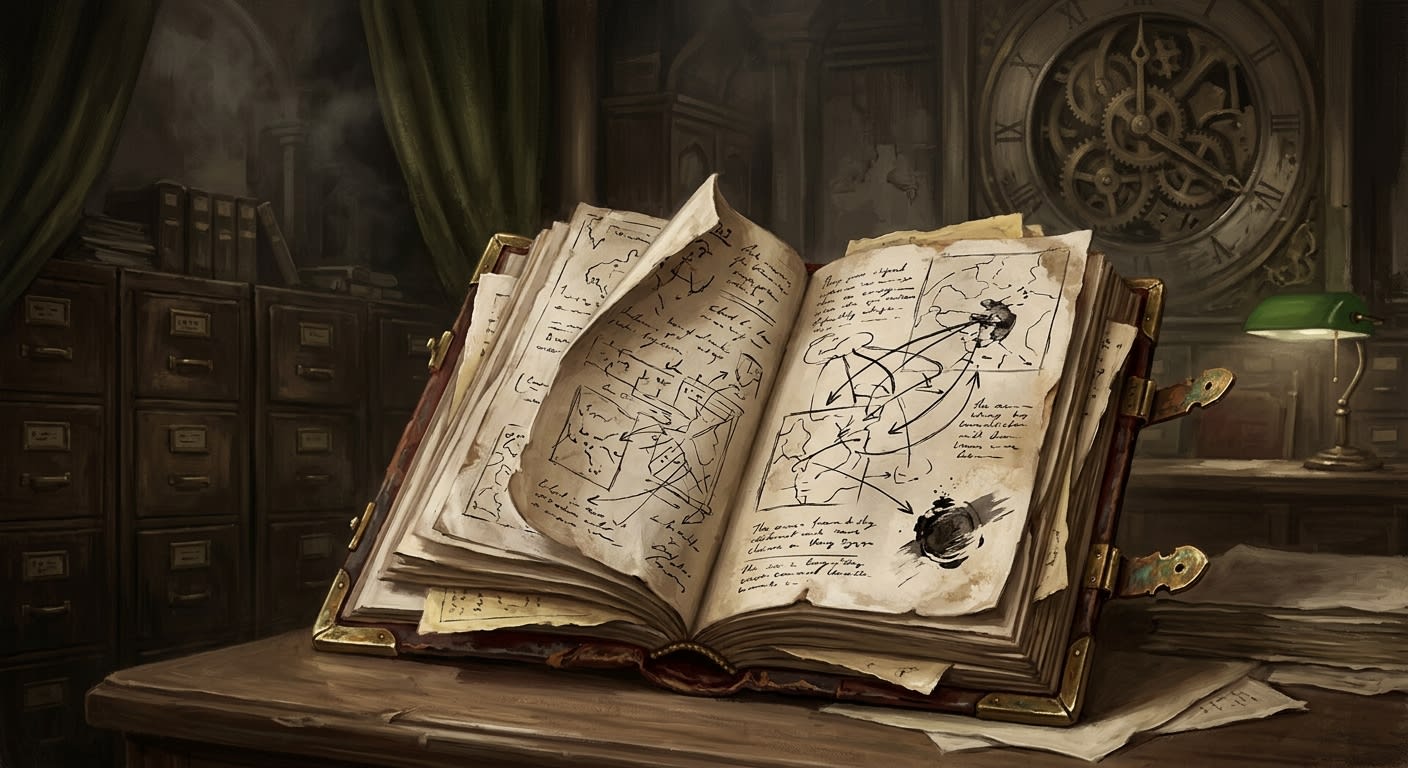
#On the Slip-Book That Knows Too Much
The Contradiction Map is the Femur-War Broker's most dangerous possession: a slip-book, hand-inked, carried in a coat pocket, updated nightly, never copied, and burned at the first sound of white-ring inspectors in the corridor. It records which parish believes what, which bastion houses which authenticated relic, which provenance chain conflicts with which, which Examiner has blessed too generously, which custodian must not meet which chaplain, which procession must be delayed by fog, quarantine, axle failure, or pious inconvenience, and how violently the discrepancy will resolve if the wrong priest opens the wrong crate at the wrong altar.
A lesser reader might call it a map of lies. The reader would be wrong, which is ordinary. Lies are simpler. The Contradiction Map records truths in lethal proximity.
The Map descends from Elder Noxa's settlement of the Triplicate Femur Incident in c. A.S. 148, though the original was probably no map at all. Noxa had three authenticated left femurs of Saint Maurus of the Burnt Lantern, two provinces ready to riot, Bastion-Brest under simultaneous siege necessity, and a Bureau of Relics too proud to admit that Heaven had produced surplus anatomy. She did not decide which femur was true. She separated the truths by feast day, Examiner writ, custody zone, and public audience. The first Contradiction Map was that separation made visible.
#On What the Map Contains
A proper Map begins with claims, not objects. The bone is merely the nuisance around which claims gather, like theologians around a free lunch. The Broker records every claimant to a relic's recognition: shrine, bastion ward-niche, noble house chapel, pilgrim confraternity, vigil ark, tariff chapel, battlefield reliquary, and the private devotional cabinet of some minor prince who mistakes possession for sanctity. Beside each claim stand feast requirements, procession windows, custody privileges, display rights, rival rumours, debt to local notaries, and tolerance for ambiguity.
The second layer is provenance. Discovery note. Transfer ledger. Examiner certificate. Blessing record. Parish display permit. Insurance valuation. Records correction. Relics side-letter. Shadows warning, when the gods are bored and the underworld lucky. The Contradiction Map marks what the provenance says, and where it would scream if made to stand beside a rival paper.
The third layer is violence. A Map without violence is a child's itinerary. The Broker notes which crowd will tolerate a delay, which chaplain will draw a pistol before yielding custody, which pilgrimage house has already sold indulgence tokens, which bastion morale depends upon a ward-bone glowing on the correct night, which Relic Authenticator is corrupt enough to stamp twice and vain enough to object if reminded of it.
Earlier Relics summaries described Contradiction Maps as “illicit relic-routing aids.”
Corrected in internal Shadows working notes. They are civic pressure diagrams for surplus sanctity. The illegality remains, since the Bureau dislikes criminals possessing better descriptions than ministries.
#On Materials and Codes
The ordinary Map is a slip-book no larger than a hymnal, bound in rubbed calf or oilcloth, with pages cut for quick removal. Each folio carries one conflict cluster: saint, bone, parties, route, feast, hazard, current owner, admitted owner, true owner where applicable, and the owner the Broker will name if beaten by Purity in a room without windows. The folios are stitched with weak thread so that one tug empties the spine into flame.
Ink colours vary by school. Peace Brokers use grey for delay, red for riot risk, blue for Relics tolerance, black for claims too old to disturb, and green for payments received. Profit Brokers add gold, because vulgarity is their native tongue. Paper-Only brokers disdain stable colour systems. They prefer gaps, missing lines, obsolete canton marks, and ink that appears brown until warmed by a candle.
A Map may include rumour channels: which Examiner is touring, which Inquisitor is awake, which notary office has been compromised by the Bureau of Shadows, which checkpoint marshal accepts candle-money, which commerce clerk has a nephew in debt. These details appear sordid only to those who prefer their miracles unmanaged and their riots punctual.
#On Use in the Field
A Broker consults the Map before breakfast. He checks whether the Feast of Ember Vigil has moved under a local calendar correction, whether rain has flooded the ferry road, whether a ward-chaplain's sermon has elevated local expectation, whether a rival Broker has sold a secondary fragment to a parish whose bells can be heard from the first parish if the wind is malicious. He rehearses three custody narratives and chooses the one least likely to produce corpses before noon.
By midday the Map is open in a backroom chapel or port warehouse. Crates sit under inspection light. Wax sweats. Clients ask for certainty, that vulgar idol of the frightened. The Broker sells procedural certainty instead: your femur will be displayed on your feast day; the rival femur will be under inspection hold; the third claimant will receive an Equivalence Letter; the Examiner will be delayed by a bridge complaint; no one will see all three labels unless a fool speaks above his grade.
The Map's highest art is the manufactured delay. Inspection hold. Liturgical calendar conflict. Provenance review. Quarantine. Flood interruption. Temporary devotional overcapacity. Feast displacement. Axle failure witnessed by two men who were paid to notice the axle after it had already failed. Delay turns contradiction into weather. People curse weather. They do not indict weather.
BROKER FIELD NOTE — RHEINSCARP DERIVATIVE CASE Two authenticated ribs scheduled within one bell-span. Map mark: ash cross / child-crowd present. Broker solution: quarantine rumour, ferryman payment, substitute candle vigil. Recovered margin: “If both boxes sing, run.” Disposition of Broker: █████████████
A seized Map can kill more efficiently than a cannon. Purity reads names. Records reads provenance. Relics reads embarrassment. Shadows reads networks. Each Bureau finds a different crime and all are correct enough to sharpen knives.
#On Paper-Only Practice
The Paper-Only faction considers the physical Contradiction Map childish. A map that can be found can be filed; a map that can be filed can be read by a man with clean gloves and no mercy. Their superior Map is distributed across omissions. One clerk holds a witness list missing its third line. One notary holds a seal-rubbing under an obsolete canton. One tariff chapel holds a delay card for a crate that never moved. One retired Examiner remembers certifying “associated osseous material” and accepts a monthly fee to forget the noun.
The Paper-Only broker stands between these partial papers and draws the shape in his head. He touches no bone. He moves recognitions. He does not move saints through streets. He moves the permissions by which streets kneel when a box passes.
Their custody gaps are the purest Map-work in the trade. A claim is thinned, thickened, redirected, or buried beneath procedure until the procession has gone home and the candles have been sold. No relic moves. No saw bites. The contradiction alters its posture because the paperwork has been taught to look elsewhere.
Bureau of Shadows Internal Assessment 77-R treated Paper-Only mapping as a subset of general relic mediation.
Corrected in working annotations. Paper-Only mapping is the trade's operating grammar, inconveniently staffed by criminals and fit to be understood only in sealed rooms.
#On Peace and Profit
Peace Brokers call their Maps Quiet Books, Interval Folios, sleeping registers. This is affectation with a useful pulse. Their Maps minimise contradiction yield. They mark which shrine can accept a substitute reliquary for one feast day, which custodian will tolerate a sealed letter from Relics if the wax is old enough to flatter him, which procession can be made late without humiliation, and which bone must never sing within hearing of a crowd.
Profit Brokers use larger Maps. Naturally. They track contradiction yield: how many legally assertable truths can be extracted from one dispute, how many clients can be billed before public collision, how many secondary fragments can be introduced without drawing an Examiner who still reads carefully. A saint with seventeen femurs is, to them, no scandal. He is inventory with a feast calendar.
The factions despise one another because each sees the other's Map as moral failure. Peace men call Profit men butchers with ledgers. Profit men call Peace men cowards with small ambitions. Paper-Only men call both Bone Splitters and wash their hands of dust they never touched. The Bureau condemns all three factions and tolerates them in direct proportion to their usefulness.
#On Occupational Madness
The Map changes the mapper. Seal-sickness begins with checking wax consistency before sleep. Provenance drift follows: the Broker forgets which chain was original and which was manufactured to cover the correction to the false restoration of the true transfer. He smells old ink and knows the month of issue. He hears a bell and counts custody zones. He looks at a saint's feast and sees routes, threats, windows, fees, ash.
The worst cases become beautiful. This is the danger. A young Broker scatters evidence from fear. A veteran master grows elegant. He aligns witness initials, regularises phrase patterns, balances packets across jurisdictions, and forgets that ugliness is camouflage. Pattern recognition follows. White rings follow pattern recognition. Bells follow white rings.
Relic response remains the final occupational hazard. Bones dislike being lied around, if not lied to. A femur moved through six jurisdictions under six competing custody narratives may glow, hum, warm, crack, sing, or divide along a line matching the number of claimants. The Bureau calls these unsolicited phenomena. Brokers call them warnings. The bones maintain a tactful silence except when they do not.
#On Present Classification
As of A.S. 201, Contradiction Maps remain unofficial, condemned, necessary, and in continuous use across Zones 1–5 (Unregistered). Bureau of Shadows Internal Assessment 77-R estimates two hundred to three hundred and forty active Brokers and eleven hundred to sixteen hundred annual relic transfers. It recommends continued observation and the immortal instruction: do not arrest anyone useful.
The Bureau of Relics renews its advisory every year: it authenticates, distributes, and does not broker. The advisory has received zero reports in fifty-three years. The custodians who renew it know which tavern holds the man with the current Map. The man with the current Map knows which custodian will deny him under oath and warn him before Matins.
A Contradiction Map is heresy if seized, infrastructure if needed, evidence if convenient, rumour if denied, and ash if the Broker has any sense. It proves the Synod's most guarded practical doctrine: contradiction is only dangerous when simultaneity is mismanaged.