
#On the Men Who Refuse the Bone
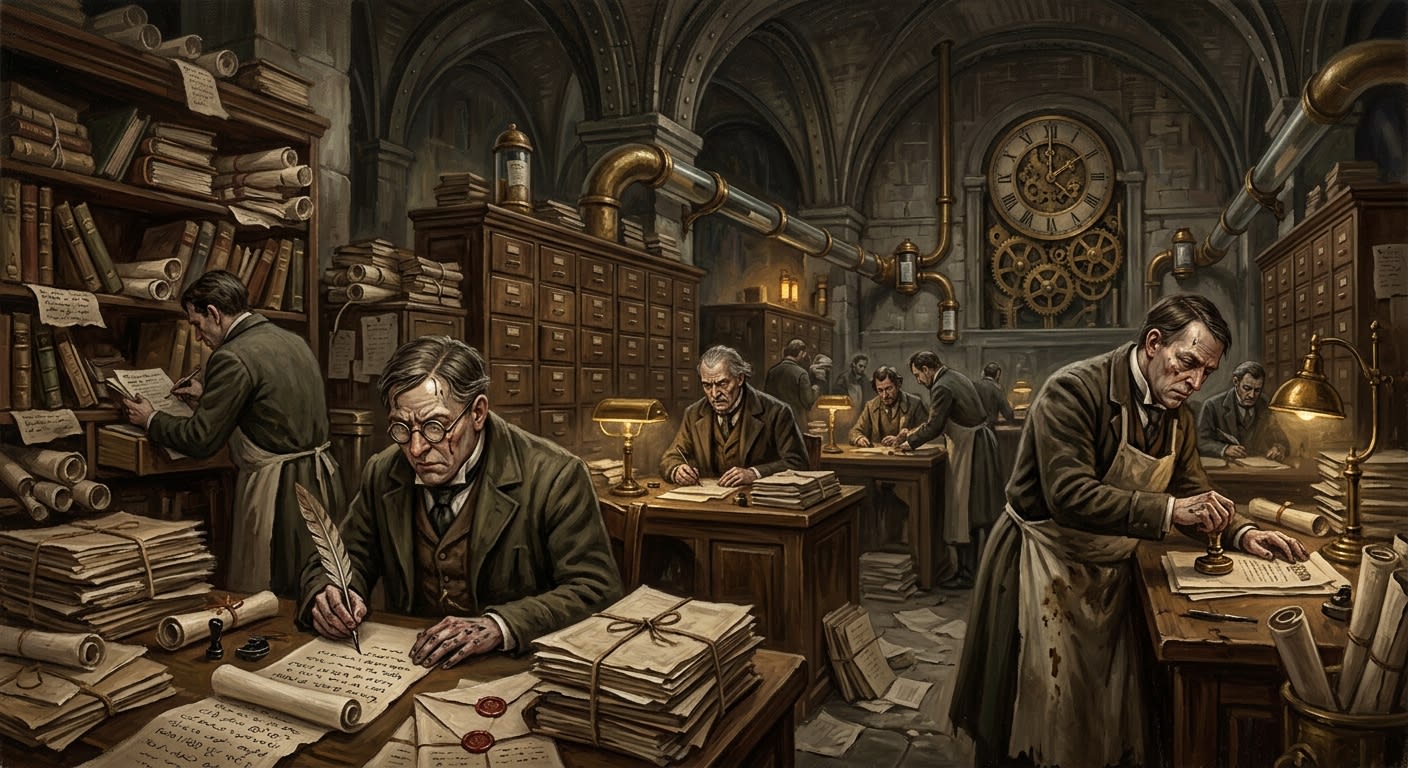
The Paper-Only faction is the smallest, most paranoid, and most insulting branch of the Femur-War Broker trade. Its members never touch the relic. They move custody narratives, provenance chains, authentication histories, notarised disclaimers, witness packets, delay writs, and the little lethal phrases by which one shrine's truth becomes another shrine's clerical error.
The Peace Brokers sell quiet. The Profit Brokers sell multiplication. The Paper-Only men sell the thing both factions use and neither fully understands: the story by which a seal teaches flesh to obey.
They call the bone theatrical furniture. That phrase has caused three fistfights, two warehouse exclusions, and one profitable apology. The Bone Splitters — the Paper-Only term for anyone still sawing femurs in backroom chapels — consider it contempt. They are correct. Contempt, unlike most relic fragments, requires no authentication.
#On the Doctrine of the Lighter Thing
The faction claims descent from Elder Noxa more sharply than either rival camp. The Peace Brokers call her mother. The Profit Brokers call her precedent. Paper-Only men call her proof.
Their argument is elegant enough to be dangerous. During the Triplicate Femur Incident, Noxa did not shave the saint. She did not rebox the ward-niche femur at Bastion-Brest. She did not prove which relic contained the correct holiness, because holiness was already everywhere and making a mess. She moved calendar, writ, audience, and custody language. The saint remained where he lay. The miracle travelled through paperwork.
Paper-Only apprentices copy that line until it becomes hand-memory. Their initiation replaces relic viewing with packet reconstruction: three false manifests, two true seals, one missing witness, and a deadline measured in bells. The successful apprentice prevents the papers from meeting. The failed apprentice is sent to carry crates for Profit Brokers, which is considered merciful only by people who dislike apprentices.
Earlier Relics summaries classed Paper-Only brokers as “forgers without access to inventory.”
Revised. They possess the inventory that matters. Bones embarrass doctrine; documents instruct it.
#On the Instruments of Narrative Custody
A Paper-Only broker's kit is small enough to hide inside a missal and expensive enough to ransom a minor shrine. He carries no saw. He carries no filing spoon. He carries no velvet reliquary cloth darkened by saint-dust. His tools are seal-wax, archive ink, transfer forms, blank equivalence letters, witness-name slips, route delay cards, counter-seal rubbings, and a knife reserved for paper rather than men. The distinction is ceremonial.
The work begins with the provenance chain. Every authenticated relic has a legal skeleton: discovery note, custody ledger, transfer witness, Examiner certificate, blessing record, parish display permit, insurance valuation, and whatever private correction the Bureau of Records pretends it did not require from the Bureau of Relics. The Paper-Only broker does not change the bone. He changes which bones the chain can see.
The Equivalence Letter is their finest instrument. It does not say two relics are the same. It says one relic's local authentication may be honoured under another jurisdiction's devotional necessity, provided no universal claim is advanced in the presence of an adverse witness. That sentence has prevented riots. It has also caused headaches among honest priests, a population whose survival has never been central to policy.
#On the Contempt for Bone Splitters
The Paper-Only faction regards the Bone Splitters with the disdain of archivists for butchers who drip on the catalogue. Peace Brokers, in their view, are timid Bone Splitters: reluctant to saw, fond of delay, still sentimental about the object. Profit Brokers are vulgar Bone Splitters: eager to saw, fond of dust, convinced that anything kissable can be invoiced.
Both camps miss the office wall for the reliquary case. The Relics Bureau's power rests on authentication, and authentication rests on procedure. A femur locked in a box is a dead fact. A femur named in a ledger, witnessed by a clerk, carried through tariff, blessed under local law, and defended by an Examiner's phrasing is a civic instrument. The Paper-Only broker sells that instrument without risking splinters.
This superiority makes them hated. Profit men say Paper-Only brokers are cowards who fear active holiness. Peace men say they are too clever to know when people are about to bleed. Both accusations have merit. A man who moves only papers can forget that processions contain bodies, that bodies panic, and that panicked bodies trample children with a doctrinal purity no ledger can improve.
BROKER DISPUTE RECORD — WAREHOUSE CHAPEL, MARSEILLE Profit claimant: “You cannot sell what no one can kiss.” Paper-Only reply: “Your clients kiss what my packet permits them to recognise.” Subsequent noise: █████████████ Inventory loss: one seal-head, two teeth, no relics.
The faction's cruelty is bloodless until it is not. A forged witness attenuation slip can move a crowd away from a shrine or toward one. A delay writ can save a procession or strand it beside a hostile parish gate. A correction in the wrong hand can summon White-Mantled Inquisitors faster than a demon flare.
#On the Contradiction Map Without the Crate
All Femur-War Brokers keep some form of Contradiction Map. Paper-Only brokers consider the physical map childish. A map that can be found can be filed; a map that can be filed can be read by a man with clean gloves and no mercy. The better map is distributed across omissions.
One clerk holds a witness list missing its third line. One notary holds a seal-rubbing labelled under an obsolete canton. One tariff chapel holds a delay card for a crate that never moved. One retired Examiner remembers certifying “associated osseous material” and refuses, for a monthly fee, to remember the noun that preceded it. The Paper-Only broker stands between these partial papers and draws the actual shape in his head.
Their best trick is the custody gap. The gap is never announced. It is dressed as inspection, seasonal closure, quarantine, contested jurisdiction, feast displacement, flood interruption, or my favourite, “temporary devotional overcapacity.” During the gap, a claim is thinned, thickened, redirected, or buried so deeply under procedure that by the time an auditor reaches it, the procession has gone home and the candles have been sold.
Bureau of Shadows Internal Assessment 77-R treated Paper-Only activity as a subset of general relic mediation.
Corrected in working notes. Paper-Only activity is not a subset; it is the operating grammar beneath the trade, inconveniently staffed by criminals.
#On Their Diseases and Failures
Paper-Only brokers suffer seal-sickness without wax under their nails. They wake to check registry numbers. They test their own handwriting against forged samples. They smell old ink and know the month of issue, which is impressive at dinner and intolerable in marriage.
Provenance drift is their private hell. A Bone Splitter can point to a crate and say the trouble is inside. A Paper-Only man has no such mercy. After years of moving custody narratives, he may forget whether a saint's fourth transfer was original, inserted, corrected, erased, restored, or invented to cover a prior restoration. His mind becomes a Records annex with poor ventilation.
Their occupational death often begins with neatness. The paranoid young broker scatters evidence. The aging master grows elegant. He begins to make packets beautiful. He aligns witness initials. He regularises phrasing across jurisdictions. He forgets that ugliness is camouflage. Pattern recognition follows, then white rings, then bells.
#On the Present Utility of Men Who Touch Nothing
As of A.S. 201, Paper-Only brokers remain the faction least numerous, least visible, and least safe to arrest in haste. Bureau of Shadows estimates the larger trade at two hundred to three hundred and forty brokers across Zones 1–5, with annual throughput between eleven hundred and sixteen hundred relic transfers. No estimate isolates Paper-Only operators. The Bureau is capable of counting them; the Bureau is also capable of understanding why the number should remain misplaced.
Their clients are the same frightened sanctities everyone serves: shrines, ward chaplaincies, noble houses, Relics custodians, Relic Authenticators with overgenerous histories, and senior men who prefer paperwork to confession. Their rivals use them while insulting them. Profit Brokers need packets for fragments. Peace Brokers need language for delay. Relics needs deniability. Shadows needs maps no one can seize because the map has learned to become rumour.
The Paper-Only faction's central blasphemy is also the Synod's central convenience: truth travels through documents faster than it travels through bone. The Bureau will condemn this sentence when spoken by criminals. It will issue it as policy when written by a committee.
They do not carry relics. They carry recognitions. They do not move saints through streets. They move the permissions by which streets kneel when a box passes. Somewhere a femur rests in darkness, untouched, while three cities alter their feast calendars around a sentence no pilgrim will ever read.