
#On the Day Three Bones Learned to March
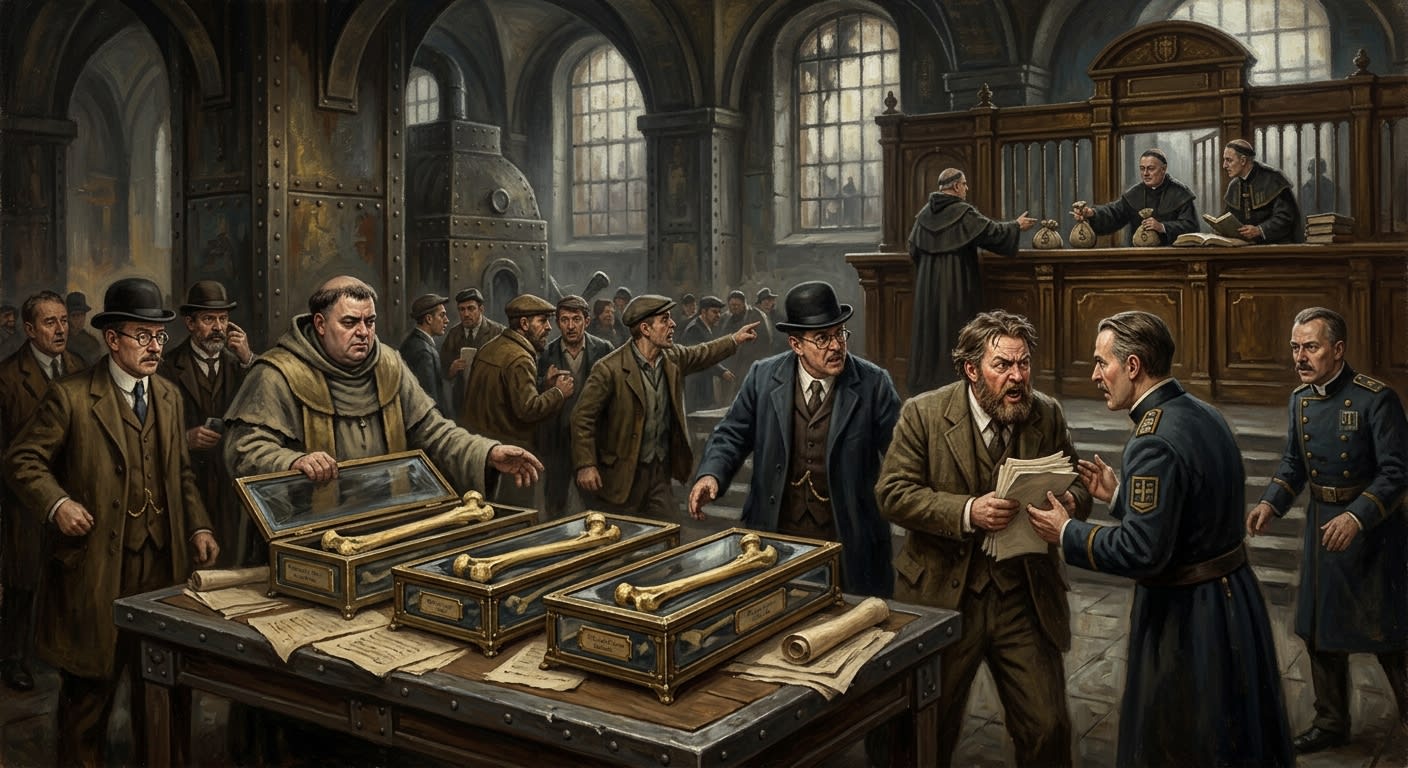
The Triplicate Femur Incident of c. A.S. 148 is the founding catastrophe of the Femur-War Broker profession, the little holy riot from which a tolerable underworld learned to dress itself in neutral-grey cord. Three authenticated left femurs of Saint Maurus of the Burnt Lantern entered one manifest. Within eight days, three provinces were reciting arithmetic with knives.
The Bureau of Records now calls the matter doctrinal exuberance in the face of surplus sanctity. The Broker community calls it a Caravan Factor who put three lies on one page. The dead, being badly positioned in the archive, have not submitted a preferred phrasing.
The incident matters because all three relics worked. Fraud would have been easy. Fraud is meat for auditors and rope for small criminals. The three femurs glowed, warded, answered blessing, and possessed provenance chains clean enough to make Relics examiners purr in their dreadful little rooms. Heaven, Hell, or bureaucracy had produced a theological ambush.
#On Saint Maurus and the Three Reliquaries
Saint Maurus of the Burnt Lantern had already endured martyrdom, which should have been enough indignity for one body. The Synod, with its gift for posthumous administration, improved upon death by certifying his left femur in three places.
Two reliquaries belonged to Rhineland shrine houses whose names survive only in factional ledgers and angry devotional songs. One reliquary was installed at Bastion-Brest, where it occupied a ward-niche and glowed under shell vibration. Each casket bore its own provenance chain. Each chain bore its own Examiner's hand. Each Examiner had stamped with the full confidence of a man who has never imagined that another office might be ruining him simultaneously.
The Brest femur possessed siege necessity. The Rhineland femurs possessed local antiquity and pilgrim revenue. The first had guns around it. The second and third had choirs around them. The distinction was aesthetic; both types of claimant can become lethal by third bell.
The dangerous point was not duplication alone. The Bureau of Relics had survived duplicate saints before, usually by filing disagreement beneath older disagreement until both fossilised into tradition. The dangerous point was simultaneity. Three claims entered the same visible moment. The contradiction acquired witnesses.
Earlier custodial memoranda described the three femurs as “rival relics of uncertain comparative grade.”
Withdrawn. All three were authenticated, all three were active, and all three embarrassed the Bureau with equal vigour.
#On the Manifest at Rheinscarp
The unnamed Caravan Factor carrying quarterly rotation papers made the error that every profession secretly fears: he allowed the truth to appear in a convenient format. His manifest listed all three femurs together. It did not whisper. It did not hedge. It placed sanctity in columns.
The packet reached a tariff-chapel weigher at Rheinscarp, that vertical city where movement is registration, registration is fee, and fee is the local form of prayer. The weigher placed one femur on the scale and found three in the list. Rheinscarp clerks are trained to fear undercount, overcount, miscount, ghost count, and unlicensed absence. A triple saint-leg fell outside their usual terrors and so rose immediately to supervision.
Two auditors reviewed the discrepancy. A Records cross-reference found no fraud marker. A tariff query requested consolidation. The word consolidation should be treated with holy suspicion; it is what clerks say when they intend to make several frightened men share one desk.
Rheinscarp did what Rheinscarp does best. It charged, copied, escalated, stamped, and made every interested party aware of its own potential loss. Within forty-eight hours, shrine messengers were riding. Within four days, chaplaincies were refusing inspection. Within eight, three provinces had heard that Saint Maurus had either multiplied, been stolen, been forged, been divided by miracle, been concealed by Relics, or been kidnapped by Bastion-Brest for ward purposes. Several of these claims were idiotic. Idiocy has never impeded mobilisation.
#On the Riot of Competing Certainties
The riots did not begin as riots. They began as processions correcting one another.
Rhineland Shrine A sent its banners first, claiming prior custody and accusing Shrine B of opportunistic duplication. Shrine B replied with an older witness monk, two notarised seal rubbings, and a hymn whose third stanza implied that Shrine A had always had trouble distinguishing relics from soup bones. Bastion-Brest sent no procession. It sent a ward chaplain's refusal, wrapped in siege language and smelling faintly of powder.
Pilgrims seized crossings. Shrine guards blocked inspection teams. Ward officers refused to lower the Brest casket, citing active defensive necessity, local sanctity, and the profoundly human principle that no one enjoys being caught with a duplicate saint. A Records courier was beaten with his own packet tube. Three tariff stalls burned. One Examiner hid in a flour loft for eleven hours while a crowd below chanted three different versions of Maurus's death.
WITNESS ABSTRACT — RHEINSCARP LOWER STAIR Child observed holding two paper saint-labels, asking which one would protect her father at Brest. Mother's answer: ███████████████████ Subsequent movement of crowd: upward, violent. Casualty annotation: sealed by Records, copied by Shadows.
The death count remains diplomatically unstable. Femur-War Broker tradition insists the riots killed more people than the siege Bastion-Brest was conducting at the same time. Relics dislikes the comparison because it makes civilian arithmetic rude. War dislikes it because it suggests a paperwork error outperformed enemy shelling. Both dislikes are useful evidence.
#On Elder Noxa's Settlement
Elder Noxa entered the affair as a registry scribe in relic custody traffic, probably Rhineland, probably attached to a tariff chapel whose name the Bureau of Shadows later scraped from minor histories. Her full civil name is sealed. Her method was not.
Noxa refused the question that had trapped better-paid fools: which femur is true? The answer would have destroyed two constituencies and discredited at least one Examiner, possibly three, and the Bureau of Relics has never forgiven anyone for making its arithmetic visible. Noxa asked better questions. Which feast day did each shrine require? Which Examiner's writ governed each custody zone? Which chaplaincy could endure delay without losing authority? Which crowd could be fed substitute splendour for forty-eight hours without setting fire to a door?
Then she separated the femurs in time.
Each reliquary kept its saint. Each provenance chain remained intact. Each Examiner escaped public correction, which was the costliest relic on the table. The three femurs occupied the same doctrinal space while avoiding the same administrative moment. The miracle remained impossible. The streets became passable.
The settlement became the first peace of the broker trade. Peace Brokers claimed its restraint. Profit Brokers noticed that three femurs meant three clients. The Paper-Only faction saw the deeper horror: Noxa had barely moved the bone at all. She moved schedule, seal, witness, and recognition.
Earlier editions of this Codex attributed the Incident to administrative negligence.
Amended under Records correction. The approved phrase is doctrinal exuberance in the face of surplus sanctity. The unofficial phrase remains better and less printable.
#On the Professions Born from One Page
After the Incident, relic traffic changed its posture. Before A.S. 148, duplicate relics were local embarrassments, tolerable when slow, fatal when public. After Noxa, they became routes, calendars, packets, silence fees, and factional inheritances. The broker appeared in the gap between denial and need.
The Bureau of Relics issued its Standing Advisory: the Bureau authenticates, the Bureau distributes, the Bureau does not broker. It has renewed the advisory annually since A.S. 148. Reports received: zero. Clients served: ask any custodian after wine and before conscience.
The Incident established the trade's private vocabulary. Contradiction yield: how many legally assertable truths can be extracted from one dispute. Seal-sickness: the mind's collapse under too many stamps. Provenance drift: the loss of certainty after forging enough truth to bury the original. Paper collision: two certificates meeting before the right men have been paid to look elsewhere.
Bureau of Shadows Internal Assessment 77-R, filed A.S. 199, later estimated two hundred to three hundred and forty active brokers across Zones 1–5 and eleven hundred to sixteen hundred annual relic transfers. Its recommendation remains the finest bureaucratic epitaph for the Incident: do not arrest anyone useful.
#On the Present Classification
As of A.S. 201, the Triplicate Femur Incident is taught nowhere officially and everywhere practically. Relics trainees hear it as a cautionary rumour. Records clerks meet its ghost whenever three clean files produce one dirty outcome. Brokers teach it as scripture, copying the three-column calendar until the hand understands what the mouth is forbidden to say.
Rheinscarp remembers the tariff panic and charges for related tours in at least two districts, which is vulgar, lucrative, and civic in the only sense Rheinscarp respects. Bastion-Brest remembers the ward-niche and refuses, with admirable consistency, to discuss whether the casket still glows under shell vibration. The Rhineland shrines remember possession. Shrine memory is a form of armed bookkeeping.
The Bureau's official position is mercifully compact: all records have been regularised. This is true in the way a corpse is quiet. Regularisation did not undo the riots, unburn the stalls, unsplit the processions, or restore the dead. It placed the pages where their disagreement could no longer embarrass anyone with sufficient clearance.
Three femurs entered one manifest. A profession walked out.