
#On the Origin of the Contradiction Trade
"All femurs are authentic if notarized." — Bureau of Relics, Edict of Authentication, A.S. 147
The Bureau of Relics resolved the Reliquary Schisms with an axiom. Seventeen femurs of Saint Aldebrand, each authenticated, each notarized, each impossible — and the Bureau chose bureaucratic tranquillity over anatomical honesty. The axiom ended the duels. It ended the bishop-murders of Salzburg and Bruges. It did not, the reader will note, end the surplus.
The surplus bred the trade. When the Cellar Saints disgorged their hoards after the Atheist Wars, femurs and finger-bones surfaced in quantities the Bureau could stamp but could not distribute without contradiction. Two shrines claimed the identical tibia. Three bastions demanded the same vertebra for their ward-niches. A reliquary procession in Constantinople collided, on the Feast of Saint Veritas (Unregistered), with a second reliquary procession bearing an identical relic authenticated by a different Examiner. The resulting brawl killed fourteen men and required a jurisdictional ruling from the Bureau of Masks and Seals, which took eleven months to issue and settled nothing.
Into this gap stepped the broker. The Synod does not acknowledge his existence. The Bureau of Relics has no file for his profession. The Bureau of Shadows has seven.
#On the Substance of the Work
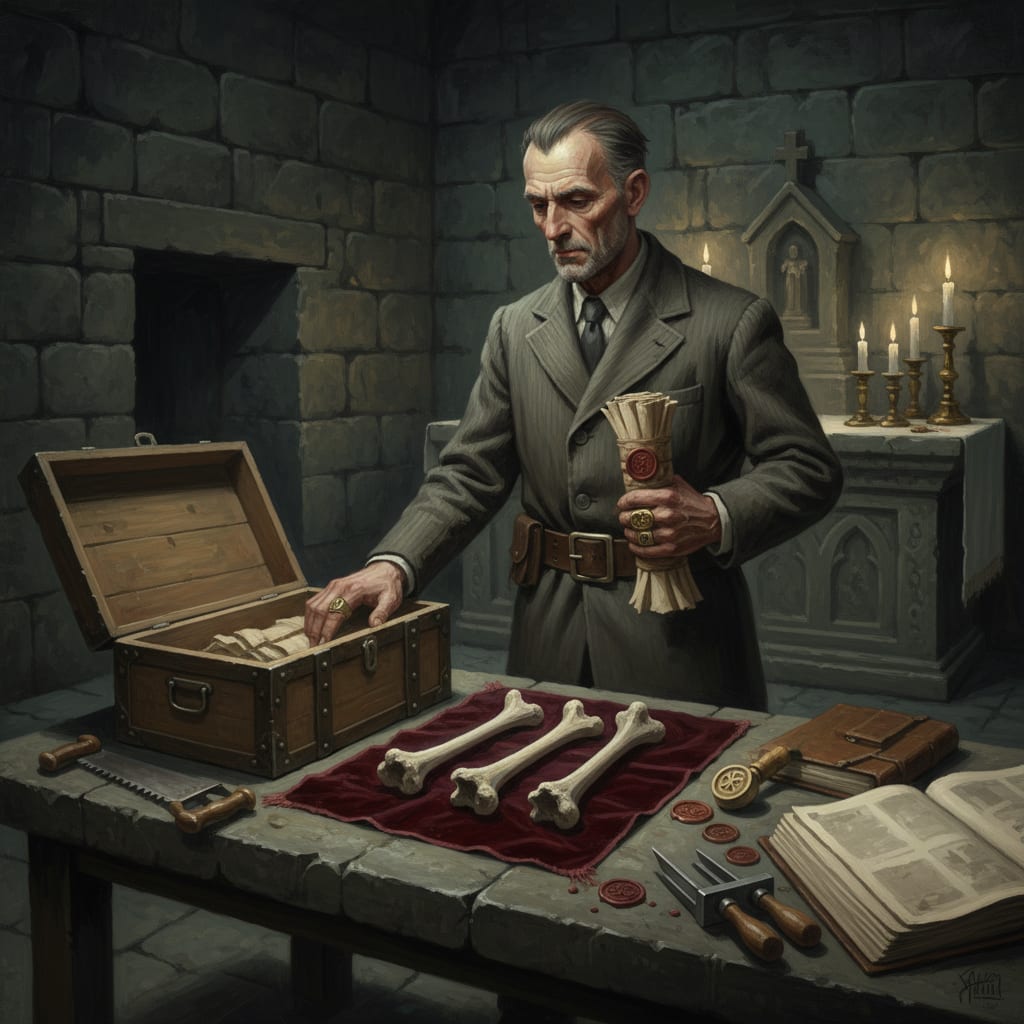
The Femur-War Broker's function is brutally simple: he moves incompatible relic-claims through the same civic space without permitting them to collide. He manages the coexistence of truths the Synod insists are singular. He is a routing problem dressed in a neutral-grey cord and a ring with interchangeable seal-faces.
The standing advisory has been renewed annually for fifty-three years. The Bureau has not, in fifty-three years, received a single report. The Broker's clients include the Bureau's own custodians.
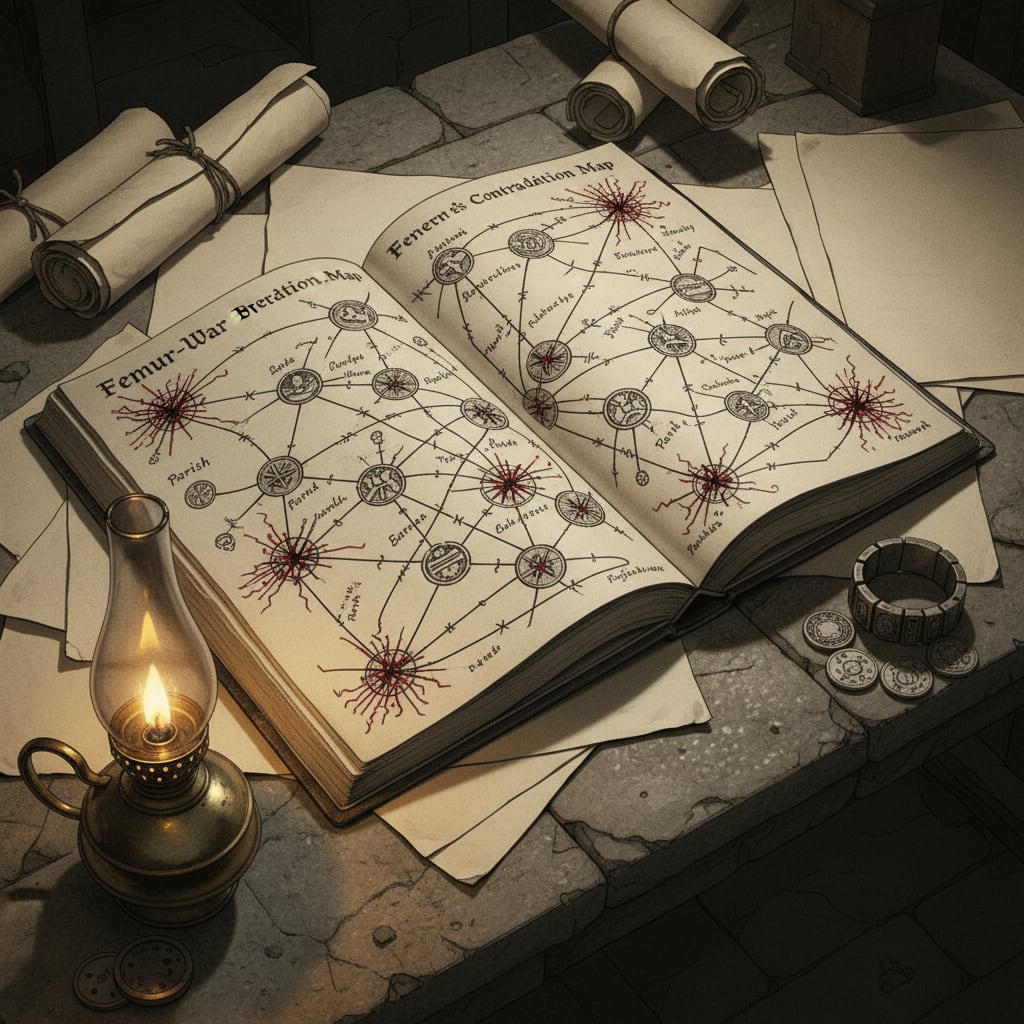
His day begins with the Contradiction Map — a slip-book, hand-inked, carried in a coat pocket with a modular seal ring and a blank writ-paper rolled in a wax vial. The Map records which parish believes what, which bastion houses which authenticated relic, which provenance chain conflicts with which, and how violently the discrepancy might resolve itself if the wrong priest opens the wrong crate at the wrong altar. He checks rumour channels — which Examiner is currently touring, which Inquisitor is awake, which notary office has been compromised by the Bureau of Shadows. He rehearses three versions of the same custody narrative before breakfast.
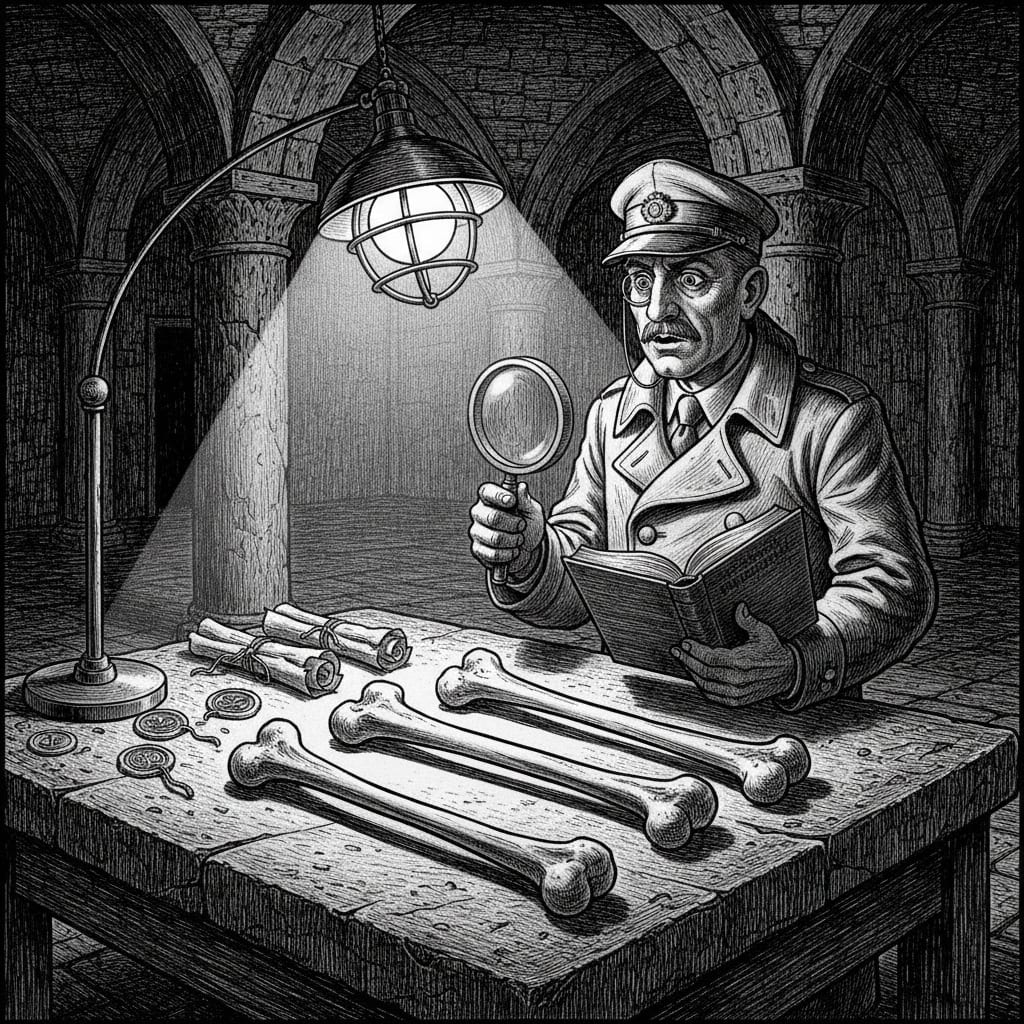
By midday he is in a backroom chapel or a port warehouse, standing over an opened crate under inspection light — that perpetual, suspicious, angled illumination that makes every bone look guilty. He negotiates splits: a femur for one shrine, filings for another, a "secondary fragment" (the Bureau's euphemism for shavings produced by a fine-toothed bone saw) for the third. He swaps seals. He drafts disclaimers written in the careful dialect of jurisdictional sanctity — "true under local provenance law as administered by the examining authority of this canton" — phrases that sanctify both claims under different doctrinal sub-clauses and that crumble to ash if they ever reach the same auditor's desk.
By nightfall the actual crates move — on carts, on ferries, through hidden chapels and crypt-route smuggling lines, past checkpoint marshals who have received their candle-money and whose ledgers will show an inspection delay that never happened. If the crate starts singing — and relics in transit do sing, with a regularity the Bureau of Bells finds distressing and the Bureau of Relics denies — the Broker quarantines it, renegotiates delivery terms, and charges an emergency premium that his clients pay without argument because the alternative is a miracle occurring in a warehouse, which generates paperwork no living broker can survive.
#On the Triplicate Femur Incident and Its Consequences
The profession's founding catastrophe is called, among practitioners, the Triplicate Femur Incident, and it predates the Reliquary Schisms by name if not by nature. Three reliquaries — two in the Rhineland, one at Bastion-Brest — each certified the left femur of Saint Maurus of the Burnt Lantern. Each possessed an unbroken provenance chain. Each had been authenticated by a separate Examiner. Each had been installed in a ward-niche and blessed by a separate chaplaincy. All three wards functioned. All three femurs glowed.
The riots began when a Caravan Factor transporting relics for quarterly rotation accidentally listed all three femurs on the same manifest. The manifest reached a tariff-chapel weigher at Rheinscarp, who weighed one femur but found three listed, ran the discrepancy through two auditors and a Bureau of Records cross-reference, and produced a filing contradiction that propagated through three provinces in eight days. The riots killed more people than the siege that Bastion-Brest was conducting at the time.
Elder Noxa — a former registry scribe whose full name the Bureau of Shadows has sealed — settled it. She did not prove which femur was genuine. She proved that the question was irrelevant. She arranged for each reliquary to display its femur on a different feast day, under a different liturgical calendar, authenticated under a different Examiner's writ. The three femurs ceased to coexist in time. They occupied the same doctrinal space but never the same administrative moment. The contradiction survived. The city did not burn.
Earlier editions of this Codex attributed the Triplicate Femur Incident to "administrative negligence."
The Bureau of Records has revised this attribution to "doctrinal exuberance in the face of surplus sanctity." The Broker community attributes it to "a Caravan Factor who put three lies on one piece of paper."
#On the Tools of Mediation
The Broker's primary instrument is paper, and his primary weapon is the seal.
He carries a modular seal ring — a band of base metal with interchangeable wax-stamp faces, each face corresponding to a different jurisdiction, notarial office, or neutral authority. He carries forged seal-heads for emergencies, split-wax moulds for duplicating official stamps, and archive inks whose chemical composition matches Bureau of Records standard issue within the tolerances of an Examiner's reagent test. He carries a bone saw, a set of reliquary filing tools, and the quiet understanding that any saint whose remains are currently being subdivided in a backroom chapel would, if consulted, almost certainly object.
His most dangerous possession is his Contradiction Map. It is a liability that would end him if confiscated — a hand-drawn cartography of who believes what, where the provenance chains conflict, which auditors have been paid, which Inquisitors have been avoided, and which Relic Authenticators are corrupt enough to stamp a femur they have already stamped for someone else. The Map is updated nightly. It is never copied. It is burned at the first sound of white-ring inspectors in the corridor.
The secondary instrument is time. A Broker's most common service is the manufactured delay — an "inspection hold" at a checkpoint, a "liturgical calendar conflict" that postpones a procession, a "provenance review" that buries a contradiction in procedure until the feast day passes and the rival claimant's congregation goes home. Most clients do not need truth. They need recognition and a window of undisturbed display. The Broker sells both.
#On the Factions and Their Quarrels
The trade divides itself, with the vicious neatness of a profession that must never be caught arguing in public.
The Peace Brokers — the oldest faction, claiming descent from Noxa's original settlement — insist that their work prevents bloodshed. They minimize contradiction yield, refuse to handle relics that have exhibited supernatural behaviour in transit, and maintain standing relationships with senior Bureau of Relics custodians who know that the Bureau's authentication system would collapse without the Brokers' routing and who repay the service with advance notice of Examiner tours.
The Profit Brokers maximize contradiction yield. They have discovered that a relic with competing provenance chains is worth more than a relic with one — because each chain represents a client, and each client pays. A saint with seventeen femurs is a revenue stream, provided the embarrassment is filed correctly. The Profit Brokers subdivide relics with enthusiasm, manufacture "secondary fragments" with industrial regularity, and regard the Peace Brokers as sentimentalists who have mistaken squeamishness for ethics.
The Paper-Only (Unregistered) faction — smallest, most paranoid, most philosophically coherent — never touches the relic. They move stories. They handle custody narratives, provenance chains, authentication histories, and notarised disclaimers. They regard the Bone Splitters (both Peace and Profit) with the contempt of men who have understood that the bone is irrelevant, that the seal is the miracle, and that anyone still sawing femurs in a backroom chapel has missed the point of the profession entirely.
#On the Hazards of the Trade
The Broker's occupational diseases are specific and instructive.
The first is seal-sickness (Unregistered) — the compulsive checking and rechecking of stamp authenticity, registry numbers, wax consistency, and counter-seal alignment. A Broker who has survived three audits develops the habit of testing his own seal ring against his own wax before breakfast. The seal has not changed; his trust in his own instruments has eroded past the point of functional confidence. Veteran Brokers report testing seals in their sleep.
The second is provenance drift (Unregistered) — the slow loss of certainty about which custody narrative is original and which is manufactured. After a decade of crafting parallel provenance chains, a Broker may find he can no longer identify the genuine article. He has forged so many truths that the original truth has been overwritten. This is, the Bureau of Doctrine would observe, a theological condition as much as a professional one.
The third is the relic itself. Bones respond to handling. A femur moved through six jurisdictions under six competing custody narratives will, on occasion, exhibit behaviour the Bureau of Relics classifies as "unsolicited phenomena" — glowing, humming, warming to the touch, or, in three documented cases, cracking along a line that divides the bone into fragments precisely matching the number of claimants. The Bureau insists this is coincidence. The Brokers insist it is a warning. The bones, as always, decline to clarify.
The greatest hazard remains human: the moment when two contradictory certificates land on the same auditor's desk. Every Broker's career is a sustained effort to prevent this collision. When it occurs — and it occurs, with the regularity of any system that depends on imperfect human beings maintaining perfect separation of incompatible paperwork — the consequences are swift. The auditor rings the bell. The White-Mantled Inquisitors arrive. The Broker, if he is wise, has already vanished into a crypt-route or a ferry chokepoint with a fresh identity and a new set of seal-faces. If he is unwise, he is erased — his name struck from the Ledger of Souls, his clients disavowed, his Map confiscated and filed in the Bureau of Shadows' vault, where it will be studied with the same clinical interest the Bureau applies to intercepted enemy communiqués.
The Map, after all, is more valuable than the Broker. It always was.