
#On Respiratory Charity
"Avoid the violet." — San Vesta night-saying
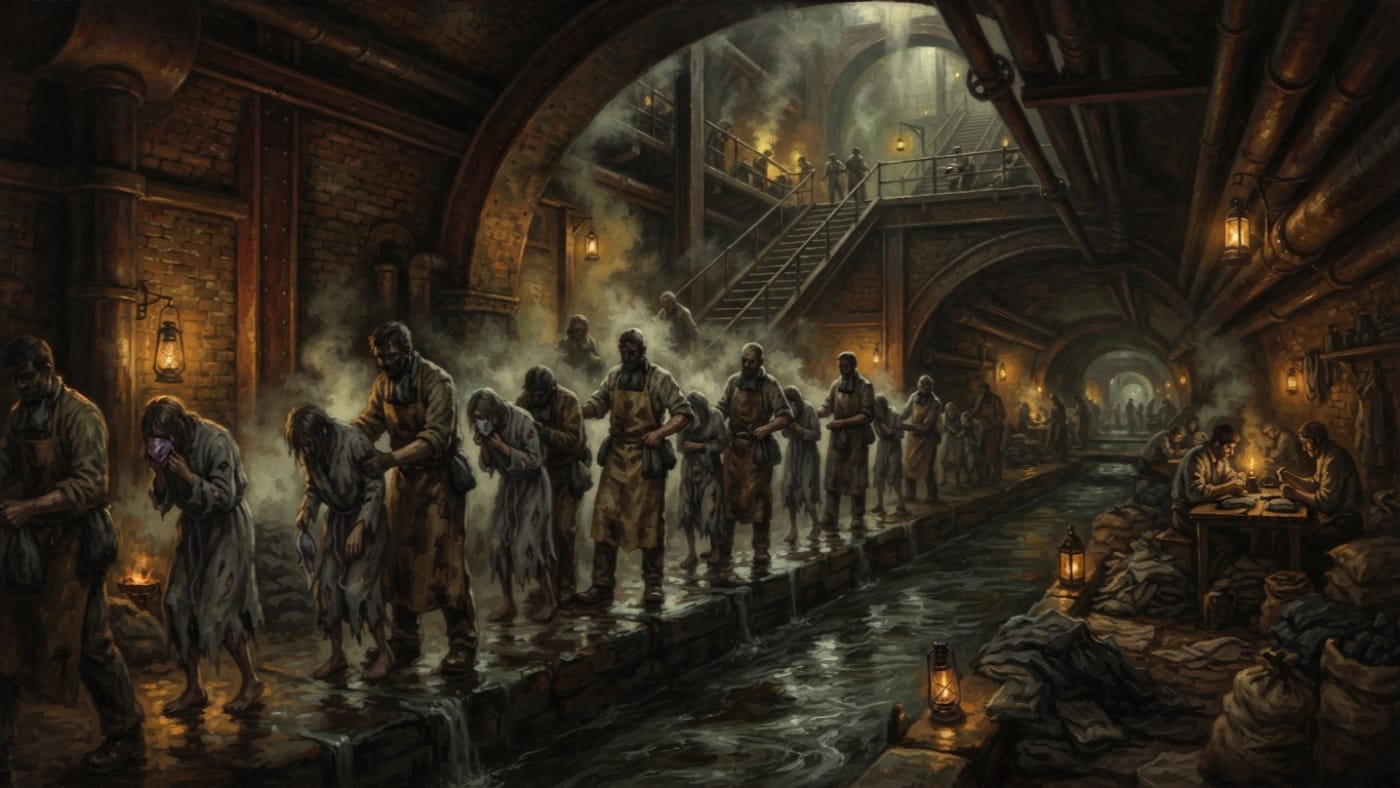
The Kiln Hall of San Vesta is a long, low vault where relic-smoke is pressed into bricks for the tribunals and cathedral chapters of the Iberian theater, and where the air is thick enough to chew. The workers there wear violet cords to show whose they are and cool-masks so they can go on breathing. The priory issues the cord. The mask, more often than the Incense Binders care to record, comes from somewhere else. It comes up out of the soot-black sluices of the Ash Canalworks, stitched by a society that calls itself the Cool Mask Brotherhood. When the Brotherhood consents to describe its business at all, it calls that business respiratory charity.
I accept the description as far as it goes. It goes as far as the kilns.
Below the kilns the Brotherhood keeps a second trade, the removal of medicine and people from San Vesta without the consent of those who hold them. It moves both through forged slips, bribes and the lava-tube underpaths beneath the canalworks. The first trade is tolerated. The second is why this entry exists. The reason for the toleration is also the reason the second trade has gone on so long, and that is a sentence no Bureau would care to see printed.
#On the Masks and Their Passage
A cool-mask is a modest object: a pad of cloth packed with charcoal and tied across the nose and mouth. It strains the worst of the particulate from each breath and does nothing more. Whatever the name promises, it does not cool the face. It does not keep out the docility the smoke is calibrated to produce, or the visions some breathers report, or the ash-lung that comes for kiln-workers in its own time. A mask postpones some of the damage, and in San Vesta that is enough to put a price on it.
A fresh mask is pale grey and smells of the charcoal-burner's yard. After a week in the Kiln Hall it is black, damp with breath and tacky with resin. After a month it is a crust that sheds grit onto the tongue at every word, and the wearer learns to speak little, which the overseers count as a second benefit.
Cool-masks issued in the Relic-Smoke Kiln Hall are replaced weekly.
The schedule says weekly. The masks are replaced when they disintegrate. The gap between those two events is filled by the Cool Mask Brotherhood.
The Brotherhood's replacements are made from salvage, and San Vesta never runs short of worn cloth or spent charcoal. The masks are sewn somewhere in the canalworks, among basalt channels that carry cooling water and runoff down from the ovens and kilns. From there they climb the terraces into the hands of workers who will not get a new one from the priory before the old one falls apart. I have not seen the workroom and the Brotherhood has not offered to show me. I record no headquarters because none has been proven to me. The canalworks are large, wet and badly lit, and the Bureau of Purity has not found the place either. Or it has found it and chosen not to say so, which in this priory comes to much the same thing.
That second possibility is the more instructive. Purity has mapped the routes the masks travel and left them open. The reasoning goes link by link, the way a provost's chain goes from wrist to wall. Without the masks there are no workers. Without the workers there is no incense, and without the incense, for the tribunals and chapters that burn it, the Bureau would face consequences it has no wish to manage. So the masks keep coming, mapped and watched and unhindered, like a leak the steward has decided is now plumbing.
#On the Other Traffic
"Paper buys bread; tunnels buy freedom." — saying of the San Vesta underworld
The Brotherhood's other cargo does not climb the terraces. It goes down.
To see why anyone would want to leave San Vesta by way of a lava tube, look at the terms on which San Vesta keeps people. The Infirmary Tribunal of Scorch decides who is treated, in what order and on what terms. The terms are always labour. A cured patient owes recovery service in the ovens, the canalworks, the kilns or the dormitories until the ledger says the body is paid, and the debt starts when the Tribunal declares the patient well. Soldiers whom the Bureau of War sends up from the trenches on litters leave the wards as labour. Pilgrims who come for a cure stay to work it off. Rations are tied to quotas and care to contracts. A ward bracelet works in effect as a lock with a name on it.
Against all this the Brotherhood sets three instruments. The first is forged paper: medical priority slips, triage slips and the other small squares on which, in this priory, a life turns. Counterfeit triage slips trade freely in the Cinder Markets, and I have no evidence that the Brotherhood made any particular one of them. The second is the bribe, paid in the priory's ordinary currencies of clean water, painkillers, untainted flour and witnessed confessions. The third is the tunnel.
The lava-tube underpaths run beneath the canalworks through rock that the old flows left hollow. They are hot, and the scald mists come up off the cooling channels without warning. A man can drown in a sluice in the dark, cook in a dead-end tube or simply stop breathing, a fate the masks cannot entirely prevent. Old tubes collapse into sink-fissures. The parent survey of this priory records that Purity has sealed eleven tunnels in the past decade and found, each time, that twelve now exist. I report the arithmetic without vouching for it. Purity counts what it seals, and nobody counts what it misses.
Nothing I have found shows where the tunnels come out, or that they come out anywhere a fugitive would wish to be. A route under San Vesta is a route out of custody, and that is all it is. Medicine leaves by the same road, and where it goes, and for whom, the Brotherhood keeps to itself.
#On Toleration and Custody
There are two sets of books here, and the Brotherhood writes in both.
In the first, the Brotherhood is a supplier. The Incense Binders depend on workers who can breathe, Purity depends on the incense, and so the masks pass. Nothing proves that the Binders sponsor the Brotherhood, share its members or know its stitchers by name. They simply benefit, as a mill benefits from a river it never asked permission to use.
In the second, the Brotherhood is a thief of custody. Every patient taken out through the canalworks is a body the Tribunal had counted, a shift the ledger had already entered and a case Sister-Physic Marra Vell's wards will never close. The Tribunal runs triage, quarantine and the accounting of acceptable losses. A fugitive turns an acceptable loss into an unexplained one, and the Tribunal resents the paperwork more than the person.
The Oven Quartermastery has a quieter grievance. In San Vesta a bread token is stamped with its bearer's name, and the token is the name. What the Ledger Cloisters enter against the token of a person who has gone down a lava tube, Quartermaster Odran Ashweight's clerks have not told me. My guess is that such people become, like anyone who loses a token, administratively absent. The Brotherhood may be the only society in the Synod that makes people vanish so they can go on living.
The Priorate Council under Prior Celestín of the Third Ember holds the doctrine stamps and repeats the line that innovation is mercy when stamped. Brotherhood mercy carries no stamp, and the Bureau of Doctrine has issued no ruling on it. I find no file on the Brotherhood at the Bureau of Mercy either, which is consistent with that Bureau's position that mercy is something it dispenses rather than something people do to each other.
Purity sits between the two sets of books and declines to reconcile them. Tolerating the masks has never meant tolerating forged slips or stolen patients, and no exemption has been granted for either. Purity has simply made no move against the one trade that would not also threaten the other. Each office knows the masks and the escapes may share a door. None of them wants to be the office that bricks it up.
#On the Present Pressure
As of A.S. 201 the Pilgrim Dormitories are overflowing, the wards are full and the Tribunal is locking down quarantine zones more often. A lockdown follows whenever a ward shows what Sister-Physic Vell calls atypical recovery patterns. The orderlies describe these as patients waking with memories that are not their own. I record the reports and the cordons that answer them, and I offer no explanation for either. The Tribunal has offered none it is willing to sign.
The Brotherhood has answered the cordons by moving through the underpaths with increasing boldness. It takes medicine and people out of the locked zones and hands masks up to the kilns as it always has, with the same grimy hands and through the same wet stone.
A general quarantine has not been ordered. The day it is, the Brotherhood's two trades will stop being separable, and every office in San Vesta will have to decide which of its books it means to keep. I decline to predict the choice. Predictions about San Vesta tend to be filed and then forgotten.
Nihil obstat — quod spirat, laborat.