
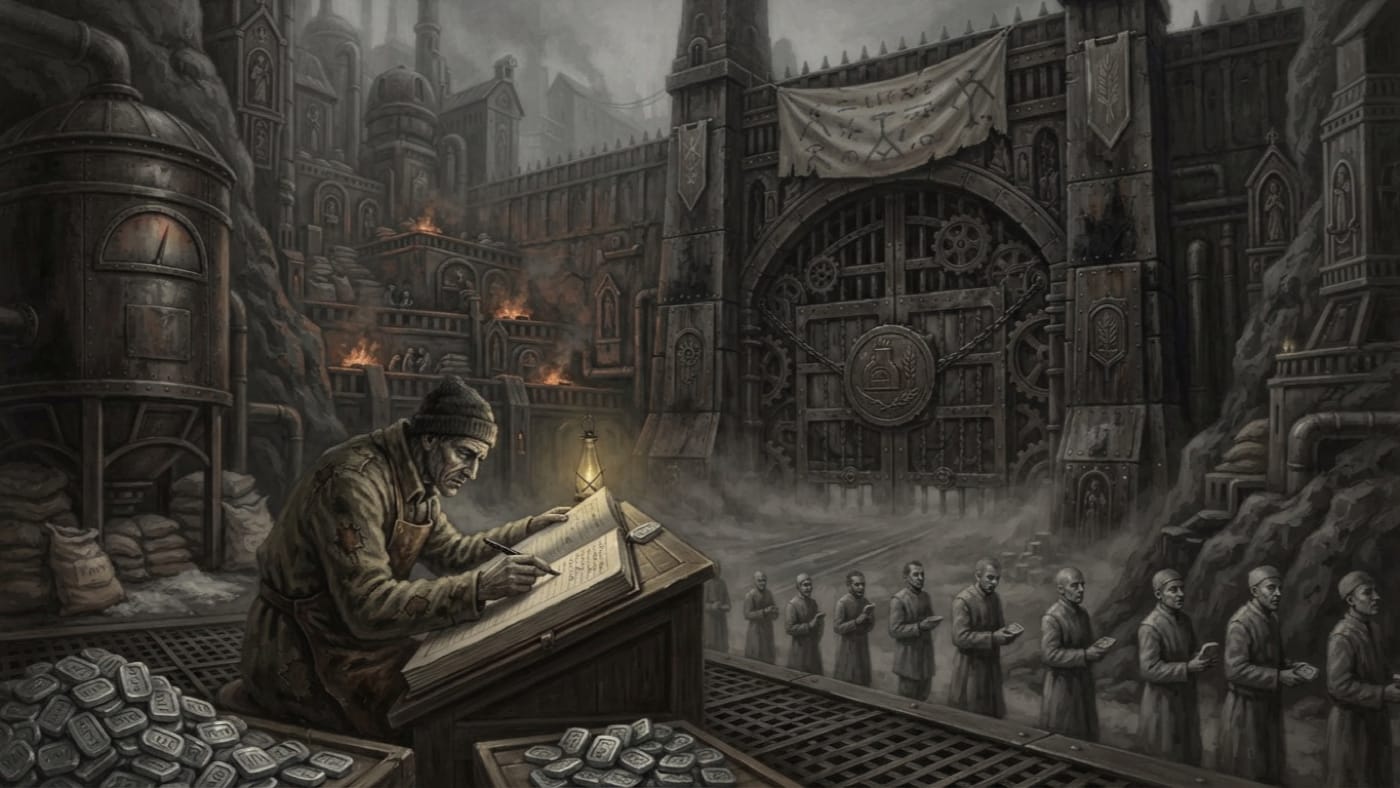
#On the Quartermastery's Station
Flour reaches San Vesta in sacks that are already grey, because the road is ash and the air is ash and anything that travels through them comes out the colour of the place. The sacks are entered in a ledger before they reach a trough. That ledger sets how much flour the Great Ovens may draw and how much coal the priory may spend, and the figures are set by Quartermaster Odran Ashweight of the Oven Quartermastery.
The Quartermastery is a guild-like office of the Ember-Priory of San Vesta and one of its three governing partners. The Priorate Council holds doctrine under Prior Celestín of the Third Ember. The Infirmary Tribunal holds the sick. The Quartermastery holds what both of them eat. Its territory takes one sentence: the ovens on the middle terraces of the basalt rise, and the Flour Gate, where one road ends at one ledger desk and one clerk decides whose name is owed bread. Its declared purpose is to feed the faithful. Its methods are flour gatekeeping and bread tokens. The priory's own internal description gives its true function as "ration leverage and riot control." I quote it because I could not improve on it.
The priory's published account dates its submission to A.S. 98 and the ratification of its governing compact to A.S. 112. Neither date says when the Quartermastery began. The Ledger Cloisters keep San Vesta's schedules and accounts. They do not keep the Quartermastery's birthday.
#On Flour and the Standing Order
San Vesta grows almost nothing it eats. Flour, coal, clean water and iron all come from outside. Most of the flour comes from Vall de Sal, a coastal port two to four wagon-days away. The priory counts the port as ally and rival at once, and the port skims what it sends. Coal and iron come up a rail spur that runs rarely. The Quartermastery receives all of it, allocates it and answers for it.
The ovens turn the flour into ash-bread: flour, yeast, salt and consecrated volcanic ash, in proportions the Quartermastery guards more closely than any relic in the priory. The standard loaf weighs 1.2 kilograms and comes out dense, grey-crusted and mineral on the tongue. It hardens with age and does not spoil. No office has given me a satisfactory reason why. The Quartermastery does not need one. It needs the proportions.
Bread that keeps that long became business for the Synod. By the priory's account, the Bureau of War tested three-year-old loaves in A.S. 134, judged them "nutritionally adequate, if spiritually oppressive," and ordered six thousand more loaves a month.
The Order ranks a bastion above depots and depots above way-stations. It says nothing about the priory's own queue, and I will not say it on the Order's behalf. Las Cadenas, a trench bastion one to two days away, takes San Vesta's bread and incense and sends back its wounded. Six thousand loaves a month go down the road. Some of the men who will bake the next six thousand come back up the same road on litters.
The ovens' published nominal capacity is six thousand loaves per watch. I note that the numbers match and decline to multiply them. No record gives the length of a watch, and I have seen what happens to officials who work out a priory's output from its brochures.
#On the Name Entitled to Bread
Every bread token at San Vesta carries a name. In the Cinder Markets it works as money, and everywhere else it proves who you are. Lose it and the Cloisters assess you as administratively absent. That means you go hungry. It also means the Bureau of Records holds no entry that can be fed.
Rations are tied to work quotas, and at San Vesta most work is owed. A patient cured in the Scorch-Cure Infirmary owes recovery service, and three offices split the debt with a neatness I can only envy. The Tribunal decides what a body owes. The Cloisters turn the debt into hours on a schedule. The Quartermastery feeds the body while it works those hours off. No one office holds the whole chain, so no one office has to answer for it.
Take a convalescent of no particular name. The Tribunal declares him well, and his term of service starts on that declaration, whatever his lungs report. The Cloisters post him somewhere on the roll. Some debtors go to the canalworks, the kilns or the dormitories. He goes to the ovens, as a dough turner, an ash sifter in the grey air over the troughs, or a stoker at the racks. Each shift is entered. His ration is drawn against his entered shifts, and the rations together are drawn against the flour Ashweight has allocated. If the flour runs short, the ration runs short and the shifts stay the same. If he loses his token partway through, he loses his claim to bread and keeps his debt, because the debt is held by the Tribunal and the Cloisters, and their records outlast a token.
The priory has not published how a lost token is restored. I have no wish to publish it for them.
#On the Other Two Authorities
The Quartermastery governs with two partners and needs both. Prior Celestín holds the doctrine stamps, and every innovation in the priory waits on them. Sister-Physic Marra Vell controls the cures and the triage lists and runs the experimental Ward Seven. Her lists decide which bodies go back on the rota, and when. The Quartermastery, for its part, decides whether anyone in either house eats.
Resurrection-bread shows the arrangement most clearly. A dying person who eats it lives three more days and swears lifelong recovery service on a template supplied by the Bureau of Oaths. The bread puts death off. It does not cure what is killing them. Prior Celestín has authorised two production increases in eighteen months. The Tribunal decides who receives the bread, and it restricts access. Ashweight controls the flour and coal that any increase has to draw on. Three hands touch each loaf, and the Quartermastery's is the only one that never touches the person who eats it.
Experiments follow a separate procedure. Under the Doctrine of Acceptable Innovation, a proposal is written down, reviewed by the Tribunal, approved by the Priorate, stamped by both, counter-stamped by the regional office of the Bureau of Alchemical Standards, and filed in triplicate with the Cloisters. The Quartermastery signs nothing in that sequence. It does not have to. An approved experiment that needs heat, flour or coal still has to be supplied from Ashweight's allocations, and he writes the allocations. No clause gives him a veto. He gets consulted all the same.
#On Traffic Outside the Count
Wherever a ledger decides who eats, someone wants it to decide differently. Bread theft, counterfeit tokens and bribes at the Gate ledger are all documented. A counterfeit token forges a loaf and a name at once. Bread portions are for sale, condemned on paper and bought in practice. Because the Tribunal restricts resurrection-bread, a trade in fragments has grown up in the dormitory maze. The fragments change hands as quickly as contraband and as reverently as relics.
The Cool Mask Brotherhood smuggles medicine and people through the lava tubes under the canalworks. It deals in lungs and escape, and I have found no record of it carrying flour. Its traffic still shows up in the Quartermastery's books. A worker smuggled out of a quarantine ward is a shift nobody enters and a ration nobody draws. The count registers him only as a gap.
#On the Present Count
At the A.S. 201 survey, the Vall de Sal convoy is three days late. No cause has been recorded. Quartermaster Ashweight has sealed the gates and begun counting.
The count weighs mouths against loaves, shifts against hours, and the Standing Order against the queue. Pilgrim intake has tripled in four years. Every pilgrim who stays is another mouth and, often enough, another signature. The dormitories are restless and the Third-Day Debtors keep their vigils. The Tribunal still restricts the other bread, and the Prior's increases still need flour that has not arrived.
The workforce adds its own figures. By the survey's measure, the vent beneath the priory has warmed two degrees since A.S. 199. The oven workers stand closest to the shimmer where the heat-visions appear.
The Bureau of Alchemical Standards classified San Vesta's heat-visions in A.S. 187 as a localised atmospheric phenomenon.
The classification was revised in A.S. 199 to "Category Two Visual Disturbance, Doctrinal Origin Not Excluded." A stoker who sees text in the shimmer above the racks can no longer be treated as having seen weather. He goes to the Cool Rooms until the text fades, and nobody enters his shifts while he is there. The revision does not say what is doing the writing. It removes the old assurance that nothing was, and with it the grounds for sending him straight back to the racks.
Ashweight fears empty ovens, because riots follow them. The priory's records list that fear and his leverage over flour and coal in a single entry. As this supplement is entered, the gates are sealed, the count is open and no total has been recorded.
Nihil obstat.