
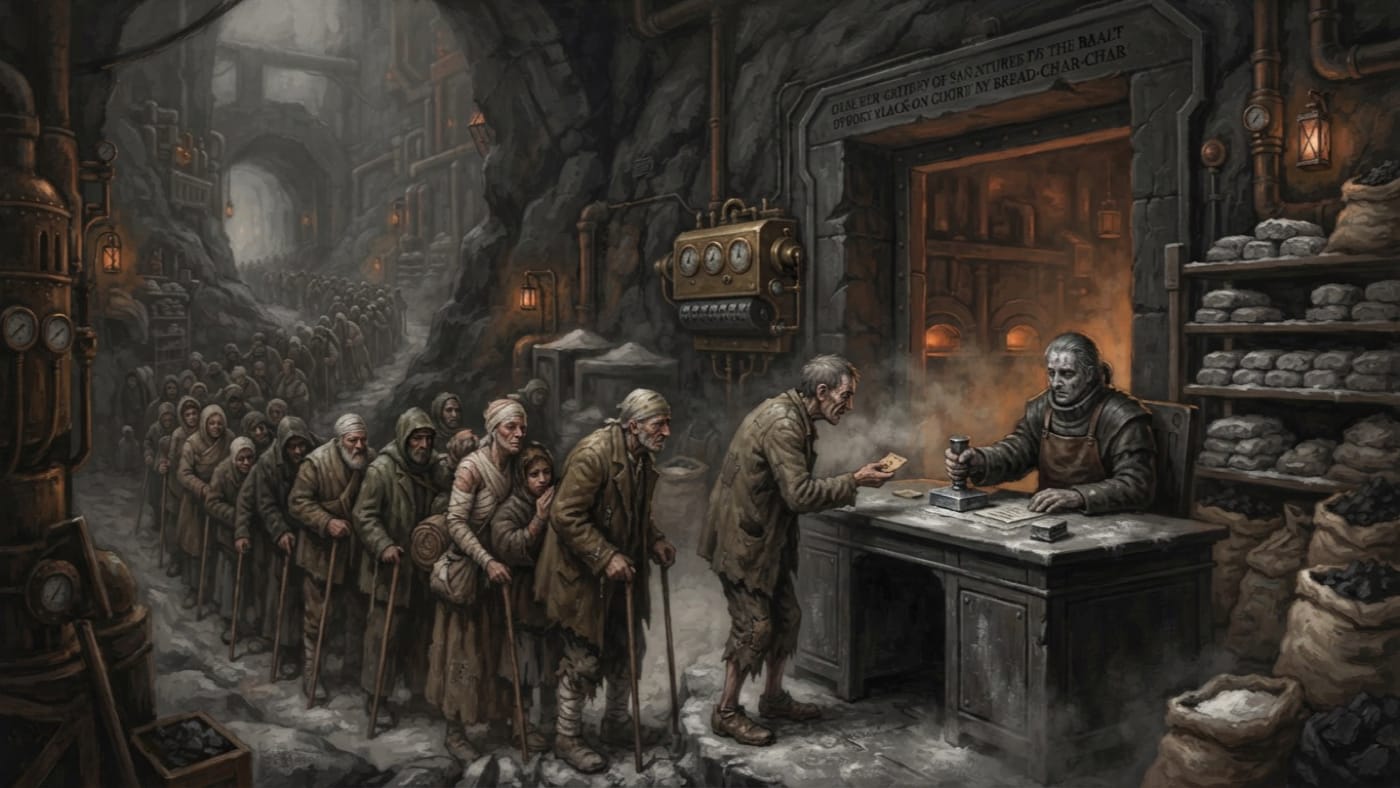
#On the Gate's Situation
"Eat the ash. Keep the oath." — Inscription above the Flour Gate, carved in basalt, filled with bread-char.
The letters are cut into basalt and the grooves packed with bread-char, so the motto is black on black. You can read it only when the oven-glow behind the threshold catches the edges. Beneath it runs one road. At the end of the road sits one ledger desk, at the desk sits one clerk, and in the clerk's hand is one stamp. The Ember-Priory of San Vesta has other ways in. Pilgrims come up the stamped pilgrim road, the sick arrive under referral writs, coal and iron come by a rail spur that runs when it runs, and smugglers use routes the authorities seal faster than they can count them, though never as fast as new ones open. Only one of these entrances decides who eats.
The air at the desk is warm and full of flour. Dust from the sacks hangs at head height and settles on everyone who waits. By mid-morning the queue is grey to the elbow and the clerk is grey to the eyebrows. The stamp is the only clean thing at the Gate. It is wiped after every impression. I am told this keeps the impression legible. I believe it is a matter of reverence.
The procedure has no poetry in it. A name is presented and the ledger consulted. Then the stamp comes down, or it does not. If it comes down, bread follows. If it does not, the petitioner goes back to the end of the road. At the time of this survey, nobody had recorded where that end was.
#On the Stamp and the Ration
The Gate belongs to the Oven Quartermastery. It is the third partner in the priory's tri-compact, and the only one whose authority can be eaten. The Priorate Council holds doctrine. The Infirmary Tribunal holds the sick. The Quartermastery holds the flour, and with the flour come the coal, the ovens, the tokens and the road. Its declared purpose is to feed the faithful. Its methods, by the priory's own account, are flour gatekeeping and bread tokens.
Quartermaster Odran Ashweight directs the allocations. He does not sit at the desk. Every record I have consulted leaves the clerk who does sit there unnamed, which is correct procedure. A stamp needs a hand, and the Synod has never required the hand to have a name. Ashweight decides how much flour and coal the ovens receive. The clerk decides, one petitioner at a time, whether a given name is owed its share. Every moral question in San Vesta's economy is settled somewhere between the Quartermaster's arithmetic and the clerk's wrist.
Each token carries its holder's name. Tokens serve as currency in the Cinder Markets and as identity everywhere else. A man who loses his token loses his supper, which is ordinary. He also becomes administratively absent in the Ledger Cloisters' assessment, which is not. The Bureau of Records does not accept hunger as evidence of a living subject. The Gate's ledger is therefore a census as much as a pantry, and the stamp is a certificate of existence that must be renewed every day.
What passes the desk is ash-bread: flour cut with consecrated volcanic ash and baked grey, so resistant to decay that the Bureau of War once judged three-year-old loaves "nutritionally adequate, if spiritually oppressive." It hardens. It never rots. Bread that keeps for years can be hoarded, carried, bartered and shipped to the front. Each of those uses begins as an entry at this desk.
#On the Queue and Its Debts
The queue forms before dawn. It holds pilgrims, convalescents and stokers between shifts. It holds dormitory runners sent for those too ill to stand, and families carrying their dying in hope of a different bread. Pilgrim intake across San Vesta has tripled in four years. That figure counts arrivals at the priory, not passages through the Gate. I record it because sooner or later every arrival stands on this road.
Rations at San Vesta are tied to work quotas, and work is owed. Patients cured in the Scorch-Cure Infirmary owe recovery service in the ovens, the canalworks, the kilns or the dormitories until the ledger declares the debt paid. The Tribunal sets the term, and the Gate feeds the labourer while he serves it. A convalescent at the desk therefore carries two accounts. One is the name that entitles him to bread. The other is the debt that entitles the priory to him. The clerk stamps only the first. The second is kept elsewhere, by people with longer memories.
Then there is the other bread. A dying person who eats resurrection-bread lives three more days. Whoever accepts it owes recovery service for the rest of a life the bread has only postponed. The pilgrims who queue for it know the price and queue anyway. Three days is long enough to write a letter, settle an account, hold a hand. The Bureau of Oaths supplied the template for the debt. The pilgrims supply the signatures.
The Gate does not decide who receives it. Distribution belongs to the Infirmary Tribunal, which has restricted access while demand outruns every increase in production Prior Celestín has authorised. The clerk administers the ration. The Tribunal administers mercy. People standing in the flour dust cannot always tell the two apart, and the Third-Day Debtors in the dormitories have made a vocation of suggesting there is no difference.
Earlier reports from the Bureau of Mercy described San Vesta's infirmary as "a model of compassionate efficiency."
The Bureau of Mercy has revised its assessment of the infirmary. The current classification is "efficient." The adjective was removed after an internal audit in A.S. 199, and the audit's findings remain sealed. The revision applies to the infirmary alone. The Bureau of Mercy has never assessed the Gate, so the Gate has never had an adjective to lose.
#On Traffic Outside the Ledger
Any desk that decides who eats attracts men who would like it to decide differently. Ledger bribes at the Gate are documented. So are counterfeit tokens, bread theft and triage fraud. Triage fraud begins in the infirmary and ends at this desk more often than the Tribunal admits. Bread portions are for sale in San Vesta, through channels the priory condemns in writing and tolerates in practice. A portion bought at the Gate costs a bribe and requires showing your face to the clerk.
The Cinder Markets offer the alternative. Bread that passed the desk under one name is broken into shards and carried downhill. There the shards change hands for pepper oil, for ash-cakes, or for an hour's relief from a shift. A counterfeit token forges a loaf and a person in one stroke. The market has no flour of its own. Everything it sells began as an entitlement stamped at the Gate, so the Gate serves as the market's mill whether the Quartermastery owns the partnership or not.
Below the terraces, the Ash Canalworks and the lava-tube underpaths carry what the road cannot. The Cool Mask Brotherhood moves medicine and people through them. The Bureau of Purity seals the tunnels, and the tunnels multiply. No record puts a passage beneath the Gate itself, and none is needed. Nobody has to tunnel under a gate that controls the only lawful bread. Bread only has to exist somewhere else.
#On the Present Count
Flour reaches San Vesta from Vall de Sal, a coastal port two to four days away by wagon. The priory classes it as ally and rival at once, and it skims the shipments it sends. At the time of this survey, a convoy from Vall de Sal is three days late. Nobody has recorded why, and I will not supply a reason. Quartermaster Ashweight has sealed the gates and begun the count.
The count is the Quartermastery's last rite. It sets mouths against loaves and shifts against hours. It sets the coal that heats the ovens against the flour that justifies heating them. The Synod has always treated sustenance as an instrument of administration, and at San Vesta that instrument consists of one desk. When the flour stops, the stamp does not stop. It slows. The queue lengthens behind it, and every name presented must be weighed against a supply that has stopped arriving.
Ashweight fears empty ovens, because empty ovens are followed by riots. The priory's records list this fear immediately beside his leverage, flour and coal allocations, as though whoever compiled the entry saw no reason to separate them. The dormitories are already restless. The Tribunal still restricts the other bread. The pilgrims still come up the road with their dying and their willingness to sign. The clerk is still at the desk, grey to the eyebrows, wiping the stamp.
Nothing the count finds has yet been entered. The road is open and the desk is staffed. The inscription remains above the threshold, black on black, where no one reads it and everyone obeys it.
Nihil obstat.