
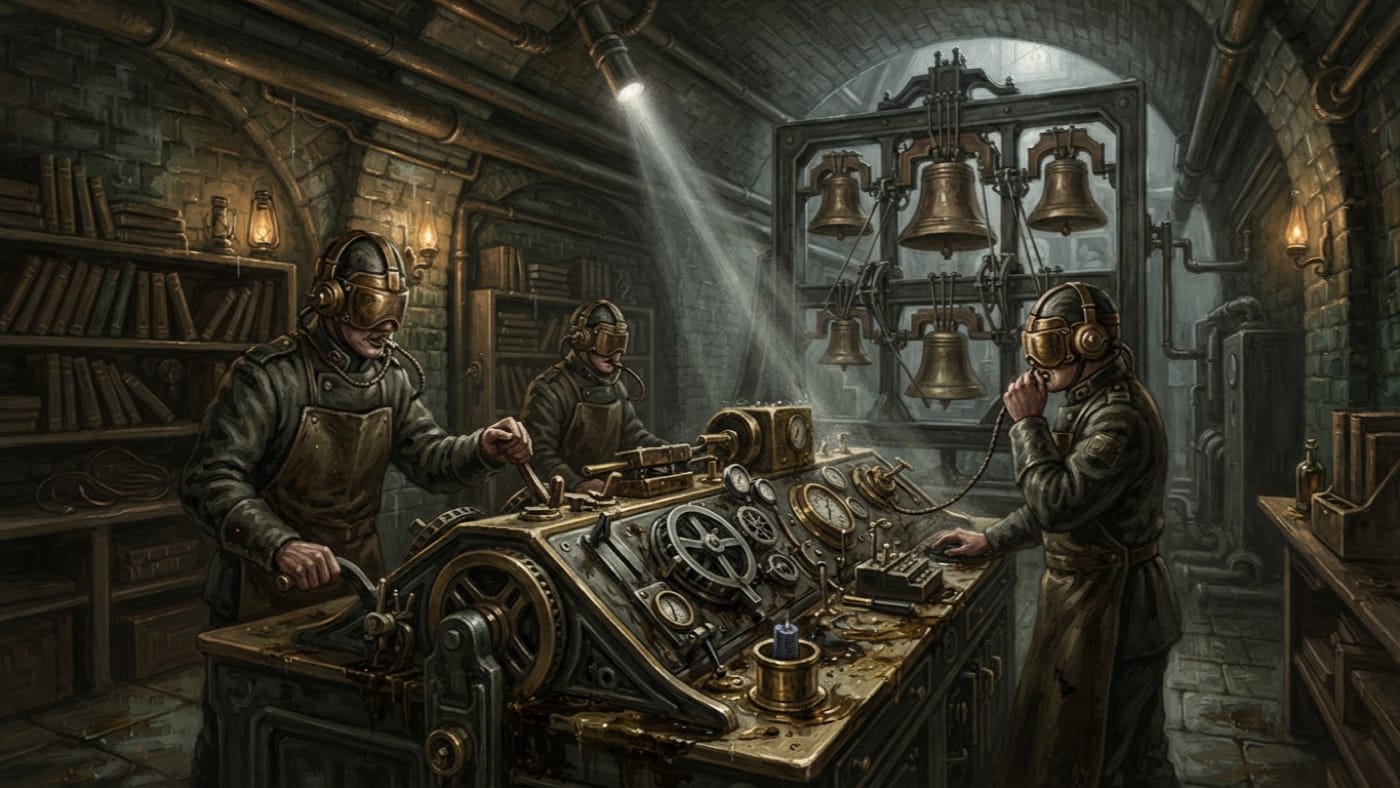
#On the Chamber Beneath the Bell
The public is allowed to admire the tower. The Counter-Toll vault, under the louvres and the bronze and below the ringing floor where Bellwardens keep their chained keys and calibration logs, is where the Bureau of Bells turns scheduled sound into armed sound. The Bureau publishes no census of these chambers. I have not been invited to take one.
Each vault is a workroom of wet stone, hot brass and dark oil. Mechanical timing wheels turn in their consoles, and the friction brakes give off a heat that collects under the vaulting like sin in a seminary. Brass dust settles on every surface, the crew included. A low hum lives in the masonry and soon lives in the stomach. The light is candle-gold or arc-white depending on the station's budget, and in either case it shakes.
The room exists because of a sentence in the Bell Codex commentary that every clerk of Bells now recites: a forged command is still a command to the citizen who has been trained well. A citizen cannot hear the difference between a lawful peal and a counterfeit one. Nor, on bad nights, can the Bureau. Someone has to answer the false note quickly, loudly, with a seal on the answer. The answer is made in the vault.
#On the Command Borrowed
Bells governed long before anyone had to fight with them. The Office of Bells was constituted in A.S. 52 / 1762 CE. The present recension of the Codex was ratified in A.S. 115 / 1825 CE. Neither date produced a Counter-Toll crew. Doctrine's counter-toll protocol held that a peal in alien cadence must be answered at once by another bell, louder and longer, but a protocol is a sentence, and a sentence has no hands.
The hands came out of Cologne. On the Night of Borrowed Curfew, a foreign peal of unknown origin entered the city's bell-grid and rang curfew three hours early. The city obeyed. Doors locked, streets emptied, and the garrison stood down. Something moved into the silence that followed. The Bureau of Bells sealed the casualty report, which records hundreds dead. Bells files the night under A.S. 134 / 1844 CE. The Bureau of Records files the same night under A.S. 136 / 1846 CE. The Bureau of War files it as "Pending Classification," which is the most honest of the three. There was one night and there are two filings. I correct neither, because correction of a sister Bureau is a privilege reserved for funerals.
In A.S. 135 / 1845 CE the Counter-Toll Corps was chartered under its first commander, Canon Veyl, called "Iron Throat." The charter dates a corps. It does not date a room. Whether any particular vault's stones are older or younger than Veyl's commission, the documents in my custody do not say, and I have refused all invitations to guess.
#On the Instruments and Their Authority
Each piece of equipment in the vault is a clause of law cast in metal.
The dominance console is a bank of mechanical timing wheels that sets which pattern strikes and when. The multi-bell arrays produce the sound, driven by strike actuators that do not tire when the crew does. The tuning banks hold the reference pitches used to shape the overwrite into a harmonic mask over the hostile tone. The hush shutters dampen and close. Note that a shutter is equipment, while Silentium is a peal, and confusing the two has put more than one apprentice in front of a tribunal. The wax-seal authority slugs turn a noise into a command. Without one, an operator ringing a perfect pattern is a man making a racket.
The crew carries smaller instruments of its own: reference forks, which operators call truth forks, cadence books, phrase tablets, and throat cords.
An alert usually starts with a voice and not with a bell. A Bellwarden on the speaking-line says I hear drift, or a tunnel listener reports a hum. The operator identifies the hostile tone by direction, cadence signature and resonance footprint. Two listeners must agree on the source before anyone escalates. Next comes selection of the overwrite doctrine, meaning a dominance pattern and its harmonic mask taken from the cadence book. The operator seats the wax slug and calls the authority phrase through the throat cord. Only then does the overwrite begin, in three bands: soft drown, hard dominance, and full district wash. The crew watches the hostile tone decay and watches the crowd, adjusts, and finally certifies the corridor clean or seals it in black wax for quarantine. One array is kept cold the whole time in case the warm ones fail.
The spoken confirmation came later than the slug. The profession's own account records a Mimic Incident in which a tone copied official patterns closely enough to pass. I do not have its date or its site, and I will not lend it mine. Since then authority has rotated through "living keys," which are confirmations spoken by an assigned throat inside an assigned window. Sealed wax can be stolen. A particular throat at a particular hour is harder to steal.
Operational extracts directed crews to drown "false bells."
Superseded by Records, Fourth Revision: replace "false bells" with "foreign bells." A false bell might be one of ours. A foreign bell belongs to someone else by definition.
#On Those Who Keep the Vault
The Counter-Toll Operators impose the counter-peal. Their colleagues keep the system they impose it with. Bellwardens maintain and calibrate the bells and report drift. Timing House (Unregistered) clerks provide the charts. Gatewardens, convoy masters and bailiffs act on the routing orders the vault produces. Each of these offices will blame the others in writing within the hour if anything goes wrong.
Operators are recognizable by their heavy ear-masks of brass and leather, the throat-wrap cords used for voice verification, the chalk cadence marks on their forearms, and the dominance sigil on the belt plate. The start of a shift is liturgical. The operator recites the throat phrase, checks the seal of the mask, strikes three test peals (low, middle, high), and chalks the day's cadence onto the arm. At the end of the shift the scrap pattern notes are burned, the brass dust is wiped from the gums, a bitter oil-tea is drunk, and the throat cord is tied in a closed loop.
The crew drills on quiet days. Late in the day comes curfew, and curfew in a vault means standby. Cologne taught every crew that the most dangerous peal is the one the city is already waiting to obey. Night shifts are kept short because foreign bells sound at night and the judgment of exhausted operators goes first.
The profession preserves a training saying, attributed to masters speaking to novices whose stomachs gave out under their first dominance pattern: "Good. Your body understands law." I have not witnessed this saying delivered. I have heard it quoted by men who plainly had.
#On Dominance and Its Failures
A dominance pattern overpowers the hostile tone and the crowd at the same time. If the overwrite is too heavy, the street feels forced, and a street that feels forced will riot or stampede. The profession's rule of thumb is to never jump straight to a district wash unless you want riots. The single mistake no operator survives is overwriting a hush corridor until it breaches. That is how a vault built to defend a boundary ends up opening it.
The vault's factions fight over this every night. Loud Mercy overwrites early, before the foreign peal has gathered the crowd. Clean Silence hushes first, because noise attracts attention and attention can come from outside. Both doctrines have corpses on their side. The Bureau of Doctrine has never declared a winner, and I suspect it prefers to keep both factions useful.
Some failures cannot be filed easily. Operators speak of ring-back, by which they mean the bell answering. The instruction for it is firm. Stop and call a marshal. Behind that sits a body of professional lore I record without endorsing. One belief holds that an operator must never overwrite while speaking a true name, and the story attached to it says a foreign bell once took up such a name as its rhythm. Operators carry charms: a bell sliver under the tongue, a waxed throat cord, an oily rag said to mask the "listening air." Their idiom if the city taps back, stop refers to suspected mimicry. What actually answers is a question for Doctrine. The procedure only requires that the striking stop.
Over a career the vault takes its fee from the body. Operators lose their hearing and contract brass-lung. They suffer pressure migraines, ruined throats, and tremor after long overwrites. Bell-sickness comes later and worse: phantom peals, compulsive tapping in cadence, an inability to bear silence, and a decline in judgment that the patient is the last to notice. Short rotations are the documented precaution. Not every station keeps to them.
#On the Certificate Afterward
When the hostile tone is dead, the paperwork begins. Auditors compare the interference logs against voice-confirmation timing, the logs against wear on the arrays, and the wear against crowd-flow records. If a phrase call falls outside its window, the operator's career ends. Operators say wear is confession, and they say it the way penitents talk about a confessor who already knows.
A clean dominance certificate leaves an authority trail. That trail can be sold. Some operators sell dominance windows to smugglers, or drown a corridor but leave a black-route gap open as a favor, or issue a "false clean" without running the full cycle. The commonest offence is padding the log to hide how close the vault came to losing cadence. Every crew does it, and every auditor knows how to find it.
The present Bureau under Master-Carillonist Aldo Venn says that its bells are never wrong. Its vaults, by contrast, are sometimes wrong in writing. Whether the carillon of Strasbourg Cathedral has such a chamber beneath it, and where, is a question the Bureau answers with a schedule. A certificate records that the right peal was rung. It does not say whether the right peal won, or who was trampled in the corridor while it did.