
#On the Disease That Rings Back
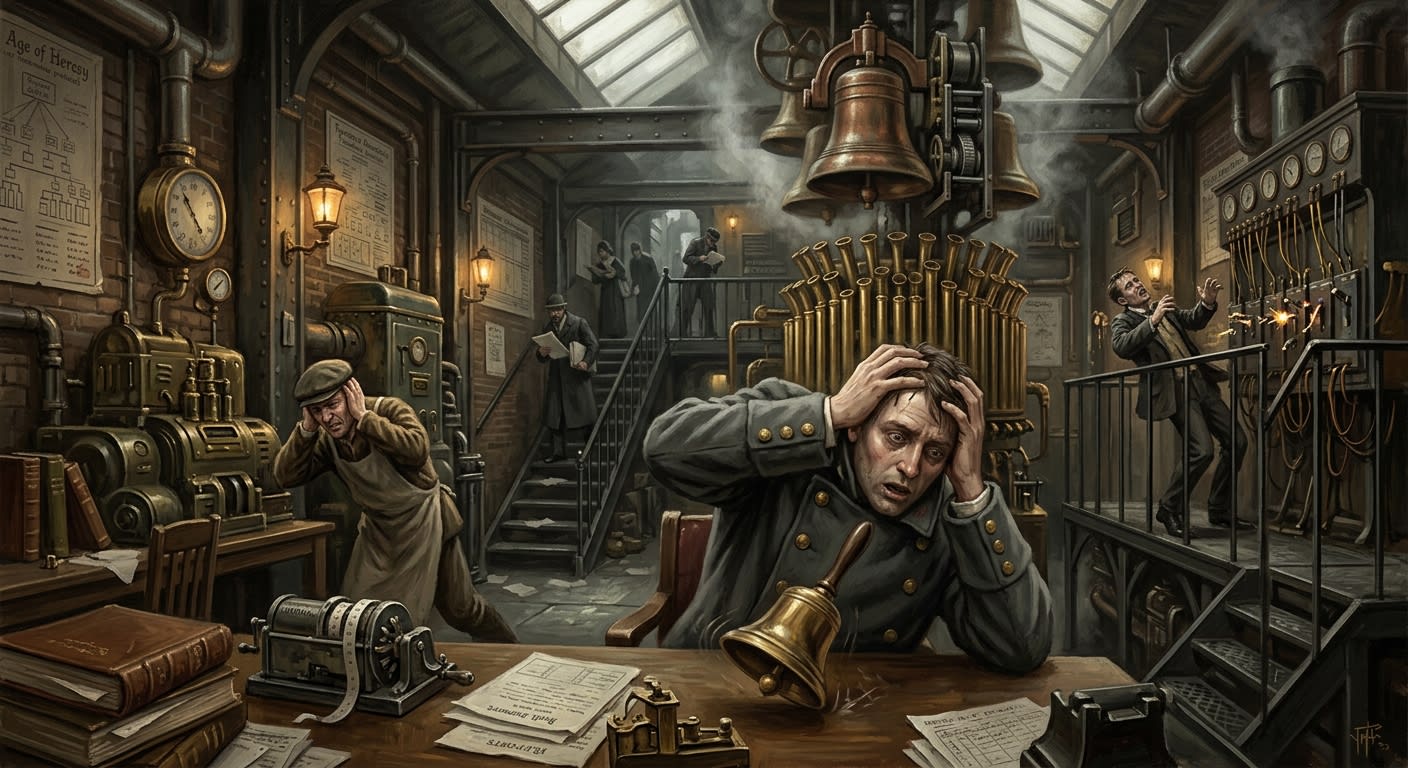
Bell-sickness is the price the Synod pays for making obedience audible.
The Bureau of Medicine calls it Sustained Resonance Exposure Syndrome when the patient is a Counter-Toll Operator, occupational resonance exposure when the patient is an Iron Choir Brand-Singer, metric paranoia when the patient is a Sky-Sermon Attendance Auditor, environmental auditory distress when the patient is poor, and Category Two Spiritual Contamination when the patient has become inconveniently theological. These names are not diagnoses. They are invoices addressed to different offices.
The sufferer hears bells. That is the child's account, and children, like junior clerks, deserve correction before they become expensive. The sufferer hears command after command has ceased. He hears schedule after schedule has been struck. He hears civic time continue in the meat of the skull, where no bell should fit and no Warden should be chained. At first the condition seems mercifully ordinary: a whine behind the left ear after a long shift, a tremor in the molars after Full Wash (Unregistered), a habit of counting steps after curfew. Then the private bell acquires doctrine.
The first medical form asks whether the patient hears ringing. The proper answer is yes, you powdered fool, he works for the Bureau of Bells. The useful question is whether the ringing has begun issuing instructions.
Bell-sickness arises among those who serve sound as law: Bellwardens chained to tower keys, Counter-Toll Operators locked in brass vaults, Litany-Engineers nursing engines through prayer and combustion, Brand-Singers holding pitch while confession is burned into flesh, Procession Marshals keeping crowds from turning into herds with hymns, and all the lesser functionaries who learn, too late, that a bell does not end when bronze stops moving. It continues in nerves. It continues in habits. It continues wherever a human being has been trained to obey before he understands.
The Synod built a civilisation of scheduled sound. Bells open gates, seal districts, move regiments, silence markets, start shifts, end prayers, authorize executions, correct riots, route pilgrims, discipline sleep, and remind infants that they were born under jurisdiction. Naturally men who spend decades inside that system begin to break according to its shape. A fish rots from the head. A bell servant cracks from the ear.
The citizen hears a bell and obeys. The professional hears the same bell and hears the hand behind it, the rope tension, the interval, the corridor, the possible forgery, the hidden answer waiting under the legal note. This is expertise. This is also exposure. The trained ear becomes a gate no one remembered to guard.
#On the First Stages
The first stage is never called the first stage while it is occurring. It is called fatigue, zeal, tower ear, brass ear, shift residue, tunnel pressure, smoke throat, front cadence, Orla's after-note, or the affectionate nonsense professionals use to make early ruin sound like belonging. The Counter-Toll novice who hears Third Bell in a closed washroom is congratulated on sensitivity. The Bellwarden who wakes before Matins because his skull has rung it early is told his discipline has entered the bones. The Brand-Singer who counts another woman's breath through a wall is praised for vocational attention.
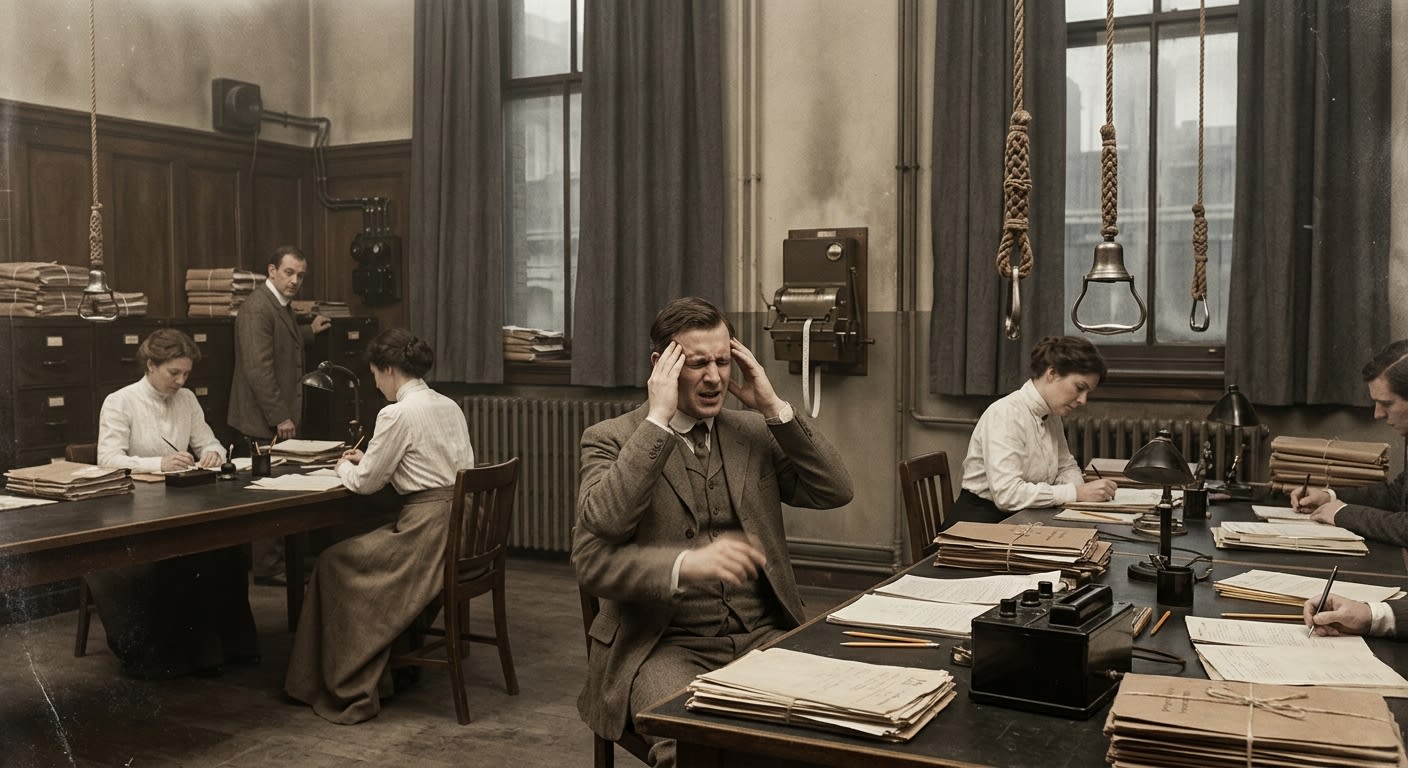
Praise is cheaper than treatment. The Bureau has always known this.
At first the patient hears what he knows. A Bellwarden hears his own bell, pitched exactly to the tower where his chain hangs. A Counter-Toll Operator hears the dominance pattern that saved a district last week, or failed to save it, or saved it at a volume that cracked windows and infants in equal measure. A Brand-Singer hears the Closing Tone, fourteen heartbeats too long. A Litany-Engineer hears a dead engine considering revival if addressed with the correct insult and the proper saint's name.
Then the timings shift. Curfew at noon. Dawn strike in sleep. Silentium while bread is being cut. The sufferer reaches for tools, keys, slates, bells, ropes, throat-wraps, metronome tokens. He catches himself standing. He catches himself saluting. He catches himself apologising to a sound nobody else heard.
The body follows. Fingers tap against table edge: long, short, long; three soft, one hard; Fifth Peal with a drag at the end. Teeth grind intervals. The jaw locks in cadence. The left hand closes as if around a rope. The throat clears before a bell-hour. The spine straightens when a cart wheel strikes cobbles in lawful rhythm. These habits are charming to inspectors because inspectors enjoy symptoms that resemble discipline. A man who cannot stop counting looks reliable from a distance.
By the second stage, silence becomes suspect. A quiet room presses against the patient like wet cloth. No peal, no tick, no hum, no engine knock, no breath pattern from the next cot: absence gathers until the sufferer must puncture it. He taps. He coughs. He mutters the schedule. He strikes a nail against the bed frame. He hums under his breath and lies about it. Silence, to healthy ears, is rest. To bell-sickness, silence is a locked gate with something patient on the other side.
The third stage is command mislocation. The patient can no longer tell whether the sound came from the tower, the corridor, the remembered tower, the expected corridor, or his own damaged nerve speaking in the accents of authority. He acts before confirmation. He moves the key. He marks the page. He opens the wicket. He rings.
#On Category Two, and the Shipka Bellwarden
The official reclassification came after the Bastion-Shipka incident (Unregistered), because the Bureau seldom recognises a disease until it threatens a schedule. A Bellwarden of eighteen years' service rang the Silentium without authorisation, triggering a garrison-wide breach alert in a sector already infested with Syrion's time-fog, sleep-plague, and the particular bureaucratic dread of men who cannot trust clocks. He stated afterward that the Silentium had been ringing for months. He had merely answered it.
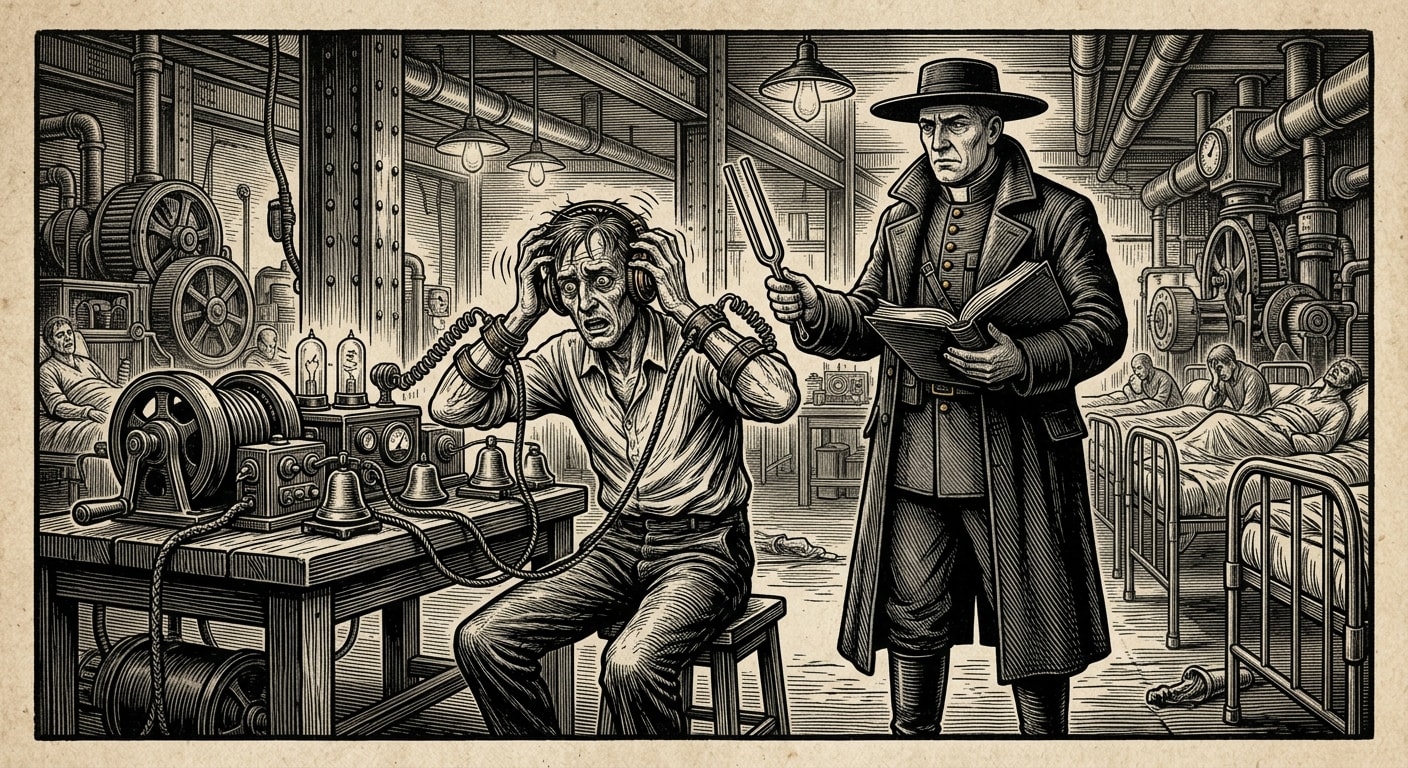
The garrison bell had not rung. His skull had.
Earlier Bellwarden manuals describe bell-sickness as “an occupational hazard, minor, non-doctrinal.”
Corrected after Bastion-Shipka. A condition that causes a trained Warden to answer an internal Silentium with an external bell is not minor, and the word non-doctrinal becomes difficult to defend once three companies arm under false alarm and one gun crew fires at fog because the fog appeared to be obeying.
The Bellwarden was not executed. This shocked the sentimental and disappointed several practical men. He was reassigned to the Bureau of Records filing annex in Sofia, where compulsive counting proved useful. Here the Bureau's genius shines with its usual damp candlelight. A man ruined by numbers of sound was placed among numbers of paper. He counts pages, docket marks, drawer teeth, window cracks, lamp-hours, and the breaths between cart arrivals. Records reports improved filing accuracy in his room. Medicine reports no cure. Bells reports personnel loss. Doctrine reports nothing, which is its most eloquent register.
The reclassification created the present absurdity. Bell-sickness is medical when pensions are requested, spiritual when blame is required, occupational when schedules must continue, and disciplinary when the patient has done something embarrassing in public. Category Two Spiritual Contamination sounds grave enough to frighten recruits and flexible enough to avoid liability. I admire it as one admires a well-made trap.
Among veterans, the incident changed the slang. Brass ear had once meant experience. After Shipka, brass ear meant the useful phase before danger. Ringhead meant a keeper whose sickness had advanced beyond retirement but whose skill remained too precious to discard. The ringhead hears absent bells, yes; he also hears real bells before the soft-eared apprentices do. This makes him both patient and instrument. The Bureau dislikes categories that contain their own rebuttal.
#On Operators Going Brass
Counter-Toll bell-sickness is more violent than the tower form because Counter-Toll work is violence with a liturgical excuse. The operator sits in a sub-tower vault lined with brass resonance plates, one human larynx inside a machine made of peal schedules, dominance wheels, strike actuators, wax-seal slugs, hot oil, sweat, and fear. He does not merely hear bells. He drowns bells. He forces lawful sound across hostile sound until one survives and the other is buried without funeral.
Canon Veyl “Iron Throat” made this doctrine respectable after the Night of Borrowed Curfew at Cologne. Foreign bell rings; Synod bell rings louder. Panic under Synod authority is preferable to calm under the enemy's. Soft Drown, Hard Dominance, Full Wash: three mercies arranged by damage radius. Veyl called volume clarity. The Corps calls it inheritance. The patient calls it, in sleep, Father.
Operators develop phantom peals earlier than Bellwardens. Their skulls hold many towers at once: hostile tone, overwrite pattern, ring-back, voice key, console pulse, city echo. They dream in chords. They wake with palms pressed against walls, searching for resonance plates that are not in the room. Their fingers continue array patterns during meals. Their wives, husbands, barrack-mates, or state-issued mattresses learn to sleep through tapping.
Then comes cadence compulsion. The operator hears a cart wheel and knows where it would fall inside Hard Dominance. He hears a crying infant and assigns it a corridor-local suppression band. He hears rain and flinches because every drop is nearly, nearly, nearly forming a legal peal. The world becomes a draft signal waiting for classification. Mercy would call this torment if Mercy had jurisdiction below the tower. Bells handles its own.
The terminal stage is called going brass. The operator cannot tolerate silence. He strikes the desk, the wall, the console, the floor, his own teeth. Some strike the skull because the skull is where the unscheduled bell has lodged. A few become perfectly calm instead, which experienced crews fear more. The calm ones sit with hands folded, listening to a private wash they refuse to describe. When asked for the hour, they answer with authorisation codes. When asked their name, they give a peal.
COUNTER-TOLL MEDICINE ANNEX — RING-BACK EXPOSURE CASE Operator heard personal voice-key repeated from inside sealed console. Console unpowered at inspection. Operator response: █████████████████████. Vault crew present: 5. Crew hearing after incident: partial / absent / disputed. Patient final notation: “I did not answer. It used me.” Disposition: sealed under Bells custody; Medicine copy incomplete.
Four-month rotations are mandated. Bastions ignore them. Shipka stretches crews to six months because time-fog makes replacement schedules embarrassingly philosophical. Irongate stretches them to eight and hides the casualty figures in pressure-door maintenance tables. Constantinople rotates at three months and still loses operators to permanent bell-sickness because twenty-three bells, the Bosphorus wind, the Third Ossuary, and Maldrake's distant iron make the city an argument no ear wins.
A.S. 199 review recommended shorter rotations, better ear-masks, silence wards, family stipends, and a pension programme. The Bureau stamped UNDER ADVISEMENT. Under Advisement is the graveyard where expensive mercy goes to improve the soil.
#On Singers, Silentists, and Orla's Command
Bell-sickness among Brand-Singers arrives through the throat as much as the ear. The Iron Choir Brand-Singer holds pitch while heated stamps convert confession into scar. Mercy Tone preserves breath, Judgment Tone accelerates truth, the Silentists reduce sound until only tick, breath, and dread remain. All three schools claim Saint Orla of the Steady Note. Saints endure professional theft with admirable stillness.
Saint Orla's final command, “Do not answer it,” has become the hinge on which half of acoustic doctrine pretends to turn. The Silentists take it literally. If the room responds, do not sing back. If the wall lowers its note under yours, stop. If the condemned's scream returns a half-beat late in another register, set down the fork and tap. The Mercy singers call this cowardice. Judgment singers call it delay. Purity calls it useful when anomaly reports fall.
Brand-Singer bell-sickness begins as cadence saturation. Footsteps become hymn cues. Rain becomes Opening Tone. A sleeping companion's breathing becomes a failing subject that must be carried. Mercy singers hear borrowed lungs in dreams. Judgment singers hear docket slams behind the eyes. Silentists hear the absence between taps and fear, correctly, that something else may hear it too.
Master Cantor Vell remains the professional wound. In A.S. 144, the East Hall answered during his Opening Hymn: half-beat delay, lower harmony, redacted action, redacted result. Afterward he reduced tone volume by half for three months and left no treatise, thereby denying every faction the pleasure of certainty. By A.S. 147 his scar-voice had thickened, his annual inspection showed cord ridging, soot-lung onset, sleep-humming, step-counting, refusal to sit beneath paired bells, and the habit of pausing after every fourteenth breath. The Bureau marked him fit for service, a phrase that should be nailed above every institutional latrine in Europe.
Orla's private cult tells the truth more clearly than Medicine. Retired Scar-Voices place her icon facing the wall because she listens better that way. Singers scratch her motto beneath hymn slates. Ash Choristers sleep with bell-hour metronome tokens beneath the tongue and dream of a woman in grey telling them to breathe through stone. Medicine calls this bell-sickness. Doctrine calls it occupational devotion. Pension eligibility hangs between the two like a man from a badly tied rope.
A devotional manual recommended “singing with compassion in imitation of Saint Orla's tenderness.”
Struck. The approved wording is “singing with steadiness in imitation of Saint Orla's control.” Compassion may occur privately, provided it does not alter tempo, inscription, subject survival, audit legibility, or the Bureau's cherished belief that mercy can be scheduled without becoming mercy.
#On Cadence Anomaly and the Question of Ownership
The greatest danger in bell-sickness is false custody, not false hearing. Men mishear constantly. Soldiers mishear orders, husbands mishear apologies, clerks mishear criticism as opportunity for promotion. The danger begins when sound detaches from ownership. A bell rings inside a skull and issues command. A dying man speaks in another man's voice. A room returns a hymn. A console repeats a living key from inside sealed brass. A page refuses to burn until a name is spoken aloud.
Cadence Anomaly sits beside bell-sickness like a cousin at a funeral who has arrived too well dressed. The Trench Courts added the category in A.S. 91 after Wound-Site 14, where dying confessions began arriving in voices that did not match their mouths. The category concerns custody: who owns the sound when a soldier's mouth moves and another dead man answers? Bell-sickness asks a neighbouring question: who owns command when the bell is internal?
The Bureau tries to separate them. Records keeps Cadence Anomaly in contradiction pouches under Cadence Examiner review. Bells keeps bell-sickness in medical annexes until a peal is misused, then claims or denies jurisdiction according to the shape of blame. Purity watches both with the sensual pleasure of an office that smells condemnation. Doctrine issues phrases that walk around the abyss without looking down.
The Joint Caution on Cadence / Bell-Sickness overlap is printed in the sour little type used for instructions born from fatalities: do not repeat anomalous phrases aloud; do not answer internal peals; do not strike tower bell in response to remembered schedule; do not burn transcript until Cadence Examiner or Bells Marshal signs; do not ask whether the command was heard, remembered, received, or borrowed unless prepared to file all four answers.
The Mimic Incident sharpened the terror. A hostile tone copied lawful Bureau patterns with enough fidelity to redirect a Line garrison for seventeen minutes before Counter-Toll restored cadence. Written authentication failed. Living keys followed. Now the operator's own throat confirms command. Splendid. We have placed the lock inside the disease.
A man deep in bell-sickness may fail his living key because the console no longer recognises what bells have done to him. Or worse, the console may recognise him too well. It may answer with the voice he had before service, before Veyl's doctrine, before Full Wash, before the first night he woke with city curfew ringing under his tongue. There are sealed retirements for less.
The Bureau's public doctrine remains severe. Bell-sickness does not absolve the sufferer of unlawful action. The internal peal provides context, not acquittal. A Bellwarden who rings wrong has rung wrong. An Operator who answers ring-back has answered. A Singer who harmonises with a room has opened the exchange. Free will survives, because if free will failed, discipline would owe apology, and discipline never carries small change.
#On Treatments, Profits, and Useful Ruins
Treatment begins with denial because denial requires no budget. The patient is ordered to rest, drink oil-tea, sleep away from paired bells, reduce tower exposure, submit to throat inspection, avoid unsanctioned humming, and report phantom peals if they become directional, imperative, anticipatory, familial, or seductive. This instruction alone proves the Bureau knows more than it admits. A phantom peal that uses your mother's voice is not tinnitus. It is an interview.
Silence weeks are prescribed for Brand-Singers. They do not speak, hum, whistle, pray aloud, cough without record, or answer questions except by slate. The first day steadies them. The second enrages them. The third reveals whether silence is medicine or opponent. Some recover enough to return. Some sit with slate in hand and write peal schedules they never learned. Some become Silentists, which is a recovery of sorts, though Orison spits when saying so.
Counter-Toll Operators receive ear-masks, bitter oil-tea, brass-rest days, rotation orders, and the secret mercy of being assigned noisy rooms so silence does not devour them. Bellwardens receive chain inspections, schedule audits, and reassignment to filing annexes when their counting turns profitable. Litany-Engineers are told to stop listening to engines while off duty. This is like telling a widow to stop recognising the dead.
The black market flourishes. Wax ear-seals blessed by retired Bellwardens. Saint Orla throat cords. Counterfeit Veyl tuning splinters. Little brass pills scraped from tower clappers. River-stone metronomes sold to mothers of choir apprentices. Silence charms from the Clean Silence faction. Loud Mercy headache oils strong enough to pickle thought. Half of it is fraud. The other half is worse, because some of it works.
Bureau profit is more respectable and less honest. Sickness extends useful service if managed just shy of scandal. Ringheads detect drift. Operators with damaged ears recognise hostile tone sooner. Brand-Singers with sleep-humming keep pitch under pain. Auditors with metric paranoia count attendance with inhuman patience. The Synod breaks specialists, discovers their broken shape has a use, and calls the discovery Providence.
Families develop their own treatments, less official and more merciful, which is why the Bureau distrusts them. A Bellwarden's wife in Cologne tied wool around the bedposts so his midnight tapping would soften before it woke the children. A Counter-Toll mother in Metz placed bowls of flour under the table to catch her son's finger rhythms and read them in the morning like tracks in snow. Brand-Singer husbands learn to breathe loudly beside sleeping wives so the sick ear has a safe rhythm to follow. Children of ringheads become experts in answering questions after the second repetition, because the first was usually addressed to a bell that died before they were born.
There are kindnesses the Bureau cannot classify without damaging them. A tower crew at Thessaloniki keeps a kettle always boiling because steam gives a Bellwarden something harmless to hear. A Sofia Records clerk leaves loose page stacks beside the Shipka man so he may count without being watched. In the Irongate vaults, Operators strike the table once before entering a room with a sick colleague: warning, greeting, proof of external sound. None of this appears in formal treatment. Formal treatment prefers straps, schedules, and circulars written by men whose ears have never bled in service.
The cruelest cases are the recovered. Recovery, in Bureau terms, means the patient returns to duty without immediate hazard. He still counts. He still pauses at wrong hours. He still hears the curfew that rang during the night he failed, or succeeded too loudly, or obeyed a tone whose source was later sealed. Medicine writes stable. Bells writes usable. The family learns to leave a small sound in every room: kettle, clock, prayer wheel, shoe tap, anything to keep silence from swelling into command.
Some patients refuse all bells afterward. They plug ears with wax, flee towers, sleep under bridges where water makes messy sound no Bureau has scheduled. A few join the Silentists, wearing abstinence like a scar. A few drift toward unauthorized melody smugglers, because illegal music at least admits it is illegal and does not pretend command is comfort. A few become excellent clerks. The page, unlike bronze, waits to be struck.
The Bureau calls these outcomes marginal. Margins are where the honest text survives.
#On Present Doctrine
As of A.S. 201, bell-sickness remains contained in the way a fire is contained when one has built the city out of kindling and employed clerks to label each flame. The condition is recognised, disputed, exploited, reclassified, underfunded, ritually softened, medically postponed, doctrinally sharpened, and professionally inevitable. No Bureau will abolish it because no Bureau will abandon bells, and no Synod that rules by scheduled sound can admit that sound has begun ruling back.
The Bureau of Bells insists that internal peals are pathological unless externally verified. The Bureau of Medicine insists that pathology may require spiritual review when the peal carries command force. The Bureau of Records insists that every report use exact timing notation. The Bureau of Purity insists on execution where contamination moves from hearing to action. The Bureau of Doctrine insists that obedience remains virtuous when properly sourced. The patient, poor instrument, insists the bell rang.
Sometimes he is wrong.
Worse, sometimes he is early.
At Strasbourg's Bell Tower, Canon Veyl's fork rests behind glass. Recruits salute it. Beneath it, in a drawer they are not shown, the first living-key throat-wrap waits in folded leather. At Sofia, the Shipka Bellwarden counts pages and pauses whenever the Silentium should not ring. At Irongate, an Operator dreams in chords and wakes with blood in his mouth. In a penitence hall, a Silentist taps once and the room does not answer. In a tower somewhere along the Line, a bell sounds without strike.
The Warden locks the district. He seals the tower. He sends for the Marshal. He does not answer.